Introduction
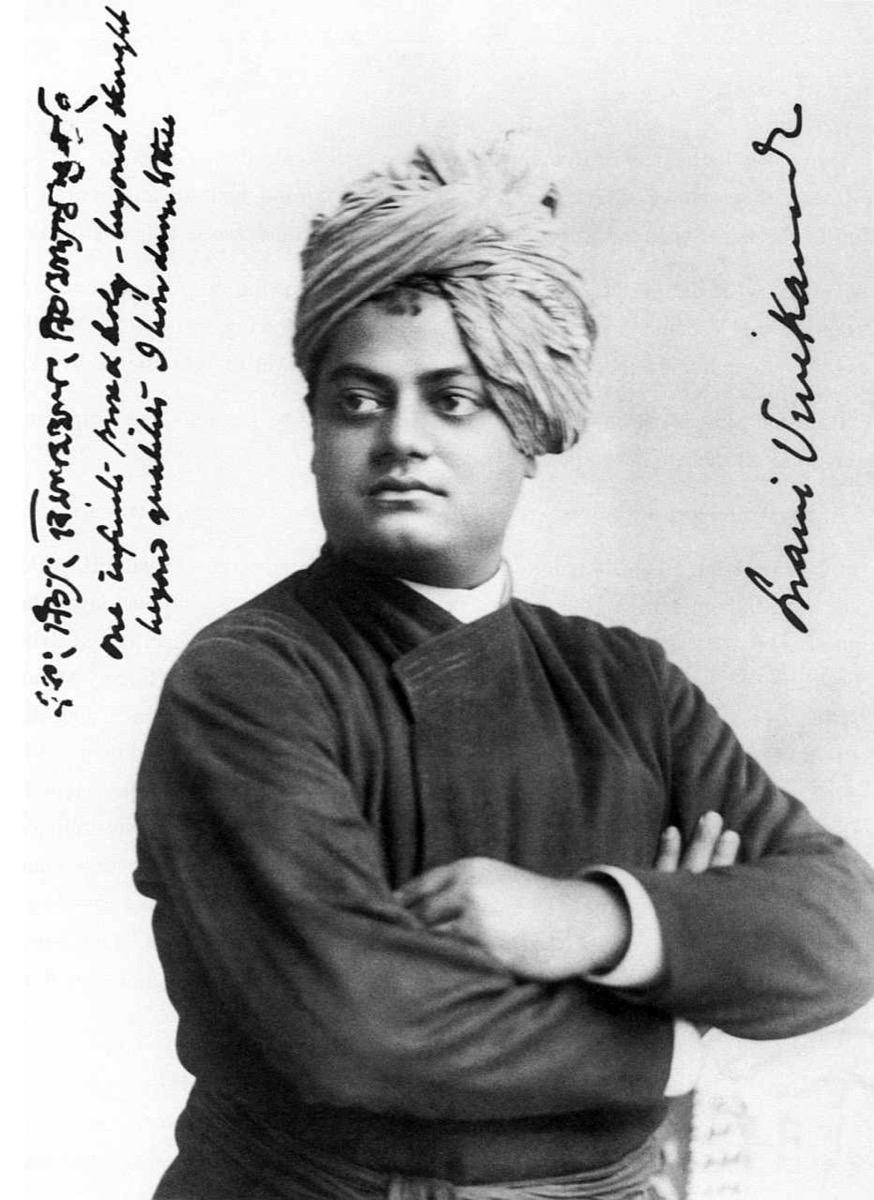
Swāmī Vivekānanda (born Narendranāth Datta; 12 January 1863 — 4 July 1902) stands as one of the most transformative figures in the modern history of Hinduism. In a brief life of thirty-nine years, he accomplished what no Hindu teacher before him had done on such a scale: he carried the philosophical and spiritual traditions of India to the world stage, articulated an intellectually rigorous and socially engaged form of Vedānta, and built an institutional framework — the Rāmakṛṣṇa Math and Mission — that continues to serve millions across the globe.
His opening address at the 1893 Parliament of the World’s Religions in Chicago, beginning with the words “Sisters and Brothers of America,” is remembered as one of the watershed moments in interfaith dialogue. The thunderous applause that greeted those five words signalled more than courtesy; it marked the arrival of Hindu thought as a living, breathing philosophy in the consciousness of the modern West (Parliament of the World’s Religions, “1893 Chicago”).
Early Life as Narendranāth Datta
Narendranāth was born into a prosperous Bengali Kāyastha family in Calcutta (modern Kolkata). His father, Viśvanāth Datta, was a prominent attorney at the Calcutta High Court, known for his progressive outlook, generosity, and wide reading in Western and Indian literature. His mother, Bhuvaneśvarī Devī, was deeply devout, steeped in the epics and Purāṇas, and instilled in her son a love of Sanskritic culture alongside disciplined habits of mind (Nikhilananda, Vivekananda: A Biography).
From childhood, Narendranāth displayed a restless intelligence and a questioning temperament. He excelled at studies — reading voraciously across Western philosophy, European history, science, and literature — and was equally adept at music, gymnastics, and oratory. At General Assembly’s Institution (now Scottish Church College) and later at the Presidency College, he studied Western logic, philosophy, and the natural sciences. He was deeply influenced by the works of David Hume, Immanuel Kant, Auguste Comte, Herbert Spencer, John Stuart Mill, and Charles Darwin, and carried their rational scepticism into his spiritual inquiries (Britannica, “Vivekananda”).
This intellectual training produced a young man who refused to accept spiritual claims on mere authority. He famously went from teacher to teacher in Calcutta asking a single question: “Sir, have you seen God?” Most gave evasive or abstract answers. It was this question that led him to the temple-garden of Dakṣiṇeśvar, and to the man who would transform his life.
Meeting Śrī Rāmakṛṣṇa
In late 1881 or early 1882, Narendranāth first visited Śrī Rāmakṛṣṇa Paramahaṁsa at the Kālī temple of Dakṣiṇeśvar on the outskirts of Calcutta. Rāmakṛṣṇa — an ecstatic mystic, a priest of Goddess Kālī, and an experimenter who had practised the disciplines of multiple religious traditions — recognised in the young rationalist a spiritual capacity of the highest order. When Narendranāth posed his question, Rāmakṛṣṇa replied without hesitation: “Yes, I have seen God. I see Him as I see you here, only more clearly. God can be seen. One can talk to Him. But who cares for God? People shed torrents of tears for their wives, children, wealth, and property, but who weeps for God? If one cries sincerely for God, one can surely see Him” (Nikhilananda, Vivekananda: A Biography).
Over the next five years (1882—1886), Narendranāth became Rāmakṛṣṇa’s foremost disciple, though the relationship was anything but passive. The young man challenged, debated, and tested his guru at every step, and Rāmakṛṣṇa patiently guided him through successive layers of spiritual experience — from devotional ecstasy (bhakti) to the non-dual realisation of nirvikalpa samādhi. Before his death from throat cancer on 16 August 1886, Rāmakṛṣṇa charged Narendranāth with the care of the other young disciples and with carrying forward his spiritual mission (Belur Math, “About Swami Vivekananda”).
Wandering Monk: Parivrajaka Years (1888—1893)
After Rāmakṛṣṇa’s passing, the young monks established a small monastery at Baranagar in North Calcutta. But Narendranāth — who had by now taken the monastic name Vivekānanda (“bliss of discrimination”) — felt impelled to see India first-hand. Between 1888 and 1893, he traversed the subcontinent on foot and by rail, travelling as a parivrajaka (wandering monk), visiting princely courts and peasant huts alike.
What he witnessed during these years profoundly shaped his philosophy. He saw grinding poverty, caste oppression, ignorance, and the subjugation of women alongside India’s extraordinary spiritual heritage. The contradiction between sublime metaphysics and abject material suffering became the central problem of his life’s work. At the southern tip of India, sitting on a rock off the coast of Kanyākumarī (now known as the Vivekānanda Rock Memorial), he is said to have meditated for three days and resolved to attend the Parliament of Religions in America — not merely to represent Hinduism, but to seek material help for India’s impoverished masses (Wikipedia, “Swami Vivekananda”).
The 1893 Parliament of the World’s Religions
Vivekānanda arrived in Chicago in July 1893, having journeyed via Japan and Canada. He had no formal credentials from any recognized religious body and initially struggled with bureaucratic obstacles. With the help of sympathizers — notably Professor John Henry Wright of Harvard, who reportedly said, “To ask for your credentials is like asking the sun to state its right to shine” — he secured a place as a delegate representing Hinduism (Britannica, “Vivekananda”).
On 11 September 1893, Vivekānanda rose to address the assembly at the Art Institute of Chicago. His opening — “Sisters and Brothers of America” — met with a standing ovation lasting two minutes from an audience of over seven thousand. In his brief address, he quoted the Śvetāśvatara Upaniṣad and the Bhagavad Gītā, proclaimed the universality of religious truth, and appealed for an end to sectarianism, bigotry, and fanaticism. Over the following days, he delivered multiple papers articulating the Vedāntic vision of religious harmony: that all religions are different paths leading to the same goal, and that the spirit of Hinduism is not exclusion but inclusion (Parliament of the World’s Religions, “1893 Chicago”).
The American press took immediate notice. The New York Herald declared him “undoubtedly the greatest figure in the Parliament of Religions,” while the Boston Evening Transcript wrote that “he is likely to be the most popular and influential man in the Parliament.” Overnight, the unknown Indian monk became a celebrity, and invitations poured in from across America and England.
Teaching in the West (1893—1897)
For nearly four years, Vivekānanda lectured, taught, and conducted classes across the United States and England. His major lecture series — on Jñāna Yoga (the path of knowledge), Bhakti Yoga (the path of devotion), Karma Yoga (the path of selfless action), and Rāja Yoga (the path of meditation and mind-control) — were transcribed and later published as four separate volumes. These remain among the most widely read introductions to Hindu philosophy in English (Advaita Ashrama, Complete Works).
In 1894, he founded the Vedānta Society of New York, the first institutional Hindu presence in America. He attracted devoted Western disciples — among them Margaret Noble (later Sister Nivedita), Captain and Mrs. Sevier, J.J. Goodwin, and Josephine MacLeod — who would play vital roles in the Mission’s early growth.
His message to the West was characteristically direct: India had spiritual treasures to share, but the West’s material progress, organisational ability, and spirit of practical service were equally valuable. He envisioned an exchange — “the best of the East and the best of the West” — that would benefit all humanity.
Practical Vedānta: Philosophy of Service and Strength
Vivekānanda’s intellectual contribution lies in what he called Practical Vedānta — the application of Advaita Vedāntic principles to everyday life and social action. Building on Śaṅkara’s non-dual metaphysics and Rāmakṛṣṇa’s experiential mysticism, he argued that if Brahman (the ultimate reality) is present equally in all beings, then service to humanity is worship of God. “They alone live who live for others,” he declared. “The rest are more dead than alive” (Advaita Ashrama, Complete Works, Vol. 1).
Key tenets of his philosophy include:
- Divinity of the individual soul: Every human being is potentially divine. The goal of life is to manifest this inner divinity through work, worship, psychic control, or philosophy — by one or more or all of these.
- Service as worship (Śiva jñāne jīva sevā): Seeing every living being as a manifestation of God, selfless service to the poor, the sick, and the ignorant becomes the highest form of worship. This principle became the motto of the Rāmakṛṣṇa Mission.
- Strength and fearlessness: Vivekānanda relentlessly preached strength — physical, mental, and moral. He condemned weakness as sinful and urged the youth of India to develop self-confidence, courage, and a spirit of enterprise.
- Harmony of religions: Following Rāmakṛṣṇa’s direct experience, he taught that all religions contain truth and lead to the same ultimate reality. Conflict arises not from the religions themselves but from misunderstanding and fanaticism.
- Education and upliftment: He argued that India’s regeneration required mass education — especially for women and the lower castes — and that a hungry person needed food before philosophy.
Founding the Rāmakṛṣṇa Mission
Upon returning to India in January 1897, Vivekānanda was received with an outpouring of popular enthusiasm. He delivered a series of landmark lectures across the country — in Colombo, Madras (Chennai), Calcutta, Lahore, and elsewhere — calling for national self-respect, social reform, and spiritual awakening.
On 1 May 1897, he formally established the Rāmakṛṣṇa Mission in Calcutta, with the dual aim of individual spiritual development and service to humanity. He later established Belur Math on the western bank of the Hooghly River near Calcutta as the headquarters of the Rāmakṛṣṇa Math and Mission. The monastery’s eclectic architectural style — blending Hindu, Islamic, Buddhist, and Christian motifs — was itself a statement of Vivekānanda’s vision of universal harmony (Belur Math, “About Swami Vivekananda”).
The Mission’s work expanded rapidly to include hospitals, schools, colleges, disaster relief, rural development, and the publication of spiritual literature. Today, the Rāmakṛṣṇa Math and Mission has over 250 centres worldwide and is one of the most respected humanitarian and spiritual organisations in India.
Social Reform and the Regeneration of India
Vivekānanda was among the most outspoken advocates for social reform in late-nineteenth-century India. He attacked caste discrimination with fierce eloquence, calling untouchability “an abomination” and declaring: “So long as the millions live in hunger and ignorance, I hold every man a traitor who, having been educated at their expense, pays not the least heed to them” (Complete Works, Vol. 5).
He championed women’s education and empowerment, founding the Śāradā Maṭh (a parallel monastic order for women, later formally established by his brother-disciple Swāmī Sāradānanda) and insisting that no nation could progress while half its population remained suppressed. He urged the youth of India to combine spiritual aspiration with practical action — to build muscles alongside character, and to serve the motherland through education, industry, and selfless work.
Final Years and Mahāsamādhi
Vivekānanda’s second visit to the West (1899—1900) took him again to America and to Europe — including Paris during the 1900 World Exhibition, where he participated in the Congress of the History of Religions. His health, undermined by years of relentless travel and intense spiritual practice, was now in sharp decline. He suffered from diabetes, asthma, and kidney disease.
Returning to India, he continued his work at Belur Math, training young monks and finalising the organisational structure of the Mission. On the evening of 4 July 1902, after a day of teaching and meditation, Vivekānanda retired to his room at Belur Math, sat in meditation, and passed away. He was thirty-nine years old. His followers believe he attained mahāsamādhi — conscious departure from the body. He was cremated on the bank of the Gaṅgā at Belur, where a temple now marks the spot (Wikipedia, “Swami Vivekananda”).
Legacy
Swāmī Vivekānanda’s impact extends far beyond the boundaries of any single tradition:
- For Hinduism: He gave modern Hinduism a confident, articulate voice on the world stage. His reinterpretation of Vedānta as a philosophy of service, strength, and universal inclusion became the dominant idiom of twentieth-century Hindu self-understanding.
- For India: He is regarded as one of the architects of Indian nationalism. Subhas Chandra Bose called him “the maker of modern India.” His birthday, 12 January, is celebrated as National Youth Day in India.
- For interfaith dialogue: His 1893 Parliament address inaugurated a new era in interreligious conversation, establishing the principle that religious diversity is not a problem to be solved but a treasure to be cherished.
- For global spirituality: The Vedānta Societies, Rāmakṛṣṇa centres, and the broader “yoga and meditation” movement in the West all trace their lineage, directly or indirectly, to the doors he opened.
Rabindranāth Tagore wrote: “If you want to know India, study Vivekananda. In him everything is positive and nothing negative.” More than a century after his death, his words continue to inspire millions seeking a spirituality that is at once philosophically rigorous, practically engaged, socially just, and universally inclusive.