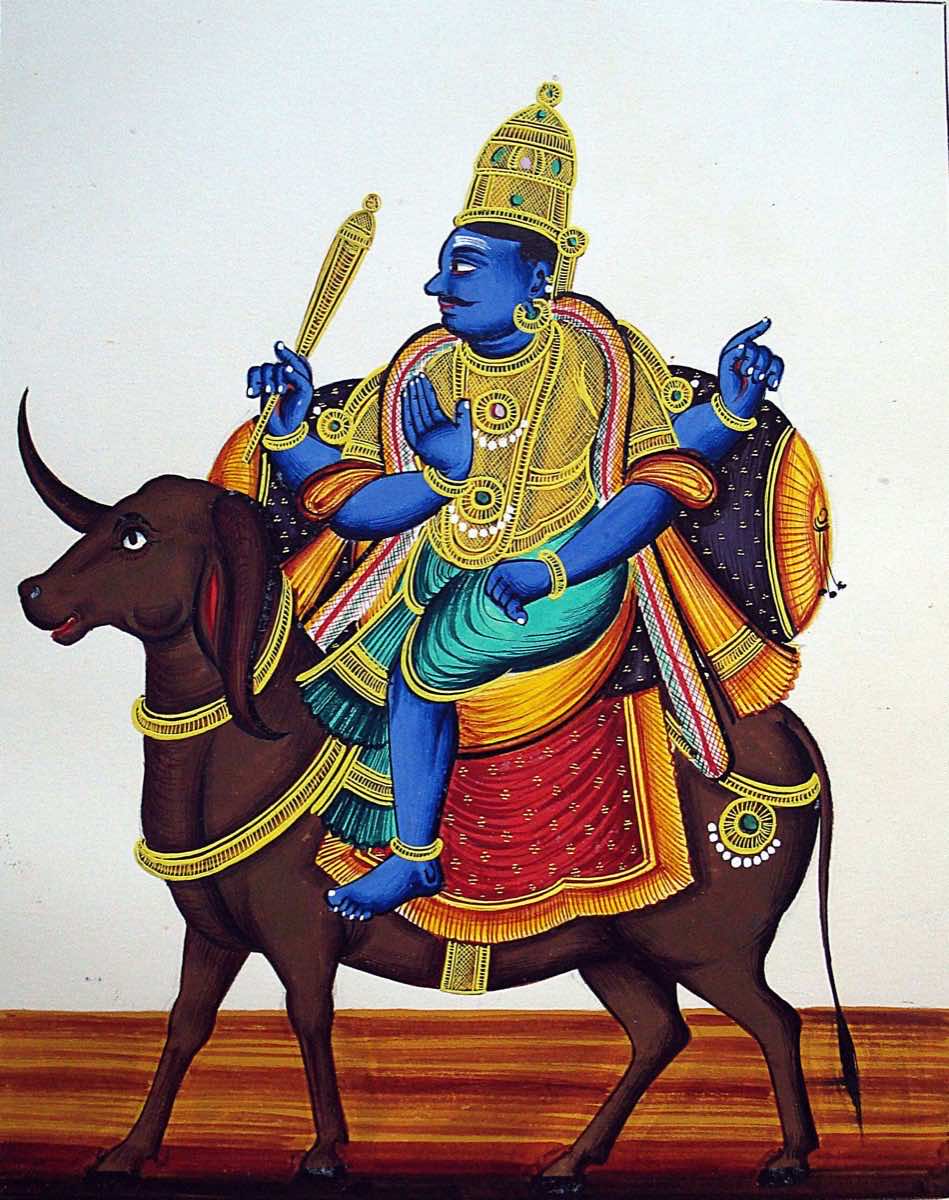
Introduction
Yama (IAST: Yama; Sanskrit: यम), also known as Yamarāja, Dharmarāja, Kāla, Mṛtyu, and Antaka, is one of the most ancient and significant deities in the Hindu pantheon. He is the god of death, the sovereign ruler of the departed, and the divine judge who weighs the merits and sins of every soul that passes from the mortal world. In the Vedic tradition, Yama holds a unique distinction: he was the first mortal being who died and, by discovering the path to the afterlife, became its eternal lord and guide (Britannica, “Yama”; Wikipedia, “Yama”).
Far from being a figure of dread alone, Yama embodies dharma itself — righteous order, cosmic justice, and moral law. His title Dharmarāja (“King of Dharma”) reflects his function as the impartial arbiter of karmic consequences, dispensing rewards and punishments with perfect equity. In the philosophical masterpiece of the Kaṭha Upaniṣad, it is Yama himself who reveals to the boy Naciketas the supreme secret of immortality — the knowledge of the Self (ātman) — making the god of death, paradoxically, the greatest teacher of life’s deepest truth (Katha Upanishad, Wikipedia; World History Encyclopedia, “Yama”).
Vedic Origins
Yama appears in the earliest stratum of Indian religious literature. In the Ṛg Veda (10.14), he is celebrated not as a fearsome punisher but as the first mortal who found the way to the realm of the ancestors (pitṛloka):
Yamaṃ ha prathamo mṛtyum āyat, prathamo ha devayānāṃ panthāṃ ānaśe — “Yama was the first to whom death came; he was the first who found the path to the gods.” (Ṛg Veda 10.14.1)
In this early Vedic conception, Yama is a benevolent figure — a king who presides over a paradise where the righteous dead feast and rejoice in the company of the ancestors. He is described as seated under a beautiful tree, drinking soma with the gods, and welcoming the departed to his abode. The Ṛg Veda hymns (10.14, 10.135, 10.154) portray him as a guide and host rather than a judge or tormentor.
The famous Yama-Yamī Sūkta (Ṛg Veda 10.10) presents a dialogue between Yama and his twin sister Yamī (Yamunā), in which Yamī proposes a conjugal union to continue the human race. Yama refuses, upholding the moral boundaries of their sibling relationship — an act that later tradition interprets as the first assertion of dharmic law regarding kinship and social order (Wikipedia, “Yama”; Britannica).
Parentage and Family
According to both Vedic and Purāṇic sources, Yama is the son of Vivasvat (Sūrya, the sun god) and Saraṇyū (Saṃjñā), the daughter of the divine architect Tvaṣṭṛ. His twin sister is Yamī, who in later mythology becomes the river goddess Yamunā. Some texts identify his half-brother as Manu (Vaivasvata Manu), the progenitor of the human race, and the planet Śani (Saturn) as another brother — all children of Sūrya.
Yama’s wife is generally named as Dhūmorṇā or Vijayā in various Purāṇic sources. His kingdom is called Yamaloka or Saṃyamanī, located in the south — the direction associated with death in the Hindu directional cosmology, where Yama serves as the Dikpāla (guardian of the south) (Exotic India Art, “Yamaraj”; World History Edu, “Yama”).
Iconography and Attributes
The iconography of Yama developed from the benign Vedic imagery to the more formidable Purāṇic depictions. In his standard Purāṇic form, Yama is described as:
- Complexion: Dark or green, like storm clouds
- Arms: Four-armed in most depictions
- Mount: A black water buffalo (mahiṣa)
- Weapons: The pāśa (noose) with which he lassos the souls of the dying, and the daṇḍa (staff or mace) of justice
- Dress: Red, yellow, or blue garments, adorned with a garland of flames
- Expression: Wrathful, with protruding fangs and glaring eyes, reflecting his role as the enforcer of cosmic justice
His two dogs — described in the Ṛg Veda (10.14.10–12) as four-eyed, broad-nosed, and brown-spotted (named Śyāma and Śabala) — guard the path to his realm. The crow and the pigeon serve as his messengers. The Ṛg Veda prays:
Yau te śvānau Yama rakṣitārau, caturakṣau pathirakṣī nṛcakṣasau — “O Yama, your two dogs, four-eyed guardians of the path, who watch over men…” (Ṛg Veda 10.14.11)
As one of the eight Dikpālas (guardians of the cardinal and intermediate directions), Yama guards the south. In temple architecture, his image appears on the southern face of structures dedicated to the directional deities (Wikipedia, “Yama”; Exotic India Art).
Yama as Dharmarāja
While the Vedas present Yama primarily as king of the dead, the Purāṇas and the epics significantly expanded his role to that of Dharmarāja — the judge of all souls. In this capacity, Yama sits in his court at Saṃyamanī and adjudicates the fate of every being who dies. His accountant, Citragupta, maintains the Agrasandhānī — the cosmic ledger in which every deed of every creature is recorded.
When a soul arrives before Yama’s throne, Citragupta reads out the record of the person’s actions — both meritorious (puṇya) and sinful (pāpa). Based on this accounting, Yama assigns the soul to one of three destinations:
- Svarga (heaven) — for the predominantly virtuous
- Naraka (hell) — for the predominantly sinful, where various punishments purify the soul before rebirth
- Punarjanma (rebirth) — return to the mortal world in a form determined by the balance of karma
This judicial function makes Yama the embodiment of the law of karma — the cosmic principle that every action produces its just consequence. His justice is utterly impartial; neither wealth, nor birth, nor power can sway his verdict. As the Garuḍa Purāṇa (chapter 2) describes: “Yama’s law is equal for the king and the pauper, the brahmin and the outcaste” (Wikipedia, “Yama”; World History Edu).
The Kaṭha Upaniṣad: Yama and Naciketas
The most philosophically profound portrayal of Yama appears in the Kaṭha Upaniṣad (c. 8th–6th century BCE), one of the principal Upaniṣads. Here, Yama is not the fearsome god of death but the supreme teacher who reveals the highest knowledge — the nature of the Self (ātman) and the secret of immortality.
The Story
The sage Vājaśravas performed a sacrifice in which he gave away all his possessions. His young son Naciketas, observing that his father was donating only old, barren, and worthless cattle, questioned: “Father, to whom will you give me?” Angered by the boy’s persistence, Vājaśravas replied: “I give you to Yama — to Death!” (Kaṭha Upaniṣad 1.1.1–4)
Naciketas, taking his father’s words as binding, journeyed to Yama’s abode. But Yama was absent, and the boy waited at his door for three days and nights without food or water. When Yama returned and discovered that a Brahmin guest had been kept waiting — a grave violation of hospitality — he offered Naciketas three boons to atone.
First boon: Naciketas asked that his father’s anger be appeased and that Vājaśravas recognise him when he returned. Yama granted this.
Second boon: Naciketas asked to learn the Nāciketa fire sacrifice (agni vidyā) that leads to heaven. Yama taught him the ritual, so pleased with the boy that he named the fire after him (Kaṭha Upaniṣad 1.1.12–19).
Third boon: Naciketas asked: “When a person dies, some say the self exists, and others say it does not. Teach me the truth of this.” (Kaṭha Upaniṣad 1.1.20)
Yama’s Teaching
Yama was reluctant. He offered Naciketas immense wealth, long life, beautiful women, kingdoms, elephants, gold — anything but the answer to this question. But Naciketas refused every temptation:
Na vittena tarpaṇīyo manuṣyo, lapsyāmahe vittam adrakṣma cet tvā / Jīviṣyāmo yāvad īśiṣyasi tvaṃ, varas tu me varaṇīyaḥ sa eva — “Man is not to be satisfied by wealth. Shall we enjoy wealth when we have beheld you? We shall live only as long as you ordain. That boon alone is to be chosen by me.” (Kaṭha Upaniṣad 1.1.27)
Pleased by the boy’s steadfastness, Yama revealed the supreme teaching: the ātman (Self) is eternal, unborn, undying, beyond all change. It is not slain when the body is slain. It is subtler than the subtle, greater than the great, and dwells in the heart of every creature:
Na jāyate mriyate vā vipaścin, nāyaṃ kutaścin na babhūva kaścit / Ajo nityaḥ śāśvato’yaṃ purāṇo, na hanyate hanyamāne śarīre — “The knowing Self is never born nor does it die. It did not originate from anything, nor did anything originate from it. It is unborn, eternal, permanent, and primeval. It is not slain when the body is slain.” (Kaṭha Upaniṣad 1.2.18)
This verse, echoed later in the Bhagavad Gītā (2.20), represents one of the foundational declarations of Hindu philosophy. That it comes from the mouth of the god of death himself is one of the great paradoxes and profundities of the Upaniṣadic tradition — the lord of mortality teaching the secret of immortality (Nachiketa, Wikipedia; Katha Upanishad, Wikipedia).
Yama in the Epics
The Mahābhārata
Yama plays several important roles in the Mahābhārata:
-
Father of Yudhiṣṭhira: In the epic’s genealogical framework, Yudhiṣṭhira — the eldest Pāṇḍava and paragon of dharma — was born through the invocation of Yama (Dharma) by Queen Kuntī using the boon granted by the sage Durvāsas (Ādi Parva 114). Yudhiṣṭhira’s unwavering commitment to truth and justice is understood as an inheritance from his divine father.
-
The Yakṣa Praśna: In the Vana Parva (chapters 311–313), Yudhiṣṭhira encounters a Yakṣa (who is actually Yama in disguise) at a cursed lake. The Yakṣa poses a series of philosophical riddles. Yudhiṣṭhira answers each one correctly, demonstrating his wisdom. The final and most famous question is: “What is the greatest wonder in the world?” Yudhiṣṭhira replies: “Day after day, countless creatures go to the abode of death, yet those who remain behind believe themselves immortal. What could be a greater wonder than this?” Pleased, Yama reveals himself and restores Yudhiṣṭhira’s fallen brothers to life.
-
Yudhiṣṭhira’s Final Journey: In the Mahāprasthānika Parva and Svargārohaṇa Parva, when Yudhiṣṭhira alone reaches heaven while his brothers fall on the way, he encounters Yama once more. Yama tests him by showing him a vision of hell where his brothers appear to be suffering. Yudhiṣṭhira, out of fraternal love, refuses to enter heaven without them. This final test proves his dharma, and Yama reveals that it was all an illusion — a last trial of the righteous king (Wikipedia, “Yama”).
The Sāvitrī-Satyavān Legend
One of the most beloved stories in the Mahābhārata (Vana Parva 277–283) features Yama as a central figure. Sāvitrī, a princess of extraordinary virtue and devotion, married Satyavān knowing that he was fated to die within a year. When the appointed day came and Yama arrived to claim Satyavān’s soul, Sāvitrī followed the god of death as he departed with her husband’s spirit.
Through a series of philosophical dialogues, Sāvitrī’s eloquence, wisdom, and devotion so impressed Yama that he repeatedly offered her boons — except the life of Satyavān. Sāvitrī cleverly asked for a hundred sons of her own. Since this was impossible without Satyavān, Yama was compelled by his own word to return Satyavān to life. This legend celebrates the power of strī dharma (womanly virtue), pativratā (devotion to the husband), and the triumph of love and dharma over death itself (Britannica; World History Encyclopedia).
Mārkaṇḍeya and Yama
Another celebrated legend involves the young sage Mārkaṇḍeya, who was fated to die at age sixteen. When Yama’s emissaries (the Yamadūtas) came to claim him, Mārkaṇḍeya clung to the Śivaliṅga and prayed to Lord Śiva. Yama himself appeared and cast his noose — but Śiva emerged from the liṅga in his fearsome Kālāntaka (“ender of death”) form and struck Yama down with a kick, protecting his devotee. Śiva then restored Yama to life and granted Mārkaṇḍeya eternal youth. This episode demonstrates that even the god of death is subject to the supreme power of Śiva (Exotic India Art; Wikipedia).
Yama in Hindu Ritual and Festival
Yama’s presence permeates Hindu ritual life:
- Yama Tarpaṇa: During the Pitṛpakṣa (fortnight of the ancestors), rituals are performed to honour the departed, and Yama is invoked as their overlord.
- Dīpāvalī: The second day of Dīpāvalī is observed as Naraka Caturdaśī or Yama Dvitīyā in some traditions, when lamps are lit to guide departed souls and to honour the relationship between Yama and Yamī.
- Yama Dvitīyā (Bhāī Dūj): Celebrated on the second day after Dīpāvalī, this festival honours the bond between brothers and sisters, rooted in the legend of Yama visiting his twin sister Yamī (Yamunā). Sisters pray for their brothers’ long life, and Yama is said to have decreed that any brother who visits his sister on this day shall not face untimely death.
- Directional worship: In temple rituals involving the Dikpālas, Yama is worshipped as the guardian of the south.
Yama Beyond Hinduism
Yama’s influence extends far beyond the Hindu tradition. He was adopted into Buddhist mythology as the ruler of the hell realms (Naraka), appearing in Pāli texts as “Yama” or “King Yama.” In Chinese Buddhism, he became Yánluówáng (閻羅王); in Japanese Buddhism, Enma-ō (閻魔王); and in Tibetan Buddhism, Shinje (gshin rje), the Lord of Death and a Dharma protector (dharmapāla). This cross-cultural transmission makes Yama one of the most widespread divine figures in Asian religious history (Wikipedia, “Yama”; World History Encyclopedia).
Philosophical Significance
Yama’s significance in Hindu thought goes beyond mythology. He embodies several foundational philosophical principles:
-
The universality of death: Yama’s noose catches every being without exception. No amount of power, wealth, or virtue can ultimately escape his grasp. This is not nihilism but a call to spiritual urgency — the awareness of mortality as the catalyst for the quest for liberation (mokṣa).
-
The law of karma: As Dharmarāja, Yama is the personification of karmic justice. His impartial judgment affirms that the moral universe is ordered, that actions have consequences, and that dharma ultimately prevails.
-
Death as teacher: The Kaṭha Upaniṣad presents the radical insight that it is precisely from the god of death that the highest knowledge — the knowledge of the deathless Self — can be learned. One must confront mortality fully to transcend it.
-
The twin of life: As the twin of Yamī (who becomes the life-giving river Yamunā), Yama represents death not as the opposite of life but as its inseparable companion — the other face of the same reality.
Conclusion
Yama, the god of death and dharma, occupies a position of profound importance in the Hindu religious imagination. From the cheerful king of the ancestors in the Ṛg Veda to the terrifying Dharmarāja of the Purāṇas, from the compassionate teacher of the Kaṭha Upaniṣad to the stern but ultimately just figure of the Mahābhārata, Yama embodies the Hindu understanding that death is not the end but a threshold — a moment of reckoning, transformation, and potential liberation.
As the Kaṭha Upaniṣad declares through Yama’s own lips:
Śreyas ca preyas ca manuṣyam etas, tau samparītya vivinakti dhīraḥ — “Both the good and the pleasant present themselves to a person. The wise, having examined both, distinguishes between them.” (Kaṭha Upaniṣad 1.2.2)
In Yama, Hinduism confronts the reality of death not with denial or despair but with wisdom, justice, and the ultimately liberating knowledge that the Self is beyond death’s reach.