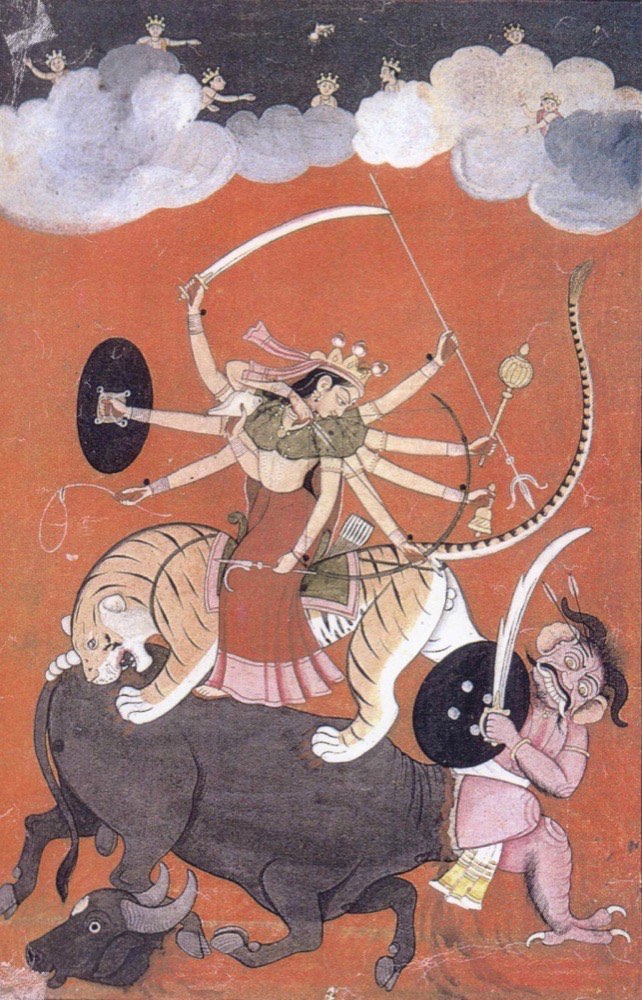
The Argalā Stotram is one of the three essential preliminary hymns that must be recited before the Durgā Saptaśatī (also known as the Devī Māhātmya or Caṇḍī Pāṭha), the 700-verse scripture that forms the supreme liturgical text of Śākta Hinduism. Together with the Devī Kavacam (the Goddess’s armour) and the Kīlakam (the pin or key), the Argalā Stotram constitutes the ritual triad that prepares the devotee’s mind, body, and spirit for the transformative encounter with the Devī Māhātmya’s sacred narrative.
The word argalā (अर्गला) means “bolt” or “lock” in Sanskrit. Just as a bolt secures a door and must be drawn back before one can enter, this stotram functions as the spiritual lock that, once recited, opens the gates to the deeper mysteries of the Saptaśatī. Without drawing this bolt, the traditional teaching holds, the full power of the 700 verses remains sealed — accessible in letter but not in transformative spirit.
The Triad: Kavacam, Argalā, and Kīlakam
The Durgā Saptaśatī prescribes a specific sequence of recitation known as the Pāṭha Vidhi (method of reading). Before the thirteen chapters of the main text, three preliminary hymns must be recited in order:
-
Devī Kavacam (The Armour of the Goddess) — A protective hymn that invokes the Goddess’s various forms to shield every part of the devotee’s body. It functions as spiritual armour, ensuring the practitioner is protected before engaging with the immense śakti (power) of the text.
-
Argalā Stotram (The Lock/Bolt) — The hymn of invocation that “unlocks” the text’s transformative power. It praises the Goddess through her various names and deeds, requesting beauty, victory, glory, and the destruction of enemies.
-
Kīlakam (The Pin/Key) — A mystical hymn attributed to Śiva himself, which “unpins” or releases the mantric energy sealed within the Saptaśatī by the sage Brahmā. Without the Kīlakam, the mantras remain inert.
Together, these three form a logical spiritual sequence: protect (Kavacam), unlock (Argalā), and release (Kīlakam). Only after completing all three does the devotee proceed to the Saptaśatī’s opening chapter, which narrates the first of three great battles between the Goddess and the forces of cosmic delusion.
Viniyoga: The Ritual Framework
The Argalā Stotram begins with its viniyoga — the ritual declaration that establishes the hymn’s sacred credentials:
ॐ अस्य श्रीअर्गलास्तोत्रमन्त्रस्य विष्णुरृषिः, अनुष्टुप् छन्दः, श्रीमहालक्ष्मीर्देवता, श्रीजगदम्बाप्रीतये सप्तशतीपाठाङ्गत्वेन जपे विनियोगः।
- Ṛṣi (Seer): Viṣṇu — Lord Viṣṇu is the revealing sage of this hymn
- Chandas (Metre): Anuṣṭubh — the most common Sanskrit verse metre (32 syllables per verse)
- Devatā (Deity): Śrī Mahālakṣmī — the presiding Goddess of the middle section of the Saptaśatī
- Viniyoga (Purpose): Recitation as an integral component (aṅga) of the Saptaśatī pāṭha, for pleasing Śrī Jagadambā (the World-Mother)
The attribution to Viṣṇu as ṛṣi is significant: it establishes that the Argalā Stotram is not merely a devotional composition but a divinely revealed text, spoken by Viṣṇu himself as part of the Devī’s worship.
The Complete Text with Translation
The Argalā Stotram comprises 27 verses (śloka-s), of which the first two serve as invocatory salutations and the last as a concluding phalaśruti (statement of the hymn’s fruits). Verses 3 through 26 share the famous refrain that gives this stotram its distinctive character.
Opening Invocations (Verses 1-2)
Verse 1:
ॐ जय त्वं देवि चामुण्डे जय भूतापहारिणि। जय सर्वगते देवि कालरात्रि नमोऽस्तु ते॥१॥
Oṃ jaya tvaṃ devi cāmuṇḍe jaya bhūtāpahāriṇi | Jaya sarvagate devi kālarātri namo’stu te ||1||
Translation: “O Goddess Cāmuṇḍā, victory to You! O remover of all afflictions, victory! O all-pervading Goddess, O Kālarātri (the dark night of dissolution) — salutations to You!”
The stotram opens by hailing the Goddess as Cāmuṇḍā — the fierce form who slew the demons Caṇḍa and Muṇḍa (Devī Māhātmya, Chapter 7) — and as Kālarātri, the terrifying night of cosmic destruction, one of the nine forms of Durgā worshipped during Navarātri.
Verse 2:
जयन्ती मङ्गला काली भद्रकाली कपालिनी। दुर्गा शिवा क्षमा धात्री स्वाहा स्वधा नमोऽस्तु ते॥२॥
Jayantī maṅgalā kālī bhadrakālī kapālinī | Durgā śivā kṣamā dhātrī svāhā svadhā namo’stu te ||2||
Translation: “O Jayantī (the victorious), Maṅgalā (the auspicious), Kālī (the dark one), Bhadrakālī (the benevolent fierce one), Kapālinī (the skull-bearer), Durgā (the invincible), Śivā (the gracious), Kṣamā (forgiveness incarnate), Dhātrī (the sustainer), Svāhā (the offering to the gods), Svadhā (the offering to the ancestors) — salutations to You!”
This verse is one of the most celebrated in Śākta liturgy. It encapsulates the Goddess’s entire range — from the terrifying (Kālī, Kapālinī) to the benevolent (Maṅgalā, Kṣamā), from the cosmic (Svāhā, Svadhā) to the personal (Dhātrī). Each name is not merely an epithet but a theological statement: the Goddess simultaneously embodies destruction and grace, power and compassion, cosmic law and intimate love.
The Core Verses: Rūpaṃ Dehi Jayaṃ Dehi (Verses 3-26)
From verse 3 onwards, the stotram adopts its signature structure. Each verse contains two parts: the first half-verse (pūrvārdha) praises a specific deed, form, or attribute of the Goddess; the second half-verse (uttarārdha) is the unchanging refrain:
रूपं देहि जयं देहि यशो देहि द्विषो जहि॥
Rūpaṃ dehi jayaṃ dehi yaśo dehi dviṣo jahi ||
“Grant me beauty (divine form), grant me victory, grant me glory — and destroy my enemies!”
This fourfold prayer — for rūpa (form/beauty), jaya (victory), yaśas (glory/fame), and the destruction of dviṣ (enmity/enemies) — is the spiritual heartbeat of the Argalā Stotram. Its repetition twenty-four times creates a powerful mantric rhythm that builds in intensity with each verse, like waves rising toward a crescendo.
The Demon-Slaying Verses (3-7)
Verse 3:
मधुकैटभविध्वंसि विधातृवरदे नमः। रूपं देहि जयं देहि यशो देहि द्विषो जहि॥३॥
Madhukaiṭabhavidhvaṃsi vidhātṛvarade namaḥ | Rūpaṃ dehi jayaṃ dehi yaśo dehi dviṣo jahi ||3||
Translation: “O destroyer of Madhu and Kaiṭabha, O bestower of boons upon Brahmā — salutations! Grant me beauty, grant me victory, grant me glory — destroy my enemies!”
This verse references the first carita (episode) of the Devī Māhātmya (Chapters 1), where Mahāviṣṇu’s Yoganidrā — the great sleep that is the Goddess herself — enabled Brahmā to awaken Viṣṇu, who then slew the demons Madhu and Kaiṭabha. In Śākta theology, it was the Devī’s own power that accomplished this destruction.
Verse 4:
महिषासुरनिर्नाशि भक्तानां सुखदे नमः। रूपं देहि जयं देहि यशो देहि द्विषो जहि॥४॥
Mahiṣāsuranirṇāśi bhaktānāṃ sukhade namaḥ | Rūpaṃ dehi jayaṃ dehi yaśo dehi dviṣo jahi ||4||
Translation: “O annihilator of Mahiṣāsura, O bestower of happiness upon devotees — salutations! Grant me beauty, grant me victory, grant me glory — destroy my enemies!”
The second carita (Chapters 2-4) narrates the most celebrated battle of the Devī Māhātmya: the Goddess Durgā’s destruction of the buffalo-demon Mahiṣāsura, who had conquered heaven itself. This episode is the centrepiece of Durgā Pūjā iconography across India.
Verse 5:
धूम्रनेत्रवधे देवि धर्मकामार्थदायिनि। रूपं देहि जयं देहि यशो देहि द्विषो जहि॥५॥
Dhūmranetravadhē devi dharmakāmārthadāyini | Rūpaṃ dehi jayaṃ dehi yaśo dehi dviṣo jahi ||5||
Translation: “O Goddess who slew Dhūmralocana, O bestower of dharma, desire, and wealth — salutations! Grant me beauty, grant me victory, grant me glory — destroy my enemies!”
Verse 6:
रक्तबीजवधे देवि चण्डमुण्डविनाशिनि। रूपं देहि जयं देहि यशो देहि द्विषो जहि॥६॥
Raktabījavadhe devi caṇḍamuṇḍavināśini | Rūpaṃ dehi jayaṃ dehi yaśo dehi dviṣo jahi ||6||
Translation: “O Goddess who slew Raktabīja, O destroyer of Caṇḍa and Muṇḍa — salutations! Grant me beauty, grant me victory, grant me glory — destroy my enemies!”
The demon Raktabīja possessed a boon that every drop of his blood that touched the ground would spawn a new demon — a vivid allegory for how desires multiply when attacked directly. The Goddess Kālī resolved this by drinking every drop before it could touch the earth (Devī Māhātmya, Chapter 8).
Verse 7:
निशुम्भशुम्भनिर्नाशि त्रैलोक्यशुभदे नमः। रूपं देहि जयं देहि यशो देहि द्विषो जहि॥७॥
Niśumbhaśumbhanirṇāśi trailokyaśubhade namaḥ | Rūpaṃ dehi jayaṃ dehi yaśo dehi dviṣo jahi ||7||
Translation: “O annihilator of Niśumbha and Śumbha, O bestower of auspiciousness upon the three worlds — salutations! Grant me beauty, grant me victory, grant me glory — destroy my enemies!”
The third carita (Chapters 5-13) culminates in the destruction of the demon brothers Śumbha and Niśumbha, who represent ego (ahaṃkāra) and self-conceit (mamakāra) — the final and most deeply rooted obstacles on the spiritual path.
The Prayer Verses (8-26)
After celebrating the Goddess’s victories, the stotram transitions to direct supplication:
Verse 8:
वन्दिताङ्घ्रियुगे देवि सर्वसौभाग्यदायिनि। रूपं देहि जयं देहि यशो देहि द्विषो जहि॥८॥
Vanditāṅghriyuge devi sarvasaubhāgyadāyini | Rūpaṃ dehi jayaṃ dehi yaśo dehi dviṣo jahi ||8||
Translation: “O Goddess whose twin feet are worshipped, O bestower of all good fortune — grant me beauty, victory, glory; destroy my enemies!”
Verse 9:
अचिन्त्यरूपचरिते सर्वशत्रुविनाशिनि। रूपं देहि जयं देहि यशो देहि द्विषो जहि॥९॥
Acintyarūpacarite sarvaśatruvināśini | Rūpaṃ dehi jayaṃ dehi yaśo dehi dviṣo jahi ||9||
Translation: “O Goddess of inconceivable form and deeds, O destroyer of all enemies — grant me beauty, victory, glory; destroy my enemies!”
Verses 10-12 invoke the Goddess as the remover of sin (duritāpahā), the destroyer of disease (vyādhi-nāśinī), and the annihilator of all sins (pāpa-nāśinī) — addressing the three planes of human suffering: karmic, physical, and moral.
Verse 13:
देहि सौभाग्यमारोग्यं देहि देवि परं सुखम्। रूपं देहि जयं देहि यशो देहि द्विषो जहि॥१३॥
Dehi saubhāgyam ārogyaṃ dehi devi paraṃ sukham | Rūpaṃ dehi jayaṃ dehi yaśo dehi dviṣo jahi ||13||
Translation: “Grant good fortune and health, O Goddess, grant supreme happiness! Grant me beauty, victory, glory; destroy my enemies!”
Verses 14-15 ask for welfare (kalyāṇa), abundant prosperity (vipulā śrī), the destruction of foes, and the bestowal of supreme strength (balam uccakaiḥ).
Verse 17:
विद्यावन्तं यशस्वन्तं लक्ष्मीवन्तञ्च मां कुरु। रूपं देहि जयं देहि यशो देहि द्विषो जहि॥१७॥
Vidyāvantaṃ yaśasvantaṃ lakṣmīvantañca māṃ kuru | Rūpaṃ dehi jayaṃ dehi yaśo dehi dviṣo jahi ||17||
Translation: “Make me learned, make me renowned, make me prosperous! Grant me beauty, victory, glory; destroy my enemies!”
This verse is particularly beloved by students and professionals, as it directly requests vidyā (knowledge), yaśas (fame), and lakṣmī (prosperity) — the three pillars of a successful worldly life sanctified by divine grace.
Verses 18-23 praise the Goddess as the crusher of demonic pride (daitya-darpa-niṣūdinī), the one whose feet are polished by the crown-jewels of gods and demons alike, the one praised by Brahmā, Kṛṣṇa, Śiva (as the Lord of Himācala’s daughter), and Indra’s consort Śacī.
Verse 26:
तारिणि दुर्गसंसारसागरस्याचलोद्भवे। रूपं देहि जयं देहि यशो देहि द्विषो जहि॥२६॥
Tāriṇi durgasaṃsārasāgarasyācalodbhave | Rūpaṃ dehi jayaṃ dehi yaśo dehi dviṣo jahi ||26||
Translation: “O saviour who ferries across the perilous ocean of worldly existence, O mountain-born Goddess! Grant me beauty, victory, glory; destroy my enemies!”
This penultimate verse captures the stotram’s deepest aspiration: liberation from saṃsāra, the cycle of birth and death. The Goddess is Tāriṇī — “She who ferries across” — the cosmic boatwoman who carries the devotee from the shore of ignorance to the far shore of mokṣa.
The Phalaśruti: Concluding Verse (27)
इदं स्तोत्रं पठित्वा तु महास्तोत्रं पठेन्नरः। सप्तशतीं समाराध्य वरमाप्नोति दुर्लभम्॥२७॥
Idaṃ stotraṃ paṭhitvā tu mahāstotraṃ paṭhennaraḥ | Saptaśatīṃ samārādhya varam āpnoti durlabham ||27||
Translation: “One who recites this stotram and then reads the great hymn (the Saptaśatī), worshipping the Seven Hundred Verses, obtains boons that are otherwise impossible to attain.”
This concluding verse explicitly states the Argalā Stotram’s function: it is a prerequisite for the full Saptaśatī pāṭha. The word durlabham (“difficult to obtain”) underscores that the rewards of the complete recitation — with the Argalā as its opening — exceed what any ordinary worship can bestow.
The Lock Metaphor: Why “Argalā”?
The choice of the word argalā (bolt/lock) as the hymn’s title carries profound symbolic meaning that illuminates the entire Śākta approach to sacred texts.
In the Tantric and Śākta traditions, sacred texts are not merely informational — they are mantric containers of living divine energy. The Durgā Saptaśatī is understood as the Goddess herself in verbal form (śabda-rūpā devī). Such concentrated power requires safeguards. The Kavacam provides physical and spiritual protection; the Argalā unlocks the text’s accessibility; the Kīlakam releases its latent energy.
The metaphor operates on multiple levels:
- Ritual level: The Argalā literally “opens” the Saptaśatī recitation — without it, the pāṭha is considered incomplete and its fruits uncertain
- Psychological level: The hymn’s repetitive refrain and escalating praise prepare the mind to receive the Saptaśatī’s teachings, gradually shifting consciousness from the mundane to the sacred
- Mantric level: In the Tantric understanding, the Argalā removes the āvaraṇa (veiling) that conceals the text’s deepest mantric power from the unprepared practitioner
The traditional commentator Bhāskararāya (18th century), in his celebrated commentary Guptavatī on the Devī Māhātmya, explains that the three preliminary hymns correspond to three layers of concealment (āvaraṇa-traya) placed upon the Saptaśatī by Brahmā to prevent its misuse. The Kavacam removes the outer layer, the Argalā the middle, and the Kīlakam the innermost.
The Refrain: A Fourfold Prayer
The refrain “Rūpaṃ dehi jayaṃ dehi yaśo dehi dviṣo jahi” deserves careful analysis, as its four requests map onto the classical Hindu framework of the four aims of life (puruṣārtha-s):
-
Rūpaṃ dehi — “Grant me form/beauty.” On the surface, this requests physical attractiveness. But rūpa in Śākta theology also means the Goddess’s own divine form (divya-rūpa) — the prayer asks that the devotee’s own form become a vessel of divine radiance. In deeper mystical interpretation, it is a prayer for svarūpa-jñāna — knowledge of one’s true nature.
-
Jayaṃ dehi — “Grant me victory.” This corresponds to artha (material success) and kāma (fulfilment of desires) — victory over external circumstances. On the inner level, it requests victory over the six internal enemies: lust, anger, greed, delusion, pride, and jealousy.
-
Yaśo dehi — “Grant me glory/fame.” Yaśas in the Vedic worldview is not mere celebrity but the radiance of a life lived in accordance with dharma — the glory that comes from righteous action.
-
Dviṣo jahi — “Destroy my enemies.” The word dviṣ (one who hates/opposes) encompasses both external adversaries and, more importantly, internal obstacles. The Devī Māhātmya itself makes clear (11.5-6) that the demons the Goddess slays are allegories for the internal forces that bind the soul.
Role in Saptaśatī Pāṭha
The Durgā Saptaśatī’s complete recitation (sampūrṇa pāṭha) follows a precise liturgical sequence:
- Ṣaḍaṅga Nyāsa — Ritual placement of mantras upon the body
- Devī Kavacam — The protective armour (38 verses)
- Argalā Stotram — The unlocking hymn (27 verses)
- Kīlakam — The releasing pin (16 verses)
- Navārṇa Mantra Japa — Recitation of the nine-syllable Devī mantra
- Rātri Sūktam — Hymn to the Goddess as Night (Ṛgveda 10.127)
- Chapters 1-13 of the Devī Māhātmya — The three carita-s
- Devī Sūktam — Hymn to the Goddess as Vāk (Ṛgveda 10.125)
- Rahasyam — Three secret chapters on the Goddess’s deeper nature
- Dhyāna and Kṣamā Prārthanā — Meditation and prayer for forgiveness
The Argalā Stotram thus occupies the third position — after protection is secured (Kavacam) and before energy is released (Kīlakam). This placement reflects a deliberate ritual logic: one must first be protected, then gain access, and only then activate the text’s mantric power.
Navarātri Recitation
The Argalā Stotram is recited most intensely during Navarātri, the nine-night festival dedicated to the Goddess, observed twice annually (Caitra Navarātri in spring and Śāradīya Navarātri in autumn). During this period:
- Daily pāṭha: Devout practitioners recite the complete Saptaśatī including the Argalā every day for nine days
- Aṣṭamī and Navamī: The most auspicious days for the complete recitation, when the Argalā’s power is considered especially potent
- Homa: In elaborate Navarātri fire-rituals, each verse of the Argalā is offered into the sacred fire with ghee oblations
- Kanyā Pūjā: Young girls, worshipped as embodiments of the nine Durgā forms, are honoured while the Saptaśatī including the Argalā is recited
The Bengali Śāradīya Durgā Pūjā (Śarad Navarātri, typically in October) features the most elaborate liturgical use of the Argalā. During the five-day Pūjā period (Ṣaṣṭhī to Daśamī), trained priests (purohita-s) recite the full Saptaśatī sequence multiple times, with the Argalā’s refrain becoming a rhythmic pulse underlying the entire festival.
The Bengali Caṇḍīpāṭha Tradition
In Bengal, the recitation of the Durgā Saptaśatī is called Caṇḍīpāṭha (reading of the Caṇḍī), and it holds a uniquely central position in religious life. The Argalā Stotram within this tradition has distinctive characteristics:
The Mahālayā Connection: Bengali Durgā Pūjā begins with Mahālayā — the new-moon day that marks the start of the Devīpakṣa (the Goddess’s fortnight). The legendary All India Radio broadcast of Mahālayā by Birendra Krishna Bhadra (first aired in 1931), which awakens millions of Bengalis before dawn, includes recitation of the Saptaśatī’s preliminary hymns including the Argalā. For generations of Bengalis, the sound of “Rūpaṃ dehi jayaṃ dehi” has been inseparable from the emotional arrival of the Goddess.
Household Caṇḍīpāṭha: In traditional Bengali households, the complete Caṇḍīpāṭha is performed during Navarātri by the family’s priest or by the householder himself. The Argalā is considered so essential that some families recite it even when time constraints prevent the full Saptaśatī — it serves as a concentrated essence of the entire text.
The Śākta Pīṭha Connection: Bengal’s great Śākta centres — Kāmākhyā, Tārāpīṭh, Kalighat, and Dakṣiṇeśvar — all feature regular Caṇḍīpāṭha that includes the Argalā. The tradition holds that the Devī Māhātmya was first revealed in Bengal, where the Goddess’s living presence is most intensely felt.
Comparison: Kavacam, Argalā, and Kīlakam
Understanding the Argalā’s unique role requires comparing it with its two companion hymns:
| Aspect | Kavacam | Argalā | Kīlakam |
|---|---|---|---|
| Meaning | Armour | Lock/Bolt | Pin/Key |
| Ṛṣi | Brahmā | Viṣṇu | Śiva |
| Function | Protection | Invocation/Unlocking | Energy release |
| Tone | Protective, defensive | Devotional, supplicatory | Mystical, technical |
| Content | Names Goddess forms for each body part | Celebrates deeds, requests boons | Explains the text’s concealed power |
| Devatā | Mahāsarasvatī | Mahālakṣmī | Mahākālī |
| Saptaśatī Section | First carita (Chapters 1) | Second carita (Chapters 2-4) | Third carita (Chapters 5-13) |
The three ṛṣi-s — Brahmā, Viṣṇu, and Śiva — correspond to the Hindu trimūrti, ensuring that the entire cosmic hierarchy participates in the Saptaśatī’s preliminary rites. The three devatā-s — Mahāsarasvatī, Mahālakṣmī, and Mahākālī — are the three primary forms of the Goddess who preside over the three carita-s of the Devī Māhātmya.
Allegorical Interpretation: The Demons as Inner Enemies
The Argalā Stotram’s verses celebrating the Goddess’s demon-slaying deeds operate simultaneously on mythological and psychological planes. Traditional commentators, especially Bhāskararāya and Nāgojī Bhaṭṭa, interpret each demon as representing specific inner obstacles:
-
Madhu and Kaiṭabha (Verse 3): These demons emerged from the wax (madhu = honey/wax) of Viṣṇu’s ears while he slept. They represent tamas (inertia) and rajas (agitation) — the fundamental modes of ignorance and restlessness that veil pure consciousness.
-
Mahiṣāsura (Verse 4): The buffalo-demon symbolizes bestial nature (paśu-bhāva) — the crude, animalistic drives of lust and violence that dominate the unreflective mind.
-
Dhūmralocana (Verse 5): His name means “smoky-eyed” — he represents the clouded vision of ignorance that prevents the soul from perceiving divine reality.
-
Raktabīja (Verse 6): The demon whose blood-drops spawned new demons represents desire (vāsanā) — which, when attacked directly, only multiplies.
-
Śumbha and Niśumbha (Verse 7): They represent ahaṃkāra (ego) and mamakāra (possessiveness) — the subtlest and most persistent inner enemies.
When the devotee recites “dviṣo jahi” (destroy my enemies), the prayer encompasses both worldly adversaries and these inner demons.
Spiritual Benefits and Traditional Claims
The Argalā Stotram’s phalaśruti (verse 27) declares that one who recites this hymn before the Saptaśatī obtains durlabha vara — “boons difficult to obtain.” Traditional commentaries elaborate on these benefits:
- Removal of obstacles (vighna-nivāraṇa): The Argalā is specifically prescribed for clearing hindrances in spiritual practice, professional endeavours, and personal life
- Victory in conflicts (vijaya): The repeated prayer “jayaṃ dehi” is invoked before examinations, legal proceedings, and challenging undertakings
- Health and longevity (ārogya): Verse 13 specifically requests health, and the stotram is recited as part of healing rituals
- Prosperity (samṛddhi): The Goddess as Mahālakṣmī is the presiding deity, ensuring material and spiritual abundance
- Protection from enemies (śatru-nāśa): Both visible adversaries and invisible negative influences
- Spiritual illumination (jñāna): The deepest benefit — the “unlocking” of the Saptaśatī leads ultimately to ātma-jñāna (self-knowledge)
Living Practice: The Argalā Today
The Argalā Stotram remains among the most widely recited preliminary hymns in contemporary Hindu worship. During Navarātri, its refrain echoes from the pandals of Kolkata to the temples of Varanasi, from the Durgā mandirs of Gujarat to the Caṇḍī shrines of Assam. Digital recitations have made it accessible to diaspora communities worldwide, yet the ancient liturgical tradition persists: the trained priest chanting the Argalā before dawn, the household devotee whispering “Rūpaṃ dehi jayaṃ dehi” before the family shrine, the gathered congregation rising in unison as the refrain builds toward its twenty-fourth repetition.
The stotram endures because its central gesture — the drawing of a bolt, the opening of a lock — speaks to a universal spiritual experience: the moment when the seeker, having donned the armour of faith and turned the key of devotion, stands before the door of the sacred and says, simply, “Open.” The Argalā Stotram is that opening. Beyond it lies the full majesty of the Devī Māhātmya — the Goddess in all her fierce, compassionate, world-sustaining glory.