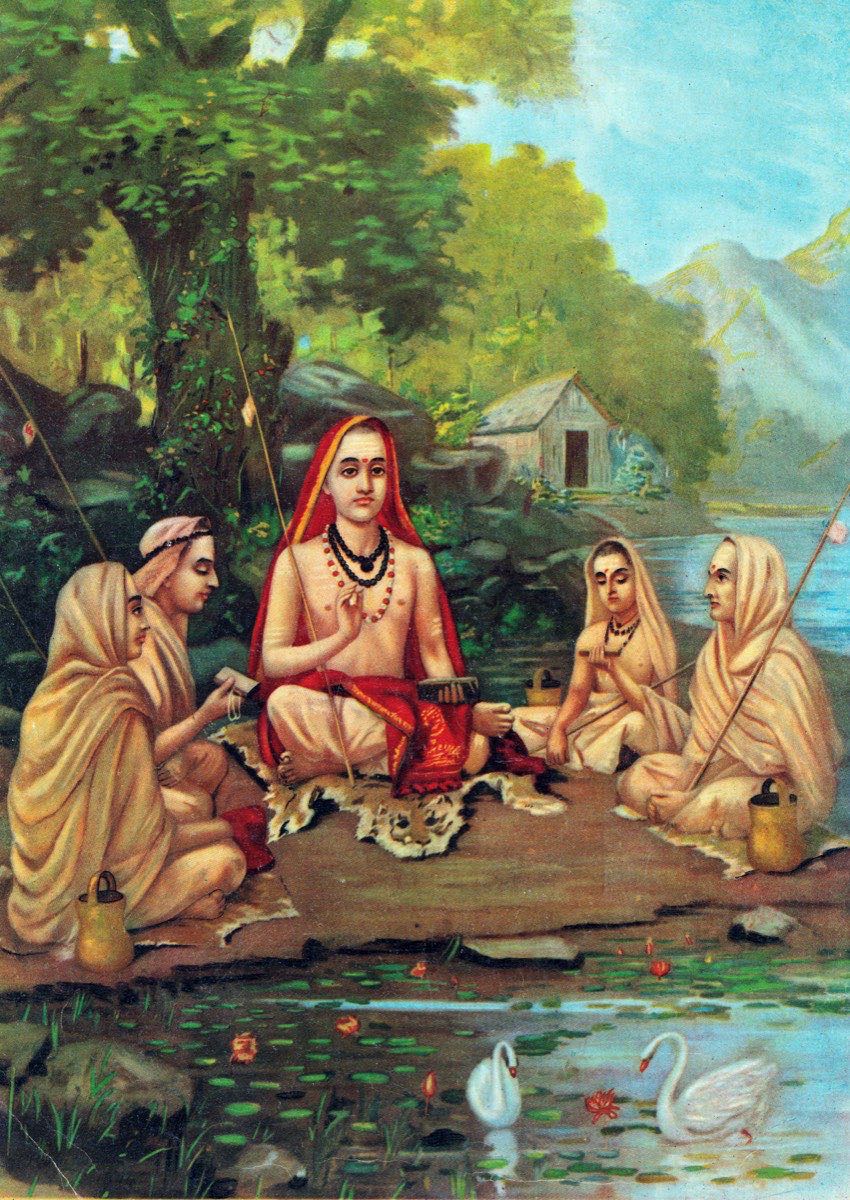
Bhaja Govindam — also known as Moha Mudgara (“The Hammer that Shatters Delusion”) — is one of the most beloved and widely recited devotional compositions in the Hindu tradition. Attributed to Ādi Śaṅkarācārya (c. 788–820 CE), the greatest exponent of Advaita Vedānta, this hymn of 31 verses strikes at the root of human attachment with devastating clarity, urging the listener to abandon worldly illusions and seek refuge in Govinda (Lord Viṣṇu/Kṛṣṇa) before the inexorable approach of death renders all material pursuits meaningless.
The Story of Its Composition
The Old Grammarian of Kāśī
The traditional account of the Bhaja Govindam’s origin is both simple and profound. During his stay in Kāśī (Vārāṇasī), Ādi Śaṅkarācārya was walking along the ghats with his disciples when he noticed a very old man sitting on the steps, laboriously memorising the rules of Sanskrit grammar from Pāṇini’s Aṣṭādhyāyī. The sight of this aged scholar spending his remaining days on mere intellectual accomplishment — ḍukṛñkaraṇe, the grammatical formula for verb conjugation — moved Śaṅkara to spontaneous compassion.
In a burst of spiritual urgency, Śaṅkara composed the opening verse:
भज गोविन्दं भज गोविन्दं गोविन्दं भज मूढमते । सम्प्राप्ते सन्निहिते काले नहि नहि रक्षति डुकृञ्करणे ॥१॥
Bhaja Govindaṃ bhaja Govindaṃ Govindaṃ bhaja mūḍhamate | Samprāpte sannihite kāle nahi nahi rakṣati ḍukṛñkaraṇe ||1||
Translation: “Worship Govinda, worship Govinda, worship Govinda, O deluded mind! When the appointed time of death arrives, the rules of grammar will not save you.”
The threefold repetition of “Bhaja Govindam” is not mere rhetorical emphasis — it is a cry of urgent awakening, as if Śaṅkara is shaking the listener out of a profound spiritual sleep.
The Disciples’ Contribution
Inspired by their master’s extemporaneous verse, Śaṅkara’s fourteen principal disciples each composed one verse of their own, adding to the composition. These fourteen verses are collectively known as the Caturdaśa-mañjarikā Stotram (The Bouquet of Fourteen Verses). Śaṅkara himself then added five more verses at the conclusion. The combined work of 31 verses became known as both Bhaja Govindam and Moha Mudgara.
The twelve verses composed by Śaṅkara after the opening are called the Dvādaśa-mañjarikā Stotram (The Bouquet of Twelve). Each verse of Bhaja Govindam uses the opening refrain — bhaja govindam — as its concluding anchor, creating a rhythmic return to the central message that binds the entire composition together.
Structure
The hymn can be divided into three parts:
- Verses 1–13 (Dvādaśa-mañjarikā): Śaṅkara’s core composition — the refrain verse plus twelve verses exposing worldly delusion
- Verses 14–27 (Caturdaśa-mañjarikā): Individual verses by fourteen disciples
- Verses 28–31: Śaṅkara’s concluding verses on the path to liberation
The metre varies — most verses use āryā or anuṣṭubh metre — but the unifying thread is the refrain and the relentless theme of impermanence.
Key Verses with Translation
On the Illusion of Wealth (Verse 2)
मूढ जहीहि धनागमतृष्णां कुरु सद्बुद्धिं मनसि वितृष्णाम् । यल्लभसे निजकर्मोपात्तं वित्तं तेन विनोदय चित्तम् ॥२॥
Mūḍha jahīhi dhanāgamatṛṣṇāṃ kuru sadbuddhiṃ manasi vitṛṣṇām | Yallabhase nijakarmopāttaṃ vittaṃ tena vinodaya cittam ||2||
Translation: “O fool, abandon the thirst for acquiring wealth. Cultivate in your mind the disposition of dispassion. Be content with whatever wealth comes to you through the fruits of your own past actions.”
This verse immediately establishes the Bhaja Govindam’s practical orientation. Śaṅkara does not demand total renunciation of all possessions — he counsels vitṛṣṇā (freedom from craving) while accepting what comes naturally through karma.
On the Fleeting Nature of Youth and Beauty (Verse 3)
नारीस्तनभरनाभीदेशं दृष्ट्वा मा गा मोहावेशम् । एतन्मांसवसादिविकारं मनसि विचिन्तय वारं वारम् ॥३॥
Nārīstanabharanābhīdeśaṃ dṛṣṭvā mā gā mohāveśam | Etanmāṃsavasādivikāraṃ manasi vicintaya vāraṃ vāram ||3||
Translation: “Seeing the body of a woman, do not fall into the snare of delusion. Reflect again and again in your mind: this is but a modification of flesh and fat.”
While the language is direct and may seem austere, Śaṅkara’s intent is not misogyny but viveka — discrimination between the Real and the unreal. The same teaching applies equally to all forms of bodily attachment. The Vivekacūḍāmaṇi (verse 76) makes the universal application clear: the body — whether male or female — is ultimately composed of the five elements and is subject to decay.
On the Impermanence of Relationships (Verse 5)
यावद्वित्तोपार्जनसक्तः स्तावन्निजपरिवारो रक्तः । पश्चाज्जीवति जर्जरदेहे वार्तां कोऽपि न पृच्छति गेहे ॥५॥
Yāvadvittopārjanasaktaḥ stāvannijaparivāro raktaḥ | Paścājjīvati jarjaradehe vārtāṃ ko’pi na pṛcchati gehe ||5||
Translation: “As long as you have the ability to earn money, so long will your family be attached to you. But when your body grows old and feeble, no one in the household even asks how you are.”
On the Illusion of Time (Verse 4)
नलिनीदलगतजलमतितरलं तद्वज्जीवितमतिशयचपलम् । विद्धि व्याध्यभिमानग्रस्तं लोकं शोकहतं च समस्तम् ॥४॥
Nalinīdalagatajalamatilaralaṃ tadvajjīvitamatiśayacapalam | Viddhi vyādhyabhimānagrastaṃ lokaṃ śokahataṃ ca samastam ||4||
Translation: “Life is as uncertain as a drop of water trembling on a lotus petal. Know that the entire world is consumed by disease, ego, and grief.”
The image of water on a lotus leaf — nalinīdalagata-jala — is a masterful poetic choice. The water appears to rest on the leaf but is never truly attached to it; at any moment, the slightest breeze sends it rolling off. So too is human life — perched precariously on the leaf of the body, never truly secure.
On the Stages of Life (Verse 7)
बालस्तावत्क्रीडासक्तः तरुणस्तावत्तरुणीसक्तः । वृद्धस्तावच्चिन्तासक्तः परमे ब्रह्मणि कोऽपि न सक्तः ॥७॥
Bālastāvatkrīḍāsaktaḥ taruṇastāvattaruṇīsaktaḥ | Vṛddhastāvaccintāsaktaḥ parame brahmaṇi ko’pi na saktaḥ ||7||
Translation: “In childhood, one is attached to play. In youth, one is attached to a young woman. In old age, one is attached to anxiety. To the Supreme Brahman, alas, no one is attached!”
This verse captures the entire span of human life in three devastating lines. Each stage brings its own form of moha (delusion), and the tragedy is that no stage naturally inclines the mind toward the divine. Spiritual seeking requires a deliberate act of will — a conscious turning away from the gravitational pull of worldly attachments.
The Teaching on True Knowledge (Verse 9)
सत्सङ्गत्वे निस्सङ्गत्वं निस्सङ्गत्वे निर्मोहत्वम् । निर्मोहत्वे निश्चलतत्त्वं निश्चलतत्त्वे जीवन्मुक्तिः ॥९॥
Satsaṅgatve nissaṅgatvaṃ nissaṅgatve nirmohatvam | Nirmohatve niścalatattvaṃ niścalatattve jīvanmuktiḥ ||9||
Translation: “Through the company of the good (satsaṅga) comes non-attachment. Through non-attachment comes freedom from delusion. Through freedom from delusion comes steadfastness in truth. Through steadfastness in truth comes liberation while yet alive (jīvanmukti).”
This is perhaps the most philosophically dense verse in the entire composition. In four steps, Śaṅkara maps the complete path from saṃsāra to mokṣa:
- Satsaṅga (holy company) — the initial catalyst
- Nissaṅgatva (non-attachment) — the fruit of satsaṅga
- Nirmohatva (freedom from delusion) — the fruit of non-attachment
- Niścala-tattva (steadfastness in the immovable Truth) — the fruit of clarity
- Jīvanmukti (liberation while alive) — the ultimate result
This chain of causation echoes the teaching of the Bhagavad Gītā (2.62-63), where Kṛṣṇa describes the chain of spiritual descent through attachment, desire, anger, and delusion — Śaṅkara here presents the ascending counterpart.
On the Body’s Impermanence (Verse 11)
मा कुरु धनजनयौवनगर्वं हरति निमेषात्कालः सर्वम् । मायामयमिदमखिलं हित्वा ब्रह्मपदं त्वं प्रविश विदित्वा ॥११॥
Mā kuru dhanajanayauvanagarvam harati nimeṣāt kālaḥ sarvam | Māyāmayam idamakhilaṃ hitvā brahmapadaṃ tvaṃ praviśa viditvā ||11||
Translation: “Do not be proud of wealth, people, and youth. Time destroys all of these in a moment. Knowing this entire world to be a product of māyā (illusion), enter the state of Brahman.”
The Disciples’ Verses: Selected Highlights
Verse by Padmapāda (Verse 14)
कामं क्रोधं लोभं मोहं त्यक्त्वाऽऽत्मानं पश्यति सोऽहम् । आत्मज्ञानविहीना मूढाः ते पच्यन्ते नरकनिगूढाः ॥
Translation: “Abandoning desire, anger, greed, and delusion, one sees the Self as ‘I am That.’ Those fools who lack Self-knowledge are cooked in the hidden hells.”
Verse by Toṭakācārya (Verse 15)
गेयं गीतानामसहस्रं ध्येयं श्रीपतिरूपमजस्रम् । नेयं सज्जनसङ्गे चित्तं देयं दीनजनाय च वित्तम् ॥
Translation: “Sing the Bhagavad Gītā and the Thousand Names of Viṣṇu. Meditate ceaselessly on the form of the Lord of Śrī. Lead the mind to the company of the wise. Give your wealth to the poor and needy.”
Śaṅkara’s Conclusion (Verse 28)
सुखतः क्रियते रामाभोगः पश्चाद्धन्त शरीरे रोगः । यद्यपि लोके मरणं शरणं तदपि न मुञ्चति पापाचरणम् ॥२८॥
Sukhataḥ kriyate rāmābhogaḥ paścāddhanta śarīre rogaḥ | Yadyapi loke maraṇaṃ śaraṇaṃ tadapi na muñcati pāpācaraṇam ||28||
Translation: “One indulges in carnal pleasures with ease; but alas, disease soon ravages the body. Even though death is the certain refuge of all in this world, even then one does not abandon sinful conduct.”
The Final Verse (Verse 31)
गुरुचरणाम्बुज निर्भरभक्तः संसारादचिराद्भव मुक्तः । सेन्द्रियमानसनियमादेवं द्रक्ष्यसि निजहृदयस्थं देवम् ॥३१॥
Gurucaraṇāmbuja nirbharabhaktaḥ saṃsārādacirādbhava muktaḥ | Sendriyamānasaniyamādevaṃ drakṣyasi nijahṛdayasthaṃ devam ||31||
Translation: “Being devoted completely to the lotus feet of the Guru, be liberated quickly from the cycle of birth and death. Through the discipline of the senses and the mind, you shall see the Lord who dwells in your own heart.”
Philosophical Framework
Advaita Vedānta and Bhakti
The Bhaja Govindam presents an apparent paradox: Śaṅkara, the supreme teacher of Advaita Vedānta (non-dual philosophy) — which holds that the individual self (ātman) is identical with Brahman and that the phenomenal world is māyā — here advocates bhakti (devotion) to a personal God (Govinda). How can the philosopher of formless, attributeless Brahman (nirguṇa) advocate worship of a formed deity (saguṇa)?
The resolution lies in Śaṅkara’s own teaching. In the Vivekacūḍāmaṇi (verse 31-32), he identifies bhakti as one of the essential qualifications (sādhana-catuṣṭaya) for a spiritual aspirant. For Śaṅkara, bhakti is not opposed to jñāna (knowledge) but is its necessary precondition. Devotion purifies the heart (citta-śuddhi), making it fit to receive the liberating knowledge of the Self.
Moreover, the Brahma Sūtra Bhāṣya (3.2.24) acknowledges that the aspirant who has not yet realised the non-dual Self legitimately worships saguṇa Brahman as a means of spiritual progression. Bhaja Govindam operates at this vyāvahārika (empirical) level — meeting the seeker where they are and directing them toward the divine.
Vairāgya: The Heart of the Teaching
The dominant theme of Bhaja Govindam is vairāgya — dispassion or detachment. Every verse is designed to loosen the grip of attachment — to wealth, youth, beauty, family, scholarship, and even life itself. This is not nihilism or world-hatred but what Śaṅkara calls viveka — the capacity to distinguish between the eternal (nitya) and the transient (anitya).
The Bhagavad Gītā (2.14) teaches: mātrā-sparśāstu kaunteya śītoṣṇa-sukha-duḥkha-dāḥ | āgamāpāyino ‘nityāḥ tāṃs titikṣasva bhārata — “Sensory contacts, O son of Kuntī, give rise to cold and heat, pleasure and pain. They come and go; they are impermanent. Endure them, O Bhārata.” Bhaja Govindam translates this teaching into vivid, unforgettable imagery.
The Urgency of Now
What distinguishes Bhaja Govindam from more systematic philosophical treatises is its urgency. The refrain — bhaja govindam — is not a gentle suggestion but a desperate imperative. The opening verse’s reference to samprāpte sannihite kāle (“when the appointed time approaches”) frames the entire composition as a meditation on mortality.
This urgency connects Bhaja Govindam to a broader tradition of maraṇa-smṛti (remembrance of death) found across Hindu, Buddhist, and Jain spiritual literature. The Mahābhārata (Śānti Parva 174.33) declares: ahany ahani bhūtāni gacchantīha yamālayam | śeṣāḥ sthāvaram icchanti kim āścaryam ataḥ param — “Day after day, beings are departing for the abode of Yama (Death). The remaining ones wish to live forever — what greater wonder is there than this?”
The Bhaja Govindam in Practice
Recitation and Singing
Bhaja Govindam is one of the most commonly sung devotional compositions in India. Its verses are set to various rāgas in the Carnatic and Hindustani classical traditions. The legendary M.S. Subbulakshmi’s rendition remains the most widely known recording, and it is regularly performed at temples, satsaṅgas (spiritual gatherings), and bhajan sessions across India.
The hymn is particularly chanted on occasions associated with Ādi Śaṅkarācārya — notably Śaṅkara Jayantī — and during periods of reflection such as Ekādaśī, Cāturmāsa, and the Navarātri season.
As a Teaching Tool
Because of its accessible language, vivid imagery, and practical orientation, Bhaja Govindam has long been used as an introductory text in Vedānta study. Many Vedāntic teaching traditions (sampradāyas) use it as a preparatory text before students advance to Śaṅkara’s more technical works such as the Upadeśa Sāhasrī, Vivekacūḍāmaṇi, or the Bhāṣyas on the Prasthāna Traya.
The hymn’s genius lies in its ability to communicate the profoundest truths of Advaita Vedānta — the unreality of the world, the identity of ātman and Brahman, the necessity of vairāgya and viveka — through simple, emotionally powerful images that require no philosophical training to understand. A drop of water on a lotus leaf, an old man memorising grammar rules, a family that abandons its aged patriarch — these images burn themselves into the mind and accomplish what lengthy philosophical arguments may fail to achieve: a genuine turning of the heart toward the divine.
As Śaṅkara himself declares in the ninth verse, this turning begins not in isolation but in satsaṅga — the company of the wise. And the Bhaja Govindam, recited and sung for over a millennium, continues to serve as precisely that: a voice of wisdom calling across the centuries, urging each listener to awaken from the dream of worldly delusion and seek the eternal Govinda who dwells in the heart.