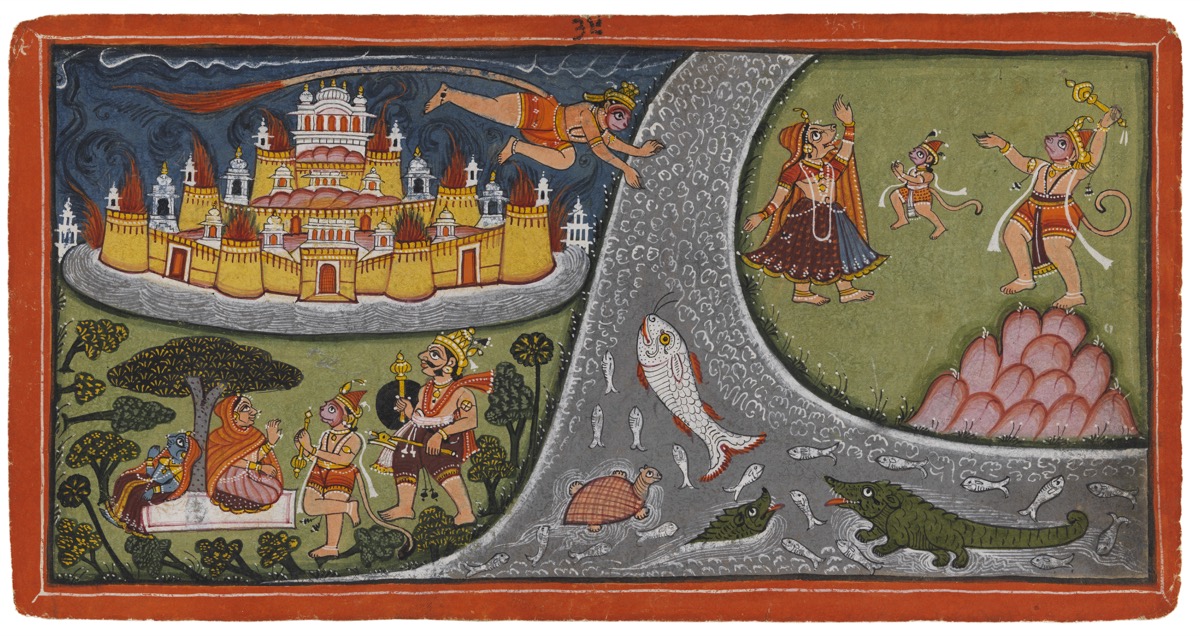
The Bajrang Baan (बजरंग बाण, literally “The Arrow of Bajrang [Hanuman]”) stands among the most powerful and intense devotional compositions in the Hindu tradition. Unlike the gentle, worshipful tenor of many devotional hymns, the Bajrang Baan is a fierce invocation — a spiritual weapon that calls upon Lord Hanuman in his warrior aspect to come immediately to the devotee’s rescue. Attributed to the great poet-saint Gosvami Tulsidas (c. 1532—1623 CE), this prayer occupies a unique position in Hanuman worship: it is not recited daily for general devotion, but reserved for times of acute crisis, danger, and spiritual emergency.
The very name captures its essence. Bajrang (बजरंग) is an epithet of Hanuman, meaning “one whose limbs (anga) are as hard as a thunderbolt (vajra),” while Baan (बाण) means “arrow.” The Bajrang Baan is thus conceived as a spiritual arrow — swift, powerful, and unerringly aimed at the destruction of whatever threatens the devotee.
Authorship and Historical Context
The Bajrang Baan is traditionally attributed to Gosvami Tulsidas, the same 16th-century saint-poet who composed the Hanuman Chalisa, Sri Ramcharitmanas, and Hanuman Bahuk. Tulsidas lived during the height of the North Indian Bhakti movement, composing devotional literature in Awadhi (a dialect of Hindi spoken in the region around Ayodhya) rather than Sanskrit, thereby making spiritual wisdom accessible to ordinary people.
While some scholars debate whether the Bajrang Baan was indeed composed by Tulsidas himself or by a later poet writing in his tradition, the prayer has been firmly embedded within the Tulsidas corpus for centuries. The use of Awadhi language, the theological framework centered on Rama-bhakti, and the intimate knowledge of Hanuman’s mythology all point to the broader Tulsidas literary tradition, even if absolute historical certainty regarding authorship remains elusive.
According to devotional tradition, Tulsidas composed the Bajrang Baan during a period of intense personal distress — some accounts suggest illness, others suggest persecution. In this dire state, the poet did not merely praise Hanuman but essentially commanded him to appear, invoking the oath (shapath) of Sri Rama himself. This element of urgency and even audacity distinguishes the Bajrang Baan from virtually all other Hanuman prayers.
Structure and Literary Style
The Bajrang Baan follows a structure common to Awadhi devotional poetry:
-
Opening Doha (दोहा): A couplet that establishes the premise — that whoever approaches Hanuman with sincere love and respectful faith will have all their auspicious tasks accomplished.
-
Chaupai (चौपाई) Verses: The main body consists of approximately 35 quatrains (four-line verses in the chaupai metre). These verses systematically invoke Hanuman’s fierce qualities, recount his legendary exploits, and command him to destroy the devotee’s enemies and obstacles.
-
Closing Doha: A final couplet that reaffirms the prayer’s power for those who recite it with unwavering devotion.
The Fierce Tone
What most distinguishes the Bajrang Baan from other Hanuman prayers is its aggressive, commanding tone. Where the Hanuman Chalisa gently praises and lovingly describes Hanuman’s virtues, the Bajrang Baan demands action. The poet does not merely request — he adjures Hanuman by the name of Rama, essentially saying: “I invoke you by the oath of your beloved Lord — come now and destroy my enemies.”
This urgency is reflected in the language itself. The verses employ martial imagery — arrows, thunderbolts, weapons, crushing blows. Hanuman is addressed not as the gentle devotee who carries Rama in his heart, but as the Mahavira (great hero), the Bajrangi (thunderbolt-bodied one), the warrior who burned Lanka, killed Akshaya Kumar, and leapt across the ocean.
Bija Mantras
A remarkable feature of the Bajrang Baan is its incorporation of bija (seed) mantras — sacred syllabic sounds that belong to the tantric tradition. Seven such mantras appear within the text:
- Om — the primordial sound
- Hrīṁ — the bija of Shakti/Maya
- Śrīṁ — the bija of Lakshmi (prosperity)
- Klīṁ — the bija of Kamadeva (attraction/desire)
- Aiṁ — the bija of Saraswati (wisdom)
- Huṁ — the bija of Shiva (protection/destruction)
- Chaṁ — associated with speed and swift action
The presence of these tantric elements elevates the Bajrang Baan beyond a simple devotional hymn into the realm of mantra-shastra (the science of sacred sound). Each bija carries its own vibrational energy, and their integration into the prayer is believed to amplify its protective power manifold.
Complete Text with Translation
Opening Doha
Devanagari: निश्चय प्रेम प्रतीति ते, विनय करें सनमान। तेहि के कारज सकल शुभ, सिद्ध करें हनुमान॥
Transliteration: Niścaya prēma pratīti tē, vinaya karēṁ sanamāna. Tēhī kē kāraja sakala śubha, siddha karēṁ Hanumāna.
Meaning: With unwavering love, faith, and respectful supplication, Hanuman accomplishes all auspicious tasks of such a devotee.
Chaupai Verses (Selected Key Sections)
Invocation of Hanuman’s Heroic Form (Verses 1—5)
The prayer opens by hailing Hanuman as the benefactor of saints (santa hitakārī) and the one who holds Rama, Lakshman, and Sita in his heart. The devotee calls upon Hanuman with intense urgency:
Devanagari: जय हनुमन्त संत हितकारी। सुन लीजै प्रभु अरज हमारी॥ जन के काज बिलम्ब न कीजै। आतुर दौरि महा सुख दीजै॥
Transliteration: Jaya Hanumanta santa hitakārī. Suna lījai prabhu araja hamārī. Jana kē kāja bilamba na kījai. Ātura dauri mahā sukha dījai.
Meaning: Victory to Hanuman, benefactor of the saints! Hear our humble prayer, O Lord. Do not delay in the work of your devotee. Rush to us eagerly and grant great happiness.
Recounting Hanuman’s Legendary Exploits (Verses 6—15)
The verses then recount Hanuman’s mighty deeds from the Ramayana, each invocation serving as both praise and reminder of his power:
Devanagari: जै जै जै हनुमंत अगाधा। दुख पावत जन केहि अपराधा॥ पूजा जप तप नेम अचारा। नहिं नहिं कछु कियो जग सारा॥
Transliteration: Jai jai jai Hanumanta agādhā. Dukha pāvata jana kēhi aparādhā. Pūjā japa tapa nēma acārā. Nahīṁ nahīṁ kachu kiyō jaga sārā.
Meaning: Hail, hail, hail to the unfathomable Hanuman! For what offence does your devotee suffer? I have not performed worship, chanting, austerities, or observances — I have done nothing in this world.
The poet frankly confesses his spiritual failings while invoking key episodes: Hanuman’s encounter with the demoness Surasa, who tried to swallow him as he crossed the ocean; his victory over Lankini, the guardian of Lanka’s gates; his burning of Lanka with his flaming tail; and his slaying of Akshaya Kumar, the powerful son of Ravana.
The Oath of Rama (Verses 16—22)
The most distinctive and potent section of the Bajrang Baan is where the devotee invokes the oath (shapath) of Sri Rama to compel Hanuman’s intervention:
Devanagari: ॐ हनु हनु हनु हनुमंत हठीले। बैरिहि मारु बज्र की कीले॥ ॐ ह्रीं ह्रीं ह्रीं हनुमंत कपीसा। ॐ हुं हुं हुं हनु अरि उर सीसा॥
Transliteration: Oṁ Hanu Hanu Hanu Hanumanta haṭhīlē. Bairihī māru vajra kī kīlē. Oṁ Hrīṁ Hrīṁ Hrīṁ Hanumanta Kapīsā. Oṁ Huṁ Huṁ Huṁ Hanu ari ura śīsā.
Meaning: Om! O stubborn Hanuman, strike my enemies with the nails of your thunderbolt! Om Hreem! O Hanuman, lord of monkeys! Om Hum! Strike the chest and head of the enemy!
Here the bija mantras are woven directly into the invocation, creating a powerful fusion of devotional and tantric elements. The repetition of seed syllables — Hanu Hanu Hanu, Hrīṁ Hrīṁ Hrīṁ, Huṁ Huṁ Huṁ — creates an almost martial drumbeat, building spiritual intensity with each repetition.
Demand for Immediate Protection (Verses 23—30)
The later verses intensify the demand for protection against specific threats — evil spirits (bhūta-preta), black magic (jādū-ṭonā), disease, enemies, and all forms of negativity:
Devanagari: ॐ चं चं चं चं चपल चलन्ता। ॐ ह्रीं ह्रीं ह्रीं हनु अरि उर दलन्ता॥ काल ज्वार मारी मरि जैहैं। बजरंगी के बचन सुन लैहैं॥
Transliteration: Oṁ Chaṁ Chaṁ Chaṁ Chaṁ capala calantā. Oṁ Hrīṁ Hrīṁ Hrīṁ Hanu ari ura dalantā. Kāla jvāra mārī mari jaihaiṁ. Bajarangī kē bacana suna laihaiṁ.
Meaning: Om Cham! Move swiftly! Om Hreem! Crush the enemies’ chests! Deadly fevers and plagues shall perish upon hearing the words of Bajrangi.
Closing Verses (Verses 31—35)
The final chaupai verses bring the prayer to its culmination, affirming that recitation with proper devotion will bring Hanuman’s unfailing protection. The poet instructs that after completing the recitation, incense (dhūpa) should be offered, and the devotee should maintain faith in Hanuman’s power:
Devanagari: पाठ करे बजरंग बाण की। हनुमत रक्षा करें प्राण की॥ यह बजरंग बाण जेहि मारे। ताहि कहो फिर कौन उबारे॥
Transliteration: Pāṭha karē Bajaranga Bāṇa kī. Hanumata rakṣā karēṁ prāṇa kī. Yaha Bajaranga Bāṇa jēhi mārē. Tāhī kahō phira kauna ubārē.
Meaning: Whoever recites the Bajrang Baan, Hanuman protects their very life. Tell me, who can save the one struck by this Arrow of Bajrang?
Closing Doha
Devanagari: प्रेम प्रतीतिहि कपि भजे, सदा धरै उर ध्यान। तेहि के कारज सकल शुभ, सिद्ध करें हनुमान॥
Transliteration: Prēma pratītihī kapi bhajē, sadā dharai ura dhyāna. Tēhī kē kāraja sakala śubha, siddha karēṁ Hanumāna.
Meaning: Whoever worships the monkey-lord (Hanuman) with love and faith, always holding him in their heart’s meditation — Hanuman accomplishes all their auspicious tasks.
When and How to Recite the Bajrang Baan
Specific Occasions for Recitation
The Bajrang Baan is not meant for casual daily recitation. Traditional guidelines emphasize that it should be reserved for:
- Acute danger or crisis — physical threats, severe illness, or life-threatening situations
- Protection from negative energies — encounters with evil spirits (bhūta-preta), black magic, or psychic attacks
- Overcoming insurmountable obstacles — when all other remedies have failed
- Legal battles or enmity — protection from powerful adversaries
- Severe fear or anxiety — when the mind is overwhelmed by dread
Recitation Guidelines
Traditional practice prescribes several guidelines for effective recitation:
-
Auspicious days: Tuesday (Mangalavāra) and Saturday (Śanivāra) are considered most potent, as these days are sacred to Hanuman.
-
Direction: Face south or east while reciting.
-
Anushthana (systematic practice): For specific goals, a 41-day (ekacallīsa dina) unbroken recitation cycle is recommended.
-
Offerings: Jaggery (guḍa), roasted gram (chanā), vermilion (sindhūra), and jasmine oil (camelī tel) are traditional offerings.
-
Dhupa (incense): The text itself instructs that incense should be lit after completing the recitation — “sadā dhūpa dai bajaranga ko” (always offer incense to Bajrang).
-
Mental state: The devotee must recite with absolute faith (niścaya prēma pratīti) and sincere devotion. The opening doha makes this the precondition for the prayer’s efficacy.
-
Brahmacharya: Some traditions recommend observing celibacy during the recitation period.
A Note of Caution
Because the Bajrang Baan contains an oath in the name of Sri Rama (Rāma shapath) that essentially compels Hanuman to act, many sages and scholars advise treating this prayer with great reverence and restraint. It is not a casual devotional exercise but a spiritual instrument of immense power. Using it frivolously or without genuine need is considered disrespectful to both Hanuman and the sacred tradition.
Bajrang Baan vs. Hanuman Chalisa: Understanding the Distinction
Both prayers are attributed to Tulsidas and both invoke Lord Hanuman, yet they serve fundamentally different purposes:
| Aspect | Hanuman Chalisa | Bajrang Baan |
|---|---|---|
| Tone | Gentle, devotional, loving | Fierce, commanding, urgent |
| Purpose | Daily worship, spiritual growth | Crisis intervention, protection |
| Structure | 40 chaupai + 2 doha | ~35 chaupai + 2 doha |
| Approach | Praise and glorification | Invocation and command |
| Bija Mantras | None | Seven tantric seed syllables |
| Frequency | Can be recited daily | Reserved for emergencies |
| Mood | Surrender and devotion | Urgency and determination |
| Effect | Inner peace, clarity, faith | Courage, protection, obstacle removal |
The Chalisa presents Hanuman as the ideal devotee — wise, strong, humble, and ever-devoted to Rama. The Bajrang Baan presents Hanuman as the divine warrior — fierce, relentless, and terrifying to evil forces. Together, they represent the two complementary aspects of Hanuman’s nature: the gentle servant and the fearsome protector.
A useful analogy: the Hanuman Chalisa is like the warm embrace of a loving guardian, while the Bajrang Baan is the guardian’s drawn sword — both expressions of the same protective love, but appropriate to different circumstances.
Spiritual and Philosophical Significance
The Theology of Divine Compulsion
The Bajrang Baan raises a profound theological question: can a devotee compel God to act? In most Hindu devotional traditions, the relationship between the devotee and the divine is one of humble supplication — the devotee prays, and God responds according to His will. The Bajrang Baan seemingly inverts this dynamic by invoking an oath (shapath) to force Hanuman’s intervention.
However, this apparent contradiction dissolves when understood in the context of prema-bhakti (love-devotion). The very opening doha establishes that the prayer works only through “niścaya prēma pratīti” — unwavering love and faith. The “commanding” tone is not that of a master ordering a servant, but of a child crying out to a parent in desperate need. Hanuman responds not because he is compelled by magical words, but because his devotee’s sincere anguish moves his compassionate heart.
This interpretation is supported by the broader theology of Tulsidas, who consistently portrays the relationship between Hanuman and his devotees as one of parental protection. Just as a mother rushes to a crying child without being formally “asked,” Hanuman rushes to the devotee who calls out with genuine distress.
The Tantric Dimension
The incorporation of bija mantras gives the Bajrang Baan a tantric dimension unusual in Vaishnavite devotional literature. This fusion of bhakti (devotion) and tantra (sacred technology) reflects the syncretic nature of Hanuman worship, which draws from multiple streams of Hindu practice. Hanuman is worshipped both as a Vaishnava deity (the supreme devotee of Rama) and as a powerful tantric guardian associated with exorcism, healing, and protection from malevolent forces.
The seven bija mantras embedded in the text function as sonic keys that activate specific spiritual energies. Their presence transforms the recitation from a purely devotional act into a ritual invocation with precise metaphysical mechanics.
Vajra Symbolism
The recurring vajra (thunderbolt/diamond) imagery in the Bajrang Baan connects to deep layers of Hindu mythology and philosophy. The vajra represents:
- Indestructibility: Like the diamond, Hanuman’s body and resolve cannot be broken
- Concentrated power: Like the thunderbolt, his intervention is swift and decisive
- Indra’s weapon: The vajra was originally the weapon of Indra, king of the gods, connecting Hanuman to his father Vayu’s close association with Indra
- Spiritual adamantine quality: The devotee’s faith, like Hanuman’s body, should be vajra-like — unbreakable
Popular Cultural Impact
The Bajrang Baan occupies a significant place in contemporary Hindu devotional culture:
- Musical renditions: Numerous singers and devotional artists have recorded the Bajrang Baan, with versions by Hariharan, Hari Om Sharan, and Gulshan Kumar’s T-Series becoming widely popular.
- Television: Indian mythological television series depicting the Ramayana frequently feature scenes of characters reciting the Bajrang Baan during moments of crisis.
- Wrestling and martial arts: Due to Hanuman’s association with physical strength, the Bajrang Baan is popular among wrestlers (pehlwān) and martial artists, who recite it before bouts for courage and protection. The tradition of anointing Hanuman idols in akharas (wrestling gymnasiums) is closely connected to this warrior aspect of Hanuman worship.
- Protection rituals: In many North Indian households, the Bajrang Baan is recited during house-warming ceremonies, before important journeys, or when family members face health crises.
- Political symbolism: The name “Bajrang” has entered Indian political discourse through organizations invoking Hanuman’s warrior aspect, demonstrating the enduring cultural power of this prayer’s imagery.
Conclusion
The Bajrang Baan stands as a testament to the multifaceted nature of Hindu devotion. It reminds us that the divine is not only gentle and compassionate but also fierce and protective — that the same Hanuman who humbly carries Rama in his heart also possesses the power to burn entire cities and move mountains. For the devotee facing genuine crisis, the Bajrang Baan offers not mere consolation but the promise of active, immediate divine intervention. Its enduring popularity across centuries speaks to a fundamental human need: the assurance that when darkness closes in, there exists a spiritual arrow — swift, powerful, and unfailing — that can pierce through any obstacle and bring the light of divine protection.
As the closing doha affirms: whoever worships Hanuman with love and faith, holding him always in the heart’s meditation, will find all their auspicious tasks accomplished. The fierce arrow of Bajrang, for all its martial intensity, is ultimately launched by love alone.