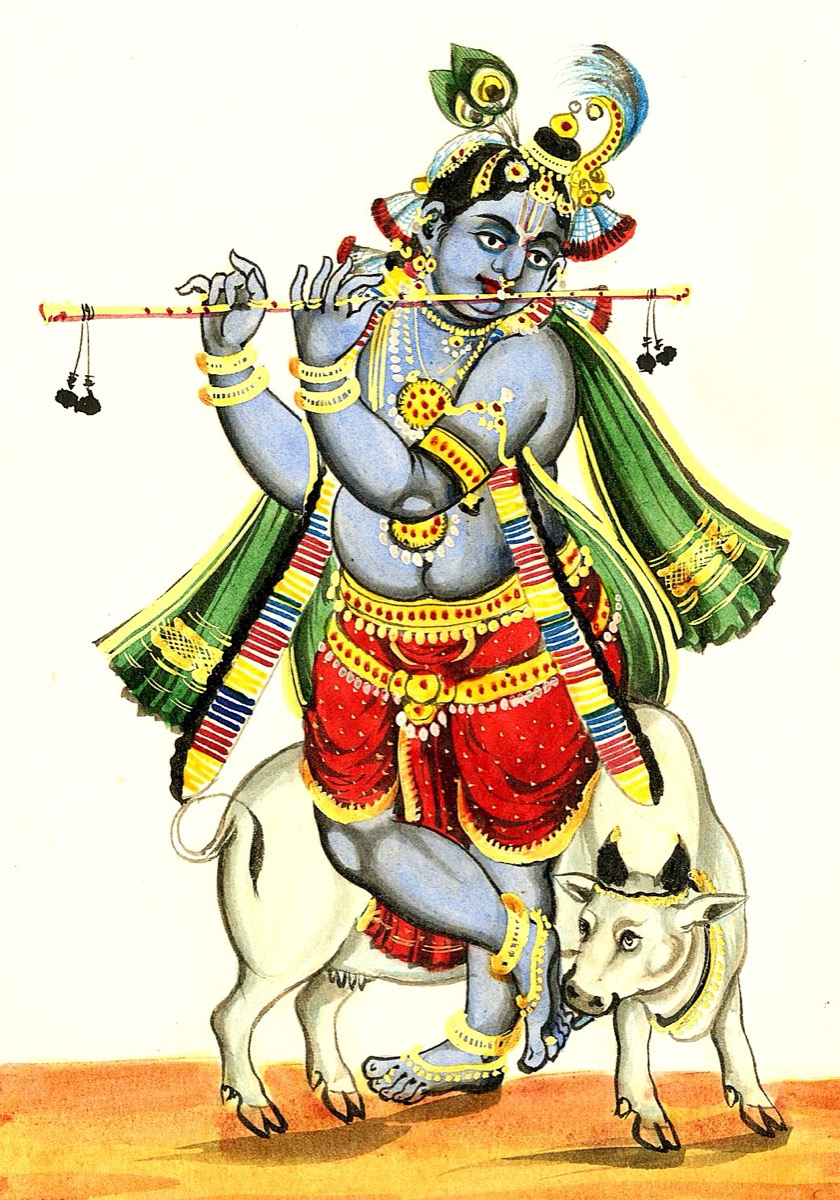
Govindāṣṭakam (श्रीगोविन्दाष्टकम्) — the “Eight Verses in Praise of Govinda” — is one of the most exquisite devotional compositions attributed to Ādi Śaṅkarācārya (c. 788–820 CE), the supreme teacher of Advaita Vedānta. In eight meticulously crafted verses, this stotra paints a luminous portrait of Lord Kṛṣṇa as Govinda — the protector of cows, the cowherd of Vṛndāvana, and simultaneously the formless Absolute that transcends all categories of existence. Each verse concludes with the majestic refrain “praṇamata govindaṃ paramānandam” — “bow down to Govinda, the Supreme Bliss” — creating a rhythmic tide of devotion that carries the reciter from intellectual contemplation to heartfelt surrender.
The Name Govinda
The name Govinda (गोविन्द) carries several layers of meaning, each revealing a different facet of the Divine. The most immediate meaning is “protector of cows” (go = cow + vinda = protector), referring to Kṛṣṇa’s pastoral life in Vṛndāvana where he tended the cattle of the cowherd community. But the Mahābhārata (Udyoga Parva 71.4) and the Viṣṇu Purāṇa offer deeper etymologies: go also means “earth,” “speech,” “the Vedas,” and “the senses,” making Govinda the protector and sustainer of all these dimensions of reality.
Ādi Śaṅkarācārya, in his commentary on the Viṣṇu Sahasranāma, explains the name thus: “govindaṃ saccidānandarūpaṃ” — Govinda is of the nature of existence-consciousness-bliss (sat-cit-ānanda). This dual signification — the personal cowherd deity and the impersonal Absolute — is precisely what the Govindāṣṭakam celebrates with such remarkable poetic skill.
Authorship and Context
Śaṅkarācārya as Devotional Poet
The attribution of the Govindāṣṭakam to Ādi Śaṅkarācārya may initially surprise those who know him primarily as the philosopher of nirguṇa Brahman (the attributeless Absolute) and the intellectual giant of Advaita Vedānta. How could the teacher who declared “brahma satyaṃ jagan mithyā” (“Brahman alone is real; the world is an appearance”) compose such passionate devotional poetry to a personal God?
The answer lies in understanding the completeness of Śaṅkara’s spiritual vision. While his philosophical works — the commentaries on the Upaniṣads, the Brahma Sūtra Bhāṣya, and the Vivekacūḍāmaṇi — establish the non-dual reality of Brahman through rigorous reasoning (yukti), his devotional compositions serve the equally essential function of purifying the heart (citta-śuddhi). In Śaṅkara’s own framework, devotion (bhakti) is not opposed to knowledge (jñāna) but is its necessary precursor. The Vivekacūḍāmaṇi (verse 31) states that among the qualifications for liberation, devotion stands supreme: “mokṣakāraṇasāmagryāṃ bhaktireva garīyasī”.
The Govindāṣṭakam, like the more widely known Bhaja Govindam, demonstrates that the Advaita master saw no contradiction between the ultimate formlessness of Brahman and the worship of Kṛṣṇa’s personal form. As the stotra itself declares in the very first verse, Govinda is simultaneously “anākāram” (formless) and “bhuvanākāram” (appearing as the universe) — the paradox that lies at the heart of Advaita.
Relationship with Bhaja Govindam
The Govindāṣṭakam and the Bhaja Govindam are companion pieces in Śaṅkara’s devotional corpus, yet they differ significantly in tone and approach. Bhaja Govindam is urgent and admonitory — it shakes the listener awake with stark warnings about the impermanence of youth, wealth, and worldly attachments. The Govindāṣṭakam, by contrast, is contemplative and celebratory — it invites the devotee to marvel at the infinite glories of Govinda, from his childhood pranks in Gokula to his cosmic role as the substratum of all existence.
If Bhaja Govindam is the sharp knock on the door of the sleeping soul, the Govindāṣṭakam is the radiant vision that greets the soul once it opens that door. Together, they represent the twin wings of Śaṅkara’s devotional teaching: renunciation of the unreal (vairāgya) and love for the Real (bhakti).
Structure and Poetic Art
The Govindāṣṭakam consists of eight verses (aṣṭaka) plus a phala-śruti (fruit-of-recitation verse) that describes the benefits of chanting. Each verse is composed in the Sragdharā-like compound metre with extraordinarily long compounds (samāsa) that cascade through multiple meanings, creating a rushing river of sound and sense. The hallmark of the stotra is its use of dvandva (contrasting pairs) and paradox: Govinda is described as both formless and the form of the world, both beyond difficulty and the supreme difficulty, both without a lord and the lord of the earth.
Each verse ends with the identical refrain: “praṇamata govindaṃ paramānandam” — establishing paramānanda (supreme bliss) as the essential nature of Govinda and the goal of all devotion.
Verse-by-Verse Exploration
Verse 1: The Cosmic and the Child
सत्यं ज्ञानमनन्तं नित्यमनाकाशं परमाकाशं गोष्ठप्राङ्गणरिङ्खणलोलमनायासं परमायासम् । मायाकल्पितनानाकारमनाकारं भुवनाकारं क्ष्मामानाथमनाथं प्रणमत गोविन्दं परमानन्दम् ॥१॥
Satyaṃ jñānam anantaṃ nityam anākāśaṃ paramākāśaṃ goṣṭhaprāṅgaṇariṅkhaṇalolam anāyāsaṃ paramāyāsam | Māyākalpitanānākāram anākāraṃ bhuvanākāraṃ kṣmāmānātham anāthaṃ praṇamata govindaṃ paramānandam ||1||
Translation: “Bow to Govinda, the Supreme Bliss — who is Truth, Knowledge, and Infinity; who is eternal, beyond space yet the Supreme Space; who delighted in crawling in the courtyard of the cowshed; who is effortless yet the supreme cause of all effort; whose manifold forms are projected by Māyā, who is formless yet appears as the universe; who is the Lord of the earth and Śrī, yet has no lord above him.”
The opening verse establishes the central paradox of the stotra. The phrase “satyaṃ jñānam anantam” directly echoes the Taittirīya Upaniṣad (2.1.1): “satyaṃ jñānam anantaṃ brahma” — “Brahman is truth, knowledge, infinity.” Śaṅkara thus immediately identifies Govinda with the Upaniṣadic Brahman. Yet in the very same breath, this infinite, formless Brahman is described as a toddler (śaiśava) who crawls with delight (riṅkhaṇalola) in the cowshed courtyard (goṣṭhaprāṅgaṇa). The juxtaposition is breathtaking: the Absolute that transcends space crawls on all fours in a dusty cattle pen.
Verse 2: The Universe in a Child’s Mouth
मृत्स्नामत्सीहेति यशोदाताडनशैशवसन्त्रासं व्यादितवक्त्रालोकितलोकालोकचतुर्दशलोकालिम् । लोकत्रयपुरमूलस्तम्भं लोकालोकमनालोकं लोकेशं परमेशं प्रणमत गोविन्दं परमानन्दम् ॥२॥
Translation: “Bow to Govinda, the Supreme Bliss — who, as a child, showed fear when Yaśodā scolded him saying ‘You are eating mud!’; in whose opened mouth were seen the fourteen worlds, visible and invisible; who is the fundamental pillar supporting the three worlds; who is both the world and beyond the world, yet invisible to ordinary sight; who is the Lord of all realms and the Supreme Lord.”
This verse recounts the beloved episode from the Bhāgavata Purāṇa (10.8.32-45) in which baby Kṛṣṇa eats mud, and when his foster-mother Yaśodā forces open his mouth, she beholds the entire cosmos — all fourteen realms (caturdaśa loka), the cosmic mountains, rivers, and the boundary between light and darkness (lokāloka). The philosophical depth here is remarkable: the Supreme Being who contains all worlds within himself trembles like an ordinary child before his mother’s scolding (tāḍana-śaiśava-santrāsam). This is the mystery of divine līlā — God’s play of apparent limitation within his own infinite freedom.
Verse 3: Destroyer and Liberator
त्रैविष्टपरिपुवीरघ्नं क्षितिभारघ्नं भवरोगघ्नं कैवल्यं नवनीताहारमनाहारं भुवनाहारम् । वैमल्यस्फुटचेतोवृत्तिविशेषाभासमनाभासं शैवं केवलशान्तं प्रणमत गोविन्दं परमानन्दम् ॥३॥
Translation: “Bow to Govinda, the Supreme Bliss — who destroyed the heroic enemies of the gods, who reduced the burden of the earth, who cures the disease of worldly existence (saṃsāra); who is Liberation itself, who ate fresh butter though needing no food at all, who swallowed the universe at the time of dissolution; who shines as the special reflection in the pure and clear mental mode yet is beyond all reflection; who is auspicious (śaiva), who is absolute peace alone.”
Here Śaṅkara presents Govinda as the cosmic warrior who destroys the asuras (enemies of the devas) and thereby lightens the earth’s burden — the very purpose of Viṣṇu’s avatāra as described in the Bhagavad Gītā (4.7-8). Yet this same cosmic warrior is simultaneously “kaivalyam” — Liberation itself, the state of absolute freedom that is the goal of Advaita Vedānta. The delightful image of baby Kṛṣṇa stealing butter (navanītāhāra) is woven into the same verse that speaks of the cosmos being dissolved back into the Absolute (bhuvanāhāra), once again yoking the playful and the philosophical.
Verse 4: The Cowherd Lord
गोपालं प्रभुलीलाविग्रहगोपालं कुलगोपालं गोपीखेलनगोवर्धनधृतिलीलालालितगोपालम् । गोभिर्निगदितगोविन्दस्फुटनामानं बहुनामानं गोधीगोचरदूरं प्रणमत गोविन्दं परमानन्दम् ॥४॥
Translation: “Bow to Govinda, the Supreme Bliss — who is the Gopāla (protector of cows), who appeared as Gopāla through his divine sport (līlā), who is the protector of his lineage; who was adored by the gopas as one who delightfully lifted Mount Govardhana while the gopīs played; whose clear name ‘Govinda’ is uttered by the cows (or the scriptures), who has countless names; who is beyond the reach of dull intellect.”
This verse is a tapestry woven from the word go in its multiple meanings: cow, earth, speech, and the Vedas. The same syllable that describes Kṛṣṇa tending cattle (gopāla) also points to his role as protector of the earth and the Vedic word. The lifting of Mount Govardhana (Bhāgavata Purāṇa 10.25) — when the seven-year-old Kṛṣṇa sheltered the entire village of Vraja from Indra’s wrath by holding up the mountain on his little finger for seven days — is perhaps the most iconic image of Govinda’s protective power. The verse concludes with the profound statement that this Govinda is “godhīgocaradūram” — beyond the reach of those whose intellect (dhī) is dull (go in this sense meaning “inert” or “bound by sense objects”). Only through devotion, not mere intellect, can Govinda be reached.
Verse 5: Unity in Multiplicity
गोपीमण्डलगोष्ठीभेदं भेदावस्थमभेदाभं शश्वद्गोखुरनिर्धूतोद्गतधूलीधूसरसौभाग्यम् । श्रद्धाभक्तिगृहीतानन्दमचिन्त्यं चिन्तितसद्भावं चिन्तामणिमहिमानं प्रणमत गोविन्दं परमानन्दम् ॥५॥
Translation: “Bow to Govinda, the Supreme Bliss — who appeared separately in each circle of gopīs yet remained in the state of non-difference, shining as undivided; whose beauty is enhanced by the grey dust raised by the hooves of cows; whose bliss is grasped through faith and devotion; who is inconceivable yet exists for those who contemplate him; who possesses the glory of the wish-fulfilling gem (cintāmaṇi).”
This verse alludes to the Rāsa Līlā (Bhāgavata Purāṇa, Canto 10, Chapters 29-33), in which Kṛṣṇa multiplied himself to dance simultaneously with each gopī, so that every one of them felt she alone was with him. Śaṅkara uses this narrative to illustrate the Advaita principle: Govinda appears as many (bheda) while remaining essentially one (abheda). The paradox of divine omnipresence — being fully present to each being while remaining undivided — is the theological heart of this verse. The image of Govinda dusted grey by the cow-hooves (gokhura-nirdhūta-dhūlī-dhūsara) is tender and pastoral, reminding us that the Absolute chooses to play in the dust of Vṛndāvana.
Verse 6: The Cloth-Stealing Episode
स्नानव्याकुलयोषिद्वस्त्रमुपादायागमुपारूढं व्यादित्सन्तीरथ दिग्वस्त्रा दातुमुपाकर्षन्तं ताः । निर्धूतद्वयशोकविमोहं बुद्धं बुद्ध्यन्तःस्थं सत्तामात्रशरीरं प्रणमत गोविन्दं परमानन्दम् ॥६॥
Translation: “Bow to Govinda, the Supreme Bliss — who took the clothes of the young women busy bathing and climbed up a tree; who drew those direction-clad (naked) women toward him as they wished to retrieve their garments; who is free from duality, grief, and delusion; who is the Awakened One (buddha), who dwells within the intellect; whose body is pure existence alone.”
The vastra-haraṇa (cloth-stealing) episode from the Bhāgavata Purāṇa (10.22) is one of the most discussed episodes in Kṛṣṇa’s mythology. On one level it is a playful prank; on another, it symbolizes the stripping away of all false coverings — ego, possessions, pretensions — that stand between the soul and God. Śaṅkara’s theological interpretation is embedded in the verse: Govinda is “nirdhūta-dvaya-śoka-vimoham” — free from duality, sorrow, and delusion. He is “sattāmātra-śarīram” — his body is “pure existence alone,” the same sat that the Chāndogya Upaniṣad (6.2.1) identifies as the one reality from which all things arise. The use of the word “buddham” (the awakened one) to describe Kṛṣṇa is notable and connects Govinda to the universal archetype of enlightenment that transcends sectarian boundaries.
Verse 7: Lord of Time
कान्तं कारणकारणमादिमनादिं कालमनाभासं कालिन्दीगतकालियशिरसि मुहुर्नृत्यन्तं सुनृत्यन्तम् । कालं कालकलातीतं कलिताशेषं कलिदोषघ्नं कालत्रयगतिहेतुं प्रणमत गोविन्दं परमानन्दम् ॥७॥
Translation: “Bow to Govinda, the Supreme Bliss — who is beautiful, who is the cause of all causes, who is the beginning without beginning, who is Time itself yet beyond the appearance of time; who danced gracefully again and again on the heads of the serpent Kāliya in the river Kālindī (Yamunā); who is Time, who transcends the divisions of time, who encompasses all, who destroys the evils of the Kali age; who is the cause of the movement of the three times (past, present, and future).”
The seventh verse weaves together Kṛṣṇa’s subjugation of the poisonous serpent Kāliya in the river Yamunā (Bhāgavata Purāṇa 10.16-17) with profound philosophical reflections on Kāla (Time). The wordplay on kāla is dazzling: Govinda is kāla (Time), yet kālakala-atīta (beyond the divisions of time); he dances on the serpent Kāliya in the Kālindī river; he destroys the sins of the Kali age. Time, in Advaita, is a product of māyā — the cosmic illusion that projects multiplicity upon the one Brahman. Govinda, as the Lord of Time, is therefore the master of māyā itself: he wields it without being bound by it.
Verse 8: The Glory of Vṛndāvana
वृन्दावनभुवि वृन्दारकगणवृन्दाराध्यवन्द्यायां कुन्दाभामलमन्दस्मेरसुधानन्दं सुमहानन्दम् । वन्दे सान्द्रमनोज्ञावर्णविलासं विजयगोविन्दं गोविन्दं परमानन्दामृतमन्तस्थं स तु गोविन्दः ॥८॥
Translation: “In the sacred land of Vṛndāvana, worshipped and adored by hosts of celestial beings, shines Govinda with a pure, gentle smile like jasmine — the nectar of bliss, the great bliss. I bow to him whose form is dense with captivating beauty, the victorious Govinda. That Govinda, the nectar of Supreme Bliss, dwells within — he indeed is Govinda.”
The eighth and final verse brings the meditation to its climax in Vṛndāvana — the sacred forest of tulasī groves where Kṛṣṇa played his eternal pastimes. The celestial beings (vṛndāraka-gaṇa-vṛnda) worship him there, but his smile is as simple and pure as a kunda flower (white jasmine). The verse ends with the revelation that this Govinda — this supreme bliss — is not somewhere far away in Vṛndāvana: he is “antaḥstham” — dwelling within the heart of every being. This internalization of the divine is the ultimate teaching of both bhakti and Advaita: the God you seek outside is already the Self within.
The Phala Śruti: Fruit of Recitation
गोविन्दाष्टकमेतदधीते गोविन्दार्पितचेता यो गोविन्दाच्युत माधव विष्णो गोकुलनायक कृष्णेति । गोविन्दाङ्घ्रिसरोजध्यानसुधाजलधौतसमस्तघो गोविन्दं परमानन्दामृतमन्तस्थं स तु गोविन्दः ॥
Translation: “He who recites this Govindāṣṭakam with his mind offered to Govinda, uttering the names Govinda, Acyuta, Mādhava, Viṣṇu, Gokulanāyaka, and Kṛṣṇa — having washed away all his sins in the nectar-ocean of meditation on Govinda’s lotus feet — attains Govinda, the nectar of Supreme Bliss, who dwells within. He indeed becomes Govinda.”
The concluding verse promises that the sincere reciter, through the practice of nāma-smaraṇa (remembrance of divine names) and meditation on Govinda’s lotus feet, will have all sins washed away and will ultimately realize the indwelling Govinda — not merely as an external deity but as one’s own innermost Self. The final declaration — “sa tu Govindaḥ” (“he indeed is Govinda”) — is a stunning Advaitic assertion: the devotee who fully surrenders to Govinda discovers that he or she was never separate from Govinda to begin with.
Philosophical Significance
Bhakti Within Advaita
The Govindāṣṭakam is a masterclass in how personal devotion (saguṇa upāsanā) and non-dual realization (nirguṇa jñāna) can coexist without contradiction. Throughout the stotra, Śaṅkara employs the device of paradoxical pairs: formless yet having the form of the universe, effortless yet the source of all effort, without a lord yet the lord of all. These are not logical contradictions but expressions of a reality that transcends the categories of ordinary reason — what the Upaniṣads call “neti neti” (“not this, not this”), the via negativa that points beyond all conceptual frameworks.
The Teaching of Līlā
The stotra celebrates Kṛṣṇa’s līlā — divine play — as a theological concept of the highest importance. The Absolute does not create the world out of necessity or compulsion but out of the sheer overflow of bliss (ānanda). Every episode cited in the Govindāṣṭakam — the crawling in the cowshed, the mud-eating, the butter-stealing, the Govardhana-lifting, the Rāsa dance, the Kāliya subduing — is an expression of this spontaneous, self-delighting play. The world itself, with all its apparent imperfections, is nothing but Govinda’s līlā.
Nāma-Mahimā: The Glory of the Divine Name
The phala-śruti emphasizes six names of the divine — Govinda, Acyuta, Mādhava, Viṣṇu, Gokulanāyaka, and Kṛṣṇa — as vehicles of liberation. In the bhakti traditions, and especially in Śaṅkara’s teaching, the divine name is not merely a label but a sonic form of the deity itself. To chant “Govinda” with a surrendered heart is to invoke the very reality that the name denotes. This is why Śaṅkara titled his more famous composition “Bhaja Govindam” — “worship Govinda” — and why the Govindāṣṭakam serves as the contemplative counterpart to that urgent call.
Devotional Practice and Musical Tradition
Recitation and Ritual
The Govindāṣṭakam is traditionally recited during Viṣṇu pūjā, on Ekādaśī days, during Janmāṣṭamī celebrations, and as part of daily prayer routines. At the Śṛṅgeri Maṭha and other Śaṅkarācārya monasteries, it forms part of the regular stotra-pāṭha (hymn recitation) curriculum. Devotees often recite it during the Brahma Muhūrta (the auspicious hour before dawn) for maximum spiritual benefit.
Musical Renditions
The stotra has been set to music by numerous artists in the Carnatic and devotional music traditions. The long samāsa-rich verses lend themselves to elaborate ālāpana (melodic exploration), and the recurring refrain “praṇamata govindaṃ paramānandam” provides a natural melodic anchor. Legendary musicians such as M.S. Subbulakshmi and other stalwarts of devotional music have rendered memorable versions that have carried the stotra’s message to millions.
Contemplative Practice
Beyond ritual recitation, the Govindāṣṭakam lends itself to dhyāna (meditation). A practitioner may take a single verse and contemplate its layers of meaning — moving from the narrative image (baby Kṛṣṇa crawling in the cowshed) to the philosophical truth it embodies (the Infinite voluntarily assuming finitude) to the devotional response it evokes (wonder, love, surrender). This threefold contemplation of kathā (narrative), tattva (truth), and bhāva (devotional feeling) is the classical method of stotra-sādhana in the Śaṅkara tradition.
Connection to the Broader Śaṅkara Stotra Corpus
The Govindāṣṭakam belongs to a large body of devotional works attributed to Śaṅkara that includes hymns to various deities: the Bhaja Govindam and Viṣṇu-bhujañga-prayāta-stotram for Viṣṇu/Kṛṣṇa, the Śivānanda-laharī and Dakṣiṇāmūrti Stotram for Śiva, the Saundaryalaharī for Devī, and the Gaṇeśa Pañcaratnam for Gaṇeśa. This pañcāyatana (five-deity) devotional approach demonstrates that for Śaṅkara, all personal forms of the divine are equally valid doorways to the one non-dual Brahman.
Among the Kṛṣṇa-oriented stotras, the Govindāṣṭakam stands out for its integration of Bhāgavata mythology with Upaniṣadic metaphysics. While the Bhaja Govindam focuses on vairāgya (dispassion) and uses Govinda’s name primarily as a contrast to worldly attachments, the Govindāṣṭakam dwells lovingly on Govinda’s qualities, pastimes, and transcendent nature — making it a more complete expression of what the tradition calls guṇa-gāna (singing of divine attributes).
Conclusion
The Govindāṣṭakam is a jewel of Indian devotional literature — compact in form yet infinite in depth. In just eight verses, Ādi Śaṅkarācārya accomplishes what lesser poets require entire volumes to attempt: he captures the full spectrum of Kṛṣṇa’s reality, from the cosmic to the intimate, from the philosophical to the devotional, from the transcendent to the immanent. To recite the Govindāṣṭakam is to enter a sacred space where the formless Brahman and the blue-skinned cowherd of Vṛndāvana are recognized as one and the same — and where the devotee, having surrendered in love, discovers that this same Govinda was always dwelling within.
As the phala-śruti declares with luminous finality: “sa tu Govindaḥ” — “he indeed is Govinda.” The one who truly knows Govinda becomes Govinda — and that is the Supreme Bliss, paramānanda.