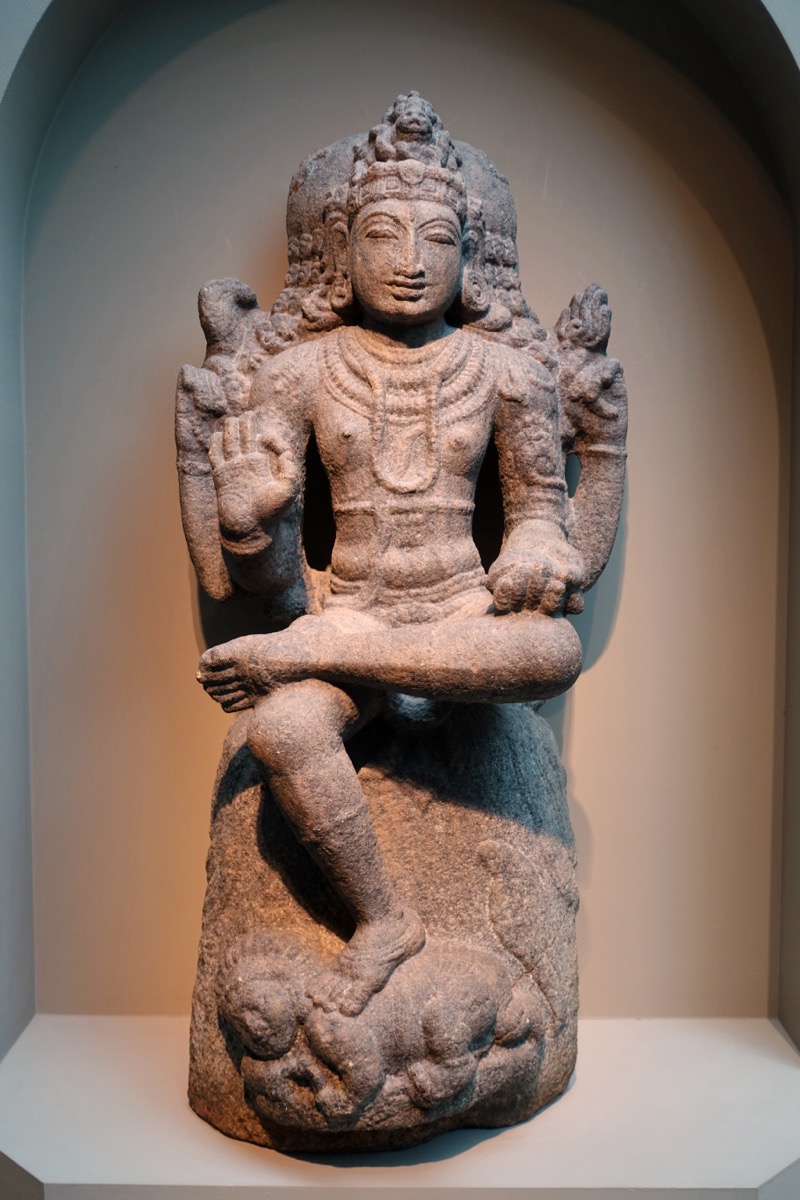
The Dakṣiṇāmūrti Stotram is one of the most philosophically profound hymns in all of Sanskrit literature. Composed by Ādi Śaṅkarācārya (8th century CE), this ten-verse masterpiece distills the essence of Advaita Vedānta into luminous poetry, celebrating Lord Śiva in his form as Dakṣiṇāmūrti — the south-facing (dakṣiṇā) divine teacher who imparts the highest knowledge of Brahman through silence. Śaṅkara’s disciple Sureśvarācārya wrote an elaborate commentary on this work called the Mānasollāsa (“Delight of the Mind”), testifying to its importance within the Advaita tradition.
Who is Dakṣiṇāmūrti?
Dakṣiṇāmūrti (Sanskrit: दक्षिणामूर्ति) is a form of Lord Śiva depicted as a youthful teacher seated beneath the cosmic banyan tree (vaṭa-vṛkṣa), facing south. The name carries multiple layers of meaning:
- Dakṣiṇā = “south” — Śiva faces south, the direction associated with death (Yama), signifying his power to conquer mortality through knowledge
- Dakṣiṇā = “grace” or “gift” — the one who bestows the supreme gift of Self-knowledge
- Mūrti = “form” or “embodiment” — the living embodiment of wisdom
According to the Purāṇic tradition, at the dawn of creation, the four mind-born sons of Brahmā — Sanaka, Sanandana, Sanātana, and Sanatkumāra — wandered the universe seeking the ultimate truth. Despite their immense austerities and Vedic learning, the nature of Brahman eluded them. At last they arrived at the foot of a great banyan tree on Mount Kailāsa and found a radiant youth — Śiva as Dakṣiṇāmūrti — seated in profound silence. The young guru was surrounded by aged disciples (vṛddhāḥ śiṣyāḥ). He taught without uttering a single word, and through the power of that silence (mauna-vyākhyā), all doubts of the Kumāras were resolved. This scene — the young teacher and old students, the silent transmission of non-dual truth — is the iconic image celebrated in the stotram.
Śaṅkarācārya’s Composition
Ādi Śaṅkarācārya composed the Dakṣiṇāmūrti Stotram as a concentrated expression of Advaita philosophy. The hymn is written in the Śārdūlavikrīḍita metre (nineteen syllables per quarter), one of the most majestic metres of Sanskrit poetry. Each of the ten verses ends with the same refrain (dhruva-pada):
तस्मै श्रीगुरुमूर्तये नम इदं श्रीदक्षिणामूर्तये Tasmai śrī-gurumūrtaye nama idaṃ śrī-dakṣiṇāmūrtaye “To that Śrī Dakṣiṇāmūrti, who is the embodiment of the Guru, this salutation.”
This refrain is not mere repetition — it anchors the devotee’s mind in reverence after each successive layer of philosophical truth has been unveiled. The stotram proceeds from vivid metaphysical analogies (mirror, dream, seed, lamp) to the direct declaration of the Upaniṣadic mahāvākya “Tat tvam asi” — “You are That.”
The Dhyāna Śloka (Meditation Verse)
Before the ten main verses, a celebrated meditation verse describes Dakṣiṇāmūrti’s iconic form:
मौनव्याख्या प्रकटितपरब्रह्मतत्त्वं युवानं वर्षिष्ठान्ते वसद् ऋषिगणैरावृतं ब्रह्मनिष्ठैः। आचार्येन्द्रं करकलितचिन्मुद्रमानन्दमूर्तिं स्वात्मारामं मुदितवदनं दक्षिणामूर्तिमीडे॥
Mauna-vyākhyā prakaṭita-parabrahma-tattvaṃ yuvānaṃ varṣiṣṭhānte vasad ṛṣi-gaṇair āvṛtaṃ brahmaniṣṭhaiḥ | Ācāryendraṃ kara-kalita-cin-mudram ānandamūrtiṃ svātmārāmaṃ mudita-vadanaṃ dakṣiṇāmūrtim īḍe ||
Translation: “I praise Dakṣiṇāmūrti — the youthful one who reveals the truth of the Supreme Brahman through the exposition of silence; who is surrounded by aged sages established in Brahman; the foremost of teachers, whose hand displays the Cin Mudrā (gesture of consciousness); who is the embodiment of bliss, delighting in his own Self, with a joyful countenance.”
The Cin Mudrā
The Cin Mudrā (also written Jñāna Mudrā) is the hand gesture where the tip of the index finger touches the tip of the thumb, while the other three fingers remain extended. In the Advaita interpretation:
- The thumb represents Brahman (the Absolute)
- The index finger represents the jīva (individual self)
- Their union signifies the identity of Ātman and Brahman — the central teaching of Advaita
- The three extended fingers represent the three guṇas (sattva, rajas, tamas) or the three states (waking, dreaming, deep sleep) that must be transcended
Thus, without speaking a word, Dakṣiṇāmūrti’s very hand gesture communicates the entirety of Vedāntic teaching.
The Ten Verses: Text and Meaning
Verse 1 — The Mirror Analogy
विश्वं दर्पणदृश्यमाननगरीतुल्यं निजान्तर्गतं पश्यन्नात्मनि मायया बहिरिवोद्भूतं यथा निद्रया। यः साक्षात्कुरुते प्रबोधसमये स्वात्मानमेवाद्वयं तस्मै श्रीगुरुमूर्तये नम इदं श्रीदक्षिणामूर्तये॥
Viśvaṃ darpaṇa-dṛśyamāna-nagarī-tulyaṃ nijāntargataṃ paśyann ātmani māyayā bahir ivodbhūtaṃ yathā nidrayā | Yaḥ sākṣāt kurute prabodha-samaye svātmānam evādvayaṃ tasmai śrī-gurumūrtaye nama idaṃ śrī-dakṣiṇāmūrtaye ||
Meaning: The entire universe is like a city seen reflected in a mirror — it appears to be outside, but actually exists within one’s own Self. Through Māyā, it seems to have been projected outward, just as a dream-city appears real during sleep. He who, at the time of awakening (prabodha), directly realizes his own Self as the non-dual Reality — to that Śrī Dakṣiṇāmūrti, the embodiment of the Guru, this salutation.
This opening verse introduces Śaṅkara’s most celebrated analogy. A city reflected in a mirror appears to exist within the mirror, yet the mirror is untouched by the reflection. Similarly, the entire world of names and forms exists within consciousness (Ātman), appearing as though external through the power of Māyā. The moment of spiritual awakening is compared to waking from sleep — the dream dissolves, and only the dreamer (the Self) remains.
Verse 2 — The Seed and Sprout Analogy
बीजस्यान्तरिवाङ्कुरो जगदिदं प्राङ्निर्विकल्पं पुनः मायाकल्पितदेशकालकलना वैचित्र्यचित्रीकृतम्। मायावीव विजृम्भयत्यपि महायोगीव यः स्वेच्छया तस्मै श्रीगुरुमूर्तये नम इदं श्रीदक्षिणामूर्तये॥
Bījasyāntar ivāṅkuro jagad idaṃ prāṅ nirvikalpaṃ punaḥ māyā-kalpita-deśa-kāla-kalanā vaicitrya-citrīkṛtam | Māyāvīva vijṛmbhayaty api mahā-yogīva yaḥ svecchayā tasmai śrī-gurumūrtaye nama idaṃ śrī-dakṣiṇāmūrtaye ||
Meaning: This universe, like a sprout latent within a seed, was originally undifferentiated (nirvikalpa). Then, through Māyā’s fabrication of space and time, it was painted with astonishing diversity. He who manifests this variety like a magician (māyāvī) or a great yogin acting by his own will — to that Śrī Dakṣiṇāmūrti, this salutation.
The seed-sprout metaphor shows that the manifold world was always present in potential within undifferentiated Brahman. Māyā does not create something from nothing — it unfolds what was always latent, like a tree emerging from a seed. The Lord is compared both to a magician (whose show appears real but is illusory) and to a great yogin who creates through saṅkalpa (will) alone.
Verse 3 — “Tat Tvam Asi”
यस्यैव स्फुरणं सदात्मकमसत्कल्पार्थकं भासते साक्षात्तत्त्वमसीति वेदवचसा यो बोधयत्याश्रितान्। यत्साक्षात्करणाद्भवेन्न पुनरावृत्तिर्भवाम्भोनिधौ तस्मै श्रीगुरुमूर्तये नम इदं श्रीदक्षिणामूर्तये॥
Yasyaiva sphuraṇaṃ sadātmakam asat-kalpārthakaṃ bhāsate sākṣāt tat tvam asīti veda-vacasā yo bodhayaty āśritān | Yat sākṣātkaraṇād bhaven na punar āvṛttir bhavāmbhonidhau tasmai śrī-gurumūrtaye nama idaṃ śrī-dakṣiṇāmūrtaye ||
Meaning: It is by His luminous manifestation alone that the unreal (asat) world of imagined objects appears to shine as if real. He who instructs those who take refuge in him with the Vedic declaration “Tat tvam asi” (“You are That”) — by the direct realization of which there is no more return to the ocean of saṃsāra — to that Śrī Dakṣiṇāmūrti, this salutation.
This verse directly introduces the mahāvākya (great saying) of the Chāndogya Upaniṣad (6.8.7). The world borrows its apparent reality from Brahman, just as a rope-snake borrows its apparent existence from the rope. The Guru’s teaching of “Tat tvam asi” — the identity of the individual self and the Absolute — leads to liberation (mokṣa), ending the cycle of rebirth.
Verse 4 — The Lamp in the Pot
नानाच्छिद्रघटोदरस्थितमहादीपप्रभाभास्वरं ज्ञानं यस्य तु चक्षुरादिकरणद्वारा बहिः स्पन्दते। जानामीति तमेव भान्तमनुभात्येतत्समस्तं जगत् तस्मै श्रीगुरुमूर्तये नम इदं श्रीदक्षिणामूर्तये॥
Nānācchidra-ghaṭodara-sthita-mahā-dīpa-prabhā-bhāsvaraṃ jñānaṃ yasya tu cakṣur-ādi-karaṇa-dvārā bahiḥ spandate | Jānāmīti tam eva bhāntam anubhāty etat samastaṃ jagat tasmai śrī-gurumūrtaye nama idaṃ śrī-dakṣiṇāmūrtaye ||
Meaning: His consciousness (jñāna) is like a brilliant great lamp placed inside a pot with many holes — its light streams outward through the openings of the eyes and other sense-organs. “I know” — by His light alone shining, this entire world shines after Him. To that Śrī Dakṣiṇāmūrti, this salutation.
This verse echoes the Kaṭha Upaniṣad (2.2.15): tameva bhāntam anubhāti sarvaṃ, tasya bhāsā sarvam idaṃ vibhāti — “When He shines, everything shines after Him; by His light, all this is illumined.” The pot with holes is the body; the lamp is pure consciousness; the holes are the sense organs. Consciousness does not travel outward — it illumines from within, and by its light alone all objects become known.
Verse 5 — Refutation of Wrong Identifications
देहं प्राणमपीन्द्रियाण्यपि चलां बुद्धिं च शून्यं विदुः स्त्री बालान्धजडोपमास्त्वहमिति भ्रान्ताभृशं वादिनः। तस्मै श्रीगुरुमूर्तये नम इदं श्रीदक्षिणामूर्तये॥
Dehaṃ prāṇam apīndriyāṇy api calāṃ buddhiṃ ca śūnyaṃ viduḥ strī-bālāndha-jaḍopamās tv aham iti bhrāntā bhṛśaṃ vādinaḥ | Māyā-śakti-vilāsa-kalpita-mahā-vyāmoha-saṃhāriṇe tasmai śrī-gurumūrtaye nama idaṃ śrī-dakṣiṇāmūrtaye ||
Meaning: Those who identify the Self with the body, prāṇa, senses, the fickle intellect, or the void — those deluded proponents are like women, children, the blind, and the dull-witted who erroneously say “I am [the body].” To Him who destroys the great delusion fabricated by the sport of Māyā’s power — to that Śrī Dakṣiṇāmūrti, this salutation.
Śaṅkara here systematically refutes the various schools that reduce the Self to something it is not: the Cārvāka (materialists who equate Self with the body), various Buddhist schools (that posit śūnya/void), and all philosophies that stop short of recognizing pure consciousness as the ultimate reality. Dakṣiṇāmūrti’s teaching destroys (saṃhāriṇe) the delusion born of Māyā.
Verse 6 — Consciousness in Deep Sleep
राहुग्रस्तदिवाकरेन्दुसदृशो मायासमाच्छादनात् सन्मात्रः करणोपसंहरणतो योऽभूत्सुषुप्तः पुमान्। प्रागस्वाप्समिति प्रबोधसमये यः प्रत्यभिज्ञायते तस्मै श्रीगुरुमूर्तये नम इदं श्रीदक्षिणामूर्तये॥
Rāhu-grasta-divākara-indu-sadṛśo māyā-samācchādanāt sanmātraḥ karaṇopasaṃharaṇato yo ‘bhūt suṣuptaḥ pumān | Prāg asvāpsam iti prabodha-samaye yaḥ pratyabhijñāyate tasmai śrī-gurumūrtaye nama idaṃ śrī-dakṣiṇāmūrtaye ||
Meaning: Like the sun or moon eclipsed by Rāhu, the Self — though pure existence (sanmātra) — appears to be covered by Māyā. When the sense organs withdraw in deep sleep, one becomes suṣupta (deeply asleep). Yet upon waking, one recognizes: “I was asleep” — He who is thus recognized [as the continuous witness] — to that Śrī Dakṣiṇāmūrti, this salutation.
The eclipse analogy is powerful: the sun is never actually extinguished by Rāhu — it only appears so from a particular vantage point. Similarly, consciousness is never actually obscured by Māyā. The continuity of the “I” across waking, dreaming, and deep sleep proves that the Self persists even when all objects vanish — a key argument for the Advaita doctrine of the ever-present sākṣin (witness-consciousness).
Verse 7 — The Unchanging “I” Across All States
बाल्यादिष्वपि जाग्रदादिषु तथा सर्वास्ववस्थास्वपि व्यावृत्तासु अनुवर्तमानमहमित्यन्तःस्फुरन्तं सदा। स्वात्मानं प्रकटीकरोति भजतां यो मुद्रया भद्रया तस्मै श्रीगुरुमूर्तये नम इदं श्रीदक्षिणामूर्तये॥
Bālyādiṣv api jāgrad-ādiṣu tathā sarvāsv avasthāsv api vyāvṛttāsu anuvartamānam aham ity antaḥ sphurantaṃ sadā | Svātmānaṃ prakaṭīkaroti bhajatāṃ yo mudrayā bhadrayā tasmai śrī-gurumūrtaye nama idaṃ śrī-dakṣiṇāmūrtaye ||
Meaning: Through childhood, youth, old age; through waking, dreaming, and deep sleep; through all the changing states — the sense of “I” (aham) continuously shines within, persisting even as states come and go. He who reveals this Self to his devotees through the auspicious mudrā (bhadra mudrā, i.e., the Cin Mudrā) — to that Śrī Dakṣiṇāmūrti, this salutation.
This verse establishes the unchanging witness-consciousness as the true Self. Bodies change, mental states change, but the “I” that knows all these changes does not itself change. Dakṣiṇāmūrti reveals this truth not through words but through the Cin Mudrā — the “auspicious gesture” that silently points to the identity of jīva and Brahman.
Verse 8 — The Apparent World of Differences
विश्वं पश्यति कार्यकारणतया स्वस्वामिसम्बन्धतः शिष्याचार्यतया तथैव पितृपुत्राद्यात्मना भेदतः। स्वप्ने जाग्रति वा य एष पुरुषो मायापरिभ्रामितः तस्मै श्रीगुरुमूर्तये नम इदं श्रीदक्षिणामूर्तये॥
Viśvaṃ paśyati kārya-kāraṇatayā sva-svāmi-sambandhataḥ śiṣyācāryatayā tathaiva pitṛ-putrādy-ātmanā bhedataḥ | Svapne jāgrati vā ya eṣa puruṣo māyā-paribhrāmitaḥ tasmai śrī-gurumūrtaye nama idaṃ śrī-dakṣiṇāmūrtaye ||
Meaning: One sees the world through differences — cause and effect, servant and master, teacher and student, father and son — whether in dream or in waking. This person, bewildered by Māyā, [fails to see the underlying unity]. To that Śrī Dakṣiṇāmūrti [who removes this bewilderment], this salutation.
All relational distinctions — hierarchical, familial, causal — are projections of Māyā upon the non-dual substratum. The dream example reinforces this: in dream, one may play all roles (father, son, teacher, student), yet upon waking, all those distinctions dissolve into the single dreamer. Waking life, Śaṅkara implies, is similarly a projection that dissolves in the light of Self-knowledge.
Verse 9 — The Eightfold Manifestation
भूरम्भांस्यनलोऽनिलोऽम्बरमहर्नाथो हिमांशुः पुमान् इत्याभाति चराचरात्मकमिदं यस्यैव मूर्त्यष्टकम्। नान्यत्किञ्चन विद्यते विमृशतां यस्मात्परस्माद्विभोः तस्मै श्रीगुरुमूर्तये नम इदं श्रीदक्षिणामूर्तये॥
Bhūr ambhāṃsy analo ‘nilo ‘mbaram ahar-nātho himāṃśuḥ pumān ity ābhāti carācarātmakam idaṃ yasyaiva mūrty-aṣṭakam | Nānyat kiñcana vidyate vimṛśatāṃ yasmāt parasmād vibhoḥ tasmai śrī-gurumūrtaye nama idaṃ śrī-dakṣiṇāmūrtaye ||
Meaning: Earth, water, fire, air, ether, sun, moon, and the conscious soul (pumān) — this entire world of moving and unmoving beings is His eightfold form (mūrti-aṣṭaka). For those who inquire deeply, nothing whatsoever exists apart from this all-pervading Supreme Lord. To that Śrī Dakṣiṇāmūrti, this salutation.
The concept of Aṣṭamūrti (“eight forms”) of Śiva is an ancient theological idea found in the Śvetāśvatara Upaniṣad and the Śiva Purāṇa. The five elements, the sun, the moon, and the conscious being together constitute the entire manifest universe — and all of this is nothing other than Śiva himself. For the discerning inquirer (vimṛśatām), there is no second reality.
Verse 10 — The Phala Śruti (Fruit of Recitation)
सर्वात्मत्वमिति स्फुटीकृतमिदं यस्मादमुष्मिन् स्तवे तेनास्य श्रवणात्तदर्थमननाद्ध्यानाच्च संकीर्तनात्। सर्वात्मत्वमहाविभूतिसहितं स्यादीश्वरत्वं स्वतः सिद्ध्येत्तत्पुनरष्टधा परिणतं चैश्वर्यमव्याहतम्॥
Sarvātmatvam iti sphuṭīkṛtam idaṃ yasmād amuṣmin stave tenāsya śravaṇāt tad-artha-mananād dhyānāc ca saṃkīrtanāt | Sarvātmatva-mahā-vibhūti-sahitaṃ syād īśvaratvaṃ svataḥ siddhyet tat punar aṣṭadhā pariṇataṃ caiśvaryam avyāhatam ||
Meaning: Since the truth of being the Self of all (sarvātmatva) has been made clear in this hymn, by listening to it (śravaṇa), reflecting on its meaning (manana), meditating upon it (dhyāna), and reciting it (saṃkīrtana), one attains lordship (īśvaratva) endowed with the great glory of being the Self of all. The eightfold supernatural powers (aṣṭa-aiśvarya) — aṇimā, laghimā, mahimā, garimā, prāpti, prākāmya, īśitva, and vaśitva — arise spontaneously and without obstruction.
The concluding verse maps perfectly onto the Vedāntic methodology of śravaṇa-manana-nididhyāsana (hearing, reflection, and meditation) prescribed by the Bṛhadāraṇyaka Upaniṣad (2.4.5). Śaṅkara adds saṃkīrtana (devotional recitation), bridging the bhakti and jñāna paths. The eightfold powers are not the goal — they are natural byproducts of Self-realization.
Māyā and the World-Appearance
The Dakṣiṇāmūrti Stotram offers some of the clearest expositions of the Advaita doctrine of Māyā in devotional literature. Śaṅkara uses four complementary analogies across the verses:
- The mirror and the city (Verse 1): The world is a reflection — real as an appearance, but not independently real
- The dream (Verses 1, 8): Waking experience shares the structure of dream — both are projections of consciousness that dissolve upon awakening
- The seed and sprout (Verse 2): The manifest world was latent in undifferentiated Brahman — creation is unfolding, not origination from nothing
- The lamp in the pot (Verse 4): Consciousness illumines from within; sense-perception is not consciousness traveling outward but light streaming through openings
Together, these analogies establish that the world is neither wholly real (sat) nor wholly unreal (asat) — it is mithyā (neither real nor unreal), an appearance dependent on Brahman for its seeming existence.
The Cin Mudrā: Teaching Beyond Words
The Cin Mudrā (चिन्मुद्रा) is central to the iconography and philosophy of Dakṣiṇāmūrti. In this gesture:
- The circle formed by thumb and index finger represents the dissolution of the apparent boundary between individual and absolute consciousness
- The three extended fingers symbolize what must be transcended: the three bodies (sthūla, sūkṣma, kāraṇa), the three states (jāgrat, svapna, suṣupti), and the three guṇas
- The hand held at the heart indicates that truth is found within, not in external pursuits
This gesture embodies Dakṣiṇāmūrti’s silent teaching method — the mauna-vyākhyā (“exposition through silence”) praised in the dhyāna śloka. The deepest truths cannot be communicated through words alone; they must be directly apprehended in the silence of the stilled mind.
Importance in South Indian Temples
Dakṣiṇāmūrti holds a unique place in South Indian temple architecture. In the canonical layout of a Śiva temple (āgamic prāsāda), the Dakṣiṇāmūrti icon is always installed on the south wall of the central shrine (garbhagṛha), facing south — hence the name. This placement is found consistently across:
- Bṛhadīśvara Temple, Thanjavur (11th century Chola masterpiece)
- Kailāsanātha Temple, Kanchipuram (8th century Pallava)
- Mīnākṣī Temple, Madurai
- Chidambaram Naṭarāja Temple
- Gaṅgaikoṇḍacōḻapuram temple
The Dakṣiṇāmūrti niche is traditionally where Vedāntic discourses are delivered and where students receive initiation. In the Śaṅkara Maṭhas (the monastic institutions founded by Śaṅkarācārya at Śṛṅgeri, Dvārakā, Purī, and Jyotirmaṭh), the Dakṣiṇāmūrti Stotram is chanted daily as part of the liturgical routine.
Recitation Traditions
The Dakṣiṇāmūrti Stotram is traditionally recited:
- On Guru Pūrṇimā — the full moon day in the month of Āṣāḍha, dedicated to the Guru
- On Pradoṣa days — the thirteenth tithi sacred to Śiva
- During Śivarātri — especially Mahāśivarātri
- Daily — by Advaita sannyāsins as part of their nityakarma (daily observance)
- At the commencement of Vedāntic study — as an invocation of the supreme Guru
The hymn is typically chanted after the dhyāna śloka and concluded with the traditional śānti mantra: Om śāntiḥ śāntiḥ śāntiḥ. In many South Indian traditions, the stotram is recited in the Dakṣiṇāmūrti sannidhi (the south-facing niche) of the temple while facing the icon.
Sureśvarācārya’s Mānasollāsa
Śaṅkara’s direct disciple Sureśvarācārya composed an extensive commentary on the Dakṣiṇāmūrti Stotram called the Mānasollāsa (“Delight of the Mind”), also known as the Dakṣiṇāmūrti Vārtika. This commentary expands each verse into elaborate philosophical discussions, drawing upon Upaniṣadic passages, logical arguments, and meditative instructions. The Mānasollāsa is considered one of the most important independent works of the early Advaita tradition and is studied extensively in traditional Vedānta pāṭhaśālās (schools).
Philosophical Significance
The Dakṣiṇāmūrti Stotram is remarkable for compressing the entire teaching of Advaita Vedānta — typically expounded across the Prasthānatraya (Upaniṣads, Brahmasūtras, and Bhagavadgītā) — into ten verses. Its central declarations include:
- Brahman alone is real — the world is an appearance (vivarta), not a transformation (pariṇāma)
- The Self is self-luminous — it is not known through any external means but reveals itself
- Ignorance (avidyā) is beginningless but terminable — through the Guru’s teaching and direct realization
- The Guru is Śiva himself — the human teacher and the cosmic teacher are ultimately one
As the Upaniṣadic declaration states: Yasya deve parā bhaktiḥ yathā deve tathā gurau — “To one who has supreme devotion to God and equally to the Guru, these truths become manifest” (Śvetāśvatara Upaniṣad 6.23).
The Dakṣiṇāmūrti Stotram thus stands as Śaṅkarācārya’s most concentrated and poetically brilliant exposition of non-dual truth — a hymn that transforms philosophical doctrine into living devotion, revealing that the Guru, the Self, and the Supreme Reality are one and the same.