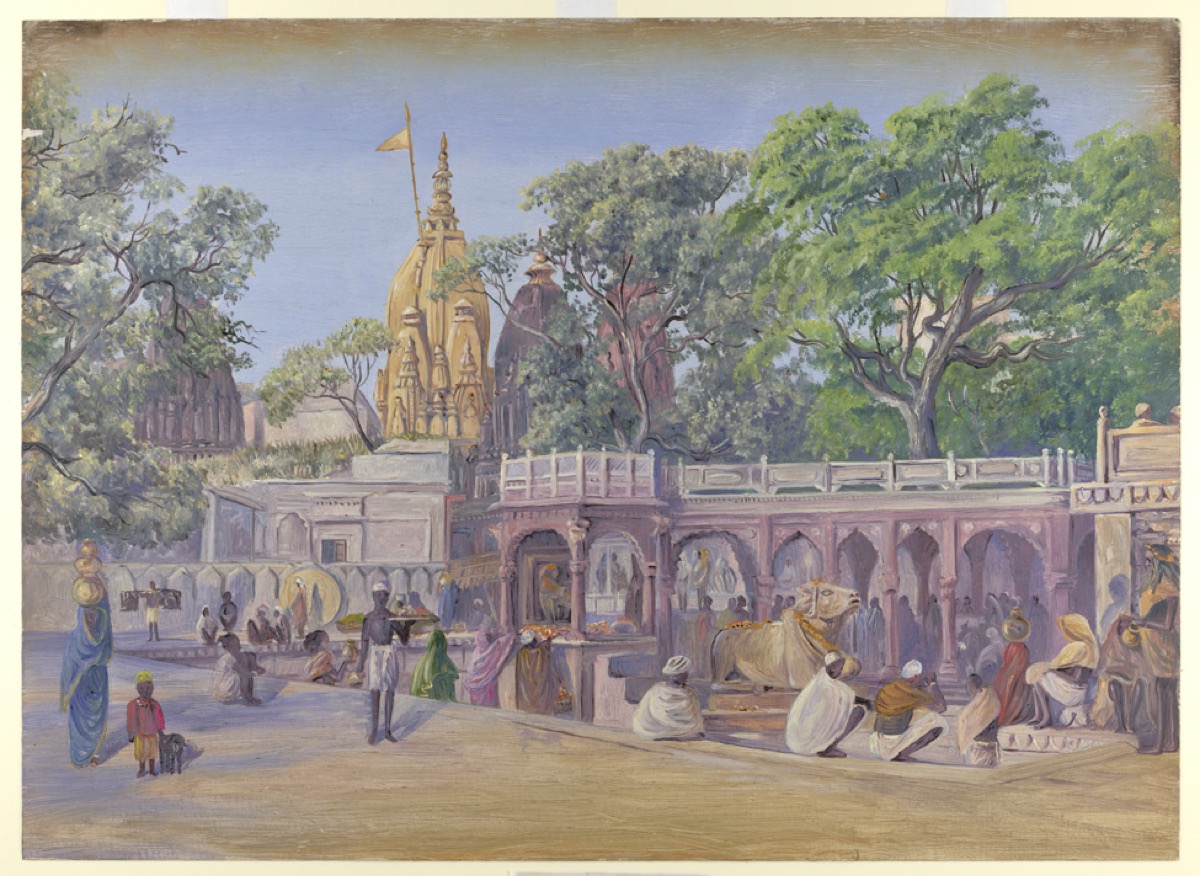
The Dāridrya Dahana Stotram (दारिद्र्य दहन स्तोत्रम्, “The Hymn That Burns Away Poverty”) is a celebrated Sanskrit stotra addressed to Lord Śiva in his form as Viśveśvara — the Lord of the Universe — enshrined at the great Kāśī Viśvanātha temple in Vārāṇasī (Benares). Attributed variously to Ādi Śaṅkarācārya (c. 788—820 CE) and to a poet named Vāsudeva, this compact yet theologically rich hymn has been recited for centuries by devotees seeking relief from poverty in all its dimensions — material want, emotional suffering, and spiritual ignorance. The stotra’s power lies in its remarkable ability to wed practical, worldly concerns with the highest Śaiva metaphysics, presenting Śiva not merely as a granter of wealth but as the cosmic fire (dahana) that incinerates the very root of human deprivation.
Attribution and Historical Context
The Question of Authorship
The Dāridrya Dahana Stotram is most commonly attributed to Ādi Śaṅkarācārya, the great 8th-century philosopher-saint who consolidated Advaita Vedānta and travelled the length of India establishing the four maṭhas (monastic centres). Śaṅkara is credited with composing numerous devotional stotras alongside his philosophical treatises — including the Śivānandalaharī, Saundaryalaharī, Bhaja Govindam, and the Dakṣiṇāmūrti Stotram. The Dāridrya Dahana Stotram fits comfortably within this devotional corpus.
However, some scholarly editions attribute the stotra to a poet named Vāsudeva, about whom little is known. The language and style of the hymn are consistent with the classical Sanskrit stotra tradition of the 8th to 12th centuries CE, and it is possible that the attribution to Śaṅkara is a later tradition — a common phenomenon in Indian literature, where famous names attract anonymous compositions.
Regardless of its precise authorship, the stotra’s theological content is firmly rooted in Kāśī Śaivism — the devotional and philosophical tradition centred on the worship of Śiva as Viśvanātha in the sacred city of Vārāṇasī.
Kāśī Viśvanātha: The Setting
The stotra is intimately connected to the Kāśī Viśvanātha Temple, one of the twelve Jyotirliṅgas (self-manifested liṅgas of light) and the most sacred Śiva temple in India. Vārāṇasī — also known as Kāśī (“the Luminous City”) and Benares — is regarded in Hindu tradition as the city where Śiva himself permanently resides. According to the Kāśī Khaṇḍa of the Skanda Purāṇa, Śiva declared:
“The three worlds form one city of mine, and Kāśī is my royal palace within it.”
Diana Eck, in her landmark study Banaras: City of Light, describes Kāśī as a city that is simultaneously a geographical place and a metaphysical reality — the tīrtha (crossing place) between the mortal and the immortal. To die in Kāśī is to receive mokṣa (liberation), for Śiva himself whispers the tāraka mantra (the liberating mantra) into the ear of the dying.
It is within this sacral geography that the Dāridrya Dahana Stotram places its vision of Śiva as the destroyer of poverty.
Structure and Sanskrit Text
The Dāridrya Dahana Stotram consists of seven to nine verses (the number varies slightly across recensions), each composed in the elegant Vasantatilakā metre — a classical Sanskrit metre of fourteen syllables per quarter-verse, renowned for its flowing, majestic cadence. Every verse ends with the refrain:
दारिद्र्यदुःखदहनाय नमः शिवाय Dāridrya-duḥkha-dahanāya namaḥ Śivāya “Salutation to Śiva, the burner of the misery of poverty.”
This refrain functions as both a structural device and a mantra — each repetition deepens the devotee’s identification of Śiva with the destruction of deprivation.
Verse-by-Verse Commentary
Verse 1: The Lord of the Universe
विश्वेश्वराय नरकार्णवतारणाय कर्णामृताय शशिशेखरधारणाय। कर्पूरकान्तिधवलाय जटाधराय दारिद्र्यदुःखदहनाय नमः शिवाय॥
Salutation to Śiva — the Lord of the Universe, who ferries beings across the ocean of hell, whose words are nectar to the ears, who bears the crescent moon upon his crest, who is resplendently white as camphor, who wears matted locks — to Śiva, the burner of the misery of poverty, I bow.
This opening verse establishes Śiva through a chain of compound epithets (samāsa), each revealing a different dimension of his nature:
- Viśveśvara (Lord of All): Śiva’s sovereignty is not limited to one realm but encompasses the entire cosmos
- Narakārṇava-tāraṇa (Ferryman across the ocean of hell): Śiva saves beings from the consequences of their karma
- Karṇāmṛta (Nectar to the ears): The very mention of Śiva’s name is like amṛta — it nourishes and heals
- Śaśi-śekhara-dhāraṇa (Bearer of the crescent moon): The moon on Śiva’s head symbolizes his mastery over time (kāla)
- Karpūra-kānti-dhavala (White as camphor’s radiance): Śiva’s luminous white form represents purity and the transcendence of all dualities
- Jaṭā-dhara (Wearer of matted locks): The jaṭā symbolizes renunciation and the yogic discipline through which Śiva commands all powers
Verse 2: The Three-Eyed Lord
The second verse invokes Śiva as Tryambaka (the Three-Eyed One) and Tripurāntaka (the Destroyer of the Three Cities). The three eyes represent the sun, moon, and fire — or, in Śaiva philosophy, the three states of consciousness (waking, dreaming, deep sleep) that Śiva transcends. The destruction of the three demonic cities (Tripura) — one of gold, one of silver, one of iron — symbolizes the annihilation of the three guṇas (sattva, rajas, tamas) that bind the soul to saṃsāra.
Verse 3: The Gaṅgādhara
The third verse celebrates Śiva as Gaṅgādhara — the one who bears the sacred Gaṅgā in his matted locks. When the river Gaṅgā descended from heaven to earth, her force would have shattered the world. Śiva caught her in his hair and released her gently — an act of supreme compassion. The verse draws a parallel: just as Śiva tames the cosmic Gaṅgā, he tames and destroys the torrential flood of poverty that overwhelms the devotee.
Verse 4: The Wearer of Serpents
This verse describes Śiva adorned with serpents (nāga) as ornaments — around his neck, arms, and waist. The serpents represent the kuṇḍalinī śakti, the coiled spiritual energy that lies dormant at the base of the spine and, when awakened through yogic practice, rises to unite with Śiva at the crown cakra. Poverty, in this reading, is a symptom of dormant spiritual energy; Śiva’s grace awakens the kuṇḍalinī and burns away the lethargy that causes deprivation.
Verse 5: The Pañcavaktra (Five-Faced Lord)
The fifth verse invokes Śiva’s five faces (Pañcavaktra): Sadyojāta (west), Vāmadeva (north), Aghora (south), Tatpuruṣa (east), and Īśāna (zenith). Each face corresponds to one of the five elements, five prāṇas, and five cosmic functions (creation, preservation, destruction, concealment, grace). By addressing Śiva in his fivefold totality, the verse affirms that liberation from poverty requires the grace of the complete divine reality, not merely one aspect of it.
Verse 6: The Dancer of the Cremation Ground
This verse turns to one of Śiva’s most paradoxical and powerful images — the Śmaśānavāsī (dweller in the cremation ground). Śiva dances among funeral pyres, smeared with ashes (bhasma), wearing a garland of skulls. This terrifying image is, in Śaiva theology, the ultimate statement about poverty and wealth: Śiva, the Lord of the Universe, chooses to dwell among the destitute dead, wearing nothing but ashes. He is the richest being in existence precisely because he has renounced all possessions. True wealth, the verse implies, is not the accumulation of material goods but freedom from the need for them.
Verse 7: The Liberation of Kāśī
The final verse brings the stotra full circle to Kāśī — the city of light, the city of Śiva. It declares that whoever recites this stotra in Kāśī (or with the mental visualization of Kāśī) will have their poverty destroyed by Śiva’s grace, just as fire destroys dry grass. The verse concludes with the ultimate promise: Śiva does not merely alleviate poverty — he burns it (dahana) to ash, so that it can never return.
Theological Significance
Three Dimensions of Poverty
The Dāridrya Dahana Stotram operates on three simultaneous levels of meaning:
-
Material poverty (artha-dāridrya): The most immediate and accessible level. The stotra acknowledges that material deprivation causes real suffering and that the divine can and does respond to the devotee’s material needs. This is consistent with the Hindu understanding of puruṣārtha — the four legitimate goals of human life, of which artha (wealth) is one.
-
Emotional and relational poverty (bhāva-dāridrya): Poverty is not only a matter of money. Loneliness, grief, fear, and despair are all forms of deprivation. The stotra’s description of Śiva as karṇāmṛta (nectar to the ears) and narakārṇava-tāraṇa (ferryman across the ocean of suffering) addresses these deeper forms of want.
-
Spiritual poverty (jñāna-dāridrya): The deepest poverty is ignorance (avidyā) — the failure to recognize one’s true nature as Ātman, identical with Brahman. This is the poverty that the stotra most urgently seeks to destroy. When Śiva “burns” spiritual poverty, the result is not merely comfort but mokṣa — permanent liberation from the cycle of birth and death.
Śiva as Dahana (The Cosmic Fire)
The key word in the stotra’s title and refrain is dahana — “burning, conflagration.” This is not a gentle, gradual process but a violent, total destruction. The imagery is deliberate: Śiva is Mahākāla (Great Time) and Rudra (the Howler), the deity whose cosmic dance (tāṇḍava) destroys worlds. When he turns this destructive power upon poverty, the destruction is complete and irreversible.
The fire imagery also connects to the Vedic Agni tradition. In the Ṛg Veda, Agni is the priest of the gods, the intermediary between the human and divine worlds, and the purifier of offerings. Śiva, as dahana, serves the same function — he is the fire that purifies the devotee’s life of all that is impoverished, barren, and unworthy.
Recitation Practice
Traditional Method
- Time: Early morning (brāhma-muhūrta, approximately 4:00—5:30 AM) or during the evening sandhyā (twilight)
- Place: Before a Śiva-liṅga, ideally in Kāśī, but any clean, sanctified space will serve
- Preparation: Bathe, wear clean clothes, and apply bhasma (sacred ash) to the forehead in three horizontal lines (tripuṇḍra)
- Invocation: Begin with “Oṃ Namaḥ Śivāya” (three times)
- Recitation: Chant all verses with clear pronunciation, focusing on each epithet’s meaning
- Frequency: Once daily is standard; eleven recitations (ekādaśāvṛtti) are recommended for specific material needs
- Duration: A traditional practice prescribes daily recitation for forty days without interruption
Auspicious Days
- Monday (Somavāra): The day sacred to Śiva
- Mahā Śivarātrī: The Great Night of Śiva (February—March)
- Śrāvaṇa month (July—August): The entire month is dedicated to Śiva worship
- Pradoṣa Vrata: The twice-monthly fast observed on the thirteenth day of each lunar fortnight
The Stotra in the Broader Śaiva Tradition
The Dāridrya Dahana Stotram belongs to the vast corpus of Śiva stotras that form a central pillar of Hindu devotional literature. Other notable Śiva stotras include:
- Śiva Tāṇḍava Stotram: Attributed to Rāvaṇa, celebrating Śiva’s cosmic dance
- Liṅgāṣṭakam: Eight verses to the Śiva-liṅga
- Śivāṣṭakam: Eight verses of praise to Śiva
- Rudram (Śrī Rudram): The Vedic hymn to Rudra-Śiva from the Yajurveda
- Śivānandalaharī: The “Wave of Bliss of Śiva” by Śaṅkarācārya
Among these, the Dāridrya Dahana Stotram is distinctive for its explicit focus on poverty as a spiritual category. While other stotras celebrate Śiva’s cosmic attributes or seek liberation in abstract terms, this hymn grounds its theology in the lived experience of material and spiritual want — making it accessible and urgent for devotees in every circumstance of life.
Conclusion
The Dāridrya Dahana Stotram is a hymn that refuses to separate the sacred from the mundane. It addresses Lord Śiva as both the transcendent Absolute and the compassionate Lord who hears the cry of the impoverished devotee. Its vision is unflinching: poverty — whether of the purse, the heart, or the spirit — is a fire that burns, and only a greater fire can extinguish it. That greater fire is Śiva himself, the Lord of Kāśī, the dancer in the cremation ground, the bearer of the Gaṅgā and the crescent moon. For those who recite this stotra with faith, it offers not merely the hope of material relief but the promise of that ultimate wealth which is the knowledge of the Self — the wealth that, once gained, can never be lost.