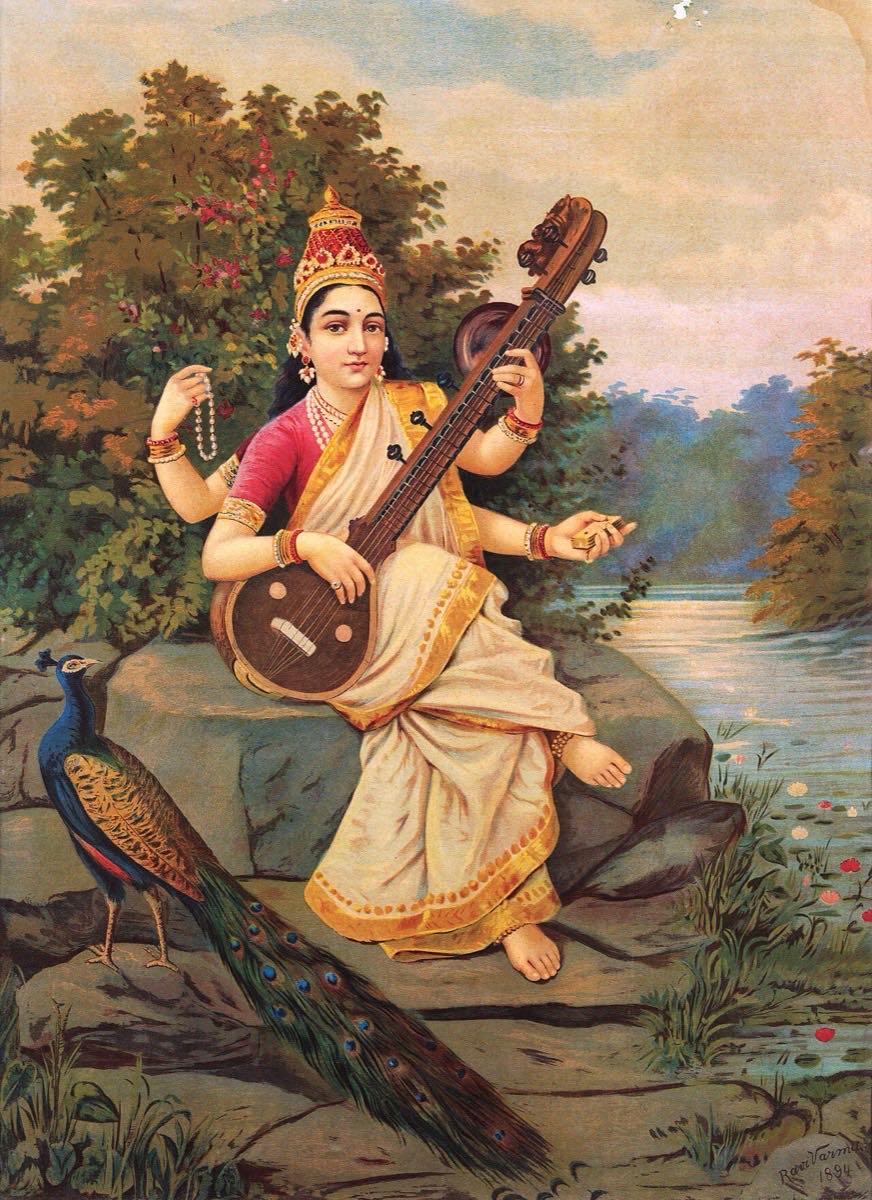
The Devī Sūktam, also known as the Vāk Sūktam or Vāgāmbhṛṇī Sūktam, is hymn 125 of the tenth maṇḍala of the Ṛgveda — and one of the oldest goddess hymns in the entire history of human civilization. Composed at least three thousand years ago, this extraordinary hymn of eight verses (ṛk-s) does something virtually without parallel in ancient religious literature: the Goddess speaks in her own voice, proclaiming herself as the supreme power behind every god, every sacrifice, every act of perception, and every breath of life.
Where other Vedic hymns are composed by human seers praising external deities, the Devī Sūktam is an ātma-stuti — a self-declaration by the Divine Feminine of her own infinite nature. The seeress Vāgāmbhṛṇī (Vāk, daughter of the sage Ambhṛṇa) does not merely praise the Goddess; she has dissolved her individual identity into the Goddess and speaks as the Goddess herself. As the great commentator Sāyaṇācārya explains: “Vāgāmbhṛṇī, a brahmaviduṣī (one who has realized Brahman), has eulogized herself in this sūkta” — meaning that the seer has become one with the seen, the worshipper one with the worshipped.
This hymn stands as the fountainhead of Śākta theology — the tradition that recognizes the Goddess (Devī, Śakti) as the ultimate, all-encompassing reality. From this single Ṛgvedic hymn flow the great rivers of later Goddess-centred scripture: the Devī Māhātmya, the Devī Bhāgavata Purāṇa, the Devī Upaniṣad, and the vast literature of Tantric Śāktism.
The Complete Hymn in Devanāgarī
अहं रुद्रेभिर्वसुभिश्चराम्यहमादित्यैरुत विश्वदेवैः। अहं मित्रावरुणोभा बिभर्म्यहमिन्द्राग्नी अहमश्विनोभा॥१॥
अहं सोममाहनसं बिभर्म्यहं त्वष्टारमुत पूषणं भगम्। अहं दधामि द्रविणं हविष्मते सुप्राव्ये यजमानाय सुन्वते॥२॥
अहं राष्ट्री संगमनी वसूनां चिकितुषी प्रथमा यज्ञियानाम्। तां मा देवा व्यदधुः पुरुत्रा भूरिस्थात्रां भूर्यावेशयन्तीम्॥३॥
मया सो अन्नमत्ति यो विपश्यति यः प्राणिति य ईं शृणोत्युक्तम्। अमन्तवो मान्त उप क्षियन्ति श्रुधि श्रुत श्रद्धिवं ते वदामि॥४॥
अहमेव स्वयमिदं वदामि जुष्टं देवेभिरुत मानुषेभिः। यं कामये तं तमुग्रं कृणोमि तं ब्रह्माणं तमृषिं तं सुमेधाम्॥५॥
अहं रुद्राय धनुरातनोमि ब्रह्मद्विषे शरवे हन्त वा उ। अहं जनाय समदं कृणोम्यहं द्यावापृथिवी आ विवेश॥६॥
अहं सुवे पितरमस्य मूर्धन् मम योनिरप्स्वन्तः समुद्रे। ततो वि तिष्ठे भुवनानु विश्वोतामूं द्यां वर्ष्मणोप स्पृशामि॥७॥
अहमेव वात इव प्र वाम्यारभमाणा भुवनानि विश्वा। परो दिवा पर एना पृथिव्यैतावती महिना सं बभूव॥८॥
ॐ शान्तिः शान्तिः शान्तिः॥
IAST Transliteration
Verse 1: Ahaṃ rudrebhir vasubhiś carāmy aham ādityair uta viśvadevaiḥ | Ahaṃ mitrāvaruṇobhā bibharmy aham indrāgnī aham aśvinobhā ||
Verse 2: Ahaṃ somam āhanasaṃ bibharmy ahaṃ tvaṣṭāram uta pūṣaṇaṃ bhagam | Ahaṃ dadhāmi draviṇaṃ haviṣmate suprāvye yajamānāya sunvate ||
Verse 3: Ahaṃ rāṣṭrī saṃgamanī vasūnāṃ cikituṣī prathamā yajñiyānām | Tāṃ mā devā vyadadhuḥ purutrā bhūristhātrāṃ bhūryāveśayantīm ||
Verse 4: Mayā so annam atti yo vipaśyati yaḥ prāṇiti ya īṃ śṛṇoty uktam | Amantavo mānta upa kṣiyanti śrudhi śruta śraddhivaṃ te vadāmi ||
Verse 5: Aham eva svayam idaṃ vadāmi juṣṭaṃ devebhir uta mānuṣebhiḥ | Yaṃ kāmaye taṃ tam ugraṃ kṛṇomi taṃ brahmāṇaṃ tam ṛṣiṃ taṃ sumedhām ||
Verse 6: Ahaṃ rudrāya dhanur ā tanomi brahmadviṣe śarave hanta vā u | Ahaṃ janāya samadaṃ kṛṇomy ahaṃ dyāvāpṛthivī ā viveśa ||
Verse 7: Ahaṃ suve pitaram asya mūrdhan mama yonir apsv antaḥ samudre | Tato vi tiṣṭhe bhuvanānu viśvotāmūṃ dyāṃ varṣmaṇopa spṛśāmi ||
Verse 8: Aham eva vāta iva pra vāmy ārabhamāṇā bhuvanāni viśvā | Paro divā para enā pṛthivyaitāvatī mahinā saṃ babhūva ||
Oṃ śāntiḥ śāntiḥ śāntiḥ
Verse-by-Verse Translation and Commentary
Verse 1 — Unity with All Gods
“I move with the Rudras, with the Vasus; I move with the Ādityas and with the Viśvadevas. I uphold both Mitra and Varuṇa, both Indra and Agni, and both the Aśvins.”
The Goddess opens with a stunning declaration of her identity with every class of Vedic deity: the Rudras (cosmic life-forces associated with Śiva), the Vasus (guardians of natural treasures), the Ādityas (solar deities governing cosmic law), and the Viśvadevas (the universal gods collectively). She does not merely worship these powers — she is the power that moves through them all. The word “aham” (I) thunders through every line, a first-person assertion of absolute sovereignty.
The pairs she “upholds” (bibharmi) — Mitra-Varuṇa (friendship and cosmic order), Indra-Agni (sovereign power and sacred fire), and the Aśvins (the divine healers) — represent the totality of Vedic divine functions. The Goddess is the single thread running through the entire pantheon.
Verse 2 — Sustainer of Sacrifice and Abundance
“I bear the pressed-out Soma, the destroyer of foes. I bear Tvaṣṭṛ, and also Pūṣan and Bhaga. I bestow wealth upon the one who offers oblations — the devout sacrificer who presses the soma.”
Here the Goddess identifies herself as the sustaining power behind the Vedic ritual system. Soma — both the sacred plant-drink and the moon-deity — represents the bliss of communion with the divine. Tvaṣṭṛ is the divine architect who fashions form, Pūṣan the nourishing guide who shepherds cattle and souls, and Bhaga the bestower of fortune. The Goddess “bears” (bibharmi) them all; they exist and function through her power.
The second half of the verse reveals the Goddess’s generosity: she bestows draviṇam (wealth, both material and spiritual) upon the faithful worshipper (haviṣmate, the one who offers havis, the oblation). This establishes a reciprocal theology: the one who approaches the Goddess through devotion and sacrifice receives her abundance.
Verse 3 — Queen of the Universe
“I am the sovereign queen, the gatherer of treasures, the most thoughtful one, the foremost among those worthy of worship. The gods have established me in many places — me, who abides in many stations and enters into many forms.”
The word rāṣṭrī (queen, sovereign) is one of the most remarkable in Vedic literature — a feminine form of rāṣṭra (realm, dominion), establishing the Goddess as the supreme ruler of all existence. She is not consort or handmaiden but the rāṣṭrī herself. The term cikituṣī (the most aware, the most wise) emphasizes her as the embodiment of supreme consciousness.
The gods (devāḥ) have “established” (vyadadhuḥ) her in many places (purutrā) — a phrase that the Śākta tradition reads as the gods recognizing and installing the Goddess as the power that already pervades all things. She is bhūristhātrā (abiding in many stations) and bhūryāveśayantī (entering into many forms) — immanent in every particle of creation.
Verse 4 — The Source of All Perception
“Through me, one eats food; through me, one sees; through me, one breathes; through me, one hears what is spoken. Though they know it not, they dwell dependent on me. Hear, O celebrated one — I tell you what is worthy of faith.”
This is perhaps the most philosophically profound verse in the hymn. Every act of biological existence — eating, seeing, breathing, hearing — occurs only through the Goddess’s power. She is the prāṇa (life-force) that animates every being, yet beings are amantavaḥ (unaware, unmindful) of her presence within them. They “dwell upon her” (mānta upa kṣiyanti) without knowing the ground upon which they stand.
The closing phrase — śrudhi śruta śraddhivaṃ te vadāmi — is a direct address to the listener: “Hear, O famous one, I speak to you what is worthy of your śraddhā (faith).” This transforms the hymn from a theological statement into a personal revelation, a divine mother speaking intimately to each hearer.
Verse 5 — The Bestower of Greatness
“I myself declare this — I, who am pleasing to both gods and humans. Whomsoever I will, I make him mighty; I make him a Brāhmaṇa, a Ṛṣi, one of excellent wisdom.”
The Goddess now asserts her role as the source of all human excellence. She makes whom she chooses ugra (mighty, powerful), brahmāṇa (a knower of Brahman), ṛṣi (a seer of truth), and sumedhā (one of brilliant intellect). This verse radically democratizes spiritual attainment: it is not birth, caste, or ritual alone that makes a sage — it is the grace of the Goddess. The word kāmaye (I desire, I will) places the initiative entirely in the Goddess’s hands, establishing a theology of divine election that prefigures the later bhakti tradition’s emphasis on grace over effort.
Verse 6 — The Goddess as Cosmic Warrior
“I draw the bow for Rudra so that his arrow may slay the hater of Brahman. I create strife among the people. I have pervaded heaven and earth.”
In a startling shift, the Goddess reveals her fierce, protective aspect. She stretches the bow (dhanur ātanomi) of Rudra (Śiva in his fearsome form) — not Rudra himself, but the Goddess is the power behind the weapon. The target is the brahmadviṣ — the hater or despiser of Brahman (sacred knowledge, the ultimate reality). Those who oppose truth are destroyed by a power that operates through the gods but originates in the Goddess.
The phrase dyāvāpṛthivī ā viveśa (I have entered heaven and earth) echoes the Vedic concept of antaryāmin — the inner controller who pervades all of creation from within.
Verse 7 — Mother of the Creator
“I give birth to the father (creator) at the summit of this world. My origin is in the waters, within the ocean. From there I spread through all beings; I touch the very vault of heaven with my crown.”
The theological implications here are staggering. The Goddess declares that she gives birth to the creator (pitaram suve) — the father of the universe originates from her. She is not the created but the creatrix, not the daughter of Brahmā but his very source. Her womb (yoni) lies in the cosmic waters (apsv antaḥ samudre) — the primordial ocean from which the Ṛgvedic creation myths say all existence emerged.
From that oceanic origin, she “spreads through all beings” (bhuvanānu viśva) and “touches heaven with her stature” (dyāṃ varṣmaṇopa spṛśāmi). She is simultaneously the primordial depth and the cosmic height, encompassing all that lies between.
Verse 8 — Infinite as the Wind
“I alone blow forth like the wind, setting in motion all the worlds. Beyond heaven, beyond this earth — so vast have I become in my greatness.”
The final verse is a crescendo of cosmic self-revelation. The Goddess compares herself to vāta (the wind) — invisible, all-pervading, the mover of all things. Like the wind that touches every corner of existence without being seen, she animates (ārabhamāṇā) all worlds (bhuvanāni viśvā).
Her concluding declaration — paro divā para enā pṛthivyā (beyond heaven, beyond earth) — establishes her as transcendent: not merely immanent within creation but extending infinitely beyond it. The word mahinā (greatness, majesty) in the closing phrase summarizes the entire hymn: her glory is without measure, without boundary, without end.
Authorship: Vāgāmbhṛṇī — The Woman Who Became the Goddess
The anukramaṇī (Vedic index) attributes this hymn to the ṛṣikā (female seer) Vāgāmbhṛṇī — literally “Vāk, daughter of Ambhṛṇa.” What makes this attribution extraordinary is that the devatā (deity) of the hymn is also Vāgāmbhṛṇī. In Vedic convention, the ṛṣi (seer) and the devatā (deity) are usually distinct: a human sage “sees” and praises a divine power. Here, however, the seer and the seen are identical — the ṛṣikā has realized her own identity as the Supreme Goddess and speaks from that state of total union.
This rare structure — called ātma-stuti (self-praise) in Sanskrit poetics — is found in only a handful of Ṛgvedic hymns. The most famous parallel is Ṛgveda 10.119, the hymn of Indra’s self-intoxication with soma, but the Devī Sūktam goes far beyond ecstatic boasting: it is a systematic declaration of cosmic metaphysics spoken by a realized woman.
The name Vāk itself is deeply significant. Vāk means “speech” — the power of articulation that gives form to thought and brings the unseen into manifestation. In Vedic philosophy, Vāk is not merely human language but the cosmic creative principle: the divine word through which Brahman projects the universe. The identification of a woman seer with this cosmic power represents one of the earliest and most profound recognitions of feminine spiritual authority in any world religion.
The Śākta Reading: Goddess as Supreme Brahman
For the Śākta tradition — the Hindu path that worships the Goddess as the supreme reality — the Devī Sūktam is nothing less than the Vedic charter of their entire theology. The key Śākta principles that emerge from this hymn include:
-
The Goddess is not subordinate to any male deity. She “upholds” Mitra, Varuṇa, Indra, and Agni — they function through her, not she through them.
-
She is the creator of the creator. Verse 7’s declaration that she “gives birth to the father” places her beyond the Vedic creator-god (Prajāpati/Brahmā).
-
She is simultaneously immanent and transcendent. She pervades heaven and earth (verse 6) yet extends “beyond heaven, beyond earth” (verse 8).
-
She is the life-force in all beings. Every breath, every act of perception, every morsel of food consumed — all occur through her power (verse 4).
-
Grace is her sovereign prerogative. She makes whom she wills a sage, a seer, a person of power (verse 5).
These principles, first articulated in the Devī Sūktam around 1000 BCE or earlier, were later elaborated in the Devī Māhātmya (c. 5th-6th century CE), the Devī Bhāgavata Purāṇa (c. 9th-14th century CE), and the Devī Upaniṣad — all of which draw directly or indirectly upon the Vāk Sūkta’s theological framework.
Connection to the Devī Māhātmya
The Devī Māhātmya (Durgā Saptaśatī), the central narrative scripture of Śākta Hinduism found in the Mārkaṇḍeya Purāṇa, can be read as a mythological dramatization of the Devī Sūktam’s declarations. Where the Sūktam states theological principles in the first person, the Māhātmya narrates them as cosmic events:
- The Sūktam’s “I uphold Indra and Agni” becomes the Māhātmya’s narrative in which the Goddess manifests from the combined tejas (radiance) of all the gods.
- The Sūktam’s “I stretch the bow of Rudra” becomes Mahiṣāsuramardinī, the Goddess wielding the weapons of all the gods to slay the buffalo-demon.
- The Sūktam’s “I give birth to the father at the summit of this world” becomes the Māhātmya’s theology of Mahāmāyā — the supreme power who projects and dissolves the entire universe, including the Trinity of Brahmā, Viṣṇu, and Śiva.
The Devī Māhātmya (1.78-81) contains a passage often called the “Tantrokta Devī Sūktam” — a separate hymn that directly echoes the Ṛgvedic original but adapts its language for Purāṇic worship.
Ritual Use and Chanting Traditions
During Navarātri and Durgā Pūjā
The Devī Sūktam is recited as a liturgical component during the great festivals of the Goddess:
- Navarātri (Nine Nights): The hymn is chanted during homa (fire ritual) and daily pūjā, especially on the nights dedicated to the Mahāvidyā forms of the Goddess.
- Durgā Pūjā: In the Bengali tradition, the Devī Sūktam is recited during the Mahāṣṭamī and Sandhi Pūjā rituals. It forms part of the complete Durgā Saptaśatī pārāyaṇa (ceremonial recitation), where it is chanted after the main text of the Devī Māhātmya.
- Vasanta Navarātri (Spring Nine Nights): The hymn accompanies worship of the Goddess in her benign forms — Sarasvatī, Lakṣmī, and Durgā.
Vedic Chanting Method
As a Ṛgvedic hymn, the Devī Sūktam is properly chanted with the three Vedic svara (tonal accents): udātta (raised), anudātta (lowered), and svarita (circumflex). The chandas (metre) is predominantly Triṣṭubh (4 × 11 syllables) with some variation. Traditional Vedic pāṭhaśālā-s (schools of recitation) preserve the precise tonal patterns handed down through the guru-śiṣya paramparā (teacher-student lineage) for millennia.
In Śrī Vidyā and Tantric Practice
Within the Śrī Vidyā tradition — the most sophisticated school of Śākta worship — the Devī Sūktam is correlated with the sixteen nityā (eternal) powers of the Goddess Lalitā Tripurasundarī. Practitioners integrate its verses into their daily upāsanā (worship), understanding each verse as a mantra activating a specific dimension of the Goddess’s cosmic power.
Scholarly Perspectives
Western Indological Analysis
Western scholars have recognized the Devī Sūktam as a text of extraordinary importance. Arthur A. Macdonell (1854–1930), in his Vedic Mythology, identified it as one of the earliest expressions of henotheistic goddess worship in the Indo-European world. Wendy Doniger has noted the hymn’s remarkable assertion of feminine theological authority in a corpus otherwise dominated by male seers and male deities.
The hymn’s position in the tenth maṇḍala of the Ṛgveda — the latest stratum of the collection — has led scholars like Jan Gonda to argue that it represents an emerging theology of divine unity in which multiple deities are understood as aspects of a single supreme power. The Devī Sūktam takes this emergent monotheism and gives it a distinctly feminine character.
The Question of Date
The tenth maṇḍala is generally dated to the later Ṛgvedic period (approximately 1200–1000 BCE), though some scholars place individual hymns earlier or later. The Devī Sūktam’s theological sophistication — its comprehensive claim of divine sovereignty, its metaphysics of immanence and transcendence, its concept of a Goddess who “gives birth to the father” — suggests a mature theological tradition that may have developed over centuries before being crystallized in this hymn.
Musical and Recitation Traditions
The Devī Sūktam has been transmitted orally for over three thousand years through the Vedic svādhyāya (self-study) tradition. Several distinct recitation styles exist:
- Ṛgvedic Śākalya Pāṭha: The standard recitation following the Śākalya recension, with precise svara markings, used by traditional Vedic paṇḍit-s in Maharashtra and South India.
- Saṃpuṭa Pāṭha: A Tantric method where each verse is “enclosed” (saṃpuṭita) between repetitions of a bīja mantra (seed syllable), typically hrīṃ (the Goddess’s seed sound).
- Devotional singing: In popular worship, the hymn is often set to simple melodic patterns (rāga-based) and sung in group devotion, particularly during Navarātri.
- Classical music renditions: Several prominent Carnatic and Hindustani musicians have set the Devī Sūktam to classical rāga-s, bringing its ancient words to concert audiences.
The Living Voice of the Goddess
The Devī Sūktam occupies a unique and irreplaceable position in the history of world religion. It is not merely a hymn about the Goddess — it is the Goddess’s own voice echoing across three millennia, declaring in language of breathtaking directness that she is the reality behind every god, every ritual, every breath, every thought. In a world that often marginalizes feminine spiritual authority, this ancient hymn stands as a permanent testimony: the oldest, most authoritative voice in the Vedas — the sacred corpus that Hindus regard as apauruṣeya (not of human authorship) — belongs to a woman who realized herself as God.
As the Goddess declares in verse 8: “Beyond heaven, beyond this earth — so vast have I become in my greatness.” No subsequent scripture has found it necessary to add anything to this declaration. It is complete in itself, as the Goddess is complete in herself — pūrṇa, whole, without remainder.
Oṃ śāntiḥ śāntiḥ śāntiḥ