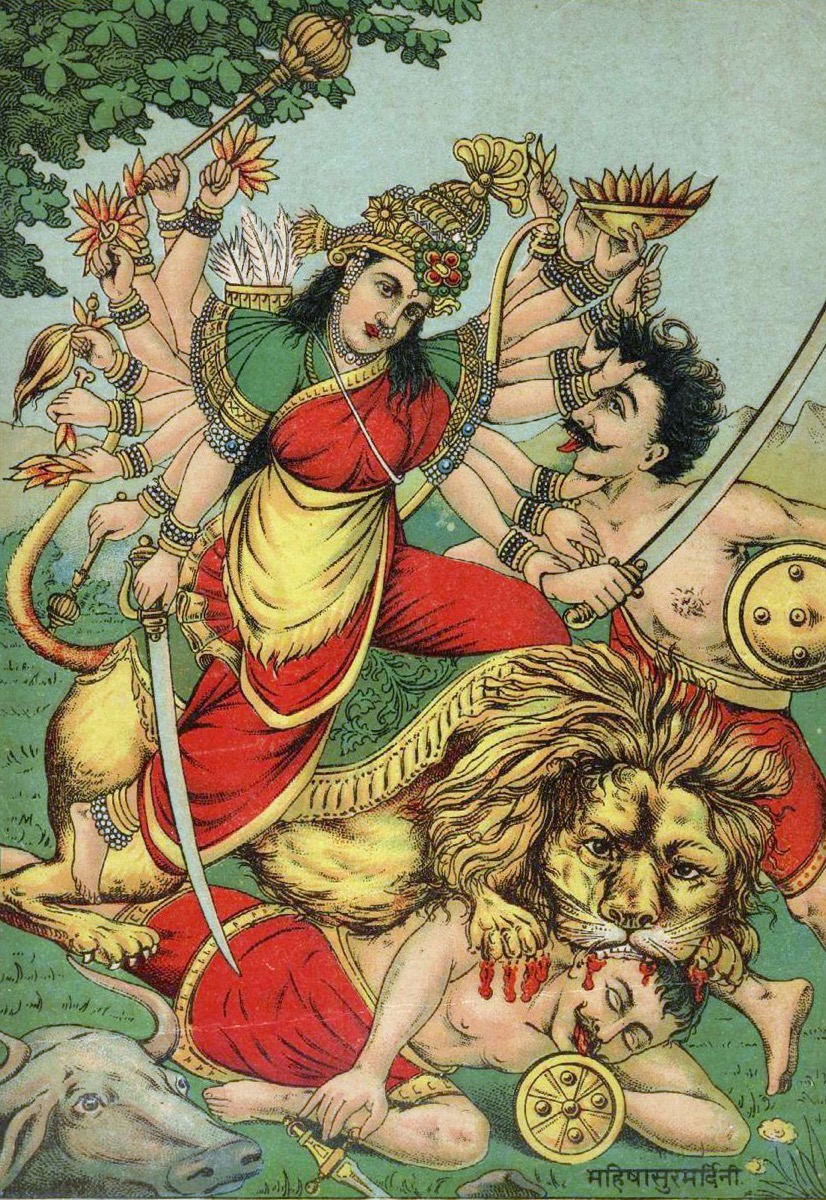
The Durgā Chālīsā (दुर्गा चालीसा, “Forty Verses to Durgā”) is one of the most beloved devotional hymns in the Śākta tradition of Hinduism. Comprising forty verses (chaupāī) framed by invocatory and concluding couplets (dohā), this prayer celebrates Goddess Durgā — the invincible Divine Mother who vanquishes demons, protects her devotees, and bestows both material prosperity and spiritual liberation. Recited by millions during Navrātri (the Nine Nights festival) and throughout the year, the Durgā Chālīsā occupies a central place in North Indian goddess worship alongside the more ancient Devī Māhātmya and the Durgā Saptaśatī.
Origins and Attribution
Unlike the Hanumān Chālīsā, which is firmly attributed to Goswāmī Tulasīdāsa, the Durgā Chālīsā’s authorship remains uncertain. It is a product of the popular devotional tradition (loka-paramparā) of North India, likely composed between the 17th and 19th centuries CE. The language is a blend of Awadhī and Braj Bhāṣā Hindi, consistent with the devotional poetry of that era.
What is certain is that the Durgā Chālīsā draws its theological content from two major scriptural sources:
- The Devī Māhātmya (also known as Durgā Saptaśatī or Chaṇḍī Pāṭha) — the 5th—6th century CE text from the Mārkaṇḍeya Purāṇa that narrates Durgā’s cosmic battles against the demons Madhu-Kaiṭabha, Mahiṣāsura, and Śumbha-Niśumbha.
- The Devī Bhāgavata Purāṇa — which elaborates on the Goddess’s many forms, her relationship to the supreme Brahman, and the theology of Śakti as the dynamic, creative power of the universe.
Structure of the Durgā Chālīsā
The Durgā Chālīsā follows the standard chālīsā format:
-
Opening Dohā (Couplets): Two to four invocatory couplets that establish the mood of devotion. The poet bows to the Goddess, acknowledges her as the source of joy (sukha karanī) and the remover of sorrow (duḥkha haranī), and invokes her light (jyoti) that pervades the three worlds.
-
Forty Chaupāī (Quatrains): The body of the hymn, consisting of forty four-line verses in the chaupāī metre. These verses describe the Goddess’s form, recount her mythological exploits, enumerate her many names and manifestations, and affirm the spiritual benefits of her worship.
-
Closing Dohā: The concluding couplets contain the phala-śruti — the declaration of the fruits that accrue from sincere recitation.
The Opening Verses: Vision of the Divine Mother
The Durgā Chālīsā begins with one of the most vivid portraits of the Goddess in Hindi devotional literature:
नमो नमो दुर्गे सुख करनी। नमो नमो अम्बे दुःख हरनी॥ निरंकार है ज्योति तुम्हारी। तिहुँ लोक फैली उजियारी॥
Salutations, salutations to Durgā, the bestower of happiness. Salutations, salutations to Ambā, the remover of sorrow. Your radiance is formless; its light has spread across the three worlds.
These opening lines establish two fundamental aspects of Durgā’s nature: she is simultaneously transcendent (niraṅkāra — formless, beyond all form) and immanent (her light fills all three realms of existence). This theological paradox — the Goddess who is both nirguṇa (without attributes) and saguṇa (with attributes) — lies at the heart of Śākta philosophy.
The Nine Forms of Navadurgā
A significant portion of the Durgā Chālīsā is devoted to celebrating the Navadurgā — the nine manifestations of the Goddess worshipped during the nine nights of Navrātri. Each form corresponds to one night of the festival:
1. Śailaputrī (Daughter of the Mountain)
The first form of Navadurgā, worshipped on the first day of Navrātri. She is Durgā as the daughter of Himavān, the king of the Himalayas. She rides a bull (Nandī) and carries a trident and lotus, symbolizing her identity as Pārvatī, the consort of Śiva.
2. Brahmacāriṇī (The Ascetic)
The second form, representing Durgā as the unmarried ascetic who performed intense tapas (austerity) to win Śiva as her husband. She carries a japmālā (rosary) and kamaṇḍalu (water vessel), symbols of renunciation and spiritual discipline.
3. Candraghaṇṭā (She of the Moon-Bell)
The third form, distinguished by a half-moon (candra) shaped like a bell (ghaṇṭā) on her forehead. She rides a tiger, wields multiple weapons, and represents the Goddess in her fierce yet protective aspect.
4. Kūṣmāṇḍā (The Cosmic Creator)
The fourth form, whose name means “she who created the universe with her gentle smile (īṣat hāsa).” She is associated with the sun and is believed to dwell within the solar orb, nourishing the cosmos with her radiance.
5. Skandamātā (Mother of Skanda)
The fifth form, depicting Durgā as the mother of Kārttikeya (Skanda), the god of war. She sits on a lion, holding her infant son in her lap — an image of maternal tenderness within divine power.
6. Kātyāyanī (Daughter of Sage Kātyāyana)
The sixth form, narrating how the Goddess was born from the collective anger of the gods to the sage Kātyāyana’s hermitage, from where she set forth to slay the buffalo-demon Mahiṣāsura. This form is central to the Devī Māhātmya narrative.
7. Kālarātrī (The Dark Night)
The seventh form, depicting the Goddess in her most terrifying aspect — dark-skinned, with dishevelled hair, flaming eyes, and a necklace of lightning. She destroys demons and negative forces. Despite her fearsome appearance, she is called Śubhaṅkarī — “she who does good.”
8. Mahāgaurī (The Great White One)
The eighth form, representing Durgā in her purest, most radiant aspect. After the fierce austerities that darkened her skin, Śiva bathed her in the Gaṅgā, and she emerged dazzlingly white (gaura). She symbolizes purity, tranquillity, and the rewards of spiritual effort.
9. Siddhidātrī (The Bestower of Perfections)
The ninth and final form, who grants all eight siddhis (supernatural perfections) and nine nidhis (treasures). She sits on a lotus, worshipped by gods, sages, siddhas, and yogins. She represents the culmination of the Navrātri journey — the devotee who has progressed through all nine forms receives the ultimate spiritual attainment.
Key Mythological Episodes
The Slaying of Mahiṣāsura
The most prominent narrative thread in the Durgā Chālīsā is the battle between Durgā and the buffalo-demon Mahiṣāsura. According to the Devī Māhātmya (chapters 2—4), Mahiṣāsura had obtained a boon from Brahmā that no male being — god, demon, or human — could kill him. Emboldened, he conquered the three worlds and drove the gods from heaven.
In desperation, the gods pooled their collective energies (tejas), and from this blazing confluence a radiant female form emerged — Durgā. Each god contributed a weapon: Śiva gave his trident, Viṣṇu his discus, Vāyu his bow, Agni his spear. Mounted on a lion, Durgā rode into battle and, after a ferocious combat lasting nine days, slew Mahiṣāsura. This victory is the origin of her epithet Mahiṣāsuramardinī — “the Slayer of the Buffalo Demon.”
The Destruction of Śumbha and Niśumbha
The Chālīsā also references the later battle (Devī Māhātmya, chapters 5—13) in which Durgā — in her form as Ambikā — destroyed the demon brothers Śumbha and Niśumbha and their generals Caṇḍa, Muṇḍa, and Raktabīja. The slaying of Raktabīja, whose every drop of blood spawned a new demon, required the Goddess to manifest Kālī, who drank all the blood before it could touch the ground.
The Chālīsā Tradition
The word chālīsā derives from the Hindi chālīs (चालीस), meaning “forty.” The chālīsā is a distinctively North Indian devotional genre that emerged during the Bhakti movement. Its characteristics include:
- Fixed length: Exactly forty chaupāī verses, bracketed by dohā couplets
- Vernacular language: Composed in Awadhī, Braj Bhāṣā, or Khaṛī Bolī Hindi, not Sanskrit
- Accessible theology: Complex philosophical ideas expressed in simple, memorable language
- Musical recitability: The chaupāī metre creates a natural rhythm suited to congregational singing
The most famous chālīsā is unquestionably the Hanumān Chālīsā of Tulasīdāsa, but the tradition encompasses dozens of texts dedicated to various deities: the Śiva Chālīsā, Gaṇeśa Chālīsā, Lakṣmī Chālīsā, Sarasvatī Chālīsā, and many more. The Durgā Chālīsā ranks among the most popular of these after the Hanumān Chālīsā itself.
What distinguishes the chālīsā from Sanskrit stotras is its democratic character. While Sanskrit hymns often required Brahmanical learning and ritual purity for recitation, chālīsā texts were composed in the language of the people and could be recited by anyone, regardless of caste, gender, or formal education. This accessibility was central to the Bhakti movement’s revolutionary spirit.
Recitation During Navrātri
The Durgā Chālīsā reaches its peak of popularity during Navrātri, the nine-night festival observed twice yearly (Chaitra Navrātri in spring and Śāradīya Navrātri in autumn). During this period:
- Devotees recite the Durgā Chālīsā daily, often in combination with the Durgā Saptaśatī (700 verses) and the Durgā Ārtī.
- Many undertake a nine-day fast (vrata), breaking it only on the tenth day (Vijayadaśamī or Dussehra).
- In temples across North India, the Chālīsā is recited during the evening aarti, accompanied by bells, drums, and conch shells.
- Home shrines (ghar-mandir) are decorated with images of the Navadurgā, and families gather to recite the Chālīsā together.
The Śāradīya Navrātri (September—October) is particularly significant in eastern India, where it coincides with Durgā Pūjā — the greatest festival of Bengal, Assam, and Odisha. While the Bengali tradition centres on Sanskrit texts and elaborate paṇḍāl installations, the Durgā Chālīsā serves as a bridge between the Sanskrit liturgical tradition and popular Hindi devotion.
Theological Significance
Durgā as Supreme Reality
The Durgā Chālīsā, following the Devī Māhātmya, presents the Goddess not as the consort of a male deity but as the supreme, independent divine reality. She is described as niraṅkāra (formless), jyoti-svarūpā (whose nature is pure light), and the source from whom even Brahmā, Viṣṇu, and Śiva derive their powers. This is consistent with the Śākta theological position that Śakti — the divine feminine energy — is the ultimate ground of all existence.
Protection and Grace
The Chālīsā repeatedly emphasizes Durgā’s role as protector (rakṣakī). She is the fortress (durgā literally means “the inaccessible one” or “fortress”) in which her devotees find shelter from the demons of fear, poverty, disease, and ignorance. Her grace is described as available to all who call upon her sincerely, without preconditions of ritual purity or social status.
The Phala-Śruti (Fruits of Recitation)
The closing dohā promises that whoever recites the Durgā Chālīsā with devotion will receive the Goddess’s protection, see their wishes fulfilled, and ultimately attain liberation (mukti). The traditional belief holds that a devotee who recites the Chālīsā daily for forty days (chālīsa dina) — a number mirroring the forty verses — will experience a tangible manifestation of the Goddess’s grace.
Conclusion
The Durgā Chālīsā is far more than a devotional poem — it is a compact theological treatise, a ritual text, and a living tradition that connects millions of Hindus to the protective, empowering presence of the Divine Mother. In its forty verses, it encompasses the cosmic mythology of the Devī Māhātmya, the ritual calendar of Navrātri, the nine forms of the Navadurgā, and the deeply personal faith of a devotee seeking shelter in the lap of the Mother. For those who recite it with sincerity, the Durgā Chālīsā remains what its opening lines declare: a source of happiness and the remover of all sorrow.