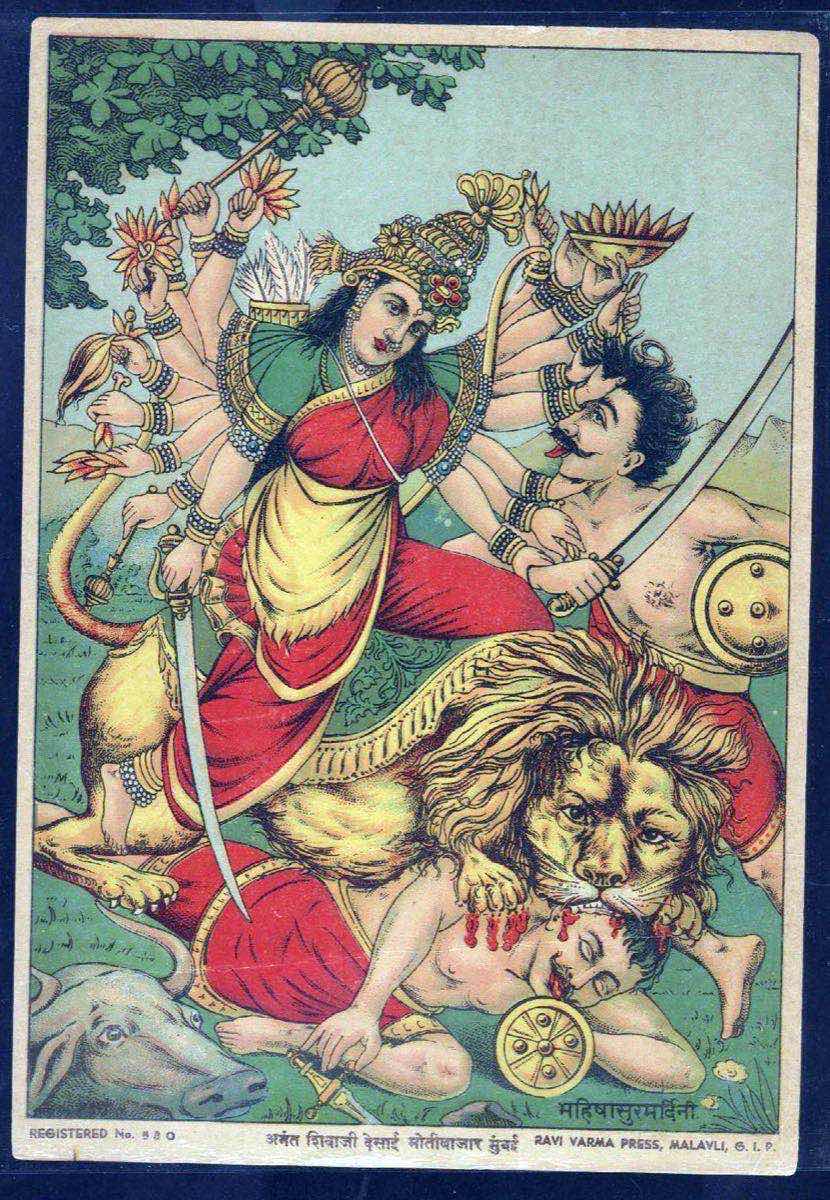
The Durgā Sūktam is one of the most powerful and ancient Vedic hymns dedicated to the invincible Goddess Durgā. Found in the Mahānārāyaṇa Upaniṣad — which itself forms the concluding section of the Taittirīya Āraṇyaka (10.1) of the Kṛṣṇa Yajurveda — this hymn occupies a unique position in Hindu liturgy: it is simultaneously a Vedic fire-hymn addressed to Jātavedas (Agni, the all-knowing fire) and an invocation of the supreme feminine power who carries the devotee across all obstacles, as a boat crosses the ocean.
The hymn’s central metaphor — Durgā as the one who ferries souls past all durgāṇi (difficulties, impassable places) — is in fact the etymological origin of the Goddess’s very name.
The Complete Hymn
The Durgā Sūktam consists of a series of verses, with the core set traditionally numbered as five to seven ṛk-s (verses). The opening verse is the most celebrated:
जातवेदसे सुनवाम सोममरातीयतो निदहाति वेदः। स नः पर्षदति दुर्गाणि विश्वा नावेव सिन्धुं दुरितात्यग्निः॥
IAST Transliteration: Jātavedase sunavāma somam arātīyato nidahāti vedaḥ | Sa naḥ parṣad ati durgāṇi viśvā nāveva sindhuṃ duritātyagniḥ ||
Verse-by-Verse Translation
Verse 1
Jātavedase sunavāma somam arātīyato nidahāti vedaḥ | Sa naḥ parṣad ati durgāṇi viśvā nāveva sindhuṃ duritātyagniḥ ||
Word-by-word:
- Jātavedase — To Jātavedas (Agni, “knower of all beings”)
- sunavāma — we press, we offer
- somam — the soma libation
- arātīyataḥ — one who is hostile, the enemy
- nidahāti — burns down, destroys
- vedaḥ — the knower (Agni who knows all)
- saḥ — He/She
- naḥ — us
- parṣat — may carry across
- ati — beyond
- durgāṇi — difficulties, dangers, impassable places
- viśvā — all
- nāvā iva — like a boat
- sindhum — the ocean
- durita — evil, calamity
- ati — beyond
- agniḥ — the fire (Agni)
Translation: “We press the soma for Jātavedas, the knower who burns down all hostility. May that Agni carry us beyond all difficulties, as a boat crosses the ocean — beyond all evil.”
Verse 2
Tām agnivarṇāṃ tapasā jvalantīṃ vairocanīṃ karmaphaleṣu juṣṭām | Durgāṃ devīṃ śaraṇam ahaṃ prapadye sutarasi tarase namaḥ ||
Translation: “I take refuge in that Goddess Durgā, who is of the colour of fire, who blazes with austerity, who is the resplendent daughter of Virocana (the Sun), and who is worshipped through the fruits of action. O You who are excellent at carrying across — salutations to You!”
This verse marks a crucial transition: the hymn shifts from addressing Agni-Jātavedas to directly invoking Goddess Durgā herself, establishing her identity as the supreme power who ferries devotees across the ocean of worldly existence (saṃsāra).
Verse 3
Agne tvaṃ pārayā navyo asmān svastibhir ati durgāṇi viśvā | Pūś ca pṛthvī bahulā na urvī bhavā tokāya tanayāya śaṃ yoḥ ||
Translation: “O Agni, ever-new, carry us across all difficulties with blessings. May our settlement and earth be vast and wide. Be gracious for our children and their children — grant us well-being and happiness.”
Verse 4
Viśvāni no durgahā jātavedaḥ sindhunna nāvā duritāti parṣi | Agne atrivanmanasā gṛṇāno’smākaṃ bodhyavitā tanūnām ||
Translation: “O Jātavedas, destroyer of all obstacles, carry us beyond all evil as a boat crosses the river. O Agni, praised with the mind like Atri, be the awakened protector of our bodies.”
Verse 5
Pṛtanājitaṃ sahamānam ugram agniṃ huvema paramāt sadhasthāt | Sa naḥ parṣad ati durgāṇi viśvā kṣāmad devo ati duritātyagniḥ ||
Translation: “We invoke the fierce Agni, conqueror of armies, all-subduing, from the highest abode. May that divine Agni carry us beyond all difficulties, beyond all evil, beyond all earthly tribulation.”
The Name “Durgā”: Etymological Significance
The hymn reveals the very etymological root of the Goddess’s name. The Sanskrit word durgā is derived from the root dur (difficult) + gā (to go/pass through), or alternatively from durga (a fort, an impassable place). The Goddess is so named because She enables passage through what is otherwise impassable.
The Devī Māhātmya (Durgā Saptaśatī 11.12) confirms this etymology: “Since you rescue from difficulty (durga), you are remembered as Durgā” (durgāyāḥ durgaśamanāt durgeti parikīrtitā). The Durgā Sūktam is thus the earliest scriptural source of this divine name, linking it directly to the Vedic concept of Agni as the one who carries across (parṣat) all durgāṇi.
Scriptural Context and Dating
Position in the Mahānārāyaṇa Upaniṣad
The Durgā Sūktam appears in the Mahānārāyaṇa Upaniṣad, which belongs to the Taittirīya school of the Kṛṣṇa Yajurveda. This Upaniṣad occupies a unique position as a bridge between the older Saṃhitā/Brāhmaṇa layers and the philosophical Upaniṣads. It contains numerous liturgical hymns and mantras used in daily worship, including the celebrated Nārāyaṇa Sūktam and the Durgā Sūktam.
Scholars generally date the Mahānārāyaṇa Upaniṣad to the late Vedic period (circa 800-500 BCE), though many of its constituent hymns — including the Durgā Sūktam verses — may originate from even earlier Vedic strata, as they share vocabulary and imagery with the Rigvedic hymns to Agni.
Vedic Roots
The core verses of the Durgā Sūktam are addressed to Agni under the epithet Jātavedas (“knower of all born beings” or “possessor of all that is born”). In the Rigvedic worldview, Agni is the divine priest (hotṛ) who serves as the intermediary between humans and the gods. He consumes the offering and carries it upward to the celestial powers.
The Durgā Sūktam extends this function: Agni not only carries offerings to the gods but also carries the devotee across the ocean of difficulties. This dual function — ritual priest and cosmic ferryman — becomes the basis for the later Śākta identification of this power with Goddess Durgā.
Agni as the Medium: The Fire-Goddess Connection
The relationship between Agni and Durgā in this hymn is profound and multi-layered. In verse 2, the Goddess is described as agnivarṇā (fire-coloured), directly linking her to the fire-god. The commentator Sāyaṇa explains that this is not merely a simile: Durgā is the śakti (power) inherent in Agni himself. Just as fire has the power to consume obstacles, purify offerings, and illuminate darkness, so too does Durgā destroy all impediments on the spiritual path.
The Devī Upaniṣad (a later Śākta text) develops this connection further, identifying the Goddess as the power behind all the Vedic deities: “I am the power that blows as the wind, I am the fire that blazes” (Devī Upaniṣad 4). The Durgā Sūktam thus represents one of the earliest Vedic foundations for the Śākta theological position that the feminine divine is the ultimate power (parā śakti) operating through all cosmic functions.
Philosophical Dimensions
Crossing the Ocean of Saṃsāra
The dominant metaphor of the Durgā Sūktam — the boat (nāvā) crossing the ocean (sindhu) — resonates with one of the most enduring images in Hindu philosophy. The ocean represents saṃsāra, the cycle of birth and death driven by karma and avidyā (ignorance). The boat is the divine grace (kṛpā) of the Goddess, and the act of crossing (pāra) is mokṣa (liberation).
This metaphor appears repeatedly across Hindu scripture: the Bhagavad Gītā (4.36) declares that the boat of knowledge (jñāna-plava) carries the devotee across the ocean of sin. The Śvetāśvatara Upaniṣad (1.8) speaks of crossing the river of fear. The Durgā Sūktam places this crossing under the direct agency of the Goddess — it is She, through the medium of Agni, who actively ferries the devotee beyond all danger.
The Destruction of Enemies
The word arātīyataḥ (verse 1) — “one who is hostile” — carries both external and internal meanings in the commentarial tradition. Sāyaṇa interprets the enemies as both literal foes and, more importantly, as the internal enemies: kāma (desire), krodha (anger), lobha (greed), moha (delusion), mada (pride), and mātsarya (jealousy) — the six enemies (ṣaḍ-ripus) that obstruct spiritual progress.
The fire of Durgā — invoked through Jātavedas — burns down not merely worldly opposition but the very roots of bondage within the human heart.
Use in Worship and Ritual
Durgā Pūjā and Navarātri
The Durgā Sūktam is chanted as a central liturgical element during Durgā Pūjā, the grand autumn festival celebrated principally in Bengal, Assam, and Odisha, as well as during Navarātri across all of India. During the Pūjā, the hymn is recited during:
- Prāṇa-pratiṣṭhā — the ceremony of invoking life into the clay image of the Goddess
- Ṣaṣṭhī (sixth day) — the formal welcome (bodhana) of the Goddess
- Sandhi Pūjā — the auspicious junction between Aṣṭamī and Navamī
- Homa (fire ritual) — the Durgā Sūktam mantras are offered into the sacred fire
In South Indian temples, particularly in the Śrī Vaiṣṇava and Smārta traditions, the Durgā Sūktam forms part of the daily Veda pārāyaṇa (Vedic recitation) cycle and is chanted during Abhiṣeka (ritual bathing of the deity).
Method of Chanting
The Durgā Sūktam follows the traditional Vedic chanting conventions of the Kṛṣṇa Yajurveda:
- Chandas (metre): The verses are in the Triṣṭubh metre (11 syllables per pāda, four pādas per verse), the most common metre of the Rigveda after Gāyatrī
- Ṛṣi (seer): The hymn is attributed to various Vedic seers depending on the verse
- Devatā (deity): Agni-Jātavedas / Durgā Devī
- Viniyoga (application): Protection from obstacles, removal of difficulties, invocation of divine grace
For personal practice, the Durgā Sūktam is typically chanted:
- Daily as part of morning prayers, especially during Navarātri
- 108 times as a japa practice for those seeking the Goddess’s protection
- With ghee-offerings (āhuti) in a fire-ritual (homa) for special occasions
Traditional Preparatory Practice
Before chanting the Durgā Sūktam, traditional practice prescribes:
- Ācamana — ritual purification by sipping water
- Prāṇāyāma — breath regulation (three rounds)
- Saṅkalpa — formal statement of intention
- Nyāsa — ritual placement of mantras on the body
- Recitation of the hymn with correct svara (Vedic tonal accents: udātta, anudātta, and svarita)
Connection to the Devī Māhātmya
While the Durgā Sūktam is a Vedic text, its themes resonate powerfully with the later Devī Māhātmya (also called Durgā Saptaśatī or Caṇḍī Pāṭha), the central scripture of Śākta Hinduism found in the Mārkaṇḍeya Purāṇa (chapters 81-93). The Devī Māhātmya narrates in mythological form the very powers the Durgā Sūktam invokes in liturgical form:
- The fire-coloured Goddess (agnivarṇā) of the Sūktam becomes the blazing Durgā who slays Mahiṣāsura, the buffalo-demon
- The crossing of the ocean in the Sūktam becomes the Goddess who rescues the cosmic order (ṛta) from the chaos of demonic forces
- The destruction of enemies in the Sūktam becomes the Goddess’s systematic annihilation of the demons Madhu-Kaiṭabha, Mahiṣāsura, and Śumbha-Niśumbha
The Devī Māhātmya (11.12) explicitly references the etymological connection established in the Sūktam: “Because you deliver from affliction (durga), you are remembered as Durgā.”
The Śākta Reading: Durgā as Supreme Brahman
Later Śākta commentators — following the theological framework of the Devī Bhāgavata Purāṇa, the Devī Upaniṣad, and the Lalitā Sahasranāma — read the Durgā Sūktam as an invocation not of Agni but of the Supreme Goddess who is Agni’s own inner power. In this reading:
- Jātavedas is not merely the fire-god but the Goddess’s own omniscience — She who knows all beings
- Agnivarṇā indicates that the Goddess is the primordial light from which even Agni derives his luminosity
- The soma offering represents the devotee’s surrender (śaraṇāgati) at the Goddess’s feet
- The boat is the Goddess’s grace (anugraha), and the ocean is māyā — the cosmic illusion that only the Goddess can dispel, because She is māyā’s very source
This Śākta reading does not contradict the Vedic meaning but deepens it, revealing the hymn as a multi-layered text that functions simultaneously as a Vedic fire-ritual and a Śākta act of devotional surrender.
The Durgā Sūktam in Bengal
The Durgā Sūktam holds special significance in Bengali Hindu culture, where Durgā Pūjā is the most important annual festival. In Bengal, the hymn is chanted during:
- The Mahālayā dawn broadcast on All India Radio (since 1931), which begins the Devīpakṣa fortnight
- The Ṣaṣṭhī bodhana ceremony that formally invites the Goddess
- The elaborate Sandhi Pūjā at the junction of Aṣṭamī and Navamī, considered the most powerful ritual moment of the Pūjā
Bengali Śākta tradition, influenced by the Tantric lineages of Kāmākhyā, Tārāpīṭh, and the Navadvīpa school of Caitanya Vaiṣṇavism, regards the Durgā Sūktam as a direct manifestation of the Goddess’s own voice (vāk) within the Vedas — a feminine power that predates and pervades all scriptural revelation.
Living Practice
The Durgā Sūktam remains among the most widely chanted Vedic hymns in contemporary Hindu worship. Whether in the pandals of Kolkata during Durgā Pūjā, the fire-altars of South Indian temples during Navarātri, or the personal prayer rooms of millions of households, this ancient hymn continues to invoke the same power it has invoked for three millennia: the invincible Goddess who, like a boat upon the ocean, carries her devotees beyond all fear, all danger, and all sorrow — to the far shore of liberation.
As the hymn declares: “May She carry us beyond all difficulties” — a prayer as urgent and luminous today as when it was first heard by the Vedic seers in the flickering light of the sacrificial fire.