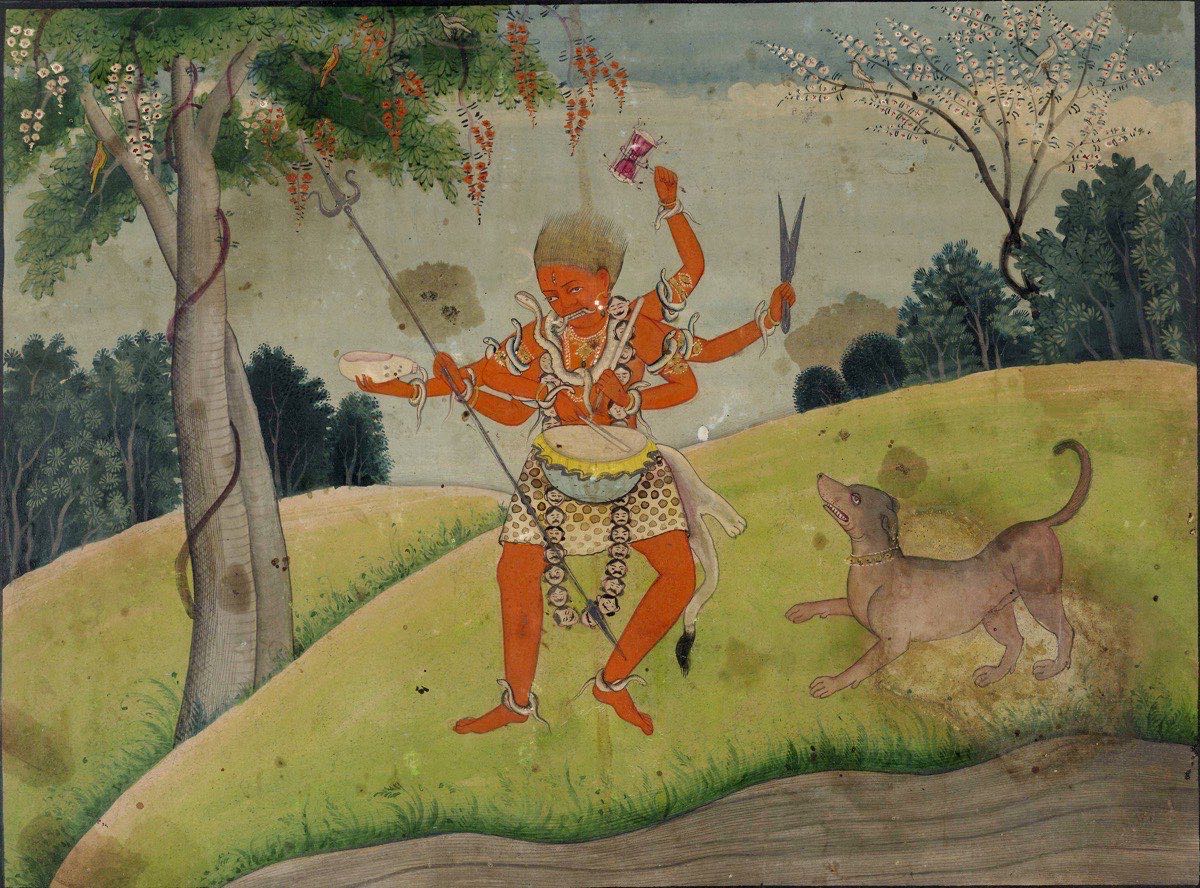
The Kālabhairavāṣṭakam is one of the most revered and powerful compositions of Ādi Śaṅkarācārya (8th century CE), the foremost philosopher-saint of the Advaita Vedānta tradition. Comprising eight magnificent verses (aṣṭakam = “eightfold”), this hymn is dedicated to Kāla Bhairava — the terrifying manifestation of Lord Śiva who rules over time (kāla) itself, guards the sacred city of Kāśī (Vārāṇasī), and liberates devotees from the bondage of mortality. Each verse concludes with the resonant refrain kāśikāpurādhināthakālabhairavaṃ bhaje — “I worship Kālabhairava, the lord of the city of Kāśī” — creating a hypnotic rhythmic effect that makes this stotra one of the most melodious in the entire corpus of Sanskrit devotional literature.
Who is Kāla Bhairava?
The name Kālabhairava is a compound of two profound concepts: Kāla (काल), meaning “time” or “death,” and Bhairava (भैरव), meaning “the terrifying one” — derived from the root bhī (to fear) or alternatively interpreted as one who destroys fear (bhaya + rava). Kāla Bhairava is thus “the one who is so terrifying that even Time itself trembles before him,” or conversely, “the one who liberates beings from the terror of death.”
In Śaiva theology, Bhairava represents the fierce, transgressive aspect of Śiva — radically different from the serene meditator of Mount Kailāsa. The Śiva Mahāpurāṇa narrates that Bhairava manifested when Brahmā’s fifth head spoke arrogantly, claiming superiority over Śiva. In righteous fury, Śiva created Bhairava, who severed Brahmā’s fifth head with his fingernail. However, the sin of brahmahatyā (killing a brāhmaṇa/creator) attached itself to Bhairava in the form of Brahmā’s skull (kapāla), which clung to his hand. Bhairava wandered through the cosmos performing penance until he reached Kāśī (Vārāṇasī), where the skull finally fell from his hand at the site known as Kapālamocana Tīrtha — the “place of skull-liberation.” Since that mythic moment, Bhairava has been the eternal guardian of Kāśī.
The sixty-four Bhairavas (Catuḥṣaṣṭi Bhairava) are said to guard the cardinal and intermediate directions of the cosmos, with Kāla Bhairava as their supreme chief (Mahābhairava). As the ruler of universal time, he governs the cycles of creation and dissolution, and his grace alone can liberate a soul from the relentless wheel of saṃsāra.
Śaṅkarācārya’s Composition in Vārāṇasī
Ādi Śaṅkarācārya, who traversed the Indian subcontinent establishing the four great maṭhas and reviving Sanātana Dharma, is believed to have composed this aṣṭakam during his sojourn in Vārāṇasī — the holiest city in Hinduism, also known as Kāśī, the “City of Light.” Though Śaṅkara is primarily known as the champion of Advaita Vedānta (non-dual philosophy), he was also a prolific composer of devotional hymns (stotras) to various deities, including Śiva, Viṣṇu, Devī, and Gaṇeśa. His ṣaṇmata (six-fold worship) system embraced all major Hindu deities as manifestations of the one Brahman.
The Kālabhairavāṣṭakam reflects Śaṅkara’s deep reverence for Kāśī and its presiding deity. In Vārāṇasī’s sacred geography, Kāla Bhairava holds the unique office of Koṭwāl (chief guardian and divine magistrate) of the city. Hindu tradition holds that every soul entering Kāśī must receive Bhairava’s permission, and at the moment of death in Kāśī, it is Bhairava who whispers the tāraka mantra (liberating mantra) into the dying person’s ear, granting mokṣa. This metaphysical role as both guardian and liberator pervades every verse of the aṣṭakam.
Complete Text with Verse-by-Verse Meaning
Verse 1
देवराजसेव्यमानपावनाङ्घ्रिपङ्कजं व्यालयज्ञसूत्रमिन्दुशेखरं कृपाकरम् । नारदादियोगिवृन्दवन्दितं दिगम्बरं काशिकापुराधिनाथकालभैरवं भजे ॥१॥
Devarājasevyamānapāvanāṅghripaṅkajaṃ vyālayajñasūtraminduśekharaṃ kṛpākaram | nāradādiyogivṛndavanditaṃ digambaraṃ kāśikāpurādhināthakālabhairavaṃ bhaje ||1||
Translation: “I worship Kālabhairava, the lord of the city of Kāśī, whose sacred lotus feet are served by Indra (the king of gods), who wears a serpent as his sacrificial thread, who bears the crescent moon upon his brow, who is an ocean of compassion, who is praised by Nārada and hosts of yogis, and who is clad in the directions (sky-clad / digambara).”
This opening verse establishes Bhairava’s paradoxical nature: he is simultaneously the fiercest form of Śiva and an ocean of compassion (kṛpākara). Even the king of the gods serves his feet, yet he is accessible to wandering yogis. The serpent as sacred thread (yajñasūtra) replaces the conventional brāhmaṇical thread, signalling Bhairava’s transgressive power that operates beyond ritual orthodoxy.
Verse 2
भानुकोटिभास्वरं भवाब्धितारकं परं नीलकण्ठमीप्सितार्थदायकं त्रिलोचनम् । कालकालमम्बुजाक्षमक्षशूलमक्षरं काशिकापुराधिनाथकालभैरवं भजे ॥२॥
Bhānukoṭibhāsvaraṃ bhavābdhitārakaṃ paraṃ nīlakaṇṭhamīpsitārthadāyakaṃ trilocanam | kālakālamambujakṣamakṣaśūlamakṣaraṃ kāśikāpurādhināthakālabhairavaṃ bhaje ||2||
Translation: “I worship Kālabhairava, the lord of Kāśī, who blazes with the radiance of a million suns, who ferries beings across the ocean of worldly existence, who is the Supreme Being, who has a blue throat (Nīlakaṇṭha), who fulfils all desired wishes, who has three eyes, who is the death of death itself (kālakāla), who has lotus-like eyes, who holds the trident of the senses (akṣaśūla), and who is imperishable.”
The epithet kālakāla — “the death of Death” — is profoundly significant. Kāla Bhairava does not merely govern time; he transcends it. For the devotee, this means that surrender to Bhairava is the ultimate answer to mortality. The compound also echoes the Mahāmṛtyuñjaya tradition, where Śiva conquers death on behalf of his devotees.
Verse 3
शूलटङ्कपाशदण्डपाणिमादिकारणं श्यामकायमादिदेवमक्षरं निरामयम् । भीमविक्रमं प्रभुं विचित्रताण्डवप्रियं काशिकापुराधिनाथकालभैरवं भजे ॥३॥
Śūlaṭaṅkapāśadaṇḍapāṇimādikāraṇaṃ śyāmakāyamādidevamakṣaraṃ nirāmayam | bhīmavikramaṃ prabhuṃ vicitratāṇḍavapriyaṃ kāśikāpurādhināthakālabhairavaṃ bhaje ||3||
Translation: “I worship Kālabhairava, the lord of Kāśī, who holds the trident, battle-axe, noose, and staff in his hands, who is the primordial cause (ādi kāraṇa), whose body is dark-hued, who is the first deity (ādi deva), who is imperishable, who is free from all illness, who possesses fearsome valour, who is the Lord, and who delights in the marvellous Tāṇḍava dance.”
The four weapons symbolise Bhairava’s cosmic functions: the trident (śūla) represents the three guṇas and the power of dissolution; the battle-axe (ṭaṅka) cuts through ignorance; the noose (pāśa) binds adharma; and the staff (daṇḍa) metes out divine justice. His love for the Tāṇḍava dance connects him to Śiva as Naṭarāja, the cosmic dancer.
Verse 4
भुक्तिमुक्तिदायकं प्रशस्तचारुविग्रहं भक्तवत्सलं स्थितं समस्तलोकविग्रहम् । विनिक्वणन्मनोज्ञहेमकिङ्किणीलसत्कटिं काशिकापुराधिनाथकालभैरवं भजे ॥४॥
Bhuktimuktiidāyakaṃ praśastacāruvigrahaṃ bhaktavatsalaṃ sthitaṃ samastalokavigrahm | vinikvaṇanmanojñahemakiṅkiṇīlasatkaṭiṃ kāśikāpurādhināthakālabhairavaṃ bhaje ||4||
Translation: “I worship Kālabhairava, the lord of Kāśī, who bestows both worldly enjoyment (bhukti) and liberation (mukti), whose form is celebrated and beautiful, who is dear to his devotees, who is eternal, who embodies all the worlds, and whose waist is adorned with tinkling golden bells that produce enchanting sounds.”
This verse reveals that Bhairava is not merely an ascetic god of destruction — he grants both material fulfilment and spiritual liberation. The golden waist-bells (hema kiṅkiṇī) are a distinctive feature of Bhairava’s iconography, and their melodious sound is said to represent the nāda (cosmic vibration) that sustains creation.
Verse 5
धर्मसेतुपालकं त्वधर्ममार्गनाशकं कर्मपाशमोचकं सुशर्मदायकं विभुम् । स्वर्णवर्णशेषपाशशोभिताङ्गमण्डलं काशिकापुराधिनाथकालभैरवं भजे ॥५॥
Dharmasetupālakaṃ tvadharmamārganāśakaṃ karmapāśamocakaṃ suśarmadāyakaṃ vibhum | svarṇavarṇaśeṣapāśaśobhitāṅgamaṇḍalaṃ kāśikāpurādhināthakālabhairavaṃ bhaje ||5||
Translation: “I worship Kālabhairava, the lord of Kāśī, who protects the bridge of dharma, who destroys the path of unrighteousness, who liberates from the noose of karma, who bestows supreme happiness, who is all-pervading, and whose body is adorned by a golden serpent coiled around him.”
Bhairava’s role as the protector of dharma (dharmasetu pālaka) and destroyer of adharma establishes him as the divine magistrate. In Vārāṇasī’s sacred geography, this is the theological basis for his title as Koṭwāl — the divine police chief who maintains cosmic moral order.
Verse 6
रत्नपादुकाप्रभाभिरामपादयुग्मकं नित्यमद्वितीयमिष्टदैवतं निरञ्जनम् । मृत्युदर्पनाशनं करालदंष्ट्रमोक्षणं काशिकापुराधिनाथकालभैरवं भजे ॥६॥
Ratnapādukāprabhābhirāmapādayugmakaṃ nityamadvitīyamiṣṭadaivataṃ nirañjanam | mṛtyudarrpanāśanaṃ karāladaṃṣṭramokṣaṇaṃ kāśikāpurādhināthakālabhairavaṃ bhaje ||6||
Translation: “I worship Kālabhairava, the lord of Kāśī, whose pair of feet radiate with the lustre of jewelled sandals, who is eternal, who is without a second (non-dual), who is the desired deity, who is untainted, who destroys the pride of death, and who liberates through his fearsome fangs.”
The phrase mṛtyudarpa nāśana — “destroyer of death’s pride” — encapsulates Bhairava’s supreme theological role. His fearsome fangs (karāla daṃṣṭra), which in iconography terrify the uninitiated, are actually the instrument of liberation (mokṣaṇa). What appears terrifying to the ego-bound soul is the very gateway to freedom.
Verse 7
अट्टहासभिन्नपद्मजाण्डकोशसन्ततिं दृष्टिपातनष्टपापजालमुग्रशासनम् । अष्टसिद्धिदायकं कपालमालिकाधरं काशिकापुराधिनाथकालभैरवं भजे ॥७॥
Aṭṭahāsabhinnapadmajāṇḍakośasantatiṃ dṛṣṭipātanaṣṭapāpajālamugrasāsanam | aṣṭasiddhidāyakaṃ kapālamālikādharaṃ kāśikāpurādhināthakālabhairavaṃ bhaje ||7||
Translation: “I worship Kālabhairava, the lord of Kāśī, whose thunderous laughter shatters the cosmic eggs of Brahmā’s creation, whose mere glance destroys the web of sins, whose rule is fierce, who bestows the eight mystical powers (aṣṭa siddhi), and who wears a garland of skulls.”
The aṣṭa siddhis (eight supernatural attainments) are the classical yogic powers described in Patañjali’s Yoga Sūtras and the Śaiva Āgamas: aṇimā (becoming infinitely small), mahimā (becoming infinitely large), garimā (becoming infinitely heavy), laghimā (becoming weightless), prāpti (obtaining anything), prākāmya (irresistible will), īśitva (lordship), and vaśitva (control over all). Bhairava, as the supreme yogin, grants these to worthy devotees. The skull garland (kapāla mālikā) symbolises his mastery over the cycle of death and rebirth — each skull represents a conquered lifetime.
Verse 8
भूतसङ्घनायकं विशालकीर्तिदायकं काशिवासलोकपुण्यपापशोधकं विभुम् । नीतिमार्गकोविदं पुरातनं जगत्पतिं काशिकापुराधिनाथकालभैरवं भजे ॥८॥
Bhūtasaṅghanāyakaṃ viśālakīrtidāyakaṃ kāśivāsalokapuṇyapāpaśodhakaṃ vibhum | nītimārgakovidaṃ purātanaṃ jagatpatiṃ kāśikāpurādhināthakālabhairavaṃ bhaje ||8||
Translation: “I worship Kālabhairava, the lord of Kāśī, who is the leader of hosts of ghosts and spirits (bhūta saṅgha), who bestows widespread fame, who purifies the residents of Kāśī of both their merits (puṇya) and sins (pāpa), who is all-pervading, who is expert in the path of righteousness (nīti mārga), who is the most ancient, and who is the lord of the universe.”
The remarkable phrase puṇya-pāpa śodhaka — “purifier of both merit and sin” — reveals a profound non-dual insight. In the highest spiritual understanding, even accumulated puṇya (religious merit) is a binding chain, keeping the soul in saṃsāra. Bhairava liberates the residents of Kāśī from both polarities, leaving only pure consciousness.
Phala Śruti (Verse 9 — Declaration of Fruits)
कालभैरवाष्टकं पठन्ति ये मनोहरं ज्ञानमुक्तिसाधनं विचित्रपुण्यवर्धनम् । शोकमोहदैन्यलोभकोपतापनाशनं प्रयान्ति कालभैरवाङ्घ्रिसन्निधिं नरा ध्रुवम् ॥९॥
Kālabhairavāṣṭakaṃ paṭhanti ye manoharaṃ jñānamuktisādhanaṃ vicitrapuṇyavardhanam | śokamohadainyalobhakopataapanāśanaṃ prayānti kālabhairavāṅghrisannidhiṃ narā dhruvam ||9||
Translation: “Those who recite this captivating Kālabhairavāṣṭakam — which is a means to knowledge and liberation, which increases manifold merit, and which destroys grief, delusion, poverty, greed, anger, and affliction — will assuredly attain the proximity of the sacred feet of Lord Kālabhairava.”
The phala śruti promises that this hymn addresses the full spectrum of human suffering: śoka (grief), moha (delusion), dainya (poverty/wretchedness), lobha (greed), kopa (anger), and tāpa (mental and physical torment). By destroying these six afflictions, the devotee moves beyond saṃsāra to the feet of Kāla Bhairava — which is to say, into the timeless presence of Śiva himself.
Kāla Bhairava as the Koṭwāl of Kāśī
In the sacred geography of Vārāṇasī, Kāla Bhairava occupies a unique administrative-spiritual role. He is the Koṭwāl — a Mughal-era term meaning “police chief” or “city guardian” — of the entire sacred precinct. This is not merely honorific. Hindu tradition holds that:
- Entry to Kāśī requires Bhairava’s tacit permission; pilgrims traditionally visit the Kāla Bhairava temple before any other shrine in Vārāṇasī.
- Bhairavī Yātanā — the “punishment of Bhairava” — is the metaphysical trial that souls undergo at the moment of death in Kāśī. This is not punitive but purgative: Bhairava burns away remaining karma so that the soul may attain liberation.
- Kāśī Viśvanātha (Śiva as lord of the universe) is the king of Kāśī, while Kāla Bhairava is his chief officer, enforcing dharmic order.
The Kāla Bhairava Temple in the Bharonāth area of Vārāṇasī is one of the city’s oldest and most venerated shrines. The deity’s silver face, visible through the inner sanctum doors and garlanded with flowers, is a focal point of daily worship. Uniquely among Hindu temple practices, liquor (madira) is offered to Kāla Bhairava as part of the ritual offering — a practice rooted in the Tantric tradition where conventional taboos are transcended in devotion.
Bhairava Theology in Śaivism
Bhairava holds a position of supreme importance in multiple Śaiva traditions:
In Kāśmīra Śaivism (Trika): The philosopher Abhinavagupta (c. 950-1016 CE) identifies Bhairava with the supreme consciousness (parā saṃvit) itself. In the Tantrāloka, Abhinavagupta describes Bhairava as the totality of the five cosmic acts — creation, preservation, dissolution, concealment, and grace — occurring simultaneously in the vibration (spanda) of awareness. The Vijñāna Bhairava Tantra, one of the most celebrated texts of Kāśmīra Śaivism, presents 112 meditation techniques (dhāraṇās) through a dialogue between Bhairava and Bhairavī (Śakti), revealing that the state of bhairava is none other than pure, non-dual awareness.
In Śaiva Siddhānta: Bhairava is revered as the supreme guru who initiates souls into liberation. The Āgamic texts describe eight primary Bhairavas (Aṣṭa Bhairava) — Asitāṅga, Ruru, Caṇḍa, Krodha, Unmatta, Kapālī, Bhīṣaṇa, and Saṃhāra — each presiding over one of the eight directions, with Kāla Bhairava as the ninth and supreme form.
In Kāpālika and Tantric traditions: Bhairava is the presiding deity of the Bhairava Tantras, a major division of the Śaiva Āgamas. The Kāpālika ascetics, who carried skulls and smeared themselves with cremation ash, modelled their practice on Bhairava’s own myth of wandering with Brahmā’s skull. These extreme practices aimed to replicate Bhairava’s transcendence of all social and ritual boundaries.
Musical Tradition and Recitation
The Kālabhairavāṣṭakam is composed in the mandākrāntā-adjacent metre with consistent rhythmic cadence, built around the sustained compound refrain kāśikāpurādhināthakālabhairavaṃ bhaje. In South Indian Carnatic music tradition, it has been classified as a composition in Rāgamālikā (garland of rāgas) set to Ādi tāla with tisra nadai (three-beat subdivision).
The hymn is traditionally recited in a deep, resonant voice that evokes Bhairava’s commanding presence. The long Sanskrit compounds create a wave-like rhythmic effect that builds with each verse, and the unchanging refrain serves as a meditative anchor — much like a mantra within a hymn. Many contemporary renditions employ the Bhairava rāga (or Bhairavī rāga) family, which is traditionally associated with the early morning hours and with Śiva himself. The rāga Bhairava, with its characteristic use of the komal ṛṣabha (flat second note) and komal dhaivata (flat sixth), creates an atmosphere of solemnity and awe.
When and How It Is Chanted
The Kālabhairavāṣṭakam is chanted on several auspicious occasions:
- Kālāṣṭamī — the eighth day (aṣṭamī) of the waning moon (kṛṣṇa pakṣa) in every lunar month, which is sacred to Bhairava. The Kālāṣṭamī falling in the month of Mārgaśīrṣa (November-December) is the most important and is celebrated as Kālabhairava Jayantī.
- Mahāśivarātri — the great night of Śiva, when all Śaiva hymns are chanted during the night-long vigil.
- Saturdays — considered Bhairava’s day in the Hindu liturgical week.
- Twilight hours (sandhyā kāla) — particularly dusk (4:00-6:00 PM), which is considered the most potent time for Bhairava worship.
Traditional practice prescribes 108 recitations using a rudrākṣa mālā, ideally performed at a Śiva temple that contains a Bhairava shrine. Offerings to Kāla Bhairava traditionally include coconut, flowers, sindūr (vermilion), mustard oil, and in certain Tantric traditions, liquor — symbolising the transcendence of conventional purity-impurity distinctions.
Connection to Tantra Traditions
Kāla Bhairava occupies a central place in Hindu and Buddhist Tantric traditions. In Tantra, Kāśī is identified with the Ājñā Cakra — the “third eye” centre between the eyebrows, the seat of commanding awareness. Just as Kāla Bhairava is the Koṭwāl of physical Kāśī, he is the presiding deity of the Ājñā Cakra in the subtle body. Worship of Kāla Bhairava is thus simultaneously an act of external devotion and internal yogic practice.
The Bhairavī Yātanā mentioned in the Kāśī Khaṇḍa of the Skanda Purāṇa represents a Tantric inversion: what appears as punishment is actually the supreme grace of awakening. Similarly, Bhairava’s terrifying iconography — the skull garland, the weapon-bearing arms, the fanged mouth, the cremation-ground associations — represents the Tantric principle that liberation (mukti) lies in embracing what the conventional mind rejects.
Bhairava is also closely associated with Śakti in her fierce forms — Kālī, Bhairavī, and Cāmuṇḍā. Every Śakti Pīṭha (seat of the Goddess) in India is traditionally guarded by a Bhairava shrine, reflecting the inseparable unity of Śiva and Śakti in Tantric philosophy.
Kāla Bhairava Temples Across India
While Vārāṇasī’s Kāla Bhairava temple is the most celebrated, Bhairava is worshipped across the subcontinent:
- Kāla Bhairava Temple, Vārāṇasī — The premier shrine, located in the Bharonāth locality, where the silver-faced deity is worshipped as the Koṭwāl of Kāśī.
- Kālabhairaveśvara Temple, Ujjain — One of the most ancient Bhairava temples, associated with the Mahākāleśvara Jyotirliṅga.
- Bhairava temples at Śakti Pīṭhas — Each of the 51 Śakti Pīṭhas has an associated Bhairava shrine, including at Kāmākhyā (Assam), Kālīghāṭ (Kolkata), and Hinguḷajā (Balochistan).
- Sweta Bhairava and Kāla Bhairava, Kathmandu — Nepal’s Bhairava tradition is exceptionally vibrant, with massive open-air Bhairava masks at Hanuman Dhoka and Durbar Square.
- Bhairava shrines in South India — At Chidambaram, Thanjavur, and other major Śaiva temples, Bhairava (known as Bhairavār in Tamil) guards the temple precincts.
Iconography of Kāla Bhairava
Kāla Bhairava is traditionally depicted with the following iconographic features, all of which are referenced in the Aṣṭakam:
- Dark or red-hued body (śyāma kāya) — representing the absorption of all phenomena into the void
- Four arms holding trident, battle-axe/sword, skull-cup (kapāla), and noose/staff
- Garland of skulls (kapāla mālikā) — symbolising mastery over death
- Serpent sacred thread (vyāla yajñasūtra) — transcending orthodox ritual
- Crescent moon (indu śekhara) — mastery over the cycles of time
- Three eyes (trilocana) — seeing past, present, and future
- Golden waist-bells (hema kiṅkiṇī) — the cosmic nāda
- His dog (śvāna) as vāhana — the faithful guardian; in Tantric symbolism, the dog represents the fearless transcendence of social taboos
- Naked or sky-clad (digambara) — beyond all coverings of māyā
The Enduring Power of the Hymn
The Kālabhairavāṣṭakam endures as one of the great masterpieces of Sanskrit devotional poetry because it achieves something rare: it communicates the terrifying majesty of the divine while simultaneously conveying boundless compassion. Śaṅkarācārya, the consummate philosopher of non-duality, here speaks as a devotee — surrendering intellectual constructs before the overwhelming presence of Kāla Bhairava. The eight verses move from external description (Bhairava’s form, ornaments, and weapons) through functional theology (his roles as guardian, liberator, and judge) to a climactic promise: that the reciter will assuredly (dhruvam) attain Bhairava’s feet.
In the end, the Kālabhairavāṣṭakam is not merely about a fierce deity in a temple in Vārāṇasī. It is about the recognition that time — the ultimate source of human terror — is itself a manifestation of the divine, and that the one who rules time is also the one who frees us from it. To chant kāśikāpurādhināthakālabhairavaṃ bhaje is to declare that even death holds no dominion over the devoted soul.
iti śrīmacchaṅkarācāryaviracitaṃ kālabhairavāṣṭakaṃ sampūrṇam — Thus ends the complete Kālabhairavāṣṭakam composed by the blessed Śaṅkarācārya.