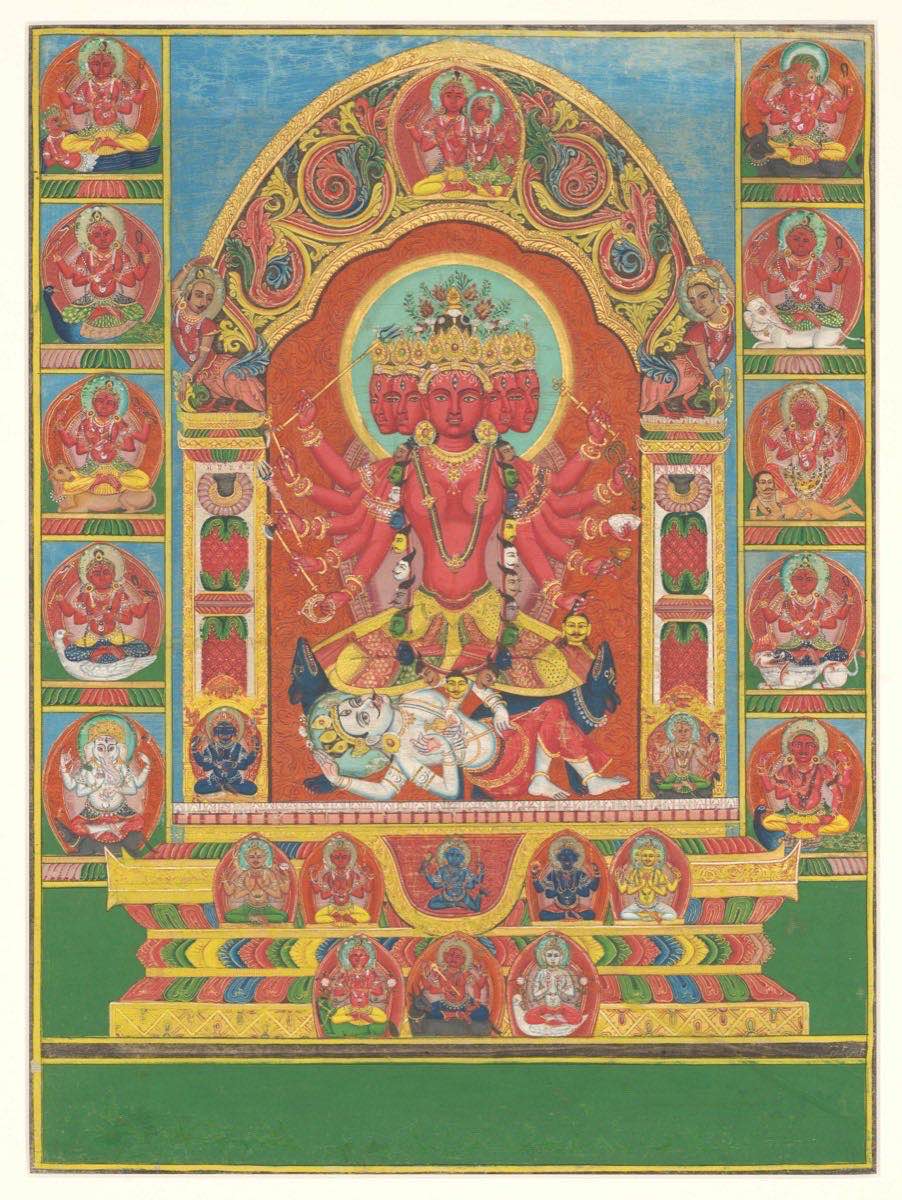
The Lalitā Sahasranāma (ललिता सहस्रनाम, “The Thousand Names of Lalitā”) is among the most revered and philosophically profound hymns in the entire Hindu tradition. Preserved within the Lalitopākhyāna section of the Brahmāṇḍa Purāṇa, this stotra comprises exactly one thousand names of Goddess Lalitā Tripurasundarī — the Supreme Divine Mother who is beautiful, playful, and the ultimate reality of the Śākta tradition. Recited daily by millions of devotees, the Lalitā Sahasranāma is the central liturgical text of the Śrī Vidyā school and stands as one of the most complete verbal portraits of the Goddess in all of Sanskrit literature.
The Narrative Setting: Hayagrīva and Agastya
The Sahasranāma is revealed within a conversation between two exalted figures. The sage Agastya, having heard the glorious account of Lalitā Devī’s destruction of the demon Bhaṇḍāsura (the Lalitopākhyāna narrative), desires to know the sacred names by which the Goddess can be worshipped. He turns to Hayagrīva — the horse-headed incarnation of Lord Viṣṇu and the supreme custodian of Vedic knowledge — who reveals the thousand names as originally recited by the Vāgdevīs (the goddesses of speech, also called the Aṣṭa Vāgdevīs or eight Vāk deities) in the divine assembly of Lalitā Devī.
This framing is significant: the names were not composed by a human sage but were uttered spontaneously by the goddesses of speech themselves in the presence of the Supreme Goddess, making this stotra a form of divine self-revelation.
Structure of the Stotra
The complete Lalitā Sahasranāma follows a carefully organized structure:
Pūrvabhāga (Introductory Section)
- Dhyāna Shlokas: Meditative verses describing Lalitā Devī seated on a lotus upon the Śrī Chakra, four-armed, holding the sugarcane bow (ikṣu-dhanus), five flower-arrows (puṣpa-bāṇa), noose (pāśa), and goad (aṅkuśa), radiant as the rising sun
- The narrative context of Agastya’s request
- Hayagrīva’s invocation before revealing the names
The Thousand Names
The 1,000 names are arranged in 182.5 stanzas (shlokas) in the anuṣṭubh metre. Unlike many other sahasranāmas, the Lalitā Sahasranāma contains no repetition — each of the thousand names is unique, a feature noted by every commentator as evidence of the stotra’s extraordinary precision. The names flow in a sequence that traces the Goddess’s form from head to toe (keśādi-pādānta varṇana), then expands into her cosmic powers, spiritual attributes, and metaphysical nature.
Uttarabhāga (Concluding Section)
- Phala Shruti: The section enumerating the fruits and benefits of recitation
- Uttara Pīṭhikā: Additional instructions on recitation, including the injunction that the Sahasranāma should be recited after due initiation (dīkṣā)
The Goddess Lalitā Tripurasundarī
Lalitā (ललिता) means “She who plays” or “the playful one” — the Supreme Goddess whose creation, sustenance, and dissolution of the universe is her divine play (līlā). She is also known as:
- Tripurasundarī — “The Beauty of the Three Worlds” (the three cities or planes: gross, subtle, and causal)
- Rājarājeśvarī — “The Queen of Queens, the Supreme Sovereign”
- Mahātripurasundarī — “The Great Beauty of the Three Cities”
- Kāmeśvarī — “The Goddess of Desire” (desire here understood as the primordial creative impulse)
- Ṣoḍaśī — “The Sixteen-Syllabled One” (referring to her primary mantra)
In Śākta theology, Lalitā is not a subordinate deity or a consort — she is Parā Śakti, the Supreme Power, identical with Brahman itself. The Brahmāṇḍa Purāṇa presents her as the source from which Brahmā, Viṣṇu, and Śiva themselves emerge.
Key Names and Their Meanings
Among the thousand names, the following carry especially deep theological and philosophical significance:
- Śrī Mātā (श्री माता, Name 1) — “The Auspicious Mother”; the very first name establishes her as the universal mother of all beings
- Śrī Mahārājñī (श्री महाराज्ञी, Name 2) — “The Great Empress”; sovereign ruler of all creation
- Śrīmat Siṃhāsaneśvarī (श्रीमत् सिंहासनेश्वरी, Name 3) — “The Goddess Enthroned on the Lion-Seat”; established in supreme sovereignty
- Cidagni-kuṇḍa-sambhūtā (चिदग्नि-कुण्ड-सम्भूता, Name 4) — “Born from the Fire-Pit of Consciousness”; she emerges from pure awareness itself
- Pañcatanmātra-sāyakā (पञ्चतन्मात्र-सायका, Name 10) — “She whose five arrows are the five subtle elements” (sound, touch, form, taste, smell)
- Cakra-rāja-rathārūḍha-sarvāyudha-pariṣkṛtā (Name 68) — “She who rides the chariot of Śrī Chakra, armed with all weapons”
- Mahā-kāmeśa-mahiṣī (महाकामेश-महिषी, Name 233) — “The Supreme Consort of Mahā-Kāmeśvara (Śiva)”
- Kuṇḍalinī (कुण्डलिनी, Name 110) — “She who is the coiled serpent power”; the spiritual energy at the base of the spine
- Pañcadaśī (Name 583) — “She who is the Pañcadaśī mantra” (the fifteen-syllabled mantra central to Śrī Vidyā)
- Lalitāmbikā (ललिताम्बिका, Name 727) — “Mother Lalitā”; the intimate, maternal aspect of the Supreme
- Kāmakalā-rūpā (कामकला-रूपा, Name 322) — “She whose form is the Kāmakalā” (the mystical triangle at the core of the Śrī Yantra)
- Viśva-grāsā (विश्वग्रासा, Name 691) — “She who devours the universe” at the time of dissolution
- Puruṣārtha-pradā (पुरुषार्थ-प्रदा, Name 291) — “She who bestows the four goals of human life” (dharma, artha, kāma, mokṣa)
- Śiva-jñāna-pradāyinī (शिवज्ञान-प्रदायिनी, Name 727) — “She who bestows the knowledge of Śiva (the Absolute)”
- Sahasranāma-stotra-paraḥ — the recitation of these thousand names is itself considered a form of worship leading to liberation
The Śrī Chakra Connection
The Lalitā Sahasranāma is inseparable from the Śrī Chakra (also called Śrī Yantra) — the most sacred geometric diagram (yantra) in Hindu tantra. The Śrī Chakra consists of nine interlocking triangles that radiate from a central point (bindu), creating a total of 43 smaller triangles. These represent the entire cosmos as an emanation from the Goddess.
The thousand names map directly onto the structure of the Śrī Chakra:
- The outermost enclosure (bhūpura) corresponds to names describing the Goddess’s external manifestations
- The successive inner enclosures correspond to increasingly subtle and interior aspects
- The central bindu — the dimensionless point of pure consciousness — corresponds to the name Mahā Bindu and the ultimate non-dual identity of Śiva and Śakti
Practitioners of Śrī Vidyā recite the Sahasranāma as a verbal meditation on the Śrī Chakra, understanding each name as a doorway to a specific aspect of cosmic reality encoded in the yantra’s geometry.
The Dhyāna Shloka: Visualizing the Goddess
The primary meditation verse that precedes the recitation paints a vivid portrait:
sindhūrāruṇa-vigrahaṁ trinayanāṁ māṇikya-mauli-sphurat tārā-nāyaka-śekharāṁ smitamukhīm āpīna-vakṣo-ruhām | pāṇibhyām alipoorna-ratna-caṣakaṁ raktotpalaṁ bibhratīṁ saumyāṁ ratna-ghaṭastha-rakta-caraṇāṁ dhyāyet parām ambikām ||
“One should meditate upon the Supreme Mother — her form the colour of vermillion and the rising sun, three-eyed, wearing a crown of rubies from which the crescent moon shines, with a gentle smile and full bosom, holding in her hands a jewelled cup filled with mead and a red lotus, gracious, her crimson feet resting upon a gem-studded pedestal.”
Phala Shruti: The Fruits of Recitation
The concluding Phala Shruti section declares extraordinary benefits for regular recitation:
- Removal of all sins — even the gravest transgressions are purified
- Fulfilment of all desires — the four puruṣārthas (dharma, artha, kāma, and mokṣa) are attained
- Protection from all dangers — the devotee comes under the direct protection of the Goddess
- Granting of knowledge — ignorance (avidyā) is destroyed and self-knowledge (ātma-jñāna) dawns
- Supreme liberation (mokṣa) — the ultimate fruit, union with the Divine Mother
The text specifically states that reciting the Sahasranāma with devotion is equivalent to performing all the great Vedic sacrifices, visiting all sacred tīrthas, and offering all forms of worship combined. This declaration makes the stotra a complete spiritual practice in itself.
Method of Recitation
Traditional practice prescribes the following procedure for a complete recitation:
- Ācamana (ritual purification with water)
- Prāṇāyāma (breath regulation)
- Saṅkalpa (statement of intention)
- Guru Vandanā (salutation to the lineage of teachers)
- Ṣaḍaṅga Nyāsa (ritual placement of mantras on the body)
- Dhyāna (meditation on the Goddess using the dhyāna shloka)
- The Thousand Names (182.5 stanzas)
- Phala Shruti (recitation of benefits)
- Closing Prayers and offering of the merit (samarpana)
A complete recitation takes approximately 30 to 40 minutes. The tradition strongly recommends recitation during Fridays (Śukravāra, sacred to the Goddess), during Navarātri, and on Pūrṇimā (full moon) nights. Daily recitation at a fixed time, preferably at dawn or dusk, is considered most beneficial.
The Great Commentary: Bhāskararāya’s Saubhāgyabhāskara
The most celebrated commentary on the Lalitā Sahasranāma is the Saubhāgyabhāskara by Bhāskararāya Makhin (c. 1690-1785), the greatest Śrī Vidyā scholar of the early modern period. Bhāskararāya brings extraordinary erudition to each name, drawing from:
- The Vedas and Upaniṣads for etymological roots
- The Tantra literature for esoteric meanings
- Sanskrit grammar (Pāṇinian analysis) for precise word derivations
- The Yoga Śāstra for connections to kuṇḍalinī and the cakras
- The Śrī Vidyā tradition for mantra-yantra correlations
His commentary reveals that each name operates on multiple levels simultaneously — the sthūla (gross, mythological), the sūkṣma (subtle, yogic), and the parā (supreme, metaphysical). This multi-layered reading transforms the Sahasranāma from a devotional hymn into a complete compendium of Śākta philosophy.
Philosophical and Theological Significance
The Lalitā Sahasranāma enshrines several foundational principles of Śākta theology:
Non-Duality of Śiva and Śakti
The names repeatedly affirm that Lalitā is not separate from Śiva but is his very essence — his power, awareness, and bliss made manifest. The name Śiva-Śakty-aikya-rūpiṇī (“She who is the unified form of Śiva and Śakti”) expresses the core Śākta insight that consciousness (Śiva) and its creative power (Śakti) are ultimately one.
The Goddess as Kuṇḍalinī
Multiple names trace the Goddess’s journey as Kuṇḍalinī Śakti — the dormant spiritual energy that rises from the Mūlādhāra (root cakra) through the Suṣumnā channel, piercing each cakra in succession, to unite with Śiva at the Sahasrāra (crown). Names such as Mūlādhāraika-nilayā (Name 99), Viśuddhi-cakra-nilayā (Name 475), and Sahasrāra-ambujārūḍhā (Name 105) map the yogic ascent.
The Supremacy of the Feminine Divine
Unlike texts that subordinate the Goddess to a male consort, the Lalitā Sahasranāma unequivocally presents the feminine divine as supreme. The names Viśva-dhāriṇī (“Upholder of the Universe”), Jagat-dhātrī (“Nurse of the World”), and Sṛṣṭi-kartrī (“Creatrix”) establish her as the independent, autonomous source of all reality.
Connection to the Soundaryalaharī
The Lalitā Sahasranāma has a deep spiritual kinship with the Soundaryalaharī (“Waves of Beauty”), attributed to Ādi Śaṅkarācārya. Both texts celebrate the beauty and power of the Divine Mother, and Śrī Vidyā practitioners often study them in tandem. The first 41 verses of the Soundaryalaharī (the Ānandalaharī section) describe the Goddess in terms that closely parallel many Sahasranāma names, while the remaining 59 verses elaborate her physical beauty in a manner reminiscent of the keśādi-pādānta description in the Sahasranāma.
Living Tradition
The Lalitā Sahasranāma remains vibrantly alive in Hindu worship today. In South India, it is recited daily in temples dedicated to the Goddess, particularly in Kāñchīpuram, Madurai Mīnākṣī Temple, and Vārāṇasī Viśālākṣī Temple. During Navarātri, mass recitations of the Sahasranāma are organized across the country, drawing thousands of participants. In the Śrī Vidyā tradition, the stotra is considered an essential daily practice (nitya-karma) without which the sādhanā remains incomplete.
The enduring power of the Lalitā Sahasranāma lies in its capacity to simultaneously satisfy devotion, philosophical inquiry, and yogic practice. In one thousand names, it captures the infinite nature of the Divine Mother — from the most intimate (Śrī Mātā, “the auspicious mother”) to the most transcendent (Brahma-rūpā, “she whose form is the Absolute”). For the devoted reciter, each name is a step on the staircase of consciousness, ascending from the world of multiplicity to the luminous unity of the Goddess herself.