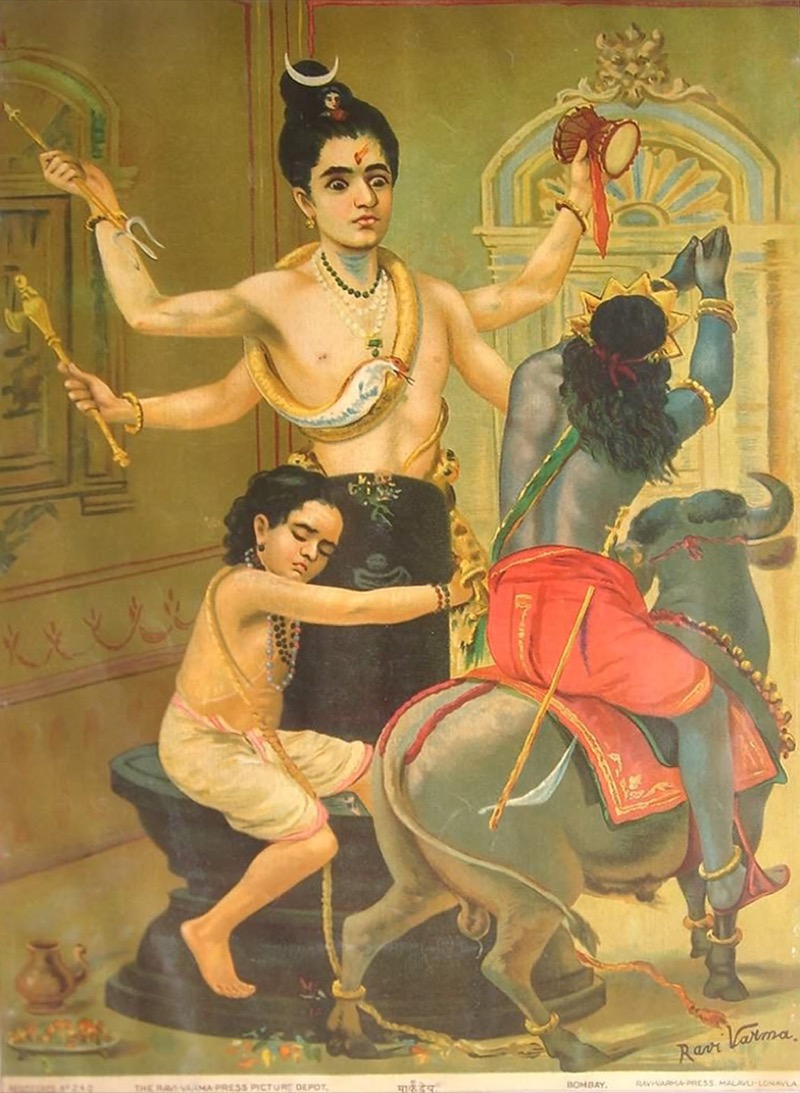
The Rudrāṣṭakam is an eight-verse hymn of extraordinary devotional power composed by Gosvāmī Tulasīdāsa (1532-1623 CE), the saint-poet who authored the immortal Śrī Rāmacaritamānasa. This hymn celebrates Lord Śiva in his aspect as Rudra — the cosmic roarer, the destroyer of evil, and the supreme bestower of liberation — painting a magnificent portrait of Śiva’s transcendent and immanent nature across eight carefully crafted stanzas in classical Sanskrit.
The Opening Verse
नमामीशमीशान निर्वाणरूपं विभुं व्यापकं ब्रह्मवेदस्वरूपम्। निजं निर्गुणं निर्विकल्पं निरीहं चिदाकाशमाकाशवासं भजेऽहम्॥
IAST Transliteration: Namāmīśam Īśāna Nirvāṇarūpaṃ Vibhuṃ Vyāpakaṃ Brahmavedasvarūpam | Nijaṃ Nirguṇaṃ Nirvikalpaṃ Nirīhaṃ Cidākāśam Ākāśavāsaṃ Bhaje’ham ||
Translation: “I bow to the Lord, the Supreme Ruler, whose form is liberation itself — all-pervading, omnipresent, the very embodiment of Brahman and the Vedas. I worship Him who is self-existent, beyond qualities (guṇas), beyond mental constructs, desireless, the consciousness-space, dwelling in the expanse of the sky.”
Tulasīdāsa: The Rāma Bhakta Who Worshipped Śiva
Understanding the Rudrāṣṭakam requires appreciating its composer’s unique theological position. Tulasīdāsa was, above all, a devotee of Lord Rāma. His magnum opus, the Rāmacaritamānasa, is the most beloved retelling of the Rāmāyaṇa in North India. Yet Tulasīdāsa was no sectarian — he recognised the profound unity of Rāma and Śiva, a theme that permeates his entire literary corpus.
In the Rāmacaritamānasa itself, Tulasīdāsa presents Śiva as the supreme devotee of Rāma and Rāma as the supreme object of Śiva’s devotion. The Bālakāṇḍa (1.108) declares: “Śiva is the greatest Vaiṣṇava, and Viṣṇu is the greatest Śaiva.” The Rudrāṣṭakam is Tulasīdāsa’s direct expression of this harmonious theology — a Rāma-bhakta’s loving hymn to the Lord whom Rāma himself worshipped.
Tradition holds that Tulasīdāsa composed the Rudrāṣṭakam in Kāśī (Vārāṇasī), the eternal city of Śiva, where he spent much of his later life. The hymn is believed to have been composed at the Tulasī Ghāṭ, the sacred bathing steps on the Gaṅgā named after the poet, where he reportedly experienced a vision of Śiva’s cosmic form.
Verse-by-Verse Analysis
Verse 1: The Transcendent Absolute
The hymn opens by addressing Śiva in his highest aspect — as Nirguṇa Brahman (the Absolute without qualities). The epithets nirvāṇarūpa (whose form is liberation), vibhu (all-pervading), vyāpaka (omnipresent), and brahma-veda-svarūpa (the embodiment of Brahman and the Vedas) place Śiva at the very summit of metaphysical reality. The phrase cidākāśa (consciousness-space) equates Śiva with the infinite awareness in which the entire universe appears and dissolves.
Verse 2: The Cosmic Form
निराकारमोङ्कारमूलं तुरीयं गिरा ज्ञान गोतीतमीशं गिरीशम्। करालं महाकाल कालं कृपालं गुणागार संसारपारं नतोऽहम्॥
“I bow to Him who is formless, the root of Oṃkāra, the Fourth State (Turīya), beyond speech, knowledge, and the senses — the Lord of mountains. I bow to the Terrible One, Mahākāla, Time itself, yet supremely compassionate — the abode of virtues, the far shore of saṃsāra.”
This verse masterfully juxtaposes Śiva’s terrifying and compassionate aspects. He is karāla (terrible) and kṛpāla (merciful), Mahākāla (the Great Time/Death) and yet the one who carries devotees across the ocean of saṃsāra. The reference to Turīya (the fourth state of consciousness beyond waking, dreaming, and deep sleep) draws directly from the Māṇḍūkya Upaniṣad, connecting Śiva to the highest Vedāntic realisation.
Verse 3: The Adorned Ascetic
तुषाराद्रि संकाश गौरं गभीरं मनोभूत कोटिप्रभा श्री शरीरम्। स्फुरन्मौलि कल्लोलिनी चारुगङ्गा लसद्भालबालेन्दु कण्ठे भुजङ्गा॥
“He whose body is fair as a snow-clad mountain, deep and profound, radiant with the splendour of a million Kāmadevas — from whose matted locks the beautiful Gaṅgā cascades, a crescent moon adorning his forehead, serpents encircling his neck.”
Tulasīdāsa here paints the iconic image of Śiva that lives in the Indian imagination: the ascetic who is simultaneously the most beautiful being in creation. The Gaṅgā flowing from his jaṭā (matted locks), the crescent moon (bālendu) on his brow, and the serpents (bhujaṅga) around his neck — these are the classic iconographic attributes detailed in the Śiva Purāṇa (Vidyeśvara Saṃhitā, chapters 9-10) and the Liṅga Purāṇa.
Verse 4: Śiva as the Universal Deity
चलत्कुण्डलं भ्रूसुनेत्रं विशालं प्रसन्नाननं नीलकण्ठं दयालम्। मृगाधीशचर्माम्बरं मुण्डमालं प्रियं शङ्करं सर्वनाथं भजामि॥
“I worship the beloved Śaṅkara, Lord of all — with swinging earrings, beautiful brows, expansive eyes, a serene countenance, blue throat (Nīlakaṇṭha), compassionate; wearing the skin of the lord of beasts (tiger-skin), garlanded with skulls — the Lord of all beings.”
The epithet Nīlakaṇṭha (blue-throated) refers to the famous myth of Samudra Manthana (the churning of the ocean), where Śiva swallowed the deadly hālāhala poison to save creation, turning his throat blue. This act, narrated in the Bhāgavata Purāṇa (8.7) and the Matsya Purāṇa, is the supreme example of Śiva’s compassion — willingly absorbing the world’s poison into himself.
Verse 5: The Cosmic Dancer and Destroyer
प्रचण्डं प्रकृष्टं प्रगल्भं परेशं अखण्डं अजं भानुकोटिप्रकाशम्। त्र्यः शूलनिर्मूलनं शूलपाणिं भजेऽहं भवानीपतिं भावगम्यम्॥
“I worship the Lord of Bhavānī (Pārvatī), who is accessible through devotion — the fierce one, the exalted, the bold, the Supreme Lord, undivided, unborn, radiant as a billion suns, the wielder of the trident who uproots all three afflictions.”
The triśūla (trident) is here given philosophical significance: it uproots the three types of suffering (tāpatraya) — ādhyātmika (arising from the self), ādhibhautika (arising from other beings), and ādhidaivika (arising from nature/cosmic forces). The phrase bhāvagamya (accessible through devotion/feeling) is theologically crucial — despite being the transcendent Absolute, Śiva is reached not through intellectual gymnastics but through the sincerity of the heart.
Verse 6: The Refuge of the Afflicted
कलातीत कल्याण कल्पान्तकारी सदा सज्जनानन्ददाता पुरारी। चिदानन्दसन्दोह मोहापहारी प्रसीद प्रसीद प्रभो मन्मथारी॥
“O destroyer of Kāma (Manmatha), be pleased, be pleased! You who transcend time, who are all-auspicious, who bring about the end of cosmic cycles, who always bestow joy upon the righteous, the destroyer of Tripura, the mass of consciousness-bliss, the remover of delusion.”
The repeated plea prasīda prasīda (be pleased, be pleased) introduces a note of intimate devotional urgency. The epithet Purārī (destroyer of the three cities) refers to the myth of Tripura-dahana, where Śiva destroyed the three aerial cities of the asuras with a single arrow — symbolising the destruction of the three bodies (gross, subtle, causal) or the three guṇas (sattva, rajas, tamas) that bind the soul.
Verse 7: The Lord of the Cremation Ground
न यावत् उमानाथ पादारविन्दं भजन्तीह लोके परे वा नराणाम्। न तावत् सुखं शान्ति सन्तापनाशं प्रसीद प्रभो सर्वभूताधिवासम्॥
“Until people worship the lotus feet of the Lord of Umā, neither in this world nor the next can they find happiness, peace, or the destruction of suffering. Be pleased, O Lord who dwells in all beings.”
This verse affirms that without Śiva’s grace, all worldly and otherworldly pursuits are futile. The epithet sarvabhūtādhivāsa (dwelling in all beings) echoes the Śvetāśvatara Upaniṣad (3.11): “He who pervades all beings, who is the one God hidden in all beings, all-pervading, the inner Self of all.”
Verse 8: The Ultimate Surrender
न जानामि योगं जपं नैव पूजां नतोऽहं सदा सर्वदा शम्भु तुभ्यम्। जरा जन्म दुःखौघ तातप्यमानं प्रभो पाहि आपन्नमामीश शम्भो॥
“I know neither yoga, nor japa, nor pūjā — yet I bow to you always and forever, O Śambhu. Scorched by the flood of sorrows arising from old age and birth, O Lord, O Śambhu, protect this helpless one who has come to you.”
The final verse is a masterpiece of devotional humility. After seven verses of magnificent theological praise, Tulasīdāsa strips away all pretence of spiritual accomplishment. The devotee confesses complete ignorance of yoga, japa, and pūjā — and throws himself entirely upon Śiva’s mercy. This śaraṇāgati (complete surrender) is the highest form of devotion in both Śaiva and Vaiṣṇava theology.
Connection to Kāśī (Vārāṇasī)
The Rudrāṣṭakam is inseparable from Kāśī, the city that Śiva himself is said to never leave. The Kāśī Khaṇḍa of the Skanda Purāṇa declares that Vārāṇasī rests on the tip of Śiva’s trident, suspended above the earth even during cosmic dissolution. Tulasīdāsa lived in Kāśī for decades, composing most of his works at Tulasī Ghāṭ and the Saṅkaṭ Mocana Hanumān Mandira.
The Rudrāṣṭakam is traditionally chanted during the evening āratī at the Kāśī Viśvanātha Temple, the most sacred Śiva temple in India. The sound of this hymn rising above the ghāṭs of the Gaṅgā at dusk, accompanied by the clanging of temple bells and the flickering of oil lamps, is one of the most powerful devotional experiences in all of Hinduism.
The hymn is also chanted during the Mahāśivarātri celebrations at Kāśī, when millions of pilgrims gather to worship Śiva through the night with fasting, chanting, and abhiṣeka of the Viśvanātha Liṅga.
Significance in Śaivite Worship
The Rudrāṣṭakam occupies a special place in the daily worship of Śiva across North India. It is chanted:
- During morning and evening pūjā in Śiva temples
- As part of the Śiva Abhiṣeka (ritual bathing of the liṅga)
- During Mahāśivarātri vigil
- In the Sāyam Āratī (evening worship) at major Śiva temples
- As a daily devotional practice (nitya pāṭha) by Śiva devotees
The hymn’s language is accessible yet profound, making it beloved by both Sanskrit scholars and ordinary devotees. Unlike the Vedic Śrī Rudram (Taittirīya Saṃhitā 4.5), which requires initiation and proper Vedic pronunciation, the Rudrāṣṭakam can be chanted by anyone with devotion, making Rudra-worship accessible to all.
Place in the Rāmacaritamānasa Tradition
While the Rudrāṣṭakam is not part of the Rāmacaritamānasa text itself, it is deeply connected to Tulasīdāsa’s broader literary and devotional corpus. In the Vinaya Patrikā (Petition of Humility), Tulasīdāsa addresses numerous poems to Śiva, expressing the same theology found in the Rudrāṣṭakam — Śiva as the supreme lord who is simultaneously Rāma’s greatest devotee.
The Rāmacaritamānasa’s Uttarakāṇḍa contains a beautiful passage where Śiva explains to Pārvatī that Rāma and he are one: “The devotees of Rāma are dear to me, and my devotees are dear to Rāma. There is no difference between us.” The Rudrāṣṭakam embodies this Rāma-Śiva unity in every verse — a Rāma-bhakta’s adoration of the Lord who is the very form of liberation (nirvāṇarūpa).
The Living Tradition
Today, the Rudrāṣṭakam echoes daily across thousands of temples, ashrams, and homes throughout India and the diaspora. Its eight verses capture the totality of Śiva — from the formless Absolute to the compassionate Lord with matted locks and a crescent moon, from the cosmic destroyer to the refuge of the helpless. In Tulasīdāsa’s hands, the ancient Vedic Rudra becomes a living presence, as close and tender as a parent yet as vast and terrible as the fire at the end of time. For the devotee who chants these verses with sincerity, the Rudrāṣṭakam remains what it has always been — a direct path to the lotus feet of Mahādeva.