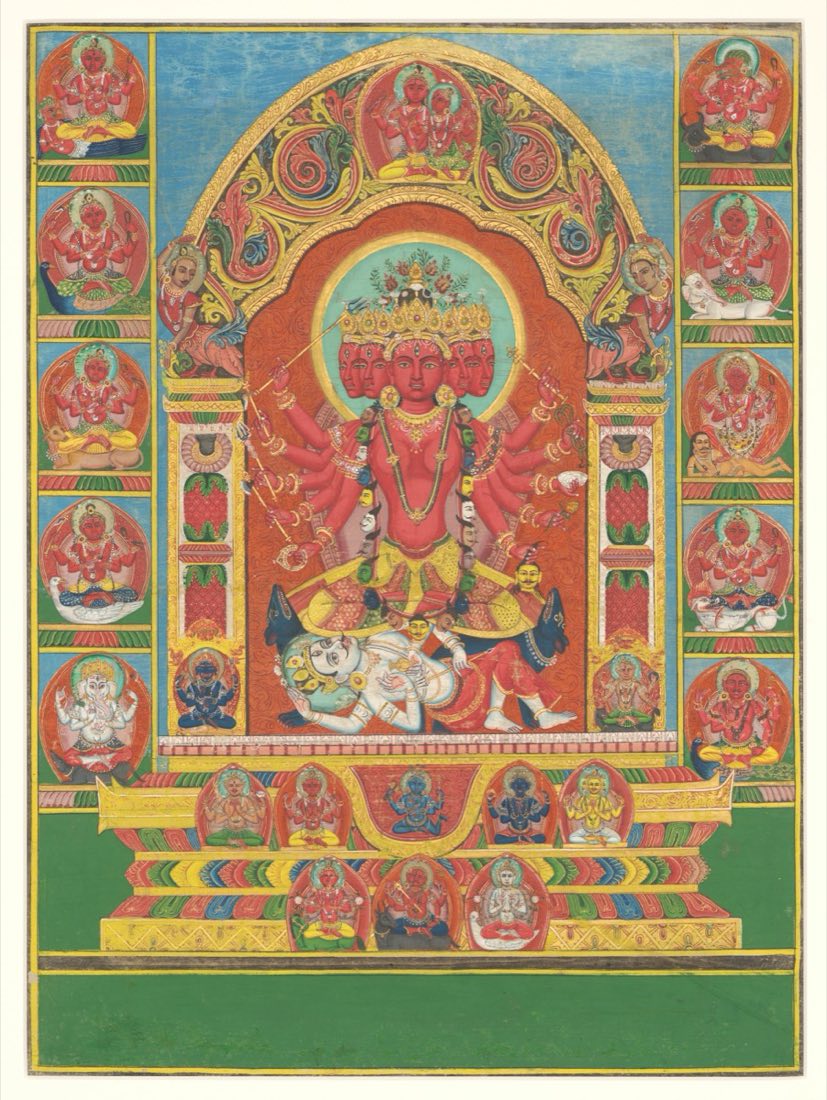
The Saundaryalaharī (“Waves of Beauty”) is one of the most celebrated devotional hymns in all of Sanskrit literature. Attributed to Ādi Śaṅkarācārya (c. 788-820 CE), the great Advaita Vedāntin who is equally revered as a supreme devotee of the Devī, this hundred-verse poem praises the beauty, grace, and omnipotence of the Divine Mother in her form as Tripurasundarī — the most beautiful goddess who pervades the three worlds of waking, dreaming, and deep sleep.
Far more than a devotional poem, the Saundaryalaharī is simultaneously a Tantric textbook, encoding instructions for Śrīvidyā worship, Śrī Yantra meditation, and the invocation of specific divine powers. Every verse is said to function as an independent mantra with its own yantra, mantra, and phalashruti (fruit of recitation).
The Complete Opening Verse
शिवः शक्त्या युक्तो यदि भवति शक्तः प्रभवितुं न चेदेवं देवो न खलु कुशलः स्पन्दितुमपि। अतस्त्वामाराध्यां हरिहरविरिञ्चादिभिरपि प्रणन्तुं स्तोतुं वा कथमकृतपुण्यः प्रभवति॥१॥
IAST Transliteration: Śivaḥ śaktyā yukto yadi bhavati śaktaḥ prabhavituṃ na cedevaṃ devo na khalu kuśalaḥ spanditum api | Atas tvām ārādhyāṃ Hari-Hara-Viriñcādibhir api praṇantuṃ stotuṃ vā katham akṛtapuṇyaḥ prabhavati ||1||
Translation: “Only when united with Śakti does Śiva become capable of creating; otherwise, the Lord is not able even to stir. Therefore, how can one who has not accumulated merit be capable of saluting or praising You, who are worshipped even by Hari (Viṣṇu), Hara (Śiva), and Viriñca (Brahmā)?”
Structure and Composition
The Saundaryalaharī is divided into two distinct sections:
Part I: Ānandalaharī — “Waves of Bliss” (Verses 1-41)
The first forty-one verses are called the Ānandalaharī and are believed, according to tradition, to be of divine origin — revealed to Śaṅkarācārya by Lord Śiva himself at Kailāsa. These verses are primarily Tantric in nature, dealing with:
- The metaphysical relationship between Śiva (pure consciousness) and Śakti (dynamic creative energy)
- The kuṇḍalinī and the cakra system of the subtle body
- The Śrī Yantra and its mystical geometry
- The ascending power of Śrīvidyā worship
- The Pañcadaśī and Ṣoḍaśī mantras of the Devī
Part II: Saundaryalaharī — “Waves of Beauty” (Verses 42-100)
The remaining fifty-nine verses are attributed to Śaṅkarācārya’s own poetic genius. These verses are primarily descriptive (stuti), praising the physical beauty of the Devī from her crown to her feet in the classic keśādi-pādānta (head-to-toe) or pādādi-keśānta (toe-to-head) format:
- Her radiant face compared to the full moon
- Her eyes like lotuses, casting sidelong glances of grace
- Her smile that puts the autumn moon to shame
- Her voice sweeter than the vīṇā
- Her arms, waist, gait, and every bodily feature described as manifestations of divine perfection
Key Verses and Their Significance
Verse 1: The Primacy of Śakti
The opening verse (quoted above) establishes the fundamental Śākta philosophical principle: without Śakti, Śiva is inert (śava, “corpse”). This encapsulates the Tantric axiom that consciousness (Śiva) requires energy (Śakti) to manifest as creation. The verse simultaneously establishes a hierarchy in which the Devī is supreme — even the Trimūrti (Brahmā, Viṣṇu, and Śiva) worship her.
Verse 8: The Sacred Geography of the Subtle Body
सुधासिन्धोर्मध्ये सुरविटपिवाटीपरिवृते मणिद्वीपे नीपोपवनवति चिन्तामणिगृहे।
“In the midst of the ocean of nectar, surrounded by a garden of celestial wish-fulfilling trees, in a grove of kadamba trees, within a mansion made of cintāmaṇi gems…”
This verse describes the Śrīpura — the divine abode of the Devī at the centre of the Śrī Yantra. The imagery maps directly onto the mystical geography used in Śrīvidyā meditation, where the practitioner visualizes ascending through concentric enclosures (āvaraṇas) of the Śrī Yantra to reach the central bindu where the Devī resides in union with Kāmeśvara.
Verse 14: The Śrī Yantra
क्षितौ षट्पञ्चाशद्द्विसमधिकपञ्चाशदुदके
This verse encodes the structure of the Śrī Yantra — the supreme geometric symbol of Śākta worship — which consists of nine interlocking triangles forming 43 smaller triangles, surrounded by lotus petals and a square bhūpura (earth enclosure). The numbers mentioned in the verse correspond to the marma sthānas (vital points) of the yantra.
Verse 32: The Kuṇḍalinī
शिवः शक्तिः कामः क्षितिरथ रविः शीतकिरणः
This verse describes the ascent of the kuṇḍalinī śakti through the six cakras — from the Mūlādhāra at the base of the spine to the Sahasrāra at the crown — where she unites with Śiva. Each cakra is presided over by specific deities named in the verse: Śiva (earth), Śakti (water), Kāma (fire), Kṣiti (earth element), Ravi (sun, fire), and Śītakiraṇa (moon, nectar).
Verse 42: The Transition Point
Verse 42 marks the transition from the Tantric Ānandalaharī to the descriptive Saundaryalaharī:
गतैर्माणिक्यत्वं गगनमणिभिः सान्द्रघटितं किरीटं ते हैमं हिमगिरिसुते कीर्तयति यः।
“O Daughter of the Himālaya! He who praises your golden crown, thickly studded with gems that are the twelve Ādityas (suns), transformed into rubies…”
This begins the keśādi-pādānta description, starting from the Devī’s crown and moving downward.
Philosophical Foundations
The Śiva-Śakti Tattva
The Saundaryalaharī articulates the core Śākta philosophical position: Śiva and Śakti are not two separate realities but two aspects of one supreme consciousness. Śiva is the static, witnessing awareness; Śakti is the dynamic power that projects, sustains, and reabsorbs the universe. Their relationship is described through the analogy of fire and its burning power — inseparable yet distinguishable.
This position is also fully compatible with Advaita Vedānta, which Śaṅkara championed. In the Advaita framework, Śakti is understood as Māyā — the inscrutable power of Brahman by which the non-dual Absolute appears as the manifold world. The Devī, in this reading, is Brahman’s own creative power, not an entity separate from Brahman.
Śrīvidyā and the Pañcadaśī Mantra
The Saundaryalaharī is intimately linked to the Śrīvidyā tradition, one of the most sophisticated schools of Hindu Tantra. The Pañcadaśī mantra — the fifteen-syllable mantra of Tripurasundarī — is encoded in several verses, particularly in the Ānandalaharī section. The three kūṭas (divisions) of the mantra — Vāgbhava, Kāmarāja, and Śakti — correspond to the three sections of the Śrī Yantra and the three cosmic functions of creation, preservation, and dissolution.
Tantra as Devotion
What makes the Saundaryalaharī remarkable is its fusion of rigorous Tantric metaphysics with overflowing devotional love (bhakti). Śaṅkarācārya — often portrayed in popular imagination as a dry philosopher of non-dualism — here reveals himself as an ecstatic poet of divine beauty. The hymn demonstrates that in the Hindu tradition, jñāna (knowledge) and bhakti (devotion) are not opposed but complementary paths that converge at the highest realization.
The Legend of Its Composition
According to the Śaṅkaravijaya (hagiographies of Śaṅkara), the sage once visited Mount Kailāsa, the abode of Śiva and Pārvatī. There, Śiva presented him with a manuscript of 100 verses praising the Devī. As Śaṅkara was descending the mountain, Nandīśvara (Śiva’s attendant), jealous of this gift, snatched the manuscript from his hands. Śaṅkara could only retain the first 41 verses. He then composed the remaining 59 verses himself, creating what we know as the complete Saundaryalaharī.
This legend accounts for the two-part structure of the hymn and the observable difference in tone — the Ānandalaharī being more esoteric and Tantric, while the Saundaryalaharī is more lyrical and descriptive.
Commentarial Tradition
The Saundaryalaharī has attracted more commentaries than almost any other Sanskrit devotional text. Among the most important are:
-
Lakṣmīdharā (c. 16th century) — The most widely studied commentary, providing detailed explanations of the Tantric symbolism and the yantra associated with each verse.
-
Kāmeśvarasūri — An early commentary emphasizing the Śrīvidyā interpretations and the relationship between the verses and the Śrī Yantra.
-
Kaivalyāśrama — A commentary from the Śṛṅgeri maṭha tradition, focusing on the Advaita Vedāntic dimensions of each verse.
-
Ānandagiri — A disciple of Śaṅkara’s tradition who composed a ṭīkā (sub-commentary) elucidating the philosophical underpinnings.
Ritual Use and Practice
Daily Recitation
The complete Saundaryalaharī is recited as a daily stotra (hymn) by devotees of the Devī, particularly those initiated into the Śrīvidyā tradition. The recitation is typically performed:
- During the three sandhyās (dawn, noon, dusk)
- On Fridays (sacred to the Devī)
- During Navarātri (the nine nights of the Goddess)
- On Pūrṇimā (full moon days)
Individual Verse Worship
A unique feature of the Saundaryalaharī is that each verse can be worshipped independently as a mantra for specific purposes. Traditional texts prescribe:
- Verse 1 — For spiritual power and overcoming obstacles
- Verse 3 — For success in learning and knowledge
- Verse 6 — For protection from enemies
- Verse 18 — For attainment of poetic skill
- Verse 22 — For removal of fear
- Verse 98 — For attainment of mokṣa (liberation)
Each verse has an associated yantra (geometric diagram), a specific bīja mantra (seed syllable), and a prescribed number of repetitions for the japa (recitation) to be effective.
Pūjā with the Śrī Yantra
The Saundaryalaharī is considered inseparable from the Śrī Yantra — the supreme yantra of the Śākta tradition. Many practitioners recite the hymn while meditating upon the Śrī Yantra, visualizing the progressive āvaraṇas (enclosures) of the yantra as they move through the verses. The central bindu (point) of the Śrī Yantra represents the ultimate union of Śiva and Śakti — the goal of both the meditation and the hymn.
Literary Excellence
The Saundaryalaharī is celebrated not only for its spiritual content but also for its extraordinary literary artistry. Śaṅkara employs virtually every alaṅkāra (ornament of poetry) known to Sanskrit poetics:
- Upamā (simile): The Devī’s face is compared to the full moon, her eyes to blue lotuses
- Rūpaka (metaphor): Her eyebrows are Kāma’s bow, her glance his arrow
- Atiśayokti (hyperbole): Even the Creator could not fashion such beauty
- Svabhāvokti (natural description): Direct evocations of colour, texture, and movement
- Yamaka (punning): Wordplay involving Śiva/śiva (auspicious), Śakti/śakta (able)
The metre used throughout is Śikhariṇī (17 syllables per quarter), whose flowing rhythm is considered especially appropriate for devotional poetry addressed to the Devī.
The Goddess Tripurasundarī
The Devī praised in the Saundaryalaharī is specifically Tripurasundarī — “the most beautiful in the three worlds” — also known as Lalitā, Ṣoḍaśī, Rājarājeśvarī, and Kāmeśvarī. She is one of the Daśa Mahāvidyās (Ten Great Wisdom Goddesses) and the presiding deity of the Śrīvidyā tradition.
Tripurasundarī is depicted as a sixteen-year-old maiden (ṣoḍaśī) of incomparable beauty, seated on a throne supported by the five forms of Śiva (Brahmā, Viṣṇu, Rudra, Īśvara, and Sadāśiva). She holds a sugarcane bow (representing the mind), five flower arrows (the five sense objects), a pāśa (noose, representing attachment), and an aṅkuśa (goad, representing aversion).
Her worship represents the highest form of Śākta sādhanā, in which the devotee realizes that the entire universe — with all its beauty, diversity, and dynamism — is nothing other than the play (līlā) of the Divine Mother’s limitless consciousness.
The Enduring Legacy
The Saundaryalaharī has been continuously recited, studied, and commented upon for over a thousand years. It is chanted daily in Śṛṅgeri, Kāñcī, and other maṭhas (monastic centres) established by Śaṅkarācārya. It remains central to the worship of millions of Devī devotees across India, from scholarly Tantric practitioners to simple householders who recite its verses for protection and blessing.
The hymn stands as a supreme testament to the Hindu vision that the Absolute is not cold, abstract, or distant — but infinitely beautiful, intimately present, and overwhelmingly gracious. In Śaṅkarācārya’s words (verse 100):
“O Mother, even if I have committed any error in the worship of your mantra, yantra, or in the seating arrangements, or in the invocation, meditation, offerings, or dismissal — may all that be forgiven, for you are the ocean of compassion.”