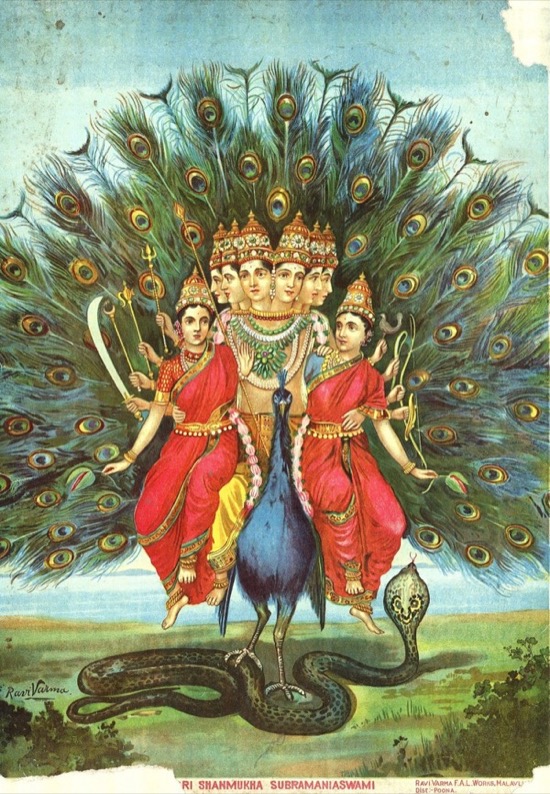
The Subrahmaṇya Aṣṭakam (सुब्रह्मण्य अष्टकम्) is a revered eight-verse hymn attributed to Ādi Śaṅkarācārya (c. 788—820 CE), the supreme exponent of Advaita Vedānta and one of the most influential philosophers in Hindu history. This stotra is addressed to Lord Subrahmaṇya — known also as Murugan, Kārttikēya, Skanda, Kumāra, and Ṣaṇmukha — the divine commander of the celestial armies and the son of Lord Śiva and Goddess Pārvatī. Each of the eight verses concludes with the same heartfelt refrain: “Vallīsanātha mama dēhi karāvalambam” — “O Lord of Vallī, extend to me the support of your hand.”
Ādi Śaṅkarācārya and the Worship of Subrahmaṇya
Ādi Śaṅkara is best known for his Advaita (non-dual) philosophy and his commentaries on the Upaniṣads, Brahma Sūtras, and Bhagavad Gītā. However, he was also a prolific composer of devotional hymns (stotras) to a wide range of deities, including Śiva, Viṣṇu, Devī, Gaṇeśa, and Subrahmaṇya. This apparent paradox — a philosopher of non-duality composing prayers to personal gods — is resolved within Śaṅkara’s own framework of vyāvahārika (conventional) and pāramārthika (ultimate) truth. At the conventional level, devotion to divine forms is both valid and necessary; at the ultimate level, all forms resolve into Brahman.
Śaṅkara’s connection to Subrahmaṇya worship is historically grounded. He was born in Kerala, a region with deep roots in Murugan worship. The Tamil Sangam literature — the earliest stratum of Murugan devotion — identifies this deity with the hills, the spear (vēl), and the martial spirit of the southern landscape. Śaṅkara, though writing in Sanskrit, would have been intimately familiar with this living tradition.
The Skanda Purāṇa Background
The theology underlying the Subrahmaṇya Aṣṭakam draws heavily from the Skanda Purāṇa, the largest of the eighteen Mahāpurāṇas, dedicated to the glory of Lord Skanda-Subrahmaṇya. The Purāṇa narrates:
- The birth of Skanda: Born from the fiery seed of Lord Śiva, received by Agni and then Gaṅgā, and nurtured by the six Kṛttikā stars (the Pleiades) — hence his name Kārttikēya (Skanda Purāṇa, Kumāra Khaṇḍa 1.1—1.20)
- The slaying of Tārakāsura: The asura Tāraka had obtained a boon that only a son of Śiva could defeat him. Skanda, born for this cosmic purpose, slew Tāraka and liberated the gods (Skanda Purāṇa, Kumāra Khaṇḍa 2.15—2.40)
- The six faces (Ṣaṇmukha): When the six Kṛttikā mothers each claimed him as their own, Skanda assumed six faces so that he could nurse from all six simultaneously — hence his epithet Ṣaṇmukha (“six-faced”)
- The marriage to Vallī and Devasenā: Subrahmaṇya married two consorts — Devasenā (the divine army, daughter of Indra) and Vallī (a tribal princess devoted to him). The Aṣṭakam’s refrain specifically invokes him as Vallīsanātha (“Lord of Vallī”)
Verse-by-Verse Analysis
Verse 1: The Plea for Support
हे स्वामिनाथ करुणाकर दीनबन्धो श्रीपार्वतीशमुखपंकजपद्मबन्धो।
“O Svāminātha, compassionate one, friend of the destitute, O you who are bound to the lotus face of Pārvatī’s Lord…”
The opening verse establishes Subrahmaṇya’s essential nature: he is karuṇākara (maker of compassion), dīnabandhu (friend of the wretched), and the beloved son of Śiva and Pārvatī. The compound Śrīpārvatīśamukhapan̄kajapadmabandho is a masterpiece of Sanskrit compounding: “O you who are connected to the lotus-face of the Lord of Śrī Pārvatī” — simultaneously identifying Subrahmaṇya as the son of Śiva and as one who reflects the beauty of his father’s divine countenance.
Verse 2: The Destroyer of Tārakāsura
The second verse praises Subrahmaṇya as the Senāpati (commander-in-chief) of the Deva army and the slayer of the demon Tārakāsura. Śaṅkara invokes the memory of the cosmic battle in which Skanda, wielding his invincible Śakti (spear), destroyed the asura whose tyranny had terrorized the three worlds. The verse implicitly argues: one who defeated the mightiest of demons can surely rescue a single devotee from worldly affliction.
Verse 3: The Six-Faced One
This verse celebrates the Ṣaṇmukha form — the six divine faces of Subrahmaṇya, each radiating distinct qualities:
- Grace (prasāda) toward devotees
- Fierceness (ugratā) toward evil
- Wisdom (jñāna) for the seekers
- Compassion (karuṇā) for the suffering
- Bliss (ānanda) in divine play
- Sovereignty (aiśvarya) over creation
The six faces also correspond to the six directions of space, symbolizing Subrahmaṇya’s omnipresence. Śaṅkara, the Advaita philosopher, would see in this multiplicity-within-unity a reflection of Brahman manifesting through diverse forms.
Verse 4: The Son of Śiva and Gaṅgā
The fourth verse celebrates Subrahmaṇya’s dual parentage: born from Śiva’s divine energy and received by Gaṅgā (the sacred river), he is simultaneously the child of fire and water, asceticism and flow. The verse references his epithet Gāṅgēya (“son of Gaṅgā”) and connects his birth to the cosmic need for a protector of Dharma.
Verse 5: The Divine Youth (Kumāra)
This verse praises Subrahmaṇya as the eternally youthful Kumāra — radiant, beautiful, and forever at the prime of divine vigour. His youth is not merely physical but metaphysical: he represents the ever-fresh, ever-renewing power of cosmic creation. The verse describes his ornaments, his peacock mount (Mayūra), and his spear (Vēl/Śakti), the weapon that symbolizes the piercing power of spiritual knowledge.
Verse 6: The Guru of the Gods
A remarkable verse in which Śaṅkara celebrates Subrahmaṇya as Svāminātha — literally, “the Lord’s Lord” or “the Guru of the Master.” This epithet derives from the celebrated episode in which young Skanda instructed his own father, Śiva, in the meaning of the Praṇava (Oṃ). When Brahmā could not explain the Praṇava satisfactorily, Subrahmaṇya imprisoned him. Śiva then approached his son, who whispered the supreme meaning of Oṃ into Śiva’s ear — becoming, in that moment, the guru of the universe’s guru. The temple at Svāmimalai in Tamil Nadu commemorates this event.
Verse 7: The Lord of Vallī
The seventh verse focuses on Subrahmaṇya’s marriage to Vallī, the daughter of the tribal chieftain Nambirājan. Unlike the formal divine marriage to Devasenā, the union with Vallī represents the spontaneous, passionate love between God and the individual soul. Vallī, a simple hunter-gatherer girl, won the Lord’s love through the intensity of her devotion. In Śaiva Siddhānta theology, Vallī represents the jīva (individual soul) and Subrahmaṇya represents Śiva — their marriage symbolizes the soul’s union with God.
Verse 8: The Final Plea
The concluding verse gathers all the epithets and attributes invoked in the preceding seven stanzas into a single, comprehensive plea. Śaṅkara addresses Subrahmaṇya as the embodiment of all divine qualities and begs for the support of his hand (karāvalambam) — the hand that wields the Śakti spear, the hand that blesses devotees, the hand that upholds the cosmos.
The Refrain: Karāvalambam
The recurring phrase “mama dēhi karāvalambam” (“give me the support of your hand”) is the emotional and theological heart of the Aṣṭakam. The Sanskrit word avalambam (support, refuge, that which one hangs upon) conveys total dependence. The image is of a drowning person reaching for a hand — and Subrahmaṇya’s hand is the one that never fails to grasp.
This refrain connects the Aṣṭakam to the broader genre of karāvalamba stotras in Sanskrit literature, which share the common theme of the devotee’s absolute helplessness and the deity’s unfailing rescue.
The Six Abodes (Āṟupadai Vīḍu)
The theology of the Subrahmaṇya Aṣṭakam resonates deeply with the Tamil tradition of the Āṟupadai Vīḍu — the six sacred abodes of Lord Murugan in Tamil Nadu:
- Tiruttaṇi — where Murugan rested after defeating Sūrapadma
- Svāmimalai — where he taught the Praṇava to Śiva
- Palani (Paḻani) — where he stands as a renunciant (Daṇḍāyudhapāṇi)
- Tiruchendur — the seaside shrine where he battled Sūrapadma
- Tirupparankundram — where he married Devasenā
- Pazhamudircholai — the lush garden-temple in the Madurai hills
These six temples correspond to the six faces, the six directions, and the six stages of the soul’s journey toward liberation. Pilgrimage to all six temples (Āṟupadai Vīḍu yātrā) is one of the most important devotional practices in Tamil Śaivism.
Significance in South Indian Worship
Tamil Nadu
In Tamil Nadu, Subrahmaṇya (Murugan) is not merely one deity among many — he is the presiding deity of Tamil culture, celebrated in the ancient Sangam literature as Cēyōṉ (“the Red One”) and Murukaṉ (“the Beautiful Youth”). The Subrahmaṇya Aṣṭakam, though composed in Sanskrit, is widely recited in Tamil temples alongside Tamil devotional works like Aruṇagirinātar’s Tiruppugazh and Nakkirar’s Tirumurugatrupadai.
Kārttikai Dīpam and Thai Pūsam
The Aṣṭakam is recited during the great Murugan festivals:
- Kārttikai Dīpam (November-December): Celebrating Skanda’s birth under the Kṛttikā stars, when a massive flame is lit atop Tiruvannamalai hill
- Thai Pūsam (January-February): The most important Murugan festival, marked by spectacular processions, kavadi-bearing devotees, and mass recitations of Subrahmaṇya stotras
- Skanda Ṣaṣṭhī (October-November): A six-day festival commemorating Skanda’s victory over Sūrapadma
Karnataka, Andhra Pradesh, and Kerala
Subrahmaṇya worship extends across South India. In Karnataka, the Kukke Subrahmaṇya Temple is one of the most visited pilgrimage sites. In Kerala, Śaṅkara’s homeland, the deity is worshipped as Subrahmaṇya Svāmī in numerous temples. The Aṣṭakam’s Sanskrit medium makes it the common liturgical text across all these regional traditions.
Philosophical Dimensions
For Śaṅkara, the Aṣṭakam operates on multiple levels:
- Devotional: At the simplest level, it is a heartfelt prayer for divine protection
- Theological: It encodes the complete mythology and theology of Subrahmaṇya from the Skanda Purāṇa
- Advaitic: The plea for karāvalambam can be read as the jīva’s prayer for the knowledge (jñāna) that dissolves the illusion of separation from Brahman — Subrahmaṇya, the guru who taught Oṃ to Śiva, being the supreme bestower of this knowledge
The hymn thus bridges the gap between saguna (with attributes) and nirguna (without attributes) worship — a characteristic signature of Śaṅkara’s devotional works.
Scripture References
- Skanda Purāṇa, Kumāra Khaṇḍa (birth and exploits of Skanda)
- Śiva Purāṇa, Kumāra Khaṇḍa (Tārakāsura-vadha)
- Tiruppugazh by Aruṇagirinātar (Tamil devotional songs to Murugan)
- Tirumurugatrupadai by Nakkirar (earliest guide to Murugan’s six abodes)
- Chāndogya Upaniṣad 7.26.2 (Sanatkumāra, identified with Skanda, as teacher)
- Bhagavad Gītā 10.24: “senānīnām ahaṃ Skandaḥ” — “Among generals, I am Skanda”
The Subrahmaṇya Aṣṭakam distils the vast mythology and deep theology of one of Hinduism’s most beloved deities into eight luminous verses. In its repeated plea for the support of the Lord’s hand, it speaks to the universal human experience of vulnerability and the devotee’s unshakeable faith that divine help is always within reach. Whether recited in the great temples of Tamil Nadu, in a Karnataka village shrine, or in the quiet of one’s own home, these verses continue to carry the prayers of millions to the feet of the eternal Kumāra.