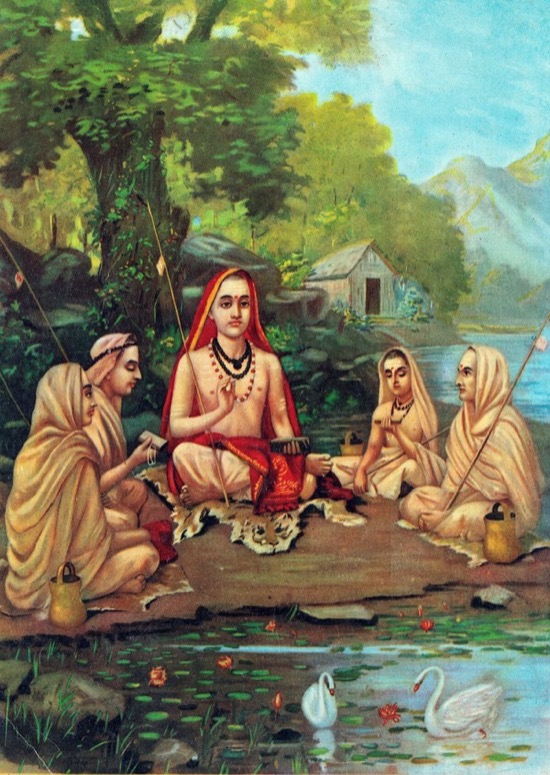
The Toṭakāṣṭakam (तोटकाष्टकम्, “Eight Verses in the Toṭaka Metre”) is a luminous Sanskrit hymn of eight stanzas composed by Toṭakācārya, one of the four principal disciples of Ādi Śaṅkarācārya (c. 788—820 CE), the great philosopher-saint who revitalized Hindu thought and established the four monastic seats (maṭhas) that endure to this day. The poem is at once a masterpiece of Sanskrit prosody, a concentrated expression of Advaita Vedānta philosophy, and a profound testament to the transformative power of the guru-disciple relationship. Every verse concludes with the refrain “Bhava Śaṅkara-deśika me śaraṇam” — “Be my refuge, O Śaṅkara, my teacher.”
Toṭakācārya: The Disciple Who Found His Voice
The Four Pillars of Śaṅkara’s Mission
Ādi Śaṅkarācārya, in his brief life of approximately 32 years, not only composed epochal philosophical works but also founded a monastic order to preserve and transmit the Advaita tradition. He appointed four principal disciples to head four maṭhas (monasteries) at the cardinal points of India:
- Padmapādācārya — Govardhana Maṭha, Purī (East)
- Sureśvarācārya — Śṛṅgeri Śāradā Pīṭham, Śṛṅgeri (South)
- Hastāmalakācārya — Dvārakā Pīṭha, Dvārakā (West)
- Toṭakācārya — Jyotir Maṭha, Joshimath (North)
Each disciple was distinguished by particular qualities: Padmapāda by his fierce devotion, Sureśvara by his philosophical rigour, Hastāmalaka by his innate Self-knowledge, and Toṭaka by the miraculous flowering of his poetic and intellectual gifts through the grace of the guru.
The Story of Giri
The traditional hagiographies (Śaṅkara-vijayas), including the Mādhavīya Śaṅkara Vijaya and the Cidvilāsa Śaṅkara Vijaya, relate that Toṭakācārya’s original name was Giri (also given as Ānandagiri in some accounts). He was an earnest but intellectually ordinary student who joined Śaṅkara’s monastic community. While his fellow students excelled in scriptural debate and philosophical analysis, Giri distinguished himself only by his selfless service to the guru — washing Śaṅkara’s clothes, preparing his meals, and attending to every physical need with tireless devotion.
The other disciples reportedly looked down upon Giri, viewing him as a well-meaning simpleton incapable of grasping the subtleties of Advaita Vedānta. The Mādhavīya Śaṅkara Vijaya (8.63—68) narrates a telling episode: one day, Śaṅkara was about to begin a discourse on the Upaniṣads but delayed the start, waiting for Giri, who was at the river washing the guru’s garments. When the other students grew impatient and suggested beginning without Giri, Śaṅkara refused, saying that his devoted servant deserved to be present.
The Miracle at the Riverbank
What happened next is the defining miracle of Toṭaka’s hagiography. Through the force of his compassion and the mysterious operation of spiritual grace (anugraha), Śaṅkara transferred the power of poetic composition and philosophical insight directly into Giri’s consciousness. Giri, who moments before could barely follow a philosophical argument, suddenly felt an irresistible surge of inspiration. He returned from the river not with washed clothes but with the eight stanzas of the Toṭakāṣṭakam flowing from his lips — a perfect poem in a demanding metre, dense with Advaita philosophy, and radiant with devotional fervour.
The other disciples were astonished. The formerly “simple” Giri had, in an instant, become a master poet and philosopher. From that day forward, he was known as Toṭakācārya — “the teacher of the Toṭaka [metre]” — named after the very metre of the poem that announced his transformation.
This story carries a profound theological message: intellectual brilliance is not the prerequisite for spiritual attainment. Guru-bhakti (devotion to the teacher) can open doors that mere scholarship cannot. Giri’s selfless service prepared the vessel; the guru’s grace filled it.
The Toṭaka Metre
The poem is composed in the Toṭaka metre (chandas), a sophisticated rhythmic pattern defined in classical Sanskrit prosody (Piṅgala’s Chandaḥśāstra and later works). The Toṭaka metre consists of four pādas (lines) of twelve syllables each, following the pattern:
⏑ ⏑ – ⏑ ⏑ – ⏑ ⏑ – ⏑ ⏑ – (sa sa sa sa)
Where ⏑ represents a short (laghu) syllable and – represents a long (guru) syllable. Each pāda is made up of four repetitions of the tribrach-iamb foot (sa-gaṇa: ⏑⏑–), creating a rolling, wave-like rhythm that is both hypnotic and exhilarating.
The Toṭaka metre is exceptionally difficult to sustain without awkwardness, as the relentless alternation of short-short-long demands precise control of syllabic quantity. That a supposedly uneducated disciple produced flawless Toṭaka verses spontaneously is the very point of the miracle — the perfection of the metre is the proof of divine grace.
Verse-by-Verse Analysis
Verse 1: Ocean of All Scripture
विदिताखिलशास्त्रसुधाजलधे महितोपनिषत्कथितार्थनिधे। हृदये कलये विमलं चरणं भव शंकरदेशिक मे शरणम्॥
“O you who are the ocean of the nectar of all known scriptures, O treasury of the truths declared by the honoured Upaniṣads — I meditate in my heart upon your pure feet. Be my refuge, O Śaṅkara, my teacher.”
The opening verse establishes Śaṅkara’s authority in two dimensions: he has mastered all śāstras (scriptures and sciences), and he is the living repository of Upaniṣadic truth. The metaphor of the “nectar-ocean” (sudhājaladhi) suggests inexhaustible wisdom, while kathitārthanidhi (“treasury of declared meanings”) emphasizes that Śaṅkara does not merely possess knowledge but actively communicates it. The devotee’s response is to place the guru’s vimala caraṇa (pure feet) in the hṛdaya (heart) — the seat of consciousness.
Verse 2: Destroyer of the Bondage of Saṃsāra
The second verse praises Śaṅkara as the one who severs the bonds of worldly existence (saṃsāra). The key term here is bhava-ambunidhi — the ocean of becoming, the endless cycle of birth and death. Śaṅkara is the helmsman who guides the soul across this ocean. For the Advaitin, saṃsāra is not a physical process but a cognitive error — the misidentification of the Self with the body-mind complex — and the guru is the one who corrects this error through the transmission of knowledge.
Verse 3: The Teacher of Non-Duality
This verse celebrates Śaṅkara’s central philosophical teaching: Advaita — the non-duality of Ātman (Self) and Brahman (Absolute Reality). Toṭaka praises his guru as one who has realized that the multiplicity of the phenomenal world is māyā (illusion) and that only Brahman exists. The verse echoes the Mahāvākya (great utterance) of the Chāndogya Upaniṣad: “Tat tvam asi” — “You are That.”
Verse 4: The Compassionate Liberator
The fourth verse focuses on Śaṅkara’s karuṇā (compassion). Unlike a mere scholar who hoards knowledge, the true guru actively seeks out those trapped in ignorance and liberates them. This verse may contain an autobiographical reflection by Toṭaka: he, the unlearned servant, was the very type of person whom Śaṅkara’s compassion rescued. The guru did not wait for the student to become worthy — he made the student worthy through grace.
Verse 5: The Ascetic Renunciant
This verse praises Śaṅkara’s vairāgya (dispassion). Having renounced worldly pleasures at a young age (tradition says he took sannyāsa at age eight), Śaṅkara embodied the Upaniṣadic ideal of the knower of Brahman who is beyond desire. The verse invokes the image of Śaṅkara as a wandering monk (parivrājaka), traversing the length and breadth of India with nothing but his staff and water-pot, yet possessing the supreme wealth of Self-knowledge.
Verse 6: The Refuter of False Philosophies
The sixth verse celebrates Śaṅkara’s intellectual victories in philosophical debate (vāda). He defeated the arguments of rival schools — Sāṃkhya, Buddhism, Jainism, Mīmāṃsā, and others — not through aggression but through the irresistible clarity of Advaita reasoning. The verse uses martial imagery (vijaya, victory) to describe these philosophical triumphs, reflecting the tradition of dig-vijaya (conquest of the quarters) that forms the narrative structure of the Śaṅkara hagiographies.
Verse 7: The Embodiment of Śiva
This verse identifies Śaṅkara with Lord Śiva himself. The name “Śaṅkara” means “the auspicious one” and is primarily an epithet of Śiva. Tradition holds that Ādi Śaṅkarācārya was an avatāra (incarnation) of Lord Śiva, sent to re-establish the Vedic dharma. Toṭaka plays on this double meaning: his guru is both the human teacher and the divine Śiva manifest in human form. The verse’s theological implication is that the guru is not merely a conduit for divine knowledge but is, in his essential nature, identical with the divine.
Verse 8: The Final Surrender
The concluding verse gathers all the preceding themes into a single act of total surrender (prapatti). Toṭaka declares that Śaṅkara is his sole refuge in the world of appearances. The repetition of the refrain for the eighth and final time acquires a cumulative emotional force — the devotee has exhausted all descriptions and is left with nothing but the refrain itself: “Be my refuge.”
Advaita Vedānta Themes in the Toṭakāṣṭakam
The poem encodes several core Advaita doctrines:
- Brahman as sole reality: The world of multiplicity is a superimposition (adhyāsa) upon the one Brahman
- The guru as the means of liberation: Self-knowledge (ātma-jñāna) is transmitted from guru to disciple, not discovered independently
- Māyā: The phenomenal world is neither wholly real nor wholly unreal but is mithyā (apparent reality) that dissolves upon Self-realization
- Śravaṇa-manana-nididhyāsana: The three-fold practice of hearing the truth from the guru, reflecting upon it, and meditating until it becomes direct experience
- The identity of guru and Brahman: The famous Guru Gītā teaching, “Gurur Brahmā, Gurur Viṣṇu, Gurur Devo Maheśvaraḥ, Guru Sākṣāt Parabrahma” — the guru is Brahman itself
Place in the Śaṅkara Maṭha Tradition
Jyotir Maṭha
Toṭakācārya was appointed the first head (maṭhādhipati) of the Jyotir Maṭha in Joshimath, Uttarakhand — the northernmost of Śaṅkara’s four monasteries. The Toṭakāṣṭakam is recited daily in the liturgy of Jyotir Maṭha and is considered the foundational devotional text of that institution.
Recitation in All Four Maṭhas
While each maṭha has its own liturgical traditions, the Toṭakāṣṭakam is recited across all four — Śṛṅgeri, Purī, Dvārakā, and Joshimath — as well as in countless Advaita monasteries, temples, and study circles throughout India. It is typically chanted during:
- Śaṅkara Jayantī: The annual celebration of Ādi Śaṅkarācārya’s birth
- Guru Pūrṇimā: The full-moon day dedicated to honouring the guru
- Morning and evening worship (pūjā) in monastic communities
- Before Vedānta study sessions: As an invocation of the guru’s grace before philosophical study
The Tradition of Guru-Stotra
The Toṭakāṣṭakam belongs to the broader genre of guru-stotras (hymns to the teacher) in Sanskrit literature. Its closest parallels include:
- Guru Paduka Stotram (attributed to Śaṅkara) — praising the guru’s sandals
- Dākṣiṇāmūrti Stotra (by Śaṅkara) — praising Śiva as the primordial guru
- Guru Aṣṭakam (attributed to Śaṅkara) — eight verses on the qualities of the true guru
What distinguishes the Toṭakāṣṭakam from these other compositions is its authorial perspective: it is written by a disciple about his living, human guru, not by a philosopher about an abstract or mythological figure. This gives it an immediacy and intimacy that few other Sanskrit hymns possess.
The Toṭaka Metre in Sanskrit Literature
The Toṭaka metre, while not as common as Anuṣṭubh or Indravajra, has a distinguished history in Sanskrit poetry. Its hypnotic rhythm, created by the relentless repetition of the sa-gaṇa foot (⏑⏑–), produces an effect that is simultaneously meditative and urgent — perfectly suited to a devotional hymn that combines philosophical reflection with emotional intensity.
The fact that this metre bears Toṭakācārya’s name (or vice versa) has cemented an inseparable association between the poet, the poem, and the prosodic form. In Sanskrit literary tradition, to speak of the “Toṭaka metre” is to evoke the story of the devoted servant who, through grace alone, became a master of the very art that bears his name.
Scripture References
- Toṭakāṣṭakam, verses 1—8 (complete text)
- Mādhavīya Śaṅkara Vijaya, Chapter 8 (hagiography of Toṭakācārya)
- Cidvilāsa Śaṅkara Vijaya (alternative hagiographic account)
- Chāndogya Upaniṣad 6.8.7: “Tat tvam asi” (the Mahāvākya central to Advaita)
- Bṛhadāraṇyaka Upaniṣad 1.4.10: “Ahaṃ Brahmāsmi” (I am Brahman)
- Vivekacūḍāmaṇi by Śaṅkarācārya, verses 33—34 (on the necessity of the guru)
The Toṭakāṣṭakam is more than a poem — it is the proof of a miracle and the testimony of a transformation. In its eight verses, a servant became a sage, silence became song, and the guru’s grace became audible. For the Advaita tradition, the Toṭakāṣṭakam stands as a permanent reminder that the highest knowledge is not the achievement of the intellect but the gift of the guru — and that the surest path to that gift is not brilliance but devotion. As Toṭaka himself declares in every verse: Bhava Śaṅkara-deśika me śaraṇam — “Be my refuge, O Śaṅkara, my teacher.”