Introduction
Hindu cosmology is one of the most expansive and sophisticated systems of thought about the nature of the universe ever conceived. While many ancient traditions imagined a single creation event followed by linear history, the Hindu sages envisioned cyclical time of staggering scale — a cosmos that breathes, expanding and contracting across billions of years in an eternal rhythm of creation, sustenance, and dissolution.
This cosmological vision is not confined to a single text but unfolds across the Vedas, Upaniṣads, Purāṇas, and Itihāsas, each layer adding depth and nuance. What emerges is a picture that resonates remarkably with modern scientific concepts of deep time, oscillating universes, and the multiverse.
The Nāsadīya Sūkta: The Hymn of Creation
The most philosophically daring creation account in any world scripture is arguably the Nāsadīya Sūkta (Ṛg Veda 10.129), the “Hymn of Not-Being.” Rather than asserting a definitive creation narrative, it begins with radical uncertainty:
“nāsad āsīn no sad āsīt tadānīṃ / nāsīd rajo no vyomā paro yat”
“There was neither non-existence nor existence then; there was neither the realm of space nor the sky beyond.”
The hymn proceeds through seven verses of deepening mystery, questioning whether even the gods know the origin of creation, and concluding with the extraordinary verse:
“He from whom this creation arose — whether he made it or did not — the highest seer in the highest heaven, he indeed knows. Or perhaps even he does not know.” (Ṛg Veda 10.129.7)
This is not agnosticism but intellectual honesty raised to the level of sacred poetry — an acknowledgement that the origin of being may exceed even divine comprehension.
Hiraṇyagarbha: The Golden Embryo
A more concrete creation account appears in the Hiraṇyagarbha Sūkta (Ṛg Veda 10.121), which hymns a “Golden Embryo” (hiraṇya-garbha) that arose in the beginning as the sole lord of all that exists:
“hiraṇyagarbhaḥ samavartatāgre bhūtasya jātaḥ patir eka āsīt”
“In the beginning arose the Golden Embryo; born, he was the sole lord of all that exists.”
This golden egg floating in the primordial waters is identified in later texts with Brahmā, the creator deity. The Manu Smṛti (1.5-13) elaborates: the self-existent (svayambhū) first created the waters, deposited a seed that became a golden egg (aṇḍa), and within it Brahmā himself was born. After a cosmic year, Brahmā split the egg in two — one half became heaven, the other earth.
The Chāndogya Upaniṣad (3.19.1) also uses the egg metaphor: “In the beginning, this universe was non-existent. It became existent. It grew. It turned into an egg.”
Brahmā’s Creation: The Lotus-Born Creator
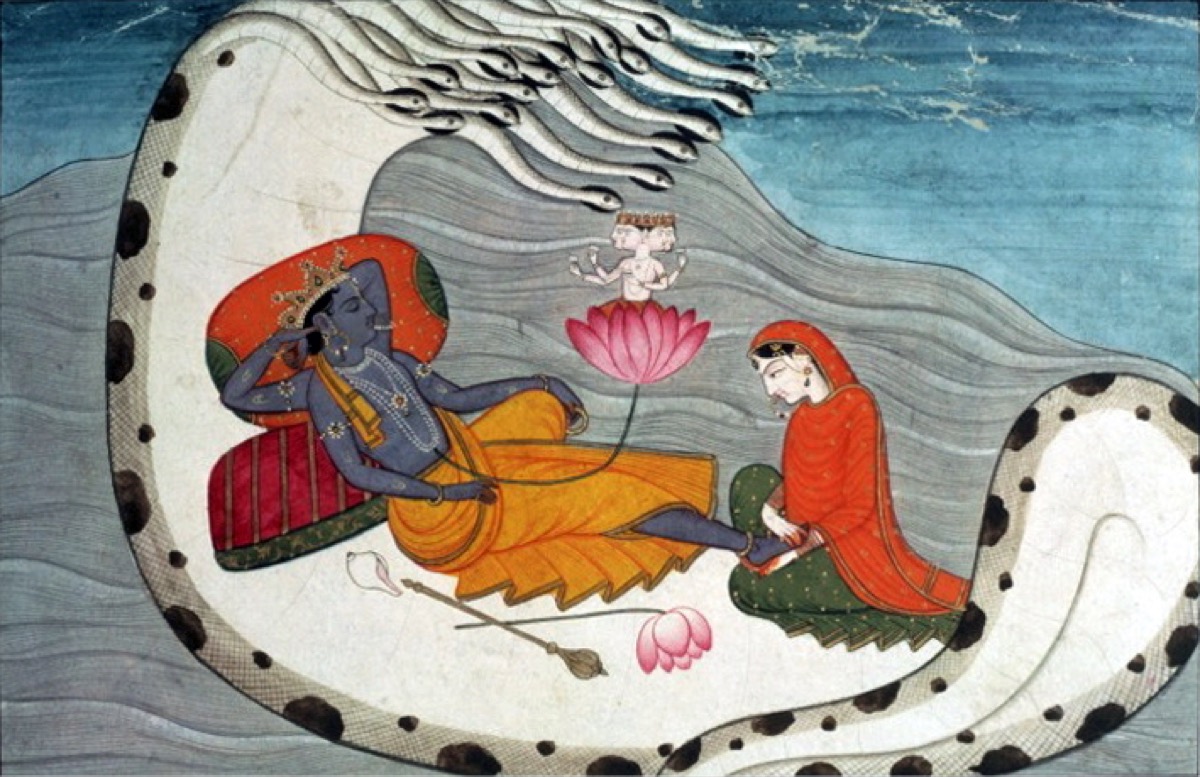
In Purāṇic cosmology, creation begins when Viṣṇu lies in yogic sleep (yoganidrā) upon the cosmic serpent Śeṣa (Ananta), floating on the causal ocean (kāraṇa sāgara). From Viṣṇu’s navel grows a lotus, and upon that lotus is born Brahmā, the demiurge who will fashion the manifest universe.
Brahmā’s creative process unfolds in stages as described in the Viṣṇu Purāṇa (1.4-5) and Bhāgavata Purāṇa (3.10):
- Mahat (cosmic intelligence) emerges first
- Ahaṅkāra (ego-principle) differentiates into three qualities (guṇas)
- From tamas arise the five subtle elements (tanmātras) and five gross elements (mahābhūtas)
- From sattva arise the mind, the ten senses, and the presiding deities
- These components combine to form the cosmic egg (brahmāṇḍa)
Brahmā then creates the prajāpatis (progenitors), devas (gods), asuras (demons), humans, animals, and all living beings through mental projection and the spoken word.
The Yuga System: Cosmic Ages
Hindu cosmology divides time into four repeating ages (yugas), named after dice throws and characterised by a progressive decline in dharma:
| Yuga | Duration (years) | Dharma | Characteristics |
|---|---|---|---|
| Satya (Kṛta) | 1,728,000 | 4/4 (complete) | Truth, virtue, no suffering |
| Tretā | 1,296,000 | 3/4 | Dharma begins to decline; Rāma’s age |
| Dvāpara | 864,000 | 2/4 | Further decline; Kṛṣṇa’s age |
| Kali | 432,000 | 1/4 | Strife, ignorance, spiritual darkness |
Together, these four yugas constitute one Mahāyuga (or Caturyuga) of 4,320,000 human years. According to traditional reckoning, we are currently in the Kali Yuga, which began in 3102 BCE with the departure of Lord Kṛṣṇa.
The Bhagavad Gītā (4.7-8) promises that whenever dharma declines and adharma rises, the divine incarnates to restore balance — a doctrine that gives the yuga cycle its redemptive dimension.
Kalpas, Manvantaras, and Brahmā’s Lifespan
The scale expands further. One thousand Mahāyugas constitute a single Kalpa (4.32 billion years), which equals one day of Brahmā. A night of Brahmā is equally long, during which the manifest universe dissolves into a latent state. Brahmā’s full day-and-night cycle thus spans 8.64 billion years — remarkably close to modern estimates of the age of the Earth and Sun.
Each Kalpa is divided into 14 Manvantaras, each presided over by a different Manu (progenitor of humanity). The current Manvantara is the seventh, ruled by Vaivasvata Manu.
Brahmā’s total lifespan is 100 Brahmā-years (311.04 trillion human years). According to the Bhāgavata Purāṇa (3.11.33-40), the current Brahmā is approximately 51 years old — meaning roughly half of the present creation cycle has elapsed, and another 155.52 trillion years remain.
Pralaya: Cosmic Dissolution
Hindu cosmology identifies several types of cosmic dissolution (pralaya):
Naimittika Pralaya (Periodic Dissolution)
At the end of each Kalpa (Brahmā’s day), the three lower worlds (bhūḥ, bhuvaḥ, svaḥ) are destroyed by fire and flood. All beings enter a latent state within Brahmā. When Brahmā awakens, creation resumes. This is sometimes called Brahma Pralaya.
Prākṛtika Pralaya (Elemental Dissolution)
At the end of Brahmā’s 100-year lifespan, the entire universe — including all higher worlds — dissolves back into Prakṛti (primordial nature). The five elements merge back into their subtle forms, the subtle elements into ahaṅkāra, ahaṅkāra into mahat, and mahat into avyakta (the unmanifest). This process is described in reverse order of creation in the Viṣṇu Purāṇa (6.4).
Ātyantika Pralaya (Ultimate Liberation)
This is not cosmic dissolution but the individual soul’s final release from saṃsāra — mokṣa. It is “ultimate” because the liberated soul never returns to the cycle.
Nitya Pralaya (Continuous Dissolution)
The Bhāgavata Purāṇa also recognises the constant flux of birth and death in daily life as a form of continuous pralaya — a philosophical reminder that dissolution is not merely a distant cosmic event but an ever-present reality.
Viṣṇu’s Cosmic Sleep and the Multiverse
Between great dissolutions, Viṣṇu reclines on Śeṣa upon the cosmic waters in yoganidrā. This image — celebrated in the Anantaśayana iconography found at Padmanābhasvāmy Temple and elsewhere — represents consciousness at rest, containing the seeds of all future creation within itself.
The Purāṇas present what can only be described as a multiverse conception. The Bhāgavata Purāṇa (3.11.41) states that innumerable brahmāṇḍas (cosmic eggs) emanate from the pores of Mahā-Viṣṇu (Kāraṇodakaśāyī Viṣṇu) like bubbles in water, each containing its own Brahmā, its own set of galaxies, and its own timeline. This vision of parallel universes emerging from a single transcendent source anticipates, in mythological form, concepts explored in modern theoretical physics.
The Brahma Vaivarta Purāṇa narrates an episode where Indra, proud of his heavenly kingdom, is visited by Viṣṇu disguised as a boy. Pointing to a procession of ants, the boy reveals that each ant was once an Indra in a previous cosmic cycle — illustrating the infinite repetition of creation.
Mount Meru and the Structure of the Universe
Purāṇic geography describes the universe as a series of concentric rings. At the centre stands Mount Meru, the cosmic axis, surrounded by seven ring-shaped continents (dvīpas) and seven oceans of different substances (salt water, sugarcane juice, wine, ghee, milk, curds, and fresh water).
Above the earthly plane rise the heavenly worlds (lokas): Bhuvar, Svar, Mahar, Janas, Tapas, and Satya (Brahmā’s abode). Below lie seven subterranean realms (pātālas) and the hells (narakas). This vertical cosmography maps not merely physical space but states of consciousness — each loka corresponding to a level of spiritual attainment.
Resonance with Modern Science
The parallels between Hindu cosmology and modern scientific findings are striking, though they should be appreciated as convergences rather than direct equivalences:
- Cyclical universe: Hindu cosmology’s oscillating model resonates with cyclic cosmological theories (such as the Steinhardt-Turok ekpyrotic model)
- Deep time: Brahmā’s lifespan of 311 trillion years dwarfs the approximately 13.8 billion years since the Big Bang, yet Hindu thought alone among ancient traditions conceived of time scales in the billions
- Multiverse: The Purāṇic vision of infinite brahmāṇḍas anticipates the landscape multiverse of string theory
- Creation from a singularity: Hiraṇyagarbha (the golden egg) as a concentrated point from which the universe expands parallels the Big Bang singularity
As Carl Sagan famously observed in Cosmos (1980): “The Hindu religion is the only one of the world’s great faiths dedicated to the idea that the cosmos itself undergoes an immense, indeed an infinite, number of deaths and rebirths.”
Conclusion
Hindu cosmology offers not a single creation myth but a layered, polyphonic vision in which philosophical inquiry (the Nāsadīya Sūkta), mythological narrative (Brahmā’s lotus birth), and mathematical precision (the yuga calculations) coexist and complement one another. At its deepest level, it teaches that creation is not a one-time event but an eternal process — and that the consciousness witnessing the cosmic drama is itself the source from which the drama springs.