Introduction
Among the most profound contributions of Hindu civilisation to world thought is its philosophy of time — Kāla. While many ancient cultures conceived of time as a straight line beginning at creation and marching toward a final judgment, the sages of India envisioned something far more radical: an infinite, cyclical cosmos in which universes arise, flourish, dissolve, and are reborn across spans so vast that they dwarf any modern conception of deep time.
The Sanskrit word kāla carries a double meaning that reveals the depth of this vision. It means both time and death — the force that brings all things into being and, equally, the force that annihilates them. In the Bhagavad Gītā (11.32), Śrī Kṛṣṇa reveals his cosmic form and declares: “kālo’smi lokakṣayakṛt pravṛddhaḥ” — “I am Time, the mighty destroyer of worlds.” Time is not a neutral container in which events happen; it is a divine power, an aspect of the Absolute itself.
This article traces the Hindu architecture of time from its smallest measurable unit to the lifespan of the creator-god Brahmā, exploring the Yuga system, the concept of Pralaya (cosmic dissolution), the astronomical calculations of the Sūrya Siddhānta, and the theological personification of Time as Kāla Bhairava.
Kāla as Cosmic Principle
Time and the Absolute
In Hindu metaphysics, Kāla is not merely a measurement but a tattva — a fundamental principle of reality. The Śvetāśvatara Upaniṣad (6.2) identifies time as one of the possible first causes of the universe, listing it alongside inherent nature (svabhāva), necessity (niyati), and chance (yadṛcchā), before concluding that it is the power of the Divine (deva-ātma-śakti) concealed within these.
The Atharvaveda (19.53-54) contains two remarkable hymns addressed directly to Kāla as a cosmic deity:
“Kāla created these creatures. Kāla at first created the Lord of Creatures (Prajāpati). From Kāla came self-existent Kaśyapa; from Kāla came tapas (creative ardour).” (Atharvaveda 19.53.8)
Here, time is not created by God — God is created by time. This is a strikingly bold philosophical position: Kāla precedes even the creator deity, making it the most fundamental reality.
Cyclical Versus Linear Time
The defining feature of Hindu temporal philosophy is its cyclical nature. Unlike the Abrahamic linear model — creation, history, eschaton — Hindu time moves in vast repeating circles within circles. The cosmos breathes: it expands (sṛṣṭi, creation), it sustains (sthiti, preservation), it contracts (laya or pralaya, dissolution), and the cycle begins anew. There is no absolute beginning and no final end.
This cyclical model has three crucial implications:
- No unique creation event: Every creation is preceded by a dissolution, and every dissolution is followed by a new creation. The question “When did it all start?” is therefore dissolved — it has been happening forever.
- Moral regeneration: Unlike apocalyptic traditions where the end of the world is a singular catastrophe, Hindu dissolution is a natural rest period after which dharma can be re-established.
- Scale beyond imagination: The cycles operate on timescales of billions and trillions of years, making even the modern scientific estimate of the universe’s age (13.8 billion years) a relatively modest figure within the larger scheme.
The Yuga System: Four Ages of Dharma
The Chaturyuga (Mahāyuga)
The foundational cycle of Hindu time is the Chaturyuga or Mahāyuga — a sequence of four ages (yugas) through which the world passes in a slow, inevitable decline of dharma (righteousness). The Manusmṛti (1.69-71), the Mahābhārata (Śānti Parva), and the Viṣṇu Purāṇa (Book I, Chapter III) all describe this system.
| Yuga | Other Name | Duration (human years) | Dharma Fraction | Proportion |
|---|---|---|---|---|
| Satya Yuga | Kṛta Yuga | 1,728,000 | 4/4 (complete) | 4 |
| Tretā Yuga | — | 1,296,000 | 3/4 | 3 |
| Dvāpara Yuga | — | 864,000 | 2/4 | 2 |
| Kali Yuga | — | 432,000 | 1/4 | 1 |
| Total Mahāyuga | Chaturyuga | 4,320,000 | — | 10 |
Each Yuga is preceded by a dawn (sandhyā) and followed by a twilight (sandhyāṃśa), each lasting one-tenth of the Yuga’s duration. These transitional periods represent the gradual onset and fading of each age.
Characteristics of Each Yuga
Satya Yuga (the Age of Truth): Dharma stands on all four legs. Humans live for thousands of years, possess extraordinary spiritual powers, and there is no disease, hatred, or sorrow. The Viṣṇu Purāṇa (Book VI, Chapter I) describes this as a time when meditation (dhyāna) alone is sufficient for liberation.
Tretā Yuga (the Age of Three-Quarters): Dharma loses one leg. Sacrifice (yajña) becomes the primary means of spiritual attainment. The great avatāra Rāma appears in this age.
Dvāpara Yuga (the Age of Halves): Dharma stands on two legs. Ritual worship (pūjā) and study of scripture become central. Kṛṣṇa, the eighth avatāra of Viṣṇu, appears toward the end of this age.
Kali Yuga (the Age of Strife): Dharma survives on a single leg. According to the Bhāgavata Purāṇa (12.2), morality collapses, rulers become tyrannical, and the only means of liberation is the chanting of God’s name (nāma-saṅkīrtana). Traditional Hindu dating places the beginning of Kali Yuga at 3102 BCE, coinciding with the departure of Kṛṣṇa.
The 4:3:2:1 ratio of the Yugas is mathematically elegant. It reflects a philosophical insight: the decline of dharma is not linear but accelerating — each age is shorter and more corrupt than the last.
From Mahāyuga to Kalpa: The Architecture of Cosmic Time
Manvantara
Seventy-one Mahāyugas constitute one Manvantara — the reign of a single Manu, the progenitor and lawgiver of humanity. Each Manvantara lasts approximately 306.72 million years. The Viṣṇu Purāṇa (Book III, Chapter I) names fourteen Manus who reign in succession during one day of Brahmā. The current Manu is Vaivasvata, the seventh in the sequence.
Between successive Manvantaras, there is a Sandhikāla (transitional period) equal in length to one Satya Yuga (1,728,000 years), during which a partial dissolution and re-creation occurs.
Kalpa: One Day of Brahmā
Fourteen Manvantaras, together with their intervening Sandhikālas, make one Kalpa — a single day of Brahmā:
- 14 Manvantaras x 71 Mahāyugas = 994 Mahāyugas
- 15 Sandhikālas x 1,728,000 years = 25,920,000 years (equivalent to 6 Mahāyugas)
- Total = 1,000 Mahāyugas = 4,320,000,000 years (4.32 billion years)
This figure is strikingly close to the modern scientific estimate of Earth’s age (4.54 billion years) — a correspondence that has fascinated scholars since it was first noticed.
Brahmā’s night is of equal duration. During this night, the physical universe is dissolved in a Naimittika Pralaya (periodic dissolution), and all beings enter a dormant state within Brahmā until the next dawn, when creation resumes.
Brahmā’s Lifespan: The Mahākalpa
Brahmā lives for 100 Brahmā-years, each consisting of 360 Brahmā-days and nights:
- 1 Brahmā-day + 1 Brahmā-night = 8.64 billion years
- 1 Brahmā-year = 360 such day-night cycles = 3,110.4 billion years
- Brahmā’s lifespan = 100 Brahmā-years = 311.04 trillion years
This number — 311.04 trillion years — represents the lifespan of the entire manifest cosmos. At its end comes the Mahāpralaya (great dissolution), in which not only the physical universe but even Brahmā himself is absorbed back into the Absolute. Then, after a period of cosmic rest equal to Brahmā’s lifespan, a new Brahmā is born and the cycle begins again.
According to the Bhāgavata Purāṇa (3.11.33-34), we are presently in the first day of the fifty-first year of the current Brahmā, known as Śvetavarāha Kalpa — meaning roughly half of the cosmic lifespan has elapsed.
Pralaya: The Rhythm of Dissolution
Hindu cosmology recognises four types of dissolution:
- Nitya Pralaya (perpetual dissolution): The constant change of death and rebirth experienced by individual beings. This happens every moment.
- Naimittika Pralaya (occasional dissolution): Occurs at the end of each Kalpa (Brahmā’s day). The three lower worlds are dissolved by fire and flood, while higher worlds remain.
- Prākṛtika Pralaya (elemental dissolution): Occurs at the end of Brahmā’s lifespan. The entire material creation (prakṛti) is dissolved, element by element, in reverse order of manifestation.
- Ātyantika Pralaya (absolute dissolution): The liberation (mokṣa) of an individual soul, which transcends the cycle of time altogether.
The Viṣṇu Purāṇa (Book VI, Chapter IV) describes the Prākṛtika Pralaya with vivid imagery: seven suns appear in the sky and evaporate the oceans, fire consumes all worlds, torrential rains flood the cosmos, and finally a great wind dissolves everything into the formless waters of the primordial ocean, upon which Viṣṇu reclines in yogic sleep (yoganidrā) until the next creation.
The Sūrya Siddhānta and Precision Time Measurement
From Truṭi to Kalpa
The Sūrya Siddhānta, one of the earliest surviving astronomical treatises of India (dated to the 4th-5th century CE in its current form), provides a remarkable system of time measurement that extends from the infinitesimally small to the cosmically vast. The Viṣṇu Purāṇa (Book I, Chapter III) offers a parallel hierarchy:
Sub-second units (Sūrya Siddhānta 1.11-13):
- Truṭi = 1/33750 of a second (approximately 29.6 microseconds)
- 100 truṭis = 1 tatpara
- 30 tatparas = 1 nimeṣa (blink of an eye, approximately 0.089 seconds)
Human-scale units:
- 15 nimeṣas = 1 kāṣṭhā (approximately 1.33 seconds)
- 30 kāṣṭhās = 1 kalā (approximately 40 seconds)
- 30 kalās = 1 ghaṭikā or nāḍikā (24 minutes)
- 2 ghaṭikās = 1 muhūrta (48 minutes)
- 30 muhūrtas = 1 ahorātra (one sidereal day)
Cosmic-scale units (Viṣṇu Purāṇa):
- 360 ahorātras = 1 human year
- The four Yugas from 432,000 to 1,728,000 years
- Mahāyuga = 4,320,000 years
- Manvantara = 71 Mahāyugas = 306,720,000 years
- Kalpa = 14 Manvantaras = 4,320,000,000 years
- Brahmā’s lifespan = 311.04 trillion years
Astronomical Accuracy
The Sūrya Siddhānta calculates the sidereal year as 365 days, 6 hours, 12 minutes, and 36.56 seconds. The modern value is 365 days, 6 hours, 9 minutes, and 9.76 seconds — a difference of only about 3 minutes and 27 seconds. The text also provides remarkably accurate values for planetary orbital periods and the precession of the equinoxes.
This precision reflects a deep engagement with empirical observation alongside the mythological framework. The same tradition that imagined 311-trillion-year cosmic cycles also measured the truṭi — a unit roughly equal to 30 microseconds — demonstrating that Hindu time philosophy operates simultaneously at the most abstract metaphysical and the most concrete empirical levels.
The Nāsadīya Sūkta: Time Before Time
The Nāsadīya Sūkta (Ṛg Veda 10.129), the celebrated Hymn of Creation, raises the ultimate question about time: what existed before it began?
“nāsad āsīn no sad āsīt tadānīṃ, nāsīd rajo no vyomā paro yat”
“There was neither non-existence nor existence then; there was neither the realm of space nor the sky beyond.” (Ṛg Veda 10.129.1)
The hymn continues:
“There was neither death nor immortality then. There was no distinguishing sign of night or day.” (Ṛg Veda 10.129.2)
If there was neither day nor night, there was no time. The Nāsadīya Sūkta therefore posits a state beyond time itself — prior to the very framework of cosmic cycles. This is not a temporal “before” but an ontological ground from which time itself emerges. The hymn famously concludes with radical agnosticism: perhaps even the highest deity does not know how creation arose.
This philosophical position has remarkable parallels with modern questions in physics about the nature of time at the Big Bang singularity, where the laws of physics — including time — break down.
Kāla Bhairava: Time as Deity
The Fierce Lord of Time
While abstract philosophical texts discuss time as a principle, Hindu devotional tradition personifies it as Kāla Bhairava — a fierce form of Śiva who is literally the “Terror of Time.” Kāla Bhairava is depicted as a dark-complexioned deity adorned with a garland of skulls, holding a trident, drum, sword, and a severed head. His vehicle is the dog — an animal associated with death and the liminal spaces between worlds.
The Kāla Bhairava Aṣṭakam, attributed to Ādi Śaṅkarācārya, praises this deity as the lord of Kāśī (Vārāṇasī) and the controller of time:
“Kālabhairavaṃ bhaje” — “I worship Kāla Bhairava.”
In Kāśī, devotion to Kāla Bhairava is paramount: tradition holds that no one may reside in the sacred city without his permission, and at death, Kāla Bhairava whispers the tāraka mantra (liberating mantra) into the ear of the dying person.
Kṛṣṇa as Kāla in the Bhagavad Gītā
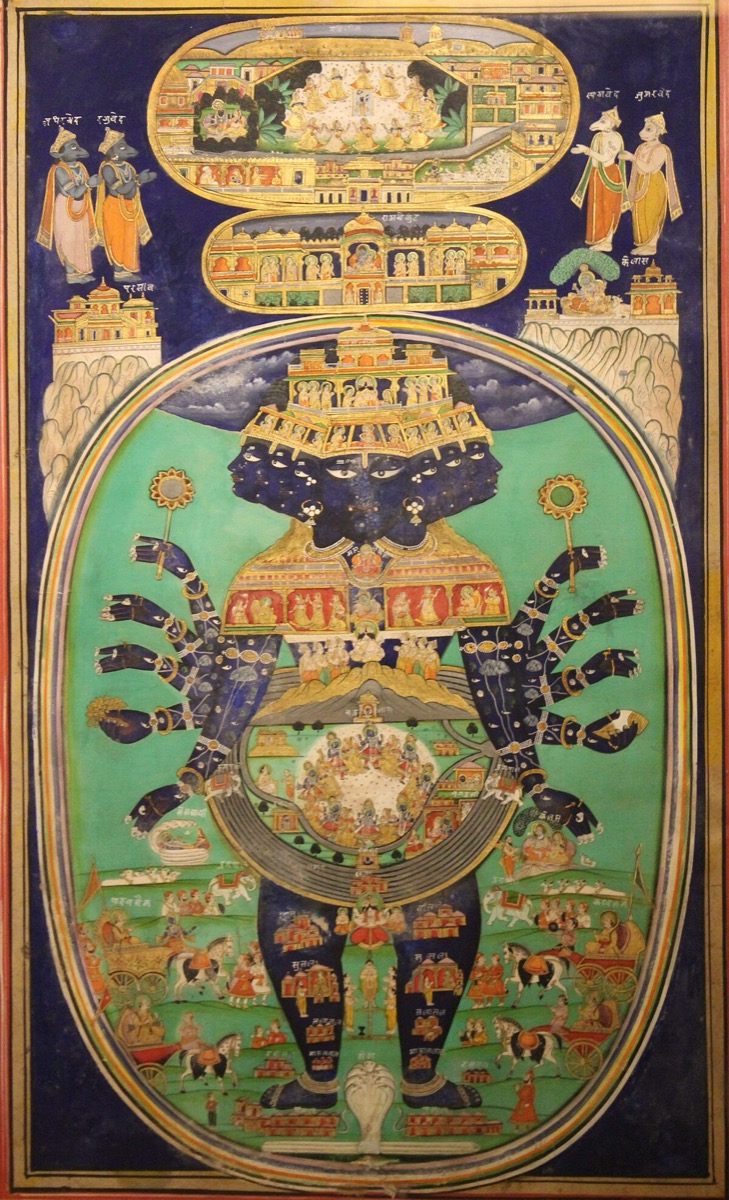
The most dramatic theological identification of God with Time occurs in the Bhagavad Gītā, Chapter 11. When Arjuna beholds the Viśvarūpa (cosmic form) of Kṛṣṇa, he sees the entire universe — past, present, and future — contained within the divine body. Warriors are streaming into the flaming mouths of the cosmic form, being crushed between its teeth. Trembling, Arjuna asks who this terrible being is, and Kṛṣṇa responds:
“kālo’smi lokakṣayakṛt pravṛddhaḥ, lokān samāhartum iha pravṛttaḥ”
“I am Time, the mighty destroyer of worlds, engaged here in destroying all beings.” (Bhagavad Gītā 11.32)
This verse reveals the deepest Hindu insight about time: Kāla is not separate from God — it is God’s own power of transformation. Creation and destruction are not opposing forces but two faces of the same divine reality. Śaṅkarācārya’s commentary on this verse explains that Time is the inherent power (śakti) through which the Supreme Being effects both the manifestation and withdrawal of the cosmos.
Parallels with Modern Cosmology
The Hindu model of cyclical cosmic time, developed millennia before modern science, bears striking structural parallels with several contemporary cosmological theories:
The Big Bounce hypothesis: Some physicists propose that the Big Bang was not the absolute beginning but rather one in an infinite series of expansions and contractions — an oscillating universe model remarkably similar to the Hindu cycle of Sṛṣṭi and Pralaya.
The multiverse: The Bhāgavata Purāṇa (6.16.37) describes innumerable universes, each with its own Brahmā, floating like bubbles in the causal ocean. This echoes the inflationary multiverse theory in modern physics, where our observable universe is one of an infinite number of “bubble universes.”
Scale correspondence: One Kalpa (day of Brahmā) equals 4.32 billion years. The Earth is approximately 4.54 billion years old, and the current scientific estimate of the universe’s age is 13.8 billion years — figures that sit comfortably within the Hindu cosmic framework rather than contradicting it.
Entropy and the Yuga cycle: The progressive decline across the four Yugas from order to chaos mirrors the second law of thermodynamics — the tendency of systems toward increasing entropy — though Hindu cosmology adds the crucial element of periodic renewal.
These parallels are structural rather than predictive, and they reflect different methodological approaches. Yet they demonstrate that the Hindu sages, through philosophical contemplation and astronomical observation, arrived at a temporal architecture of extraordinary sophistication — one that the modern scientific mind can still find intellectually fertile.
Conclusion
The Hindu philosophy of time is not a single doctrine but a layered, multi-textual tradition that encompasses abstract metaphysics, precise astronomical calculation, devotional theology, and cosmic mythology. From the Atharvaveda’s hymns to Kāla, through the Purāṇic architecture of Yugas and Kalpas, to the Sūrya Siddhānta’s microsecond measurements and Kṛṣṇa’s revelation as Time incarnate, Hindu thought offers an understanding of temporality that is simultaneously humbling in its scale and precise in its detail.
At its heart lies a single transformative insight: time is not a prison but a divine rhythm. The cosmic cycles are not meaningless repetition but the breathing of the Absolute — each exhalation a creation, each inhalation a dissolution, and the breath itself an expression of the eternal, timeless reality that underlies all change. To understand Kāla is not merely to count years and ages but to glimpse the nature of Brahman itself — that which exists beyond time, yet manifests as time for the sake of the cosmic play (līlā).