The Radiance of Holi
Holi, known as the Festival of Colors, is one of the most exuberant and beloved celebrations in the Hindu calendar. Observed on the full moon day (pūrṇimā) of the lunar month of Phālguna (February or March), it heralds the arrival of spring (vasanta), the end of winter’s grip, and a time of communal renewal. What begins with a sacred bonfire on the eve of Holi erupts the following day into a riot of coloured powders (gulāl), music, dancing, and shared sweets — a celebration that dissolves social barriers and invites all people into a shared experience of joy.
The festival’s roots stretch deep into antiquity. References appear in texts as early as Jaimini’s Pūrva Mīmāṃsā Sūtras (c. 4th century BCE) and the Kāṭhaka-Gṛhya-Sūtras, with detailed accounts in the Nārada Purāṇa and the Bhaviṣya Purāṇa. The seventh-century poet Bhāravī mentions a spring festival with colour play, and inscriptions from the Chalukya period record royal patronage of Holi celebrations. Over millennia, Holi has woven together multiple mythological narratives, seasonal rhythms, and social customs into a multifaceted festival that is at once devotional, agricultural, and deeply human.
Origins and Mythological Significance
The Legend of Prahlāda and Holikā
The most widely known origin of Holi is the story of the young devotee Prahlāda, told in the seventh skandha (canto) of the Bhāgavata Purāṇa. The demon king Hiraṇyakaśipu, having obtained a boon from Lord Brahmā rendering him nearly invincible — he could be killed neither by man nor beast, neither indoors nor outdoors, neither by day nor by night, neither by weapon nor by bare hands — grew arrogant and demanded that all beings worship him alone. His son Prahlāda, however, remained steadfast in devotion to Lord Viṣṇu.
Enraged by his son’s defiance, Hiraṇyakaśipu subjected Prahlāda to a series of torments: he was thrown from a cliff, trampled by elephants, cast into a pit of serpents, and poisoned — yet each time, Viṣṇu’s grace preserved him. In the climactic episode, Hiraṇyakaśipu enlisted his sister Holikā, who possessed a divine shawl (vastra) rendering her immune to fire. Holikā sat on a blazing pyre with young Prahlāda on her lap, expecting the boy to perish. Yet through the grace of Viṣṇu, the shawl flew from Holikā and covered Prahlāda. Holikā was consumed by the flames, and the child emerged unharmed (Bhāgavata Purāṇa 7.5-8).
This event is commemorated as Holikā Dahan — the burning of Holikā — on the eve of Holi. Communities gather around large bonfires, symbolically burning away evil, ego, and negativity, affirming the eternal truth that devotion and righteousness triumph over tyranny. The narrative reaches its fulfilment when Viṣṇu incarnates as Narasiṃha — half-man, half-lion — and slays Hiraṇyakaśipu at twilight, on the threshold of his palace, on his lap, with his claws, thus satisfying every condition of the boon while rendering it void.
Kāmadeva and Śiva
A second mythological layer connects Holi to the tale of Kāmadeva, the Hindu deity of love and desire. When Goddess Pārvatī sought to win Lord Śiva back from his deep meditation after the death of his first wife Satī, she enlisted Kāmadeva’s help. On Vasanta Pañcamī, the fifth day of spring, Kāmadeva shot his flower-tipped arrow at Śiva. Disturbed from his penance, Śiva opened his devastating third eye and reduced Kāmadeva to ashes.
Kāmadeva’s wife, Rati (the goddess of passion), performed forty days of ascetic devotion, after which Śiva, moved by compassion, restored Kāmadeva — not to bodily form but as a formless spiritual presence of love that pervades the world. Holi, arriving approximately forty days after Vasanta Pañcamī, celebrates this restoration of love to the cosmos. In South India, the Holi bonfire is known as Kāma Dahanam, directly referencing the burning of Kāmadeva. This strand of mythology gives Holi its character as a celebration of love, longing, and the regenerative power of desire when it is tempered by devotion.
Kṛṣṇa and Rādhā: Divine Play in Vṛndāvana
Perhaps the most joyful narrative behind Holi belongs to the līlā (divine play) of Lord Kṛṣṇa and Rādhā in the groves of Vṛndāvana. According to tradition preserved in the Bhāgavata Purāṇa (10th skandha) and elaborated in the Gīta Govinda of Jayadeva, the young Kṛṣṇa — whose dark complexion (śyāma varṇa) contrasted with Rādhā’s fair skin — playfully smeared colours on Rādhā and the gopīs (cowherd maidens), turning this act of loving mischief into the foundation for Holi’s custom of applying colours to one another. This is a rasa of prema bhakti — unconditional love and ecstatic surrender.
The colour play of Kṛṣṇa and the gopīs carries theological weight: in the coloured chaos of Holi, all distinctions of beauty and rank are dissolved. The dark-skinned Kṛṣṇa and the fair Rādhā become one colour; the cowherd and the king become indistinguishable. This is the rāsa-līlā made democratic — the divine play extended to all.
To this day, the Braj region — Mathura, Vṛndāvana, Barsānā, and Nandgāon — remains the spiritual epicentre of Holi, where festivities stretch across multiple weeks in distinctive local forms that are among the most celebrated in the world.
The Dhunḍhī Legend
A lesser-known but important tradition, recorded in the Bhaviṣya Purāṇa, connects Holi to the destruction of Dhunḍhī, an ogress (rākṣasī) who terrorised children. She had obtained a boon from Śiva making her nearly invulnerable, but with a weakness: she could be defeated by the pranks, shouts, and laughter of children. On the day of Holi, the children of the town gathered, shouted obscenities and jests, and drove Dhunḍhī away with their noise and fire. This legend connects Holi to the protection of the young and the power of communal laughter to dispel darkness.
Rituals and Celebrations
Holikā Dahan: The Sacred Bonfire
On the evening before the main day of Holi, communities construct large pyres from wood, dried leaves, cow dung cakes, and other combustible materials. The pyre is often built over several weeks, with neighbourhood contributions. A ritual pūjā is performed: the pyre is circled, prayers are offered to Agni (the fire god), and it is lit at the muhūrta (auspicious moment) determined by the lunar calendar.
Families circle the fire, offer prayers, and toss roasted grains (dhānā), popcorn, coconuts, and new harvest cereals into the flames. The ritual is both purificatory and agricultural: the fire consumes the residue of winter, and the roasted grains represent the first fruits of the spring harvest. In many regions, embers from the Holikā fire are carried home to relight the domestic hearth, transferring the sacred fire’s purifying power into the household.
Raṅgavālī Holi: The Day of Colours
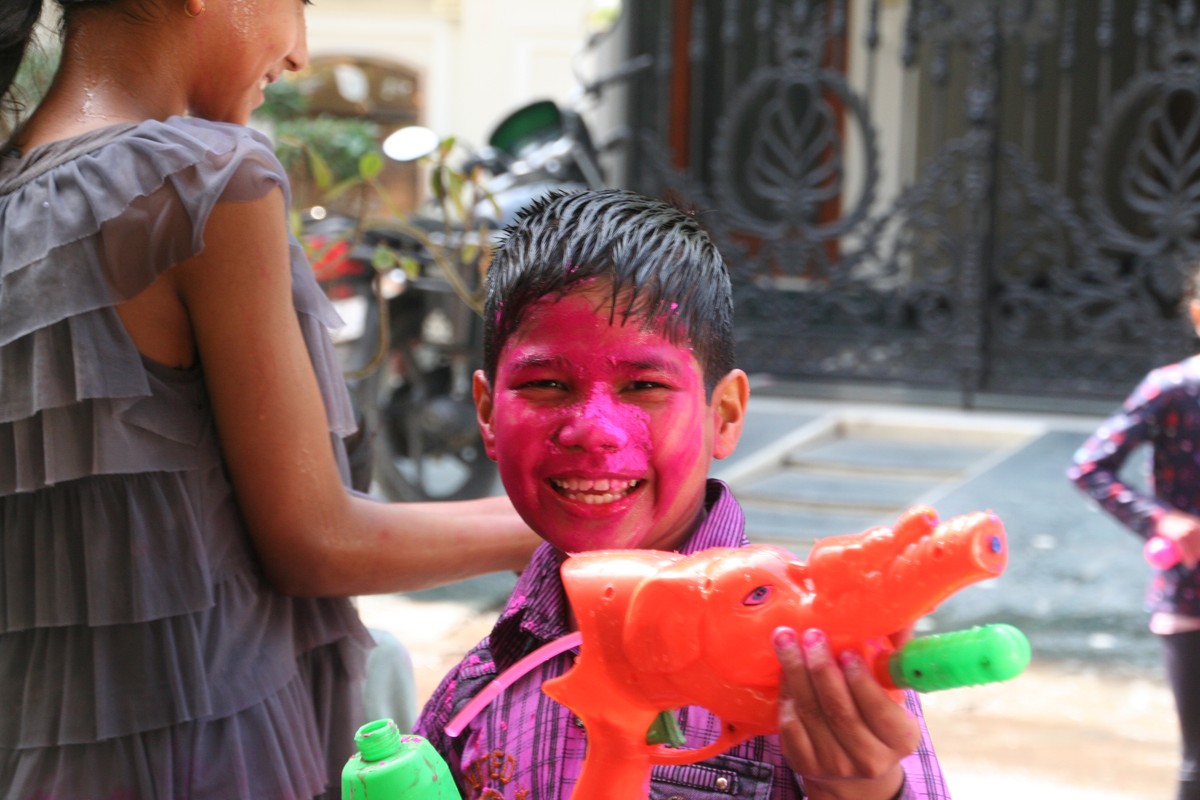
The following morning, all restraint vanishes. People take to the streets armed with gulāl (dry coloured powder), pichkārī (water guns), and buckets of coloured water. Social hierarchies collapse: the young smear colours on the old, women chase men, employers and employees play together, strangers become friends. This is the essence of Holi — the temporary dissolution of the boundaries that structure ordinary life.
The Traditional Colours and Their Āyurvedic Significance
The colours of Holi were originally derived entirely from natural sources, each carrying both symbolic and medicinal properties rooted in Āyurvedic tradition:
- Palāśa (Butea monosperma) — Known as Ṭesu or the “Flame of the Forest,” its brilliant orange-red flowers are soaked overnight in water to produce the most iconic Holi colour. In Āyurveda, palāśa has cooling and detoxifying properties, is rich in natural sulphur, and is used to treat skin conditions and balance pitta doṣa. The palāśa tree blooms precisely during Phālguna, and its flaming flowers are themselves a signal that Holi approaches (Ferns N Petals, “Palash Flower and Holi”).
- Haldī (turmeric) — Produces bright yellow. Turmeric is one of Āyurveda’s most celebrated substances — anti-inflammatory, antimicrobial, and auspicious in Hindu ritual.
- Nīm (neem) — Its leaves produce green colour. Neem is a powerful antiseptic and blood purifier, and its application during the seasonal transition from winter to spring was believed to protect against seasonal infections.
- Kumkuma (vermilion) and Candana (sandalwood) — Red and cream-white respectively. Both are cooling agents and central to Hindu worship.
- Indigo (nīla) — Produces deep blue, associated with Kṛṣṇa’s complexion.
The timing of Holi at the juncture of winter and spring is significant: Āyurveda recognises this period as one when the body is susceptible to kapha imbalances — lethargy, congestion, and vulnerability to infection. The vigorous physical activity of colour play, combined with the medicinal properties of natural dyes, was understood as a therapeutic intervention for the changing season (holifestival.org, “Natural Colors”).
In modern times, synthetic chemical colours have largely replaced natural dyes, raising health and environmental concerns. A growing movement advocates returning to traditional natural colours — a revival that is both ecologically sound and culturally authentic.
Music, Food, and Festive Culture
Music fills the air as ḍholak drums and folk songs accompany the revelry. In North India, special Holi songs (phāg, jogirā) are sung, many drawn from the Braj Bhāṣā literary tradition celebrating Kṛṣṇa and Rādhā. Families share festive foods:
- Gujiyā — Sweet dumplings filled with dried fruits and khoyā (reduced milk), the quintessential Holi sweet
- Mālapuā — Fried sweet pancakes soaked in sugar syrup
- Dahī Bhaḷḷā — Lentil dumplings in spiced yoghurt
- Pāpaḍ, namakīn, and other savoury snacks
Ṭhaṇḍāī, a chilled spiced milk drink flavoured with almonds, fennel, rose petals, and saffron, is the quintessential Holi beverage. In some traditions, it is prepared with bhāṅg (cannabis paste), traditionally associated with Lord Śiva, lending the celebration an additional layer of ecstatic abandon.
Regional Variations
Lāṭhmār Holi — Barsānā and Nandgāon
In Barsānā, the hometown of Rādhā, and neighbouring Nandgāon, the hometown of Kṛṣṇa, Holi takes the form of Lāṭhmār Holi — the “Holi of sticks.” Women of Barsānā playfully beat men from Nandgāon with wooden sticks (lāṭhī), re-enacting the legend of Kṛṣṇa arriving to tease Rādhā and being chased away by the gopīs. The men defend themselves with shields amid laughter, singing, and devotion. The week-long Braj celebrations also include Lāḍḍū Holi, where sweets are showered instead of colours; Phūloṃ kī Holi (Flower Holi) at the Bāṅke Bihārī Temple in Vṛndāvana, where tons of fresh flower petals cascade upon devotees; and Chadī Mār Holi in Gokul.
Dol Jātrā — West Bengal
In West Bengal, Holi is observed as Dol Jātrā (also called Dol Pūrṇimā or Dol Yātrā), centering on the divine love of Kṛṣṇa and Rādhā. Idols of the deities are placed on decorated palanquins (dolā) and carried in processions while devotees sing, dance, and apply ābīr (coloured powder) to one another. The festival holds special significance in Vaiṣṇava traditions, as it coincides with the birthday of Śrī Caitanya Mahāprabhu, the 15th-century Bengali saint who founded the Gauḍīya Vaiṣṇava movement.
At Śāntiniketan, the celebration becomes Basanta Utsav (Spring Festival), a tradition inaugurated by Rabīndranāth Ṭhākur (Tagore). Students and faculty of Viśva-Bhāratī University perform Rabīndra Saṅgīt, classical dance, and processional songs dressed in saffron and yellow — a refined, artistic interpretation of Holi that has become one of Bengal’s most iconic cultural events.
Phaguā — Bihar
In Bihar, Holi is known as Phaguā, rooted in Bhojpuri and Maithili folk culture. Celebrations often begin from Basanta Pañcamī and extend over several weeks. Villages resound with ḍholak and mañjīrā as phaguā gīt (folk songs) recount the tales of Rādhā and Kṛṣṇa. Distinctive customs include Dhurkheli (mud-splashing revelry) and the boisterous kurtā phāḍ (“kurta-tearing”) tradition in some urban centres.
Hola Mohallā — Punjab
In Punjab, the Sikh tradition of Hola Mohallā, established by Gurū Gobind Singh in 1680 at Ānandpur Sāhib, transforms Holi into a martial celebration. Nihāṅg Sikhs demonstrate horseback riding, sword fighting, archery, and other martial arts (gatka). The festival extends over three days and combines the energy of Holi with Sikh warrior traditions, featuring langars (communal kitchens), poetry contests, and music.
Kumaonī Holi — Uttarakhand
In the Kumaon hills, Holi takes a markedly different form. Baiṭhak Holi begins weeks before the festival proper, with evening sessions of Hindustani classical music, devotional songs, and rāga-based Holi compositions sung in intimate gatherings. The musical tradition is sophisticated and preserves rāgas associated with the spring season. This culminates in the more exuberant Kharī Holi (standing Holi) on the main day.
Other Regional Forms
Across India, Holi takes many hyperlocal expressions: Śigmo in Goa, blending spring festival with local folk traditions and elaborate float parades; Yāosaṅg in Manipur, merging with indigenous Meitei customs and featuring the Thabal Chongba (moonlight dance); Dolāyātrā in Odisha, centred on the Jagannātha temple traditions; and Rangapañcamī in parts of Maharashtra and Madhya Pradesh, where the main colour play occurs five days after the full moon.
Social Significance: Dissolving Boundaries
Beyond mythology and seasonal rhythm, Holi carries profound social meaning. The anthropological dimension is central to the festival’s enduring power: for one day, the rigid hierarchies of caste, class, age, and gender that structure Indian society are temporarily dissolved in a shared deluge of colour. The employer is drenched by the servant; the mother-in-law by the daughter-in-law; the high-born by the Dalit. Enemies reconcile, grievances are forgiven, relationships are renewed.
The phrase “Burā na māno, Holī hai!” (“Don’t take offence, it’s Holi!”) captures the spirit of communal forgiveness and the social licence to transgress normal boundaries. This ritual inversion — where the low become high and the solemn become playful — is a feature of spring festivals across many cultures, but in India it carries particular resonance in the context of a society historically structured by hierarchical distinctions.
Holi is also a celebration of the earth’s renewal. The bonfire consumes the detritus of winter, the colours evoke the flowering landscape of spring, and the communal feasting reinforces bonds of kinship. In its essence, Holi is a festival of transformation — light over darkness, warmth over cold, love over indifference, togetherness over division.
Philosophical Dimensions
Several philosophical themes underlie the festival:
The triumph of bhakti: The Prahlāda narrative affirms that sincere devotion, even in a child, is more powerful than the greatest material force. No tyranny can extinguish the flame of bhakti.
The impermanence of form: The colours that cover every surface on Holi morning are washed away by evening. The festival is an enactment of the Hindu teaching that all phenomenal appearance (nāma-rūpa) is transient, and that attachment to external form is the root of suffering.
The unity beneath diversity: When all faces are covered in the same colours, individual identity blurs. Holi enacts the Upaniṣadic teaching that beneath the surface diversity of beings lies a single, undifferentiated reality — Tat tvam asi, “You are That” (Chāndogya Upaniṣad 6.8.7).
The sanctity of play: Kṛṣṇa’s līlā with the gopīs sanctifies play itself as a mode of worship. In the Vaiṣṇava tradition, the cosmos is the spontaneous, joyful play of the divine — and Holi is humanity’s participation in that cosmic play.
Timing: Phālguna Pūrṇimā
Holi falls on the full moon day (pūrṇimā) of the Hindu month of Phālguna, typically in late February or March, aligning with the spring equinox and the astronomical transition from winter to the warm, fertile months. The full moon — the brightest night of the month — symbolises the fullness of divine grace, and its timing at the cusp of spring invests the festival with themes of renewal, fertility, and the cyclical regeneration of life.
As the colours settle and bonfires fade to embers, Holi leaves behind a world symbolically cleansed — a reminder that in the divine play of existence, joy, devotion, and love are the colours that endure.