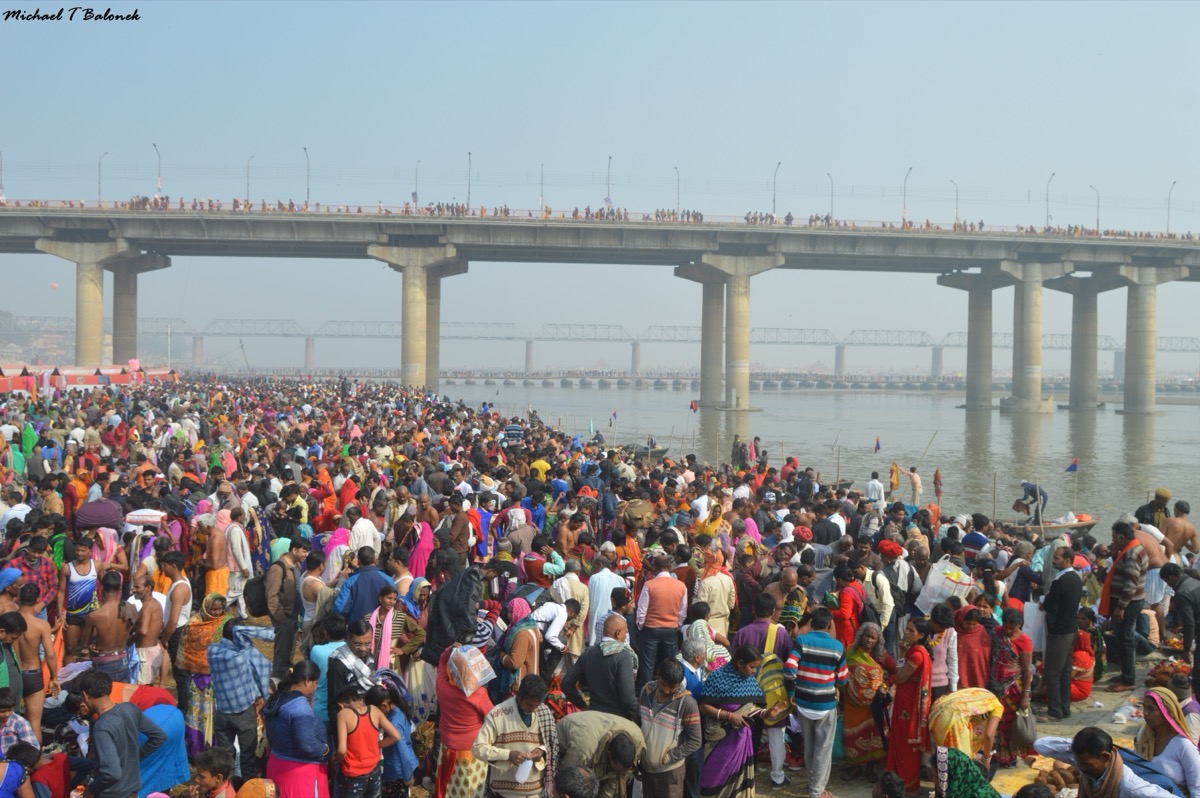
Kumbh Melā (कुम्भ मेला, “Festival of the Sacred Pitcher”) is the largest peaceful congregation of human beings on earth — a cyclic Hindu pilgrimage and festival during which tens of millions of devotees gather at the banks of sacred rivers to bathe, pray, and seek liberation (mokṣa). Held in a rotating cycle at four riverbank cities in India — Prayāgraj (at the Trivēṇī Saṅgam of the Gaṅgā, Yamunā, and the mythical Sarasvatī), Haridwār (on the Gaṅgā), Nāsik-Tryambakēśvar (on the Godāvarī), and Ujjain (on the Kṣiprā) — the Kumbh Melā draws pilgrims of every caste, sect, and social station, united by the conviction that bathing at a sacred confluence during an astrologically auspicious window can wash away lifetimes of accumulated karma and open the gates to spiritual liberation.
In December 2017, UNESCO inscribed Kumbh Melā on the Representative List of the Intangible Cultural Heritage of Humanity, recognizing it as an event that “encapsulates the science of astronomy, astrology, spirituality, ritualistic traditions, and social and cultural customs and practices, making it extremely rich in knowledge.” The 2025 Mahā Kumbh at Prayāgraj, the rarest iteration occurring once every 144 years, drew an estimated 660 million visitors over its 45-day span — more than the combined populations of the United States and the European Union.
Mythological Origins: The Samudra Manthana
The origin of Kumbh Melā is rooted in one of Hinduism’s most celebrated cosmogonic narratives — the Samudra Manthana (समुद्र मन्थन, “Churning of the Ocean of Milk”), described in the Bhāgavata Purāṇa (8.5–8.12), the Viṣṇu Purāṇa (1.9), and the Mahābhārata (Ādi Parva, 1.15–17).
According to the myth, the Dēvas (gods) and Asuras (demons), weakened by a curse of the sage Durvāsā, collaborated to churn the primordial ocean (Kṣīra Sāgara) in order to obtain amṛta — the nectar of immortality. Mount Mandara served as the churning rod, and Vāsuki, the king of serpents, as the churning rope. As the ocean yielded fourteen precious treasures (ratnas), the divine physician Dhanvantarī emerged last, bearing the kumbha (pot) of amṛta.
A fierce struggle for the nectar erupted between the Dēvas and Asuras. Lord Viṣṇu, in the enchanting form of Mohinī, seized the kumbha and assigned Jayanta (son of Indra) to flee with it. During the chase across the heavens — which lasted twelve divine days, equivalent to twelve human years — four drops of amṛta spilled from the pot and fell to earth. The four sites where the nectar touched the ground became the four Kumbh cities: Prayāgraj, Haridwār, Nāsik, and Ujjain. It is believed that the waters at these locations become imbued with the spiritual potency of amṛta during specific planetary alignments, transforming ordinary rivers into vehicles of divine grace.
The Four Sacred Sites
Prayāgraj (Allahabad)
Prayāgraj, at the Trivēṇī Saṅgam — the confluence of the Gaṅgā, Yamunā, and the invisible Sarasvatī — is considered the holiest of the four Kumbh sites. The Ṛg Veda (10.75) praises the Sarasvatī, and the Padma Purāṇa extols the Saṅgam as a tīrtha-rāja (king of pilgrimages). Prayāgraj hosts both the Mahā Kumbh (every 144 years) and the regular Pūrṇa Kumbh (every 12 years), as well as the Ardha Kumbh (every 6 years) and the annual Māgha Melā.
Haridwār
Situated where the Gaṅgā descends from the Himālayas onto the plains of northern India, Haridwār (हरिद्वार, “Gateway of Hari/Viṣṇu”) is the site where one of the four drops of amṛta is said to have fallen. The principal bathing ghat is Har-kī-Pauṛī (“Steps of the Lord”), believed to bear the footprint of Viṣṇu. Haridwār’s Kumbh, typically held in the months of Chaitra (March–April), draws enormous crowds to witness the Gaṅgā Āratī and the spectacular processions of ascetics.
Nāsik-Tryambakēśvar
On the banks of the Godāvarī — often called the “Dakṣiṇa Gaṅgā” (Ganges of the South) — the Kumbh at Nāsik is known as Siṃhastha when Jupiter enters the sign of Leo (Siṃha). The bathing takes place at Rāmaghāṭ in Nāsik and at the Kuśāvarta sacred tank near the Tryambakēśvar Jyōtirliṅga temple, one of the twelve sacred Śiva liṅgas of India.
Ujjain
Ancient Ujjayinī, one of the seven sacred cities (Sapta Purī) of Hinduism, hosts its Kumbh — also called Siṃhastha — on the banks of the Kṣiprā (Shipra) river. The city’s association with the great King Vikramāditya and the Mahākālēśvar Jyōtirliṅga temple makes it a potent center of Śaiva worship. The principal bathing ghat is Rāmaghāṭ, where King Rāma is said to have performed rites for his father Daśaratha.
Astronomical Timing: The Celestial Clock
The Kumbh Melā’s cycle is not arbitrary but is governed by precise configurations of Bṛhaspati (Jupiter), Sūrya (the Sun), and Chandra (the Moon) as they transit through the twelve signs of the Hindu zodiac (rāśi). Jupiter, whose orbital period is approximately 11.86 years, serves as the primary celestial timekeeper:
- Prayāgraj: When Jupiter (Bṛhaspati) enters Vṛṣabha (Taurus) or Mēṣa (Aries), and the Sun and Moon are in Makara (Capricorn) — typically January–February.
- Haridwār: When Jupiter enters Kumbha (Aquarius) and the Sun is in Mēṣa (Aries) — typically January–April.
- Nāsik: When Jupiter and the Sun both enter Siṃha (Leo), or when Jupiter, Sun, and Moon enter Karkaṭa (Cancer) at the lunar conjunction — typically July–September.
- Ujjain: When Jupiter is in Siṃha (Leo) and the Sun and Moon are in Mēṣa (Aries) — typically April–May.
These astronomical conditions repeat in roughly twelve-year cycles, producing a festival that rotates through the four cities. The alignment is believed to open what the Skanda Purāṇa describes as a “celestial gateway” (divya-dvāra), when the cosmic energies are at their peak and the waters of the sacred rivers become charged with spiritual potency equivalent to amṛta itself.
Types of Kumbh: Pūrṇa, Ardha, and Mahā
The Kumbh system encompasses three distinct scales of celebration:
Pūrṇa Kumbh (“Full Kumbh”) occurs every 12 years at each of the four sites, governed by the full Jupiter cycle. This is the standard, grand Kumbh Melā that draws tens of millions of pilgrims.
Ardha Kumbh (“Half Kumbh”) occurs every 6 years, exclusively at Prayāgraj and Haridwār, marking the midpoint of the Jupiter cycle. Though called “half,” these gatherings are themselves massive — the 2019 Ardha Kumbh at Prayāgraj drew over 240 million visitors across its 49-day span.
Mahā Kumbh (“Great Kumbh”) is the rarest and most auspicious iteration, held only at Prayāgraj once every 144 years (after a cycle of 12 Pūrṇa Kumbhs). The most recent Mahā Kumbh, held in January–February 2025, was an event of extraordinary magnitude, attracting an estimated 660 million devotees. Hindu tradition holds that the spiritual merit (puṇya) of bathing at a Mahā Kumbh is exponentially greater than that of an ordinary Kumbh.
Akhāṛās and Nāgā Sādhus: The Spiritual Armies
The Akhāṛās (अखाड़ा, “arena” or “regiment”) are ancient monastic orders of Hindu ascetics that form the institutional backbone of the Kumbh Melā. There are thirteen recognized Akhāṛās: seven belonging to the Śaiva tradition, three to the Vaiṣṇava tradition, and three associated with the Sikh Udāsī and Nirmalā orders.
The Akhāṛā system traces its origins to the organizational reforms attributed to Ādi Śaṅkarācārya (8th century CE), who is credited with establishing the Daśanāmī Saṃpradāya and organizing wandering ascetics into disciplined orders. By the 18th century, the Akhāṛās had evolved into powerful religio-military organizations that managed festival logistics, policed the gathering, resolved disputes, and collected taxes.
The most visually arresting participants are the Nāgā Sādhus — naked or semi-naked ascetics whose bodies are smeared with sacred ash (vibhūti), their matted locks (jaṭā) piled high, often bearing tridents and swords. The Nāgā orders were historically militant ascetic warriors who served as mercenary soldiers and traders; their martial identity is preserved in the dramatic processions and mock duels that precede the Shāhī Snān. For most of the year, these ascetics live in remote hermitages and forests — the Kumbh Melā is one of the rare occasions when they emerge before the public, and their darśana (sacred viewing) is considered deeply auspicious.
Shāhī Snān: The Royal Bath
The Shāhī Snān (शाही स्नान, “Royal Bath”) is the climactic ritual of the Kumbh Melā — the moment when the heads of the Akhāṛās, accompanied by thousands of Nāgā Sādhus, enter the sacred waters in a grand, hierarchically ordered procession. The sequence of bathing follows a strict protocol established over centuries, with the Śaiva Akhāṛās traditionally bathing first, followed by the Vaiṣṇava orders.
The procession, known as the Pēśvāī, is a spectacle of extraordinary pageantry: elephants draped in embroidered cloth, horses adorned with silver, chariots carrying Mahāmaṇḍalēśvars (supreme heads of Akhāṛās), brass bands, and thousands of ash-smeared Nāgā Sādhus marching with tridents and swords, chanting mantras. The principal Shāhī Snān dates are determined by the Hindu calendar and typically fall on Makara Saṅkrānti, Maunī Amāvasyā (the new moon of the month of Māgha), and Vasanta Pañcamī.
The theological significance of the Shāhī Snān rests on the belief that on these astronomically determined dates, the waters of the sacred river become identical with amṛta — and that immersion at the precise moment when the celestial gateway is open can dissolve the accumulated pāpa (sin) and karma of countless lifetimes, accelerating the soul toward mokṣa.
Historical Accounts
Ancient and Medieval References
The earliest possible historical reference to a Kumbh-like gathering appears in the writings of the Chinese Buddhist pilgrim Xuanzang (Hiuen Tsang), who visited India around 644 CE. He describes Emperor Śīlāditya (identified with King Harṣa of Kanauj) distributing his wealth at a grand assembly at the confluence of two rivers in the kingdom of Po-lo-ye-kia (identified with Prayāga). This assembly occurred every five years and involved massive charitable distributions and ritual bathing. However, scholars debate whether this was a precursor to the Kumbh or a distinct Buddhist-influenced royal ceremony.
The Matsya Purāṇa, Padma Purāṇa, and Skanda Purāṇa contain references to the spiritual merit of bathing at the Saṅgam during specific planetary conjunctions, providing the theological framework that later crystallized into the Kumbh tradition.
Mughal and Colonial Era
During the Mughal period, the Kumbh Melā continued to attract vast numbers of pilgrims. The Ain-i-Akbari (1596), Abū’l-Faẓl’s chronicle of Emperor Akbar’s administration, records the Prayāg melā as a major Hindu pilgrimage. European travelers of the 17th and 18th centuries left vivid accounts of the spectacle.
The British colonial administration formalized the Kumbh cycle in the 19th century, imposing a regularized twelve-year schedule and introducing crowd management measures after several stampede incidents. A devastating stampede at the 1954 Kumbh at Prayāgraj, which killed several hundred pilgrims, led to the establishment of the modern administrative framework — including the appointment of a dedicated Melā Adhikārī (Festival Officer), comprehensive security planning, and elaborate infrastructure construction.
Modern Kumbh: Logistics of the Impossible
The scale of a modern Kumbh Melā defies easy comprehension. The 2019 Kumbh at Prayāgraj (officially an Ardha Kumbh, though the government designated it “Kumbh”) illustrates the logistical achievement:
- Duration: 49 days (January 15 – March 4, 2019)
- Estimated attendance: Over 240 million visitors across the full period
- Peak single-day attendance: Over 50 million on Maunī Amāvasyā (February 4, 2019)
- Festival area: 32 square kilometers of temporary city
- Budget: Rs. 4,236 crore (approximately USD 600 million)
- Security: Over 10,000 police personnel, 1,000+ CCTV cameras
- Guinness World Records: Three entries — largest traffic and crowd management plan, biggest painting exercise of public sites, and biggest sanitation and waste disposal mechanism
The temporary city (melā kṣētra) that rises on the floodplain for each Kumbh is itself a marvel of engineering: pontoon bridges spanning the rivers, thousands of kilometers of water and electrical lines, hundreds of temporary police stations and hospitals, and a dedicated sanitation infrastructure serving millions of people daily. After the festival concludes, the entire city is dismantled without a trace.
The 2025 Mahā Kumbh at Prayāgraj surpassed all previous records, with the government reporting over 660 million visitors (66 crore) taking a holy dip during the 45-day festival — a figure larger than the combined populations of the United States and the European Union.
Spiritual Significance of the Sacred Bath
At its theological core, the Kumbh Melā is about the transformative power of the sacred bath (snāna). Hindu scripture holds that water is not merely a physical substance but a manifestation of divine energy. The Ṛg Veda (10.9.1–9) hymns to the waters (Āpaḥ Sūktam) declare: āpo hi ṣṭhā mayo-bhuvaḥ — “Waters, you are the ones who bring us the life force.”
The theology of Kumbh bathing rests on several interconnected beliefs:
-
Amṛta-charged waters: During the specific planetary alignments, the rivers at the four Kumbh sites are believed to become suffused with the essence of amṛta, the nectar of immortality.
-
Dissolution of karma: Immersion in these charged waters is held to dissolve accumulated pāpa (sin) and karma, effectively resetting the soul’s spiritual balance sheet.
-
Saṅgam theology: At Prayāgraj, the confluence of three rivers (Gaṅgā, Yamunā, Sarasvatī) symbolizes the meeting of the three guṇas (qualities of nature) — sattva, rajas, and tamas — and their transcendence through the act of bathing.
-
Community of seekers: The Skanda Purāṇa (Kāśī Khaṇḍa, 4.37) states that even the gods envy those who bathe at Prayāga during the Kumbh, because the merit earned is amplified by the presence of millions of fellow seekers, saints, and sādhus.
-
Equality before the divine: The Kumbh is one of the rare occasions in Hindu tradition where distinctions of caste, wealth, and social status are dissolved — all pilgrims enter the same water, seeking the same liberation.
The Living Heritage
Kumbh Melā is not a museum piece or an archaic survival but a living, evolving tradition that continues to shape Hindu religious life. UNESCO’s 2017 inscription recognized that the knowledge and skills associated with the Kumbh are transmitted through “ancient religious manuscripts, oral traditions, historical travelogues, and texts produced by eminent historians,” but above all through the living guru-śiṣya paramparā (teacher-disciple lineage) maintained by the Akhāṛās.
For the hundreds of millions who make the journey — whether traveling by train, bus, car, or barefoot across hundreds of kilometers — the Kumbh Melā remains what it has been for centuries: an encounter with the sacred at its most vast and accessible, a reminder that the divine is not confined to temples or texts but flows, like the Gaṅgā herself, freely and abundantly, available to all who come to her banks with an open heart.