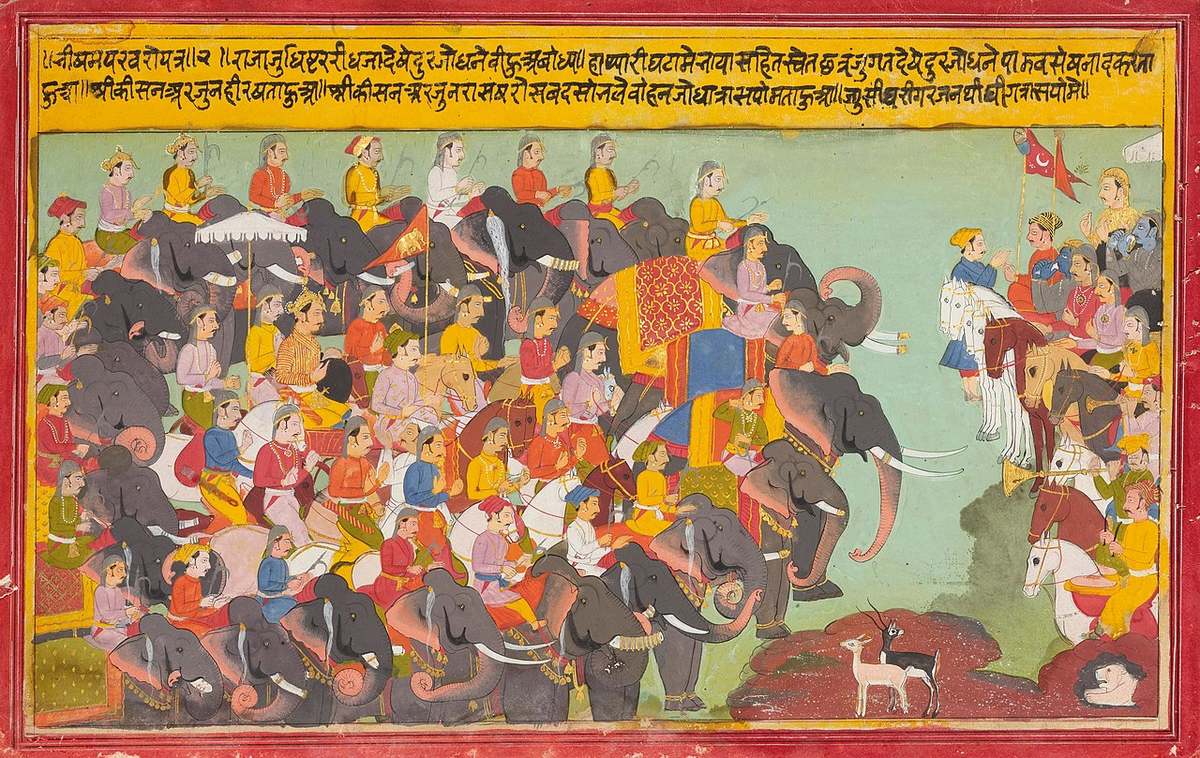
The Mahābhārata (महाभारत, “The Great Tale of the Bhārata Dynasty”) is one of the two great epics of ancient India, traditionally attributed to the sage Vyāsa. With over 100,000 ślokas (verses) — approximately 1.8 million words — it is the longest epic poem in the world, nearly ten times the combined length of Homer’s Iliad and Odyssey. At its heart is the story of a devastating war between two branches of a royal family — the Pāṇḍavas and the Kauravas — fought on the sacred field of Kurukṣetra. Yet the Mahābhārata is far more than a war narrative: it is an encyclopaedic compendium of dharma, philosophy, mythology, political science, and spiritual instruction, famously described within its own text as containing everything that exists — yad ihāsti tad anyatra, yan nehāsti na tat kvacit (“What is found here may be found elsewhere; what is not found here exists nowhere,” Ādi Parva 1.56.33).
The Author: Vyāsa and the Composition
Vyāsa (व्यास, “the compiler”), also known as Kṛṣṇa Dvaipāyana, is one of the most revered figures in Hindu tradition. He is credited not only with composing the Mahābhārata but also with dividing the original, unified Veda into four parts — the Ṛg, Yajur, Sāma, and Atharva Vedas — earning the title Veda Vyāsa. Remarkably, Vyāsa is himself a character within the epic: the grandfather of both the Pāṇḍavas and the Kauravas, born to the fisherwoman Satyavatī and the sage Parāśara on an island in the Yamunā river.
According to tradition, Vyāsa dictated the Mahābhārata to Gaṇeśa, the elephant-headed god, who served as his scribe — but only on the condition that Vyāsa never pause in his narration. Vyāsa, in turn, stipulated that Gaṇeśa must understand each verse before writing it down, a device that allowed the sage brief moments to compose particularly complex passages. The epic is presented as narrated by Vyāsa’s disciple Vaiśampāyana to King Janamejaya (Arjuna’s great-grandson) during a great snake sacrifice, and later retold by the bard Ugraśravas Sauti to the sages assembled in the Naimiṣa forest.
The Bhandarkar Oriental Research Institute (BORI) in Pune undertook the monumental task of producing the Critical Edition of the Mahābhārata between 1919 and 1966. Scholars compared over 1,259 manuscripts in Devanāgarī, Grantha, Malayalam, Śāradā, and other scripts from across the subcontinent, sifting interpolations from the archetype to establish a constituted text of approximately 89,000 verses — the most authoritative reconstruction of the epic available.
The Story: Genealogy and Rising Conflict
The Kuru Dynasty
The narrative centres on the royal house of Hastināpura, descended from the legendary King Bharata. King Śantanu marries the river goddess Gaṅgā, who bears him a son, Bhīṣma — destined to become the grand patriarch of the dynasty, bound by his famous vow of lifelong celibacy and loyalty to the throne. Later, Śantanu marries Satyavatī, and their two sons, Citrāṅgada and Vicitravīrya, both die without heirs. To continue the royal line, Satyavatī calls upon Vyāsa to father children with the two queens: Ambikā gives birth to Dhṛtarāṣṭra (born blind), and Ambālikā to Pāṇḍu (born pale).
Dhṛtarāṣṭra, being blind, cannot rule, and the kingdom passes to Pāṇḍu. But Pāṇḍu is cursed to die if he embraces a woman, and his five sons — Yudhiṣṭhira, Bhīma, Arjuna, Nakula, and Sahadeva — are born through divine boon (niyoga) from the gods Dharma, Vāyu, Indra, and the Aśvins respectively. Dhṛtarāṣṭra, meanwhile, has one hundred sons, the Kauravas, led by the eldest, Duryodhana. This dual lineage — the five Pāṇḍavas and the hundred Kauravas — sets the stage for the central conflict.
The Dice Game: The Moral Catastrophe
The pivotal episode that transforms rivalry into war is the infamous game of dice (dyūta krīḍā), narrated in the Sabhā Parva. Duryodhana, consumed by jealousy after witnessing Yudhiṣṭhira’s magnificent Rājasūya sacrifice, schemes with his uncle Śakuni — a master of gambling — to humiliate the Pāṇḍavas. Yudhiṣṭhira, bound by kṣatriya dharma never to refuse a challenge, accepts the invitation to play.
In a sequence that represents one of the most profound moral crises in world literature, Yudhiṣṭhira — the embodiment of truth and righteousness — loses everything: his wealth, his kingdom, his brothers, himself, and finally Draupadī, his wife. When Draupadī is dragged into the assembly hall and Duḥśāsana attempts to disrobe her, she poses a devastating legal and moral question to the assembled elders: Can a man who has already lost himself and is no longer free stake another person? The great Bhīṣma, asked to adjudicate, can only reply that “dharma is subtle” (sūkṣmo dharmaḥ) — a response that reveals the terrifying ambiguity at the heart of rigid rule-following.
The silence of the elders — Bhīṣma, Droṇa, Kṛpa, Vidura — in the face of this outrage is one of the epic’s most searing indictments. Only Vikarṇa, a minor Kaurava prince, speaks up to call the act adharmic. Draupadī is ultimately saved by divine intervention (Kṛṣṇa’s miraculous protection), but the wound is irreparable. The Pāṇḍavas are sentenced to thirteen years of exile — twelve in the forest and one incognito — after which Duryodhana refuses to return even five villages, declaring: “I will not give them land enough to place the point of a needle upon” (Udyoga Parva 126.21).
The Eighteen-Day War
Negotiations having failed, the two armies assemble on the plains of Kurukṣetra for a war that will last eighteen days and annihilate an entire generation of warriors. The forces are vast: tradition counts eleven akṣauhiṇīs (divisions) on the Kaurava side and seven on the Pāṇḍava side — millions of soldiers, chariots, elephants, and horses.
The war unfolds through a succession of commanders-in-chief: Bhīṣma leads the Kaurava forces for the first ten days, falling only when Arjuna, shielded behind Śikhaṇḍī, pierces him with arrows. Droṇa takes command next and is killed through a devastating deception — Yudhiṣṭhira, the man who never lied, announces the death of “Aśvatthāmā” (actually an elephant of that name), causing Droṇa to lay down his weapons in grief. Karṇa, the tragic hero whose true identity as the Pāṇḍavas’ eldest brother is revealed too late, commands on the sixteenth and seventeenth days before falling to Arjuna. Śalya commands briefly on the final day before Yudhiṣṭhira himself slays him.
The war ends with the mace duel between Bhīma and Duryodhana. Bhīma, violating the rules of combat, strikes Duryodhana’s thigh — fulfilling a vow made during Draupadī’s humiliation but raising yet another dharmic question about whether the ends justify the means. Of the vast armies that clashed, only a handful survive: the five Pāṇḍavas, Kṛṣṇa, Sātyaki, Kṛtavarma, Kṛpa, and Aśvatthāmā.
The Bhagavad Gītā: Song of the Divine
The Bhagavad Gītā (भगवद्गीता, “The Song of God”), comprising 700 verses in eighteen chapters within the Bhīṣma Parva (chapters 25-42), is the most celebrated philosophical and spiritual text within the Mahābhārata — and one of the most influential works in world literature. It arises at the moment of supreme crisis: Arjuna, the greatest warrior of his age, surveys the battlefield and sees teachers, grandfathers, uncles, brothers, sons, and friends arrayed on both sides. Overwhelmed by grief and moral confusion, he drops his bow and refuses to fight.
Kṛṣṇa’s response unfolds across the eighteen chapters as a systematic exposition of Hindu philosophy, presenting three interconnected paths (yogas) to liberation:
-
Karma Yoga (कर्मयोग, the path of selfless action) — Acting according to one’s dharma without attachment to results. The famous teaching: karmaṇy evādhikāras te mā phaleṣu kadācana — “You have the right to action alone, never to its fruits” (Gītā 2.47).
-
Jñāna Yoga (ज्ञानयोग, the path of knowledge) — Understanding the distinction between the eternal Ātman and the perishable body, realizing that the Self can neither kill nor be killed (Gītā 2.19-20).
-
Bhakti Yoga (भक्तियोग, the path of devotion) — Surrendering all actions to the divine with love and faith. Kṛṣṇa declares: sarvadharmān parityajya mām ekaṃ śaraṇaṃ vraja — “Abandoning all dharmas, take refuge in Me alone” (Gītā 18.66).
The Gītā culminates in the Viśvarūpa Darśana (Chapter 11), where Kṛṣṇa reveals His cosmic form — the entire universe contained within His body, devouring and regenerating all creation — leaving Arjuna awestruck and terrified. This theophany establishes Kṛṣṇa as the Supreme Being (Puruṣottama), integrating the personal and impersonal aspects of the divine.
The Eighteen Parvas
The Mahābhārata is organized into eighteen books (parvas), each covering a distinct phase of the narrative:
- Ādi Parva — Origins, genealogies, and the marriage of Draupadī
- Sabhā Parva — The assembly hall, the dice game, and the exile decree
- Vana Parva — Forest exile, containing the stories of Nala-Damayantī and Sāvitrī-Satyavān
- Virāṭa Parva — The year of incognito exile in King Virāṭa’s court
- Udyoga Parva — Failed peace negotiations and war preparations
- Bhīṣma Parva — The Gītā and the first ten days of war under Bhīṣma’s command
- Droṇa Parva — War under Droṇa, the death of Abhimanyu
- Karṇa Parva — Karṇa’s command and fall
- Śalya Parva — Final day of battle, Duryodhana’s defeat
- Sauptika Parva — Aśvatthāmā’s night massacre of the Pāṇḍava camp
- Strī Parva — The lamentations of the widows on the battlefield
- Śānti Parva — Bhīṣma’s teachings on governance, dharma, and philosophy from his deathbed of arrows
- Anuśāsana Parva — Further instructions on dharma, charity, and conduct
- Āśvamedhika Parva — Yudhiṣṭhira’s horse sacrifice
- Āśramavāsika Parva — Dhṛtarāṣṭra, Gāndhārī, and Kuntī’s retirement and death
- Mausala Parva — The fratricidal destruction of the Yādavas
- Mahāprasthānika Parva — The Pāṇḍavas’ final journey toward the mountains
- Svargārohaṇa Parva — The ascent to heaven
Embedded Narratives: Stories Within the Story
One of the Mahābhārata’s most distinctive literary features is its vast treasury of embedded narratives (upākhyānas) — stories within stories that mirror, illuminate, and comment upon the main plot. The Vana Parva alone contains dozens of sub-narratives, including:
-
Nala and Damayantī — A tale of love, separation, gambling addiction, and eventual reunion that directly mirrors Yudhiṣṭhira’s own experience with the dice game. King Nala, possessed by the demon Kali, loses his kingdom in a rigged gambling match and wanders in exile, while his devoted wife Damayantī searches tirelessly for him. The story, spanning 26 chapters and approximately 1,100 verses, is considered one of the finest love stories in Sanskrit literature.
-
Sāvitrī and Satyavān — The story of the princess Sāvitrī, who knowingly marries Satyavān despite the prophecy that he will die within a year. When Yama, the god of death, arrives to claim Satyavān’s soul, Sāvitrī follows him and, through her intellectual brilliance and unwavering devotion, wins back her husband’s life — a powerful illustration of pativrata dharma and the triumph of wisdom over fate.
-
The Story of Ṛṣyaśṛṅga — A tale of a sheltered sage’s son and his encounter with the world, exploring innocence, desire, and sacred duty.
These embedded narratives serve a deliberate literary purpose: they are told to the exiled Pāṇḍavas by visiting sages as consolation, instruction, and moral examples, transforming the epic into a vast pedagogical framework.
The Moral Universe: Dharma and Its Shadows
The Mahābhārata is unique among world epics in its unflinching examination of moral ambiguity. Unlike simpler narratives where good and evil are clearly demarcated, the Mahābhārata presents dharma as inherently complex, situational, and often tragically contradictory:
- Yudhiṣṭhira, the “Dharma King,” lies to his teacher Droṇa, causing Droṇa’s death — and his celestial chariot, which always hovered above the ground as a sign of his righteousness, sinks to the earth.
- Arjuna, the consummate warrior, kills his beloved grandfather Bhīṣma by hiding behind Śikhaṇḍī.
- Bhīma violates the rules of the mace duel to kill Duryodhana.
- Karṇa, who fights for the wrong side, is perhaps the most generous and heroic warrior on either army, but is destroyed by the accumulated curses of his life.
- Kṛṣṇa himself, the Supreme God, employs deception and strategic manipulation to ensure the Pāṇḍava victory.
Bhīṣma’s great discourse on dharma in the Śānti Parva — delivered from his bed of arrows over fifty-eight days as he awaits the winter solstice to die — addresses this complexity head-on, offering extended teachings on rājadharma (the duties of kings), āpaddharma (dharma in times of distress), mokṣadharma (the path of liberation), and the subtle interplay between rule and context that defines ethical life.
Cultural Legacy
The Mahābhārata’s influence on Indian civilization is immeasurable:
-
Literature and Performance: The epic has been retold in virtually every Indian language — Tamil (Villipāratam), Kannada (Pampa’s Vikramārjuna Vijayam), Telugu, Bengali, Malayalam, and many others. Its stories are dramatized in Yakṣagāna, Kathakali, Kūṭiyāṭṭam, shadow puppetry, and modern cinema and television (B.R. Chopra’s 1988 television serial remains one of the most-watched programmes in Indian broadcasting history).
-
Philosophy and Ethics: The Gītā has been translated into virtually every major world language and has influenced thinkers from Thoreau and Emerson to Gandhi, who called it his “spiritual dictionary,” and Oppenheimer, who quoted the Viśvarūpa chapter upon witnessing the first nuclear explosion.
-
Law and Governance: The Śānti Parva’s teachings on rājadharma constitute one of the most extensive treatises on statecraft in ancient literature, comparable to Kauṭilya’s Arthaśāstra.
-
Art and Iconography: Scenes from the Mahābhārata — the dice game, Kṛṣṇa’s Gītā discourse, the death of Bhīṣma — are depicted in temple sculptures from Angkor Wat in Cambodia to Prambanan in Java, across millennia and civilizations.
The Final Journey
The epic does not end with victory. The Mausala Parva narrates the self-destruction of Kṛṣṇa’s own Yādava clan in a drunken fratricidal war, and Kṛṣṇa’s own death — shot by a hunter’s arrow that strikes his foot, the one vulnerable spot. In the Mahāprasthānika Parva, the five Pāṇḍavas and Draupadī set out on their final journey toward Mount Meru, renouncing the world. One by one, Draupadī, Sahadeva, Nakula, Arjuna, and Bhīma fall and die along the way. Only Yudhiṣṭhira, accompanied by a faithful dog (who is Dharma in disguise), reaches the gates of heaven — where he faces one final moral test: he refuses to enter heaven without the dog and without his family, declaring that he will not abandon even the humblest companion.
This final image captures the Mahābhārata’s deepest teaching: that dharma is not a formula to be mechanically applied but a living commitment tested anew in every moment, demanding courage, compassion, and the willingness to stand alone for what is right — even at the gates of heaven.