Onam is Kerala’s most magnificent and beloved festival — a ten-day celebration of harvest abundance, cultural pride, and the legendary return of King Mahābali, the righteous Asura ruler whose benevolence was so great that even the gods grew envious. Celebrated in the month of Chingam (August-September) of the Malayalam calendar, with its climax on the day of the Thiruvonam nakshatra, Onam transcends religious boundaries — uniting Hindus, Christians, Muslims, and people of all faiths in Kerala in a shared celebration of prosperity, equality, and the nostalgic yearning for a golden age.
The Government of Kerala has designated Onam as the state festival, and the celebrations — featuring intricate Pūkkalam (flower carpets), the magnificent Onam Sadhya (feast), thrilling Vallam Kali (boat races), and vibrant folk performances — represent the fullest expression of Malayalam cultural identity and Kerala’s unique social ethos.
The Legend of Mahābali and the Vāmana Avatāra
The mythological heart of Onam lies in one of Hinduism’s most poignant and philosophically complex stories — the encounter between the benevolent Asura king Mahābali (also known as Māveli in Malayalam) and Vāmana, the dwarf incarnation of Lord Viṣṇu.
The Rise of Mahābali
According to the Bhāgavata Purāṇa (8.15-22) and the Viṣṇu Purāṇa, Mahābali was the grandson of the great devotee Prahlāda and the son of Virocana. Through rigorous austerities and the performance of a hundred aśvamedha yajñas (horse sacrifices) under the guidance of his guru Śukrācārya, Mahābali amassed such spiritual power that he conquered the three worlds — earth, heaven, and the nether regions — and dethroned Indra, the king of the devas.
But unlike the typical asura conqueror, Mahābali ruled with extraordinary righteousness. His kingdom knew no poverty, no crime, no inequality, no deception. The Onam folk song captures this golden age: “Māveli nāḍu vāṇīḍuṁ kālaṁ, mānuṣar ellāruṁ onnu pōle…” — “When Māveli ruled the land, all human beings were equal; there were no lies, no theft, no disease, and all measures were true and just.” This vision of Mahābali’s reign as a lost paradise of social equality is central to Onam’s emotional power.
The Coming of Vāmana
The devas, displaced from heaven and alarmed by Mahābali’s growing power, appealed to Lord Viṣṇu for help. Viṣṇu, recognizing both Mahābali’s virtue and the cosmic necessity of restoring the devas to their rightful position, chose a most unusual stratagem. He incarnated as Vāmana — a diminutive brāhmaṇa boy — and appeared at Mahābali’s court during a great yajña where the king was distributing gifts to all who asked.
When Vāmana approached the king, Mahābali — true to his nature of boundless generosity — invited the young brāhmaṇa to ask for whatever he desired. Vāmana requested merely three paces of land — enough, he said, to build a small fire-altar for his rituals. Mahābali’s guru Śukrācārya, recognizing the dwarf as Viṣṇu in disguise, warned the king not to grant the request. But Mahābali, refusing to break his word of generosity, declared: “What greater sin could there be than to refuse a seeker who comes to my door?” (Bhāgavata Purāṇa 8.19.43)
The Three Steps
As Mahābali poured the water of consecration to seal his gift, Vāmana began to grow. His form expanded until it filled the entire cosmos. With his first step, Vāmana covered the entire earth. With his second step, he covered the heavens and all the celestial worlds. Turning to Mahābali, Vāmana asked: “Where shall I place my third step?” Mahābali, understanding the cosmic nature of the being before him, bowed his head and offered: “Place your third step upon my head, Lord.”
Viṣṇu, deeply moved by Mahābali’s unflinching devotion and selflessness, pressed his foot upon the king’s head and sent him to Sutala (a realm in Pātāla, the nether world) — but granted him a boon: Mahābali could return to visit his beloved people once every year. It is this annual homecoming that Onam celebrates.
The Theological Depth
This story operates on multiple levels. On the cosmic level, it illustrates the dharmic principle that even the most righteous individual must submit to the divine order — Mahābali’s conquest of heaven, however benevolent, disrupted the cosmic balance. On the devotional level, Mahābali’s willingness to offer his own head to the Lord makes him one of Hinduism’s greatest exemplars of śaraṇāgati (unconditional surrender to God). The Bhāgavata Purāṇa (8.22.25) records Viṣṇu’s words: “Where I (Viṣṇu) cannot be won by yoga, sacrifices, or penances, I am won by unwavering devotion” — and Mahābali’s devotion was precisely this.
The Ten Days of Onam
Onam unfolds over ten magnificent days, each with its own name, significance, and escalating festivities:
-
Atham: The first day, marked by the lighting of the festival lamp and the beginning of the Pūkkalam. In Thrissur, the celebrations at the Thrikkākara Vāmanamūrti Temple (the only temple in Kerala dedicated to Vāmana) are inaugurated with great ceremony.
-
Chithira: The second day, when the Pūkkalam receives its second layer of flowers and community preparations intensify.
-
Chodhi: Markets and shops begin their Onam sales; families start purchasing new clothes and provisions.
-
Viśākam: Competitions and cultural events begin in villages and towns. The spirit of celebration grows.
-
Anizham: The famous Aranmula Uthrattathi Vallam Kali (boat race) is held near the Aranmula Parthasarathy Temple — one of Kerala’s oldest and most prestigious boat races.
-
Thrikēta: Families complete their shopping; holiday preparations reach their peak. Schools and offices begin closing for the festive break.
-
Mūlam: Temple festivities intensify. Special performances of Kathakali and other classical art forms are staged.
-
Pūrāḍam: The Pūkkalam designs become more elaborate and competitive. The installation of the Oṇattappaṉ (a small pyramid of clay representing Mahābali or Viṣṇu) begins.
-
Uthrāḍam: Known as the “First Onam” — a day of intense preparation. Families clean their homes, prepare ingredients for the Sadhya, and shop for last-minute provisions. The festive atmosphere reaches fever pitch.
-
Thiruvoṇam: The grand finale — the “Great Onam” — the day of Mahābali’s return. The Sadhya feast is served, the Pūkkalam reaches its most elaborate design, and the entire state comes alive with celebration.
Pūkkalam: The Art of Flower Carpets
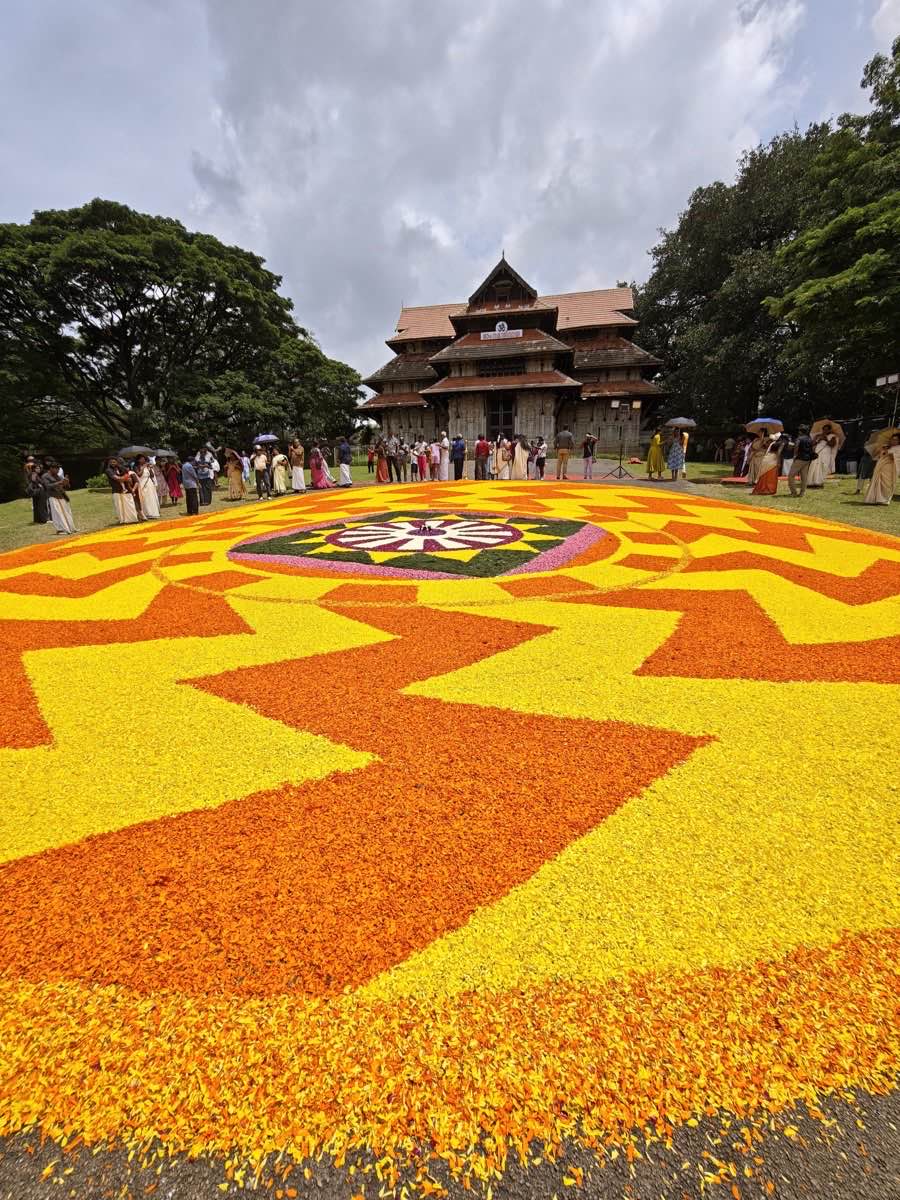
Pūkkalam (“flower carpet” or “flower rangoli”) is one of Onam’s most distinctive and visually stunning traditions. Beginning on Atham and growing more elaborate each day, families create intricate circular designs at the entrance to their homes using fresh flower petals — a living welcome mat for King Mahābali.
The Pūkkalam follows a traditional structure:
- Day 1 (Atham): A small, simple design using the yellow flowers of the thumba plant (Leucas aspera)
- Days 2-8: The design grows larger and more complex each day, incorporating additional colors — the orange of kanakāmbaram, the red of chemparatthi (hibiscus), the purple of thechi (Ixora), and many other local flowers
- Day 9 (Uthrāḍam): The design often exceeds ten feet in diameter
- Day 10 (Thiruvoṇam): The grandest Pūkkalam of all, often incorporating dozens of flower varieties in concentric circles of extraordinary precision and beauty
Pūkkalam competitions are held across Kerala, from village courtyards to corporate campuses. The most famous competition takes place at the Thrikkākara Temple in Ernakulam, where the winning designs can span over 100 feet in diameter and incorporate tens of thousands of individual flower petals.
The Onam Sadhya: A Feast on Banana Leaves
The Onam Sadhya is arguably the most celebrated vegetarian feast in India — a meal served on a banana leaf that can include 24 to 28 dishes arranged in a specific traditional order. The Sadhya embodies the Onam values of abundance, equality, and communal sharing — whether in a humble village home or a grand hotel, the feast is served identically to all.
The traditional arrangement on the banana leaf follows a prescribed pattern:
Upper left: Pickles and chips — banana chips, jackfruit chips, sharkara varatti (jaggery-coated banana chips)
Upper row: Iñji puḷi (ginger-tamarind chutney), nāraṅṅa achar (lime pickle), māṅṅa achar (mango pickle)
Center: Rice (chōṟu), served with progressively richer accompaniments — paripu (dal), sambar, rasam, and mōru (buttermilk)
Side dishes: Avial (mixed vegetables in coconut-yogurt gravy), olan (ash gourd in coconut milk), koottukari (mixed vegetable curry), thoran (dry vegetable stir-fry with coconut), pachadi (yogurt preparation), kalan (banana-yogurt curry), erisseri (pumpkin and lentil curry)
Desserts: Parippu pradhaman (lentil payasam), pāl pāyasam (milk payasam), ada pradhaman (rice-flake payasam)
The payasam (sweet pudding) is the crowning glory of the Sadhya — a meal may feature three to five varieties, each representing a different flavor and texture tradition. The meal concludes with a ball of rice and rasam, followed by mōru (buttermilk) to aid digestion.
The communal nature of the Sadhya — where all are served the same meal regardless of caste, class, or status — directly echoes the egalitarian spirit of Mahābali’s legendary kingdom.
Vallam Kali: The Snake-Boat Races
Vallam Kali (“boat play” or “boat race”) is one of Onam’s most thrilling spectacles — a tradition of competitive boat racing that dates back centuries in Kerala’s backwater regions. The most famous race is the Nehru Trophy Boat Race on Punnamada Lake in Alappuzha (Alleppey), held on the second Saturday of August.
The star of Vallam Kali is the chundan vallam (“snake boat”) — a long, sleek vessel that can measure over 100 feet in length and carry up to 100 rowers. The boats are shaped like a hooded serpent, with a raised stern curving gracefully upward. Each boat belongs to a specific village or community, and the rowers — often numbering 80 to 100 per boat — train for months before the competition.
The races are accompanied by the rhythmic singing of vanchipattu (boat songs) and the thundering of drums. The Aranmula Boat Race, held near the Aranmula Parthasarathy Temple during Onam, is the oldest snake-boat race in Kerala, traditionally associated with the annual temple festival and the procession of offerings to Lord Kṛṣṇa.
Folk Arts and Cultural Performances
Onam is a showcase for Kerala’s extraordinarily rich tradition of folk and classical arts:
Pulikali: The Tiger Dance
Pulikali (“tiger play”) is a flamboyant folk art performed on the fourth day of Onam celebrations, particularly in Thrissur. Artists paint their bodies in vivid tiger stripes and leopard spots, don elaborate costumes, and dance through the streets to the rhythm of traditional chenda (drums) and thakil (cymbals). The Thrissur Pulikali, involving hundreds of performers, is one of Onam’s most photographed events.
Thiruvāthira Kali
Thiruvāthira Kali is a graceful circular dance performed by women around a lamp (nilavilakku) to the accompaniment of devotional songs. The dancers, dressed in the traditional Kerala mundum neriyathum (white and gold garments), move in synchronised patterns that evoke the gentle rhythms of the monsoon season.
Kummāṭṭikali: Mask Dance
Kummāṭṭikali is a colorful mask dance performed by artists wearing elaborate painted wooden masks depicting various characters — gods, demons, animals, and folk figures. Performers go from house to house, entertaining families and receiving gifts of rice and money.
Other Art Forms
Additional Onam-specific art forms include Oṇakkali (group games played by women), Thumbi Thullal (a women’s dance inspired by the dragonfly), and Oṇatthallu (traditional martial arts demonstrations).
Historical and Cultural Significance
Ancient Origins
The antiquity of Onam is attested by a 12th-century inscription at the Tiruvalla Temple (Sree Vallabha Temple) in Pathanamthitta, which records a donation made to the temple as part of the Onam festival offering. The festival is also mentioned in the Silappadikaram, the 2nd-century Tamil epic by Iḷaṅkō Aṭikaḷ, which refers to a festival celebrating the Onam star (Thiruvonam/Śravaṇa nakṣatra) — suggesting that the festival may predate the Vāmana mythology and originally have been a harvest celebration later interwoven with the Purāṇic narrative.
A Festival of Social Equality
Onam’s most remarkable feature is its secular and egalitarian character. The festival’s central mythology — a righteous king overthrown by divine power but permitted to return annually to his people — has been interpreted as a folk memory of a pre-caste, pre-hierarchical golden age. The Onam Sadhya, where all eat the same meal seated together regardless of social status, embodies this ideal of equality. In a state historically marked by rigid caste hierarchy, Onam represented an annual suspension of social distinctions — a carnival of equality that, for ten days, recreated Mahābali’s legendary kingdom of justice.
Kerala’s Identity and Diaspora Celebrations
For the global Malayali diaspora — estimated at over four million people worldwide — Onam serves as the most powerful marker of cultural identity. Onam celebrations in cities from Dubai to Dallas, London to Singapore, recreate the Sadhya, Pūkkalam, and cultural performances, connecting successive generations to their ancestral traditions.
The Thrikkākara Temple and Onam Worship
The Thrikkākara Vāmanamūrti Temple in Ernakulam holds a unique place in Onam celebrations. It is the only temple in Kerala dedicated to the Vāmana form of Viṣṇu and is considered the spiritual epicenter of Onam. The temple’s ten-day festival, beginning on Atham, features elaborate rituals, processions, and the famous Pūkkalam competition.
The Oṇattappaṉ — a small clay pyramid or conical figure installed in homes during Onam — represents either Mahābali or Vāmana (interpretations vary by region). It is placed at the center of the Pūkkalam on Thiruvonam day, worshipped with flowers and prayers, and then immersed in water after the festival — symbolizing Mahābali’s departure back to Sutala until his return the following year.
Philosophical Resonance
The story of Mahābali and Vāmana carries profound philosophical resonances that elevate Onam beyond a mere harvest celebration:
The paradox of divine justice: Mahābali is righteous yet must be conquered. Viṣṇu acts against a devotee to maintain cosmic order. The story grapples with the tension between individual virtue and cosmic dharma — suggesting that even the most virtuous individual cannot exempt themselves from the larger patterns of ṛta (cosmic order).
The triumph of devotion: Despite his defeat, Mahābali emerges as the true victor — his devotion earns him a boon greater than temporal sovereignty: the eternal love of his people and an annual homecoming granted by God himself. The Bhāgavata Purāṇa (8.22.35) records that Viṣṇu stationed himself as Mahābali’s doorkeeper — the Lord serving the devotee, a reversal that illustrates the supreme power of bhakti (devotion).
The memory of a golden age: Every culture harbors the myth of a lost paradise — a time when justice, equality, and abundance prevailed. Onam keeps this memory alive, not as mere nostalgia but as an aspirational vision — a reminder that the ideal society, however briefly glimpsed, remains possible and worth striving for.
As the festive drums fall silent and the last petals of the Pūkkalam scatter in the monsoon breeze, Kerala whispers its annual farewell to Mahābali — and its annual promise that when the Thiruvoṇam star rises again in the Chingam sky, the gates between worlds will open once more, and the beloved king will return to his people.