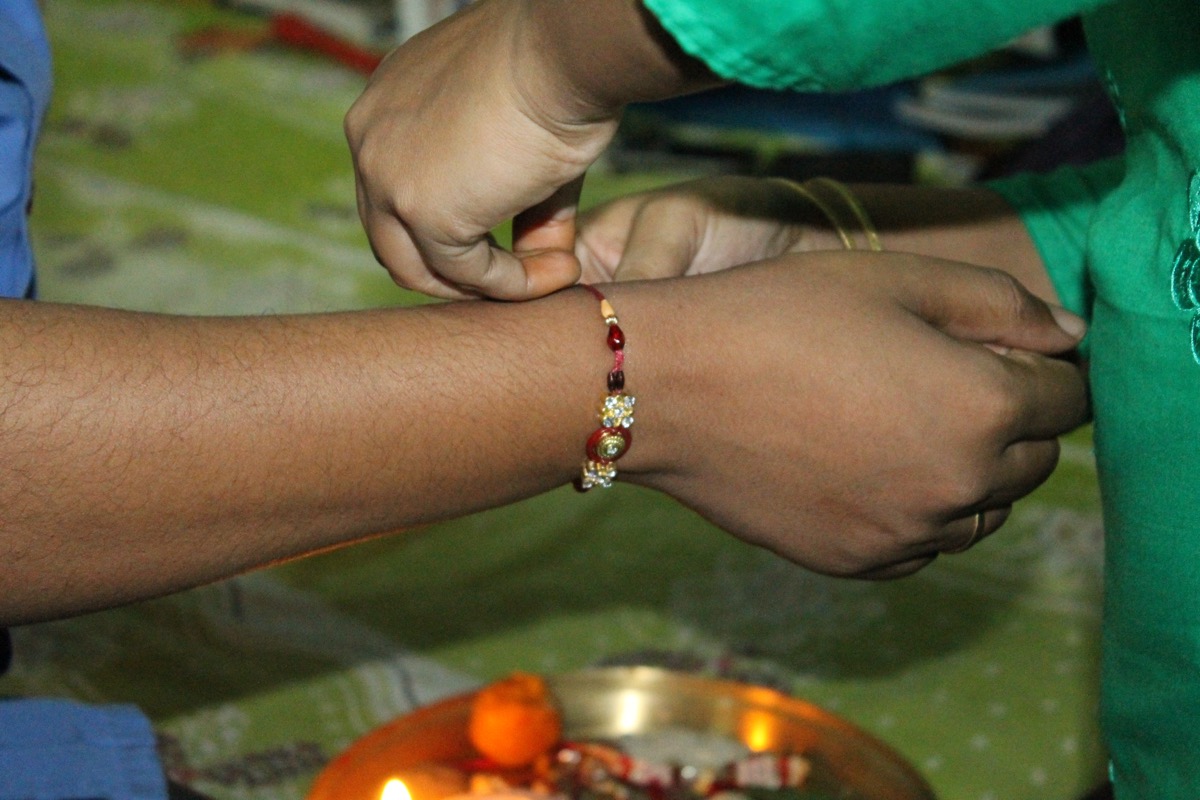
Rakṣā Bandhan (रक्षा बन्धन, “the bond of protection”) is one of the most emotionally resonant festivals in Hindu tradition, celebrated on the Pūrṇimā (full moon day) of the Hindu month of Śrāvaṇa (typically in August). On this day, sisters tie a sacred thread — the rākhī (राखी) or rakṣā-sūtra — around the wrists of their brothers, invoking divine protection upon them. Brothers, in turn, pledge to protect their sisters and offer gifts as tokens of their commitment. The festival embodies the Hindu ideal that human relationships, when consecrated through ritual and mutual obligation, become channels of divine grace.
Etymology and Scriptural Foundations
The compound rakṣā-bandhan joins two Sanskrit words: rakṣā (रक्षा, “protection, guard”) and bandhan (बन्धन, “binding, tying, bond”). The term thus signifies “the binding of protection” — a ritual act that transforms an ordinary thread into a talisman of divine safeguarding.
The practice of tying a protective thread has deep Vedic roots. The Atharva Veda (referred to as the storehouse of protective rites) contains numerous references to rakṣā threads and amulets (maṇi) tied to ward off disease, malevolence, and the evil eye. The concept of a consecrated thread conferring protection is thus among the oldest ritual ideas in Hinduism.
The Bhavishya Purāṇa provides the most direct scriptural account of Rakṣā Bandhan. It narrates that when the devas (gods) were suffering repeated defeats at the hands of the asuras (demons), Lord Indra approached his preceptor Bṛhaspati for guidance. Bṛhaspati instructed Śacī (Indra’s wife, also called Indrāṇī) to tie a consecrated thread around Indra’s right wrist on the Śrāvaṇa Pūrṇimā. Empowered by the rakṣā-sūtra and the prayers of his wife, Indra defeated the asura king Vṛtra in battle. This narrative established the Śrāvaṇa full moon as the day for tying protective threads, with the original rakṣā being a wife’s prayer for her husband’s safety in battle.
Mythological Narratives
Yamā and Yama
One of the most beloved stories associated with Rakṣā Bandhan concerns the river goddess Yamunā (also called Yamā) and her twin brother Yama, the god of death. According to tradition, Yamunā tied a sacred thread around Yama’s wrist, and Yama was so moved by his sister’s love that he granted her immortality. He further declared that any brother who receives a rākhī from his sister and pledges to protect her shall be freed from the fear of death. This narrative connects Rakṣā Bandhan with the fifth day of Diwali — Bhāī Dūj (Yama Dvitīyā) — creating a complementary pair of sibling festivals in the Hindu calendar.
Draupadī and Kṛṣṇa
The Mahābhārata tradition records a touching episode between Draupadī and Lord Kṛṣṇa. When Kṛṣṇa cut his finger on the sharp edge of the Sudarśana Cakra, Draupadī immediately tore a strip from her sari and bound his wound. Moved by her spontaneous compassion, Kṛṣṇa pledged to protect her. This vow manifested dramatically during the infamous episode of vastraharaṇa (the disrobing) in the Kaurava court, when Kṛṣṇa miraculously extended Draupadī’s sari to infinite length, shielding her honour. Though not historically tied to the Śrāvaṇa Pūrṇimā date, this narrative has become deeply interwoven with the festival’s meaning — illustrating that the rakṣā bond transcends biological kinship and encompasses all relationships of mutual care and protection.
Lakṣmī and King Bali
Another Purāṇic account links Rakṣā Bandhan to the story of Goddess Lakṣmī and the benevolent demon king Bali. After Lord Viṣṇu, in his Vāmana avatāra, had claimed the three worlds from Bali and banished him to the netherworld (Pātāla), Bali’s devotion so moved Viṣṇu that the Lord agreed to serve as Bali’s doorkeeper. Lakṣmī, distressed at her husband’s absence from Vaikuṇṭha, visited Bali and tied a rakṣā-sūtra on his wrist, making him her brother. She then requested the return of her husband as her gift. Bali, honouring the rākhī bond, released Viṣṇu. This story — found in the Bhāgavata Purāṇa commentarial traditions — explains why Rakṣā Bandhan is also observed in some Vaiṣṇava communities as a day honouring the Lakṣmī-Nārāyaṇa relationship.
Historical Traditions
The Brāhmaṇical Śrāvaṇī
In the orthodox Brāhmaṇical tradition, the Śrāvaṇa Pūrṇimā is observed as Śrāvaṇī or Upakarma — the day on which the sacred thread (yajñopavīta) is ceremonially changed and the annual study of the Vedas recommences. The priest (purohita) ties a new protective thread on the wrists of the yajamāna (patron) while reciting Vedic mantras. This Brāhmaṇical practice of tying a rakṣā-sūtra on the Śrāvaṇa full moon likely predates and coexists with the sibling-centred celebration, with both streams eventually merging into the composite festival observed today.
Rajput and Mughal History
Indian history records several instances of Rajput queens sending rākhīs to neighbouring kings — even across religious boundaries — as appeals for military protection. The most famous account involves Rani Karnavati of Mewar, who is said to have sent a rākhī to Mughal Emperor Humāyūn in 1535 CE, seeking his protection against the Sultan of Gujarat, Bahādur Shāh. Though Humāyūn arrived too late to save the fort of Chittor, the episode illustrates how the rākhī tradition transcended the purely familial context to become a powerful instrument of political alliance and inter-community solidarity.
Rabindranath Tagore and Rakshabandhan
In 1905, when the British colonial government partitioned Bengal along communal lines (Hindu West Bengal and Muslim East Bengal), the Nobel laureate Rabindranath Tagore invoked Rakṣā Bandhan as a symbol of Hindu-Muslim unity. He organized a mass rākhī-tying ceremony in Kolkata, where Hindus and Muslims tied threads on each other’s wrists as a pledge of brotherhood and resistance to the divisive partition. Tagore’s reimagining of Rakṣā Bandhan as a festival of universal solidarity — rather than merely biological kinship — remains one of the most powerful modern adaptations of a Hindu ritual.
The Ritual
The Rakṣā Bandhan ceremony follows a well-established sequence:
-
Preparation: Sisters prepare a thālī (ceremonial plate) containing the rākhī thread, a dīyā (oil lamp), kumkum (vermilion), akṣata (unbroken rice grains), and sweets.
-
Tilaka: The sister applies a tilaka of kumkum and rice on the brother’s forehead — a Vedic gesture of consecration that marks the recipient as blessed and protected.
-
Tying the Rākhī: The rākhī is tied around the brother’s right wrist while prayers for his well-being, longevity, and prosperity are offered. Many families recite a specific mantra: “yena baddho Balī rājā dānavendro mahābalaḥ / tena tvām anubadhyāmi rakṣe mā cala mā cala” — “With that same bond by which the mighty demon king Bali was bound, I bind you; O protective charm, do not falter, do not falter.”
-
Āratī: The sister performs a brief āratī by waving the dīyā in a circular motion before the brother.
-
Sweets and Gifts: Sweets are exchanged as tokens of affection. Brothers traditionally give gifts — money, clothing, or jewellery — as a pledge of their protective commitment.
Regional Variations
In North India (Uttar Pradesh, Bihar, Madhya Pradesh, Rajasthan), Rakṣā Bandhan is the pre-eminent sibling festival, observed with great fervour in every household. In West Bengal and Odisha, the day coincides with Jhulan Pūrṇimā, the celebration of the swing festival of Rādhā and Kṛṣṇa, and rākhī-tying is part of a broader day of celebrations. In Maharashtra and Goa, the day is also known as Nārali Pūrṇimā (“Coconut Full Moon”), when fishermen offer coconuts to the sea god Varuṇa, marking the end of the monsoon fishing ban and the start of the new fishing season. In Nepal, the festival is observed as Janai Purnima, when Brāhmaṇa priests tie sacred threads (janai) on the wrists of devotees at temples across the Kathmandu Valley.
The Theology of Protection
The concept of rakṣā (protection) in Hindu thought is not merely physical safety but encompasses protection of dharma, honour, spiritual well-being, and the social order. The rakṣā-sūtra is a material embodiment of an immaterial prayer — a thread charged with saṅkalpa (sacred intention) that creates an invisible field of divine protection around the wearer.
The Vedic understanding of bandhan (bond) is equally significant. In the Hindu worldview, bonds are not restrictions but connections — channels through which prāṇa (vital energy) and divine grace flow between individuals. The family is not merely a social unit but a spiritual community (kula), and each relationship within it is a sacred contract (ṛṇa) that carries both rights and obligations.
Rakṣā Bandhan ritualizes this understanding by making the invisible visible. The thread on the brother’s wrist is a constant reminder of his dharma toward his sister — and by extension, toward all those who depend on his strength and integrity. The sister’s prayer is equally binding: it is an act of tapas (spiritual austerity) that invokes cosmic forces to guard her brother. The exchange is thus mutual: protection for prayer, strength for blessing, material support for spiritual grace.
The Deeper Philosophy
Rakṣā Bandhan teaches that love, when expressed through ritual commitment, becomes a transformative spiritual force. The festival insists that human relationships are not accidental or merely biological but carry deep kārmic and dharmic significance. The brother-sister bond, consecrated by the rākhī, becomes a miniature model of the ideal relationship between the protector and the protected — a relationship that, in the Hindu cosmic vision, mirrors the relationship between the divine and the devotee.
The Bṛhadāraṇyaka Upaniṣad (2.4.5) teaches: “ātmanastu kāmāya sarvaṃ priyaṃ bhavati” — “It is for the sake of the Self that everything becomes dear.” The love between siblings is ultimately a reflection of the Ātman recognizing itself in another. Rakṣā Bandhan, by ritualizing this recognition, elevates familial love from the merely sentimental to the genuinely sacred — transforming a simple thread into a bond that holds families, communities, and ultimately the entire cosmos together in a web of mutual care and divine protection.