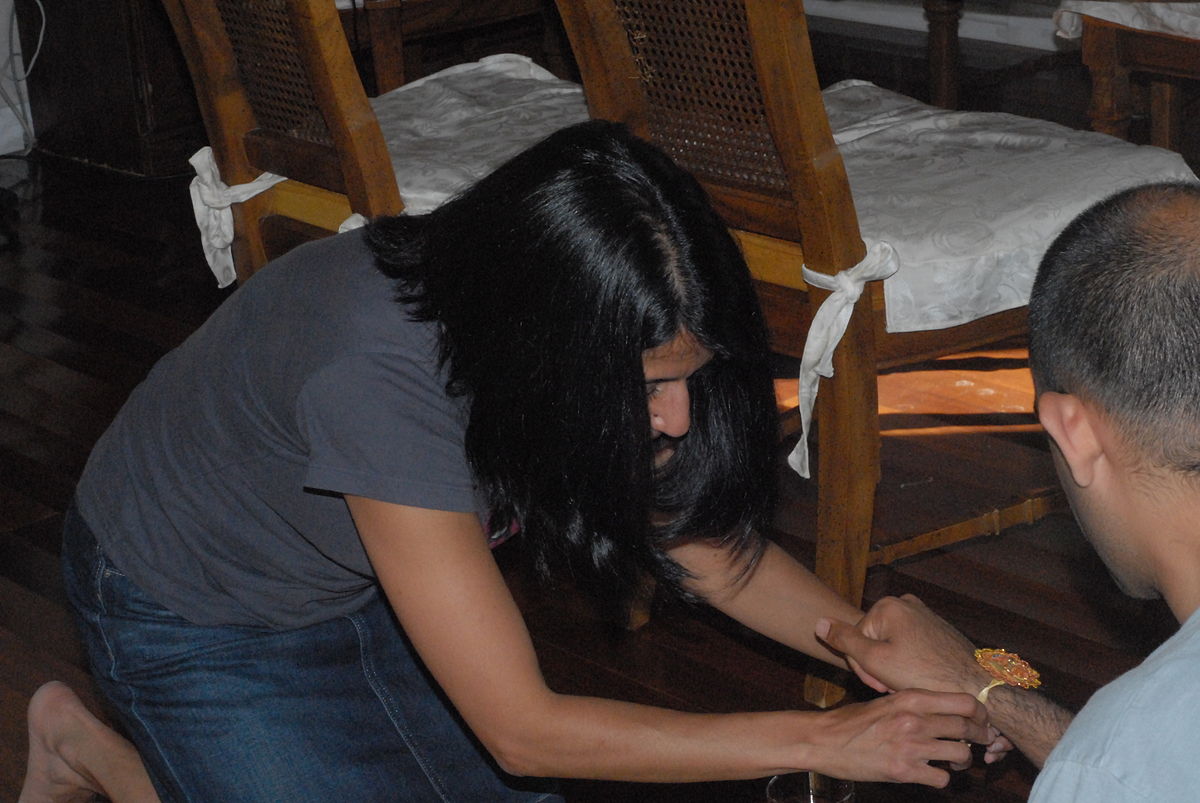
Rakṣā Bandhan (रक्षा बन्धन, “the bond of protection”) is one of the most beloved and widely celebrated festivals in Hindu tradition, honouring the sacred bond between siblings — particularly between brothers and sisters. Observed on the full moon day (Pūrṇimā) of the Hindu lunar month of Śrāvaṇa (typically falling in August), this festival is marked by the simple yet profoundly symbolic ritual of a sister tying a protective thread — the rākhī (राखी) — around her brother’s wrist, and the brother pledging to protect his sister in return.
The festival’s name itself encodes its deepest meaning: rakṣā means “protection” and bandhan means “bond” or “tie.” The rākhī thread is not merely a decorative ornament but a sacred talisman — a tangible expression of love, trust, and the promise of mutual care that transcends the material world.
Etymology and Historical Origins
The practice of tying a protective thread has ancient roots in Hindu tradition, predating the specific festival of Rakṣā Bandhan by centuries. The Sanskrit word rakṣā appears throughout Vedic literature in the context of protective mantras, amulets, and rituals designed to ward off evil forces. The Atharva Veda contains numerous rakṣā mantras — protective incantations — used in healing, warfare, and domestic life.
The specific association of thread-tying with Śrāvaṇa Pūrṇimā appears to have developed through the convergence of several distinct traditions:
-
The Brāhmaṇical thread ceremony — On Śrāvaṇa Pūrṇimā, Brāhmaṇa priests would traditionally replace their old yajñopavīta (sacred thread) with a new one, symbolizing spiritual renewal. They would also tie protective threads (rakṣā sūtra) on the wrists of their patrons after performing rituals (Britannica - Raksha Bandhan).
-
Vedic protective rituals — The Bhavishya Purāṇa describes a ritual in which wives tied protective threads on their husbands’ wrists before battle or dangerous undertakings, invoking divine protection.
-
Folk sibling traditions — Regional traditions of sisters praying for their brothers’ welfare, which gradually merged with the Brāhmaṇical thread-tying customs.
The modern festival of Rakṣā Bandhan represents the synthesis of these multiple streams into a single, unified celebration centred on the sibling bond.
Mythological Stories
Indra and Indrāṇī: The Original Rākhī
The Bhavishya Purāṇa contains what is often considered the foundational myth of Rakṣā Bandhan. When Lord Indra, the king of the devas, was engaged in a fierce battle against the demon king Bali (Vṛtrāsura in some versions), the devas were losing ground. Indra’s wife, Śacī (also known as Indrāṇī), was deeply distressed and sought the counsel of Lord Viṣṇu.
Viṣṇu gave Śacī a sacred cotton thread, blessed with divine power, and instructed her to tie it around Indra’s wrist on the day of Śrāvaṇa Pūrṇimā. Śacī performed the ritual with mantras and prayers, and the blessed rākhī — charged with the protective power of Viṣṇu himself — empowered Indra to defeat Bali and reclaim his throne in Amarāvatī. This story establishes the rākhī not merely as a symbol of affection but as a genuinely protective instrument, charged with divine śakti (power).
Yama and Yamunā: The Immortal Bond
One of the most poignant mythological narratives associated with Rakṣā Bandhan is the story of Yama (the god of death) and his twin sister Yamunā (the river goddess). According to tradition, Yama had not visited his sister for twelve years. Yamunā, grieving his absence, sought the help of the goddess Gaṅgā, who persuaded Yama to visit his sister.
When Yama arrived, Yamunā prepared a lavish feast and tied a rākhī on his wrist with great love and devotion. Yama was so moved by his sister’s selfless affection that he granted her a boon: he declared that any brother who receives a rākhī from his sister and pledges to protect her shall be granted immortality. This story is the basis for the belief that the rākhī ceremony confers long life and divine blessing upon the brother.
Kṛṣṇa and Draupadī: The Divine Promise
Perhaps the most widely known mythological story connecting Rakṣā Bandhan to the Mahābhārata concerns Lord Kṛṣṇa and Draupadī. According to tradition, when Kṛṣṇa cut his finger on the Sudarśana Cakra (his divine discus), Draupadī immediately tore a strip of cloth from her sārī and bound his bleeding wound. Moved by her spontaneous act of care, Kṛṣṇa declared her his sister and promised to protect her whenever she needed him.
This promise was dramatically fulfilled during the infamous vastraharaṇa (disrobing) episode in the Kaurava court. When Duḥśāsana attempted to strip Draupadī of her garments before the assembled court, she called out to Kṛṣṇa in desperation. Kṛṣṇa miraculously extended her sārī endlessly, preserving her honour. The thread she had tied as a bandage became the bond through which divine protection flowed — a powerful illustration of the reciprocal nature of rakṣā bandhan.
Lakṣmī and King Bali
Another beloved story from the Bhāgavata Purāṇa relates how Goddess Lakṣmī sought to bring Lord Viṣṇu back from the netherworld (Pātāla), where he had gone to serve as the gatekeeper of the generous demon king Bali after the Vāmana avatāra episode. Lakṣmī visited Bali and tied a rākhī on his wrist, making him her brother. Moved by this bond, Bali asked what she desired, and Lakṣmī requested the release of her husband. Bali complied, and Viṣṇu returned to Vaikuṇṭha.
Santośī Mā and the Cosmic Rākhī
In more recent devotional traditions, the story of Santośī Mā (the goddess of satisfaction) includes a Rakṣā Bandhan narrative. As the daughter of Lord Gaṇeśa, Santośī Mā is said to have tied rākhīs on the wrists of her divine brothers — Śubh and Lābh — establishing the festival’s connection to the broader divine family.
The Ritual of Rakṣā Bandhan
The ceremony of Rakṣā Bandhan follows a time-honoured sequence, typically performed during the śubha muhūrta (auspicious time window) calculated by the Hindu calendar:
Preparation of the Rākhī Thālī
The sister prepares a ceremonial plate (thālī) containing:
- The rākhī — a sacred thread, which ranges from a simple red and gold thread (mauli) to elaborate decorative bands adorned with beads, stones, and religious symbols
- A dīpaka (lamp) — representing the light of Agni and divine consciousness
- Akṣata (unbroken rice grains) — symbolizing prosperity and completeness
- Kumkuma (vermilion) and haldī (turmeric) — for the tilaka
- Miṣṭānna (sweets) — to be fed to the brother
The Ceremony
-
Āratī — The sister performs āratī, waving the lit lamp in a circular motion before the brother’s face, invoking divine blessings and expressing reverence.
-
Tilaka — She applies a tilaka of kumkuma (vermilion) and rice grains on the brother’s forehead, activating the ājñā cakra (the point of spiritual intuition between the eyebrows).
-
Rākhī-bandhana — The sister ties the rākhī on the brother’s right wrist while reciting prayers for his well-being, health, and longevity. Traditional mantras include: yena baddho balī rājā dānavendra mahābalaḥ / tena tvām anubadhāmi rakṣe mā cala mā cala — “With the same bond by which the mighty demon king Bali was bound, I tie you; O protector, do not waver, do not waver.”
-
Miṣṭānna — She feeds the brother a sweet, symbolizing the sweetness of their bond.
-
Praṇāma and Āśīrvāda — The brother touches the sister’s feet or hands, and in return, the sister touches the brother’s feet. The exchange of respectful greetings reinforces the mutual nature of the bond.
-
Gift-giving — The brother presents a gift to the sister — traditionally cash, clothing, or jewellery — as a symbol of his commitment to her welfare and protection.
Śrāvaṇa Pūrṇimā: The Cosmic Timing
Rakṣā Bandhan falls on Śrāvaṇa Pūrṇimā — the full moon of the month of Śrāvaṇa — which is one of the most auspicious days in the Hindu calendar. The month of Śrāvaṇa is sacred to Lord Śiva (as the month of the monsoon, when devotees perform kānvaḍa yātrā and pour Gaṅgā water on Śiva liṅgas), and the full moon carries its own special significance as a day of completeness, abundance, and spiritual power.
The choice of Pūrṇimā is symbolically appropriate: the full moon represents completeness, just as the rākhī completes the bond between siblings. The monsoon rains of Śrāvaṇa signify nourishment and renewal — fitting metaphors for the relationship being celebrated.
Regional Variations
North India: The Classical Celebration
In Uttar Pradesh, Rajasthan, Bihar, and other northern states, Rakṣā Bandhan is celebrated in its most recognizable form — with elaborate rākhī thālīs, large family gatherings, exchange of sweets and gifts, and the full ritual sequence of āratī, tilaka, and rākhī-tying. Sisters often observe a fast (vrata) until they have tied the rākhī.
West Bengal and Odisha: Jhulan Pūrṇimā
In West Bengal, Śrāvaṇa Pūrṇimā is celebrated as Jhulan Pūrṇimā, honouring the divine love of Rādhā and Kṛṣṇa. Temple deities are placed on decorated swings (jhulā) and devotees sing kīrtanas celebrating the divine romance. While the sibling rākhī tradition is also observed, the day carries this additional devotional dimension.
In Odisha, the day is celebrated as the birthday of Lord Balarāma (Kṛṣṇa’s elder brother) and is marked by the traditional Gamhā Dīyāṇ — a jumping game performed by young men. Rākhīs are also tied on the horns of cattle, honouring the sacred relationship between humans and bovines.
Maharashtra: Nārāḷī Pūrṇimā
In coastal Maharashtra, the day is known as Nārāḷī Pūrṇimā (“Coconut Full Moon”). Fishermen offer coconuts to the sea god Varuṇa, seeking his protection and blessings for a fruitful fishing season now that the turbulent monsoon seas are calming. The coconut offerings symbolize the rakṣā bandhan between the fishermen and the ocean — a bond of mutual respect, dependence, and protection.
South India: Āvaṇi Aviṭṭam
In Tamil Nadu and Kerala, Śrāvaṇa Pūrṇimā is observed as Āvaṇi Aviṭṭam, primarily a Brāhmaṇical ceremony in which the sacred thread (yajñopavīta) is ceremonially replaced. Brāhmaṇas perform rituals of repentance (prāyaścitta) for the sins of the past year and renew their commitment to Vedic study. While the sibling rākhī tradition is less prominent in these regions, the underlying theme of renewal and protection connects it to the broader Rakṣā Bandhan spirit.
Central India: Kajarī Pūrṇimā
In parts of Madhya Pradesh, Chhattisgarh, and Jharkhand, the full moon of Śrāvaṇa is celebrated as Kajarī Pūrṇimā, a harvest-related festival in which farmers worship the earth and sow new crops. Women tie rākhīs on trees and plants, extending the concept of rakṣā to the natural world — a beautiful ecological dimension of the festival.
Beyond Siblings: The Universal Bond
While Rakṣā Bandhan is most commonly associated with biological siblings, the festival’s meaning extends far beyond the nuclear family. In Hindu tradition, the rākhī can be tied by any woman on any man she considers a brother, regardless of biological relationship. This practice creates vast networks of quasi-familial bonds across communities, castes, and even religions.
Historically, Rakṣā Bandhan has also served as a tool of social unity. During the Swadeshi movement (1905), Rabindranath Tagore invoked Rakṣā Bandhan as a symbol of Hindu-Muslim unity in Bengal, organizing mass rākhī-tying ceremonies between Hindus and Muslims to protest the partition of Bengal. Women tied rākhīs on the wrists of men from the other community, establishing bonds of brotherhood across religious lines.
In contemporary India, the festival continues to evolve. Women tie rākhīs on soldiers, police officers, and public servants as expressions of gratitude and prayers for their safety. Environmental groups organize “Green Rākhīs” tied around trees to promote ecological awareness. The festival has also been adopted by Jain, Sikh, and many secular Indian families as a celebration of the universal human bond of protection and care.
Philosophical Significance
At its deepest level, Rakṣā Bandhan embodies a fundamental insight of Hindu dharma: that relationships of care and protection are sacred obligations, not merely sentimental attachments. The rākhī is a visible, tangible reminder of the invisible bonds of love, duty, and divine protection that connect all beings.
The festival also enacts the principle of reciprocity that lies at the heart of Hindu ethics. The sister prays for her brother’s well-being and ties a thread of protection; the brother pledges his protection and support in return. Neither party gives without receiving; neither receives without giving. This mutual exchange mirrors the cosmic principle of yajña — the sacred cycle of offering and blessing that sustains the universe.
The Bhavishya Purāṇa’s account of Indrāṇī’s rākhī suggests an even deeper dimension: that the protective power of the rākhī comes not from the thread itself but from the love (prema) and prayer (prārthanā) with which it is charged. The rākhī is a conduit for śakti — divine energy — channelled through the sincerity of the sister’s devotion. In this understanding, every rākhī ceremony is a small act of worship, and every brother’s wrist becomes a miniature altar.
The Eternal Thread
From the divine thread that empowered Indra to defeat the demons to the strip of sārī that bound Kṛṣṇa and Draupadī in an unbreakable bond of divine protection, the rākhī has woven itself into the very fabric of Hindu civilization. It is at once the simplest and the most profound of rituals — a thread that, once tied, creates a sacred obligation that transcends time, distance, and circumstance.
As millions of sisters across India and the global Hindu diaspora prepare their rākhī thālīs each Śrāvaṇa Pūrṇimā, they participate in a tradition that stretches back to the earliest Vedic rites of protection. The thread may be of cotton or silk, adorned with gems or plain, but the bond it represents is always the same: the ancient, unbreakable, divinely sanctioned promise that no one walks through this world unprotected, and no one bears the weight of life alone.
Yena baddho balī rājā… rakṣe mā cala mā cala — “O protector, do not waver, do not waver.”