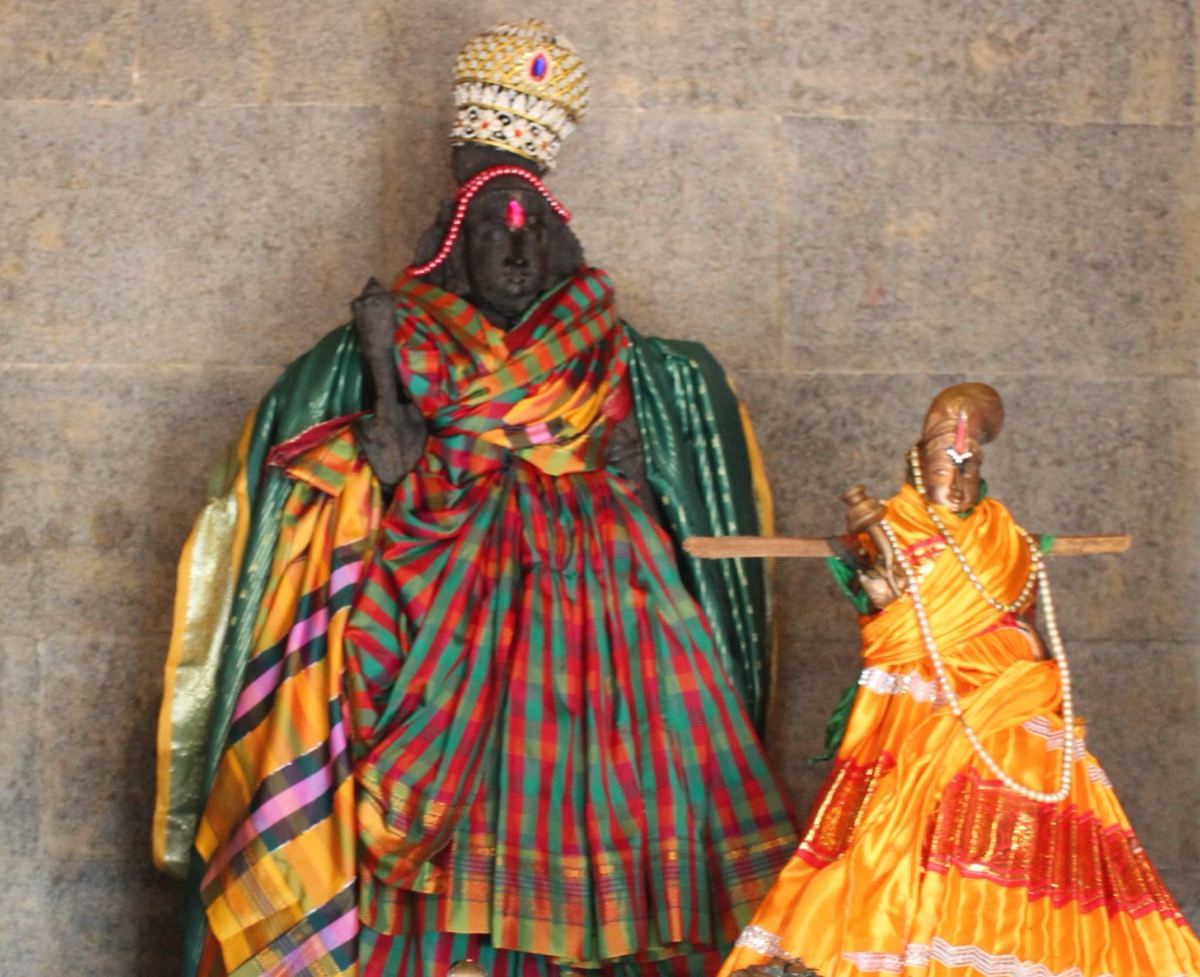
Tiruppāvai (திருப்பாவை, “The Sacred Vow”) is a garland of thirty Tamil verses composed by Āṇḍāḷ (ஆண்டாள்), the only female saint among the twelve canonical Āḻvārs of Śrī Vaiṣṇavism. Composed in the eighth or ninth century CE, these hymns depict a group of young cowherd maidens (gopikās) in the sacred town of Gokula undertaking a month-long devotional vow (nōnbu) during the Tamil month of Mārgaḻi (mid-December to mid-January) to win the grace and love of Lord Kṛṣṇa. Revered as the “essence of all the Vedas” (Vedam anaithukkum vithāgum), the Tiruppāvai occupies a uniquely exalted place in the liturgical and devotional life of millions across South India and beyond.
Āṇḍāḷ: The Woman Who Ruled God
Āṇḍāḷ—whose given name was Kōtai (கோதை, “garland”)—was found as an infant beneath a Tulasī plant in the temple garden of Śrīvilliputtūr (modern Srivilliputhur, Tamil Nadu) by Periyāḻvār (Viṣṇucitta), himself one of the twelve Āḻvārs. Periyāḻvār raised Kōtai as his own daughter in an atmosphere steeped in devotion to Lord Viṣṇu. Each day, before offering the temple garland to the deity, the young girl would secretly wear it herself, imagining herself as the bride of the Lord. When her father discovered this, he was horrified—but the Lord appeared in a dream and declared that He cherished the garlands all the more for having touched Āṇḍāḷ. From that day she was known as Cūṭikkkoṭutta Nācciyār (“the Lady who gave her worn garland to the Lord”).
The name Āṇḍāḷ means “she who rules,” signifying that she, through the sheer force of her devotion, ruled the heart of the Almighty. In Śrī Vaiṣṇava theology she is venerated as an incarnation of Bhūdevī (the Earth Goddess), one of the divine consorts of Lord Viṣṇu. She is the only woman among the twelve Āḻvārs, and her two compositions—the Tiruppāvai (30 verses) and the Nācciyār Tirumoḻi (143 verses)—form part of the Nālāyira Divya Prabandham, the four-thousand-verse Tamil canon that Śrī Vaiṣṇavas regard as equal in authority to the Sanskrit Vedas.
According to tradition, Āṇḍāḷ’s longing for the Lord reached its culmination when she was taken in bridal procession to the great temple of Śrīraṅgam (Srirangam, near Tiruchirappalli), where she merged with Lord Raṅganātha—the reclining form of Viṣṇu on the serpent Śeṣa—in divine union. This act of spiritual marriage remains one of the most celebrated events in Śrī Vaiṣṇava hagiography and is commemorated annually in the festival of Āṭi Pūram at Śrīvilliputtūr.
The Pāvai Nōnbu: Context of the Vow
The word pāvai in Tamil refers both to a young woman and to a particular class of devotional vow (nōnbu or vratam) undertaken by unmarried girls during the auspicious month of Mārgaḻi. This Tamil tradition has deep roots: the Cilappatikāram and other ancient Tamil texts describe rituals in which young women bathed at dawn, observed austerities, avoided cosmetics, ate simple food, and prayed to the deity for worthy husbands and the welfare of their community. Āṇḍāḷ’s genius was to infuse this folk-religious practice with the theology of the Bhāgavata Purāṇa, specifically the Kātyāyanī Vrata described in the Tenth Canto (Chapter 22), where the gopīs of Vraja worship Goddess Kātyāyanī throughout the month of Mārgaśīrṣa, praying for Kṛṣṇa to become their husband.
In the Tiruppāvai, Āṇḍāḷ imagines herself as one of these gopīs. She awakens her companions one by one, leads them through the pre-dawn darkness to the banks of the Yamunā, and ultimately brings them before Kṛṣṇa to receive His blessing. The vow involves specific observances: rising before dawn, bathing in cold water, abstaining from ghee and milk, wearing no flowers or kohl, refraining from gossip, and giving alms to the needy. These disciplines of the body and mind serve as a preparation for the supreme act of śaraṇāgati (surrender) to the Lord.
Structure of the Thirty Pāsurams
The thirty verses of the Tiruppāvai are traditionally understood in six thematic sections of five pāsurams each, forming a carefully crafted narrative arc from invitation to fulfilment.
Pāsurams 1—5: The Invitation and the Rules of the Vrata
The opening verse, Mārgaḻi tiṅgaḷ (“In the month of Mārgaḻi”), is among the most famous lines in Tamil literature. Here Āṇḍāḷ announces the purpose and rules of the pāvai nōnbu: the maidens will bathe at dawn, refrain from luxury, and worship Nārāyaṇa in order to obtain His grace. She invokes the cosmic order—the rains, the prosperity of the land, the welfare of all beings—linking personal devotion to universal well-being. Verses 2 and 3 elaborate the ethical and ritual prerequisites: no gossip, no cruelty, generous charity, and single-minded focus on the Lord. Verses 4 and 5 address the rain-god Varuṇa and the cosmic conditions necessary for the vow, grounding the spiritual enterprise in the rhythms of nature.
Pāsurams 6—15: Awakening the Sleeping Gopīs
The heart of the Tiruppāvai is a series of ten exquisite wake-up songs (tiruppaḷḷiyeḻucci in spirit) in which Āṇḍāḷ goes from house to house, calling on her companions to rise and join the procession. Each verse is a miniature drama: the sleeping girl protests, her relatives are described, the sounds of dawn—conch shells, churning sticks, temple bells—fill the air. These pāsurams are rich in domestic detail: the wealth of the cowherd community, the beauty of the sleeping maidens, and the urgency of the spiritual quest. They also carry deep theological resonance. The act of awakening symbolises the guru’s role in rousing the soul (jīvātman) from the sleep of ignorance (ajñāna). Each girl who joins represents a different aspect of the devotee’s preparation: humility, community, knowledge, detachment.
Commentators such as Periyavāccāṉ Piḷḷai and Vedānta Deśika have drawn elaborate allegorical meanings from these seemingly simple domestic scenes. The reluctant sleeper is the soul attached to worldly pleasures; the persistent caller is the ācārya (spiritual teacher); the destination—Kṛṣṇa’s abode—is Śrī Vaikuṇṭha (the supreme spiritual realm).
Pāsurams 16—20: Approaching Kṛṣṇa’s Household
Having gathered all her friends, Āṇḍāḷ leads them to the palace of Nandagopa (Kṛṣṇa’s foster father). In verse 16, she addresses the gatekeeper. In verse 17, she awakens Nandagopa himself, praising his generosity. Verse 18 is the celebrated invocation of Nappinnai (நப்பின்னை), Kṛṣṇa’s beloved consort in South Indian tradition, identified with Nīḷādevī (one of the three divine consorts of Viṣṇu in Śrī Vaiṣṇavism). Āṇḍāḷ addresses Nappinnai with exquisite tenderness, asking her to open the door and intercede with the Lord on behalf of the devotees. This is a crucial theological moment: it establishes the principle of puruṣakāra (divine mediation), wherein the Goddess (Śrī/Lakṣmī) serves as the intermediary between the devotee and the Lord, a cornerstone of Śrī Vaiṣṇava soteriology.
Verse 19 addresses Yaśodā and Balarāma, while verse 20 finally reaches Kṛṣṇa Himself, imploring Him to rise from His bed and fulfil the maidens’ vow.
Pāsurams 21—25: The Dialogue with Kṛṣṇa
With Kṛṣṇa awake, the gopīs present their plea. These verses contain the theological core of the Tiruppāvai. In verse 21, the maidens declare that their relationship with Him is eternal and unbreakable—they are His by birth, by nature, and by choice, and no other refuge exists. Verse 22 recounts Kṛṣṇa’s heroic deeds (the slaying of demons, the lifting of Govardhana Hill) as grounds for their confidence in His protection. Verse 23 speaks of the universality of the Lord’s grace—He is not for one group alone but for all who seek Him. Verses 24 and 25 elaborate on what the maidens truly desire: not material blessings but the privilege of eternal service (kaiṅkarya) to the Lord.
This section articulates the five essential doctrines of Śrī Vaiṣṇavism: the nature of the individual soul, the nature of God, the means of attainment (upāya), the goal of attainment (puruṣārtha), and the obstacles to liberation (virodhī).
Pāsurams 26—30: Blessings and the Fruit of the Vrata
In the final five verses, the gopīs receive from Kṛṣṇa the ritual objects of the pāvai nōnbu—the paṟai (drum), fans, lamps, and other ceremonial items. But the deeper meaning is clear: the true gift is the Lord’s grace itself. Verse 28, kaṟavaikaḷ piṉ ceṉṟu, is a summation of the entire spiritual path: the gopīs have followed the cattle (symbolic of the simple, devoted life), served the Lord, and now receive the fruit of their devotion. Verse 29, the celebrated ciṟṟam ciṟu kālē, declares the eternal bond between the Lord and His devotees—a bond that spans seven births. The concluding verse 30, vaṅgak kaṭal, pronounces the spiritual fruit (phala-śruti): whoever recites these thirty verses of Tiruppāvai composed by Kōtai of Śrīvilliputtūr will attain the grace of Nārāyaṇa, the highest bliss.
Theological Significance in Śrī Vaiṣṇavism
The Tiruppāvai holds an unparalleled position in the Śrī Vaiṣṇava tradition. It is often called the “Vedaprabandham”—the composition that encapsulates the essence of all the Vedas. The great theologian Rāmānuja (1017—1137 CE) is said to have declared that the Tiruppāvai contains within its thirty verses the entire teaching of the Vedānta: the supremacy of Nārāyaṇa, the dependence of the soul upon God, the role of the divine consort as mediator, the path of surrender (prapatti), and the goal of eternal service in Vaikuṇṭha.
Several key Śrī Vaiṣṇava doctrines find their poetic expression in the Tiruppāvai:
- Śeṣatva (the soul’s essential nature as servant of God): The gopīs define themselves entirely in relation to Kṛṣṇa.
- Pāratantrya (complete dependence on the Lord): The maidens have no independent agency; their entire enterprise depends on His will.
- Puruṣakāra (mediation through the Goddess): The invocation of Nappinnai as the essential intermediary.
- Śaraṇāgati (surrender): The culminating act of the entire poem, in which the gopīs place themselves unreservedly at Kṛṣṇa’s feet.
- Kaiṅkarya (loving service): The ultimate goal is not liberation from suffering but the joy of serving the Lord eternally.
The commentarial tradition on the Tiruppāvai is vast. Periyavāccāṉ Piḷḷai (thirteenth century) wrote one of the earliest and most influential word-by-word commentaries. Vedānta Deśika (1268—1369) composed elaborate exegetical works, and Maṇavāḷa Māmuṉikaḷ (1370—1443) continued this tradition. These commentaries elevate every line of the Tiruppāvai from pastoral poetry to precise theological statement.
Mārgaḻi Observances and the Living Tradition
The Tiruppāvai is not merely a literary text; it is a lived practice. Every year, during the month of Mārgaḻi (December—January), the thirty pāsurams are recited daily—one per day—in Vaiṣṇava temples across Tamil Nadu, Andhra Pradesh, Karnataka, and Kerala. In many temples, the Tiruppāvai replaces the regular Suprabhātam (morning wake-up hymn) during this month. At the great temple of Śrīraṅgam, the recitation of the Tiruppāvai is the centrepiece of the Mārgaḻi celebrations, culminating in the magnificent Vaikuṇṭha Ekādaśī festival, when the northern gateway (Paramapadavāsal) is opened to symbolise the gates of heaven.
At Śrīvilliputtūr, Āṇḍāḷ’s hometown, the month of Mārgaḻi is marked by special processions, elaborate decorations, and the recitation of the Tiruppāvai in the temple where the saint once sang. The gopuram (tower) of the Āṇḍāḷ temple at Śrīvilliputtūr is the official symbol of the Government of Tamil Nadu—a testament to the enduring cultural significance of this poet-saint and her work.
Beyond temple walls, the Tiruppāvai pervades domestic life during Mārgaḻi. Households across South India wake before dawn, draw elaborate kōlam (geometric patterns) at their doorsteps, and recite or listen to the pāsurams. In Chennai, the annual Mārgaḻi Music Festival features innumerable renditions of the Tiruppāvai by leading Carnatic musicians, making it a cornerstone of South India’s classical music season.
The Tēvāram tradition in Śaivism has a parallel composition—the Tiruvempāvai of Māṇikkavācakar—recited in Śiva temples during the same month. Together, the Tiruppāvai and Tiruvempāvai represent the twin streams of Tamil bhakti that have flowed side by side for over a millennium.
Tiruppāvai and Gīta Govinda: Two Streams of Bhakti
Āṇḍāḷ’s Tiruppāvai (eighth/ninth century) and Jayadeva’s Gīta Govinda (twelfth century) are often compared as the two supreme expressions of Kṛṣṇa bhakti in Indian literature. Both employ the imagery of divine love between Kṛṣṇa and His beloved, and both blur the boundary between erotic and spiritual longing. Yet significant differences distinguish them.
The Tiruppāvai is communal: a group of gopīs approach Kṛṣṇa together, and the poem emphasises collective spiritual practice and mutual encouragement. The Gīta Govinda, by contrast, is intensely personal, centering on the singular passion between Rādhā and Kṛṣṇa. The Tiruppāvai is liturgical—composed to be recited as part of a vrata, with specific rules and observances—while the Gīta Govinda is performative, designed for dance and music with rāga and tāla markings. Āṇḍāḷ writes from within the Vedāntic framework of Śrī Vaiṣṇavism, emphasising śaraṇāgati and kaiṅkarya; Jayadeva draws on the rasa (aesthetic flavour) tradition and the mādhurya (sweetness) of divine love.
Both works had profound influence on later devotional traditions: the Tiruppāvai shaped Tamil and Telugu Vaiṣṇavism, while the Gīta Govinda transformed Orissan, Bengali, and Rajasthani devotional art, music, and dance.
The Tiruppaḷḷiyeḻucci Tradition
The Tiruppāvai’s wake-up songs belong to a venerable Tamil genre called Tiruppaḷḷiyeḻucci (“sacred rising from sleep”), in which the devotee awakens the deity at dawn. This genre was developed by other Āḻvārs as well—most notably Toṇṭaraṭippoṭi Āḻvār, who composed a set of Tiruppaḷḷiyeḻucci hymns for Lord Raṅganātha at Śrīraṅgam. In the Tiruppāvai, however, the genre is transformed: it is not the deity who is awakened but the sleeping souls, the fellow devotees, who must be roused to join the journey toward God. Only in the later pāsurams does the focus shift to awakening Kṛṣṇa Himself.
This double movement—awakening both the soul and God—is one of the Tiruppāvai’s most original contributions. It suggests that the spiritual life requires both human effort (sva-niṣṭha) and divine response (ācārya-niṣṭha), a balanced vision that became central to Śrī Vaiṣṇava theology.
Enduring Legacy
The influence of the Tiruppāvai extends far beyond the boundaries of Śrī Vaiṣṇavism. It has shaped Tamil literary culture, South Indian temple worship, and the broader Hindu understanding of the feminine in devotion. Āṇḍāḷ demonstrated that a woman’s voice could not merely participate in but could define the highest theological discourse. Her gopī persona—humble, passionate, persistent, communal—has become an archetype of ideal devotion in Hindu thought.
The Tiruppāvai continues to be memorised and recited by millions of people every Mārgaḻi. Children learn it at home and in temple classes; scholars compose new commentaries; musicians render it in ever-new melodic settings. In an age of rapid change, the thirty songs of a young Tamil woman from Śrīvilliputtūr remain a living, breathing spiritual practice—proof that authentic devotion transcends the boundaries of time, language, and culture.
As the thirtieth verse declares: those who recite these sacred songs composed by Kōtai, daughter of Periyāḻvār, in the city surrounded by flourishing groves, will be blessed by Nārāyaṇa and will dwell in His eternal grace. This promise, renewed each Mārgaḻi dawn, has been kept for over a thousand years.