Introduction
Ekalavya (IAST: Ekalavya; Sanskrit: एकलव्य, meaning “solitary” or “one-pointed”) is one of the most poignant and morally complex characters in the Mahābhārata, the great Indian epic attributed to the sage Vyāsa. A prince of the Niṣāda tribal people, Ekalavya yearned to study archery under the legendary teacher Droṇācārya (Droṇa) but was refused on account of his low birth. Undaunted, the young prince retreated into the forest, fashioned a clay image of Droṇa, and through sheer devotion and relentless self-discipline, attained a mastery of the bow that rivalled — and perhaps surpassed — even that of Arjuna, Droṇa’s most prized pupil.
The story reaches its devastating climax when Droṇa, upon discovering Ekalavya’s extraordinary skill, demands his right thumb as guru dakṣiṇā (the fee owed to a teacher). Without a moment’s hesitation, Ekalavya severs his thumb and offers it — an act of sacrifice that has echoed across millennia, inspiring admiration, outrage, and intense debate about the nature of devotion, the ethics of caste hierarchy, and the cost of systemic exclusion (Mahābhārata, Ādi Parva, Sambhava Parva 132–134).
The Niṣāda Prince: Origins and Identity
Ekalavya was the son of Hiraṇyadhanus, the king (or chieftain) of the Niṣādas — a confederation of forest-dwelling and hunting tribes of ancient India. The Niṣādas occupied a position outside the four-fold varṇa system; in the hierarchical worldview of the epic, they were classified among the antyaja or marginalised communities. Despite his royal lineage within his own people, Ekalavya was regarded as socially inferior by the Kuru establishment at Hastināpura.
The Mahābhārata introduces Ekalavya as a youth of exceptional determination and natural talent. His desire to learn the martial arts was not born of ambition for power but of a genuine, burning aspiration for excellence — a quality the epic repeatedly emphasises to underscore the tragedy of his exclusion. In some later traditions, Ekalavya is identified as a cousin of Kṛṣṇa, being the son of Devashravā (Vasudeva’s brother) who was raised by the Niṣāda king Hiraṇyadhanus (Bhāgavata Purāṇa 9.24.36). This identification adds further layers of irony and pathos to the narrative.
Rejection by Droṇācārya
When Ekalavya approached Droṇācārya at the royal training ground in Hastināpura and requested to be accepted as a pupil, the master refused him. The Mahābhārata makes the reason explicit: Droṇa had been appointed by Bhīṣma to train the Kuru princes — the Pāṇḍavas and the Kauravas — and he had promised Arjuna that no student of his would ever surpass him in archery. Accepting a Niṣāda youth of such evident talent would have violated both the social conventions of the time and this personal promise.
The text of the Ādi Parva (Sambhava Parva, Section 132) records that Droṇa “refused to receive him as his pupil in archery, seeing that he was a Niṣāda (the lowest of the mixed orders).” This rejection is presented matter-of-factly in the epic itself, without explicit moral commentary — but later generations have found in it one of the starkest depictions of caste-based exclusion in all of Sanskrit literature.
The Clay Image and Self-Teaching
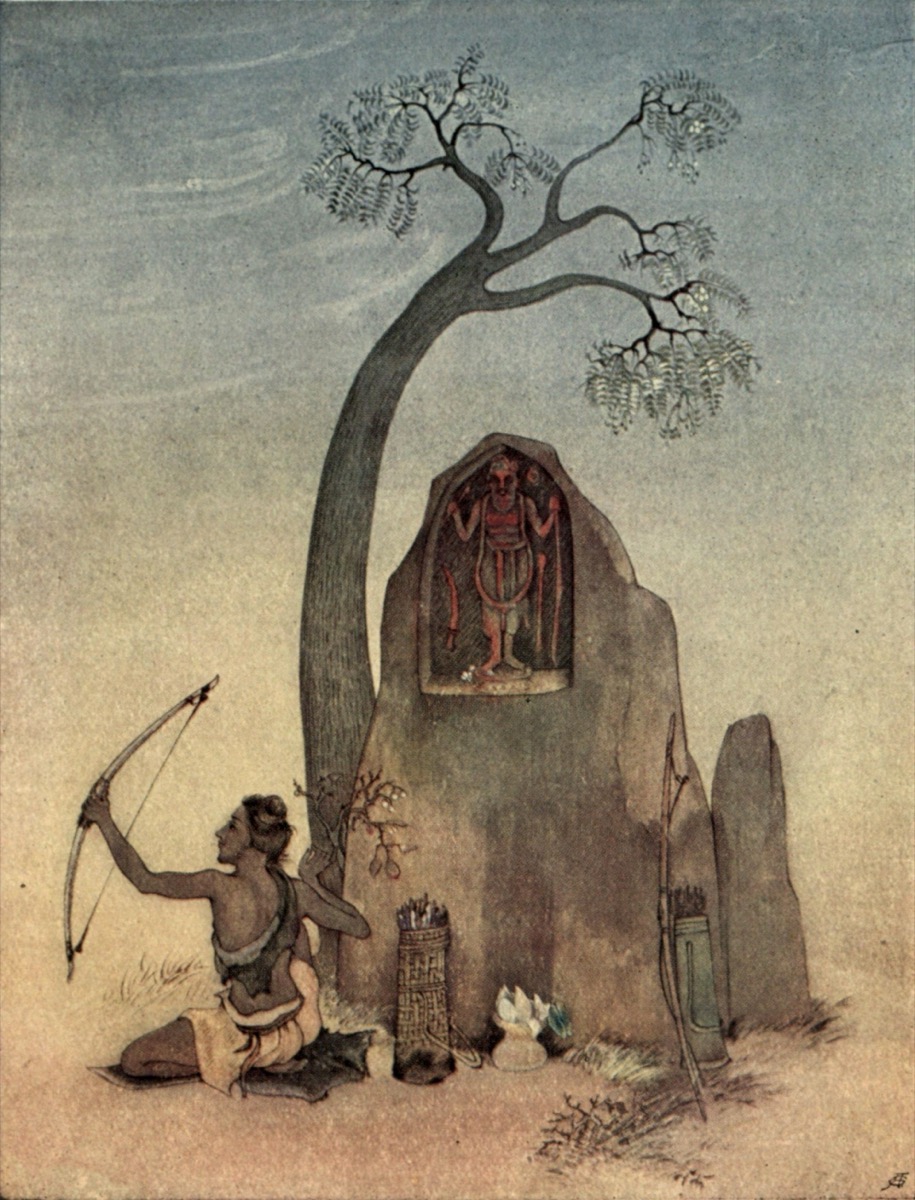
Refused by the living guru, Ekalavya did something remarkable. He went deep into the forest, gathered clay, and fashioned a mūrti (image) of Droṇācārya. Before this image he established his practice ground, and with the clay figure as his silent teacher, he commenced a regime of solitary, intense, and unrelenting archery practice.
The Mahābhārata describes his dedication in vivid terms: “Having mentally bowed down to Droṇa and set up his image, the Niṣāda prince began to practise weapons before it with the most rigid regularity” (Ādi Parva, Sambhava Parva 132). Day after day, Ekalavya shot arrows at targets, corrected his stance, refined his release, and honed his aim — all without any human instructor. His sole guide was the clay image and his unshakeable faith that Droṇa’s spirit, invoked through devotion, would direct his hand.
This episode is extraordinary for what it reveals about the Indian conception of the guru-śiṣya (teacher-student) relationship. In the traditional understanding, the connection between guru and disciple is not merely pedagogical but spiritual and metaphysical. Ekalavya’s conviction that he could learn from a clay image was not superstition but an expression of the belief that guru-bhakti (devotion to the teacher) itself is the highest form of instruction. The guru’s grace (kṛpā) flows to the devoted heart regardless of physical proximity.
Through months and years of solitary practice, Ekalavya attained a level of mastery that was nothing short of astonishing. His arrows flew with a precision and speed that the forest had never witnessed.
The Incident of the Dog
The pivotal episode that brought Ekalavya’s skill to the attention of the Kuru princes is one of the most memorable scenes in the Mahābhārata. One day, while the Pāṇḍava and Kaurava princes were practising in the forest with Droṇa, a hunting dog wandered into the area where Ekalavya was training. The dog began barking at the unfamiliar tribal youth.
Without harming the animal, Ekalavya shot seven arrows in rapid succession into the dog’s open mouth, filling it so precisely that the dog could neither close its jaw nor bark. The creature ran back to the Pāṇḍava camp with arrows protruding from its mouth but entirely uninjured — a display of archery so breathtakingly precise that it left the princes stunned.
The Mahābhārata records: “And beholding that wonderful feat, they were all filled with amazement, and searching for the unknown archer in the woods, they came upon the Niṣāda prince of dark complexion… ceaselessly discharging arrows from the bow” (Ādi Parva, Sambhava Parva 133). When the princes discovered this forest-dwelling youth and learned that he called himself “a pupil of Droṇa,” they were alarmed. Arjuna, in particular, was deeply troubled: Droṇa had promised him supremacy in archery, yet here was someone who appeared to exceed even his skill.
The Guru Dakṣiṇā: Sacrifice of the Thumb
Arjuna confronted Droṇa, reminding him of his promise. Droṇa, recognising the threat to his vow, went to the forest to meet Ekalavya. When the Niṣāda prince saw his revered guru approaching, he prostrated himself at Droṇa’s feet, introduced himself as Droṇa’s disciple, and stood with folded hands awaiting instruction.
Droṇa then made his fateful demand. He said: “If, O hero, thou art really my pupil, give me then my guru dakṣiṇā.” Ekalavya, overcome with joy at being acknowledged and eager to fulfil his duty, replied: “Command me, preceptor. What shall I give? There is nothing I would not give my guru.”
Droṇa asked for the thumb of his right hand.
The Mahābhārata describes Ekalavya’s response with devastating simplicity: “The Niṣāda prince, ever devoted to truth and desirous also of keeping his promise, with a cheerful face and an unafflicted heart cut off without ado his thumb, and gave it unto Droṇa” (Ādi Parva, Sambhava Parva 134). Without the thumb, Ekalavya could never again draw a bowstring with the same dexterity. His supreme archery was destroyed in a single act of obedience.
Interpretations: Devotion, Injustice, and Moral Ambiguity
Few episodes in Indian literature have generated as much interpretive debate as the story of Ekalavya’s thumb. The narrative sustains at least three major readings, each deeply rooted in different strands of Indian thought.
The Guru-Bhakti Interpretation
In the traditional devotional reading, Ekalavya is celebrated as the supreme exemplar of guru-bhakti — devotion to the teacher that transcends all personal interest. His willingness to sacrifice the very instrument of his art without complaint or resentment demonstrates a spiritual purity that places him above even Arjuna. In this reading, Ekalavya’s sacrifice is not a loss but a triumph: by offering his thumb, he achieves something greater than archery — he attains the perfection of surrender (samarpan). Many saints and commentators have held up Ekalavya as proof that the highest learning comes not from technique but from the quality of one’s devotion.
The Caste Discrimination Interpretation
In the modern period, and especially in Dalit, Adivasi (tribal), and anti-caste discourse, the Ekalavya episode is read as a damning indictment of the varṇa system. Droṇa’s refusal to teach Ekalavya and his subsequent demand for the thumb are seen as acts of structural violence — the deliberate crushing of merit by a Brahmin teacher protecting the privilege of his high-caste students. In this reading, Ekalavya is not a willing devotee but a victim of systemic oppression. The “cheerful face” with which the epic describes his sacrifice is itself read as a narrative device that naturalises and glorifies submission to unjust authority.
Dr. B. R. Ambedkar and subsequent anti-caste thinkers have drawn attention to episodes like Ekalavya’s as evidence that the Brahmanical tradition systematically excluded and penalised lower-caste talent. The story becomes a parable about how social hierarchies maintain themselves: not merely by denying access but by demanding that the excluded internalise and celebrate their own exclusion.
Droṇa’s Dilemma
A third reading attempts to understand Droṇa’s perspective sympathetically without condoning his action. Droṇa was bound by a promise to Arjuna, and in the dharmic framework, a teacher’s word is inviolable. Moreover, an unrivalled Niṣāda archer could pose a military threat to the Kuru state. In this pragmatic reading, Droṇa acts not out of personal malice but out of a tragic conflict between competing obligations — his duty to his official students, his promise, and the political order he serves. This does not absolve Droṇa, but it situates his cruelty within the epic’s larger meditation on the agonising complexity of dharma.
Ekalavya in the Bhāgavata Purāṇa
The Bhāgavata Purāṇa presents a significantly different account of Ekalavya’s later life and death. In this text (Skandha 9, Chapter 24), Ekalavya is identified as the biological son of Devashravā, a brother of Vasudeva (Kṛṣṇa’s father), who was abandoned in infancy and raised by the Niṣāda king Hiraṇyadhanus. This makes Ekalavya a cousin of Kṛṣṇa — a startling genealogical twist that deepens the pathos of his story.
According to the Bhāgavata tradition, after losing his thumb, Ekalavya entered the service of King Jarāsandha of Magadha, a fierce enemy of Kṛṣṇa. During Jarāsandha’s assault on the Yādava kingdom, Ekalavya fought against Kṛṣṇa and was slain by him. Some versions elaborate that Kṛṣṇa killed Ekalavya to prevent him from siding with the Kauravas in the coming Kurukṣetra war, recognising that even without his thumb, Ekalavya’s martial prowess remained formidable.
In a further twist, certain traditions hold that Kṛṣṇa granted Ekalavya a boon at the moment of death: he would be reborn to take revenge on Droṇa. According to this belief, Ekalavya was reincarnated as Dhṛṣṭadyumna, the Pāñcāla prince who ultimately slew Droṇācārya on the battlefield of Kurukṣetra — thus completing a karmic cycle of justice deferred.
Ekalavya as a Symbol of Self-Learning
Beyond the controversies of caste and devotion, Ekalavya has become a universal symbol of self-directed learning (svādhyāya). His story demonstrates that the human will, when combined with discipline and devotion, can achieve mastery without institutional support, formal instruction, or social approval. In an age that increasingly values autodidacticism and self-made achievement, Ekalavya resonates as an ancient archetype of the self-taught genius.
Indian educational philosophy has long recognised two modes of learning: guru-mukha vidyā (knowledge received from the mouth of a teacher) and svayam-śikṣā (self-instruction). Ekalavya bridges these categories in an unprecedented way — he is self-taught, yet he attributes all learning to his guru. This paradox speaks to a deeper truth: that the inner teacher (antarātman) and the outer teacher (bāhya-guru) are ultimately one.
Modern Legacy: Awards, Institutions, and Tribal Identity
In modern India, Ekalavya has transcended the boundaries of scripture to become a potent cultural and political symbol. Several significant institutions and honours bear his name:
-
Ekalavya Award: Instituted by the Government of Karnataka in 1993, this annual award recognises outstanding achievement in sports. The states of Madhya Pradesh and Haryana also confer Ekalavya Awards to young athletes, honouring the spirit of self-made excellence.
-
Eklavya Model Residential Schools (EMRS): A flagship programme of the Government of India, launched in 1997–98, to provide quality education to tribal children in remote areas. The choice of name explicitly invokes Ekalavya as a symbol of tribal aspiration and the right to education regardless of social origin.
-
India Post Stamp (2013): The Government of India issued a commemorative postage stamp depicting Ekalavya, marking his significance in national consciousness.
Among Adivasi (tribal) communities across India — particularly the Bhil, Gond, and other forest-dwelling peoples — Ekalavya is revered as a folk hero and ancestor figure. He represents the dignity of tribal identity, the injustice of social exclusion, and the irrepressible spirit of those who refuse to be defined by the limitations others impose upon them.
Artistic Depictions
Ekalavya’s story has inspired artists across centuries and media. The most iconic visual motif shows the young Niṣāda prince practising archery before the clay image of Droṇa in a forest clearing — a scene that captures both his solitude and his devotion. Another frequently depicted moment is the act of offering: Ekalavya kneeling before Droṇa, severing his thumb with a knife or arrow-head.
The celebrated Indian artist Nandalal Bose (1882–1966) created a powerful illustration of Ekalavya for the 1914 book Myths of the Hindus and Buddhists by Sister Nivedita and Ananda Coomaraswamy. Raja Ravi Varma’s school also produced oleographs of the scene. In modern times, Ekalavya features prominently in comic books (notably the Amar Chitra Katha series), television adaptations of the Mahābhārata, and contemporary art installations that explore caste, merit, and resistance.
The 2007 Bollywood film Eklavya: The Royal Guard, though not a direct retelling, draws thematic inspiration from the original story’s exploration of loyalty, sacrifice, and moral ambiguity.
The Moral Complexity of the Story
What makes the Ekalavya episode endure is its refusal to offer easy answers. The Mahābhārata is a text that consistently resists moral simplification, and this story is among its finest examples. Is Ekalavya a saint of devotion or a victim of oppression? Is Droṇa a responsible teacher keeping a promise or a bigot crushing talent? Is the sacrifice noble or tragic? The genius of the epic lies in the fact that it is all of these simultaneously.
The story also raises questions that remain urgently relevant: Who has the right to education? Can merit be suppressed by social hierarchy? What is the moral status of promises that enforce injustice? And what does it mean to be a “good student” in a system that is itself flawed?
In the Śānti Parva of the Mahābhārata, Bhīṣma reflects that dharma is sūkṣma — subtle, elusive, and context-dependent. The story of Ekalavya is perhaps the supreme illustration of this principle. It does not tell us what to think; it compels us to think deeply, to feel the weight of competing values, and to confront the uncomfortable truth that in a world of imperfect institutions, even acts of supreme virtue can be instruments of injustice.
Conclusion
Ekalavya stands in the Mahābhārata as a figure of extraordinary power and pathos — a self-made master whose devotion to his guru was matched only by the injustice he suffered at that guru’s hands. His story has travelled from the pages of the ancient epic to the classrooms, courts, and political movements of modern India, gathering new meanings with each generation.
Whether read as a parable of guru-bhakti, a critique of caste oppression, or a celebration of self-reliance, the story of the Niṣāda prince who sacrificed his thumb endures because it touches something fundamental about the human condition: the tension between talent and circumstance, between devotion and justice, between the world as it is and the world as it ought to be.