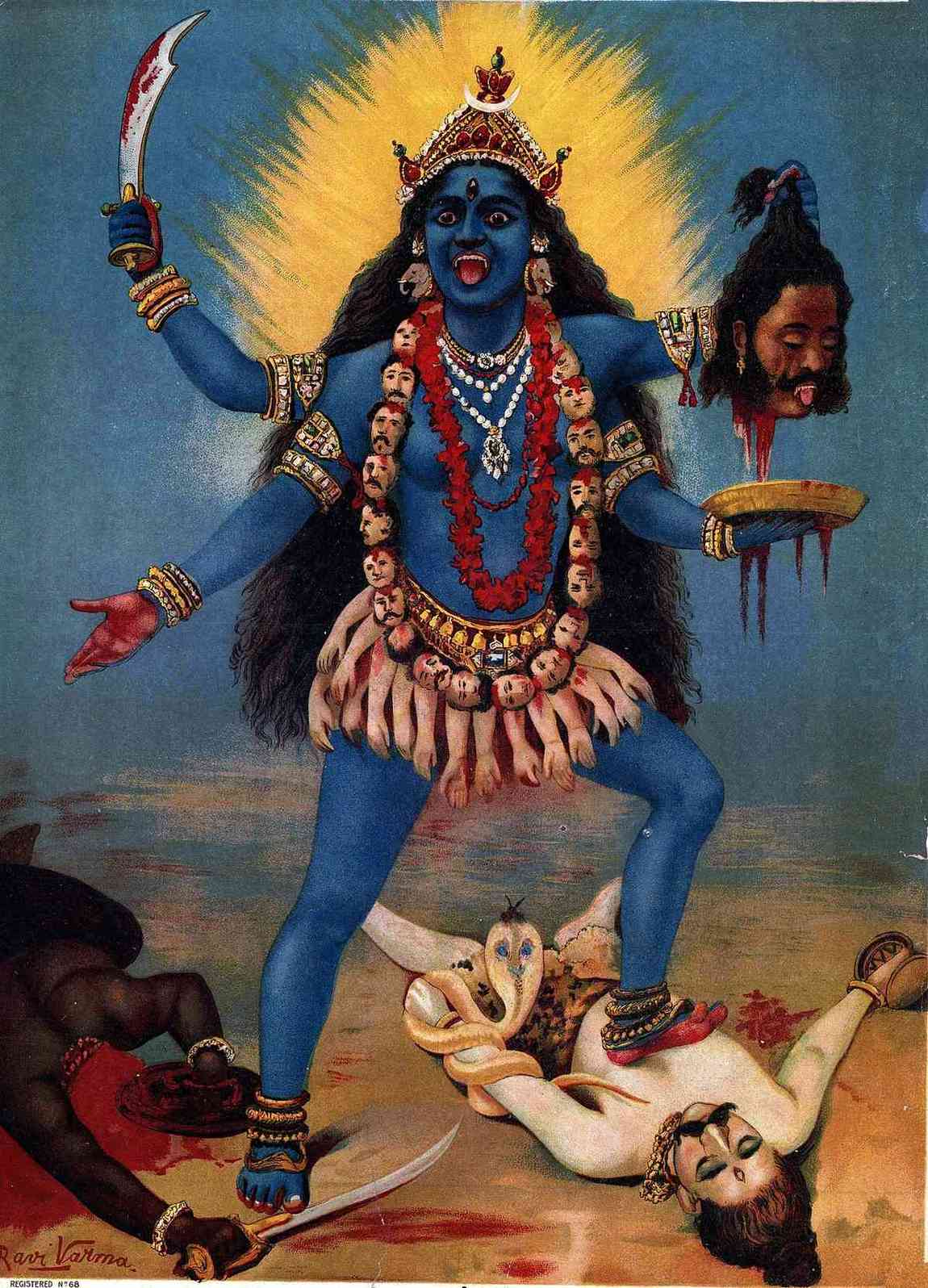
Goddess Kālī (काली), also known as Kālikā (कालिका), Śyāmā (श्यामा, “the Dark One”), and Ādyā Śakti (आद्या शक्ति, “the Primordial Power”), is one of the most powerful and profoundly revered deities in Hinduism. She embodies the fierce, transformative aspect of the Divine Feminine (Śakti) and occupies a central position in Śākta and Tāntric traditions. Far from being merely a goddess of destruction, Kālī represents the ultimate reality that dissolves illusion, conquers ego, and grants liberation (mokṣa) to her devotees.
Etymology and Early References
The name Kālī derives from the Sanskrit root kāla (काल), which carries the dual meaning of “time” and “black/dark.” She is thus understood as both “the Dark One” and “She who is Time” — the power that devours all things at the end of each cosmic cycle. The earliest textual reference to the name appears in the Atharva Veda (c. 1200—1000 BCE), where Kālī is mentioned not as a goddess but as one of the seven tongues of Agni, the god of fire (Muṇḍaka Upaniṣad 1.2.4 provides a related listing). The transformation from a fiery epithet to a fully developed goddess took centuries of theological evolution across Purāṇic and Tāntric literature.
Mythological Origins
Emergence in the Devī Māhātmya
The most celebrated account of Kālī’s origin appears in the Devī Māhātmya (also known as the Durgā Saptashatī or Caṇḍī Pāṭha), which forms chapters 81—93 of the Mārkaṇḍeya Purāṇa (c. 5th—6th century CE). This text, comprising 700 verses across 13 chapters, is the earliest Sanskrit work to elevate the Goddess to the position of supreme divinity.
In Chapter 7 of the Devī Māhātmya, during the battle against the demon generals Caṇḍa and Muṇḍa, the face of Goddess Durgā darkens with fury, and from her wrathful brow emerges Kālī — terrifying in form, emaciated, with a gaping mouth and lolling tongue, wielding a sword and a noose. Kālī annihilates the demon armies and severs the heads of Caṇḍa and Muṇḍa, presenting them to Durgā. For this deed, Durgā bestows upon her the title Cāmuṇḍā (“Slayer of Caṇḍa and Muṇḍa”).
The Slaying of Raktabīja
In Chapter 8 of the Devī Māhātmya, Kālī plays a decisive role in defeating the demon Raktabīja (“Blood-seed”), who possessed a terrifying boon: every drop of his blood that touched the ground would spawn a duplicate warrior. As the other goddesses (the Mātṛkās) wounded Raktabīja, countless clones arose from his spilling blood. At Durgā’s command, Kālī spread her enormous tongue across the battlefield, drinking every drop of blood before it could touch the earth. She then devoured the duplicate demons and finally slew Raktabīja himself, drained of all blood.
Kālī and Śiva
A widely known narrative describes how, intoxicated by battle and the blood of demons, Kālī began a frenzied dance of destruction that threatened to annihilate the cosmos. To halt her rampage, Lord Śiva lay down in her path. When Kālī inadvertently stepped upon her husband’s chest, she was struck with shame and extended her tongue — the iconic image of Kālī that is most widely recognised. This story, found in the Liṅga Purāṇa and regional Bengali traditions, illustrates the interdependence of Śakti (dynamic creative power) and Śiva (pure, still consciousness). Kālī dancing upon Śiva symbolises the truth that energy and consciousness are inseparable: without Śiva, Śakti has no ground; without Śakti, Śiva is inert (śava, a corpse).
Sacred Iconography
The iconography of Kālī is rich with layered symbolism, each element conveying a profound philosophical teaching.
- Dark complexion: Her blue-black skin represents the infinite void from which all creation arises and into which all dissolves — the formless Brahman beyond name and attribute.
- Four arms: In her upper-left hand she holds a khaḍga (sword) representing divine knowledge that severs the bonds of ignorance; her lower-left hand holds a severed head symbolising the destruction of ego (ahaṃkāra). Her upper-right hand displays the abhaya mudrā (gesture of fearlessness), and her lower-right hand shows the varada mudrā (gesture of boon-granting).
- Garland of fifty skulls (muṇḍamālā): The fifty skulls represent the fifty letters of the Sanskrit alphabet, signifying Kālī as Śabda Brahman — the embodiment of sacred sound and primordial vibration from which all language and creation emerge.
- Skirt of severed arms: This symbolises the severance of karma — the accumulated actions that bind the soul to the cycle of saṃsāra.
- Dishevelled hair: Represents freedom from social convention and the untamed nature of ultimate reality.
- Protruding tongue: Variously interpreted as the consumption of all that is impure, the taste of the rajasic (passionate) nature, or the expression of modesty upon realising she has stepped on Śiva.
The Forms of Kālī
Hindu tradition recognises numerous forms of Kālī, each with distinct characteristics and modes of worship. The Tantra Purāṇa enumerates nine principal forms:
-
Dakṣiṇā Kālī — The most benevolent and widely worshipped form, depicted with dark blue or black complexion. She faces south (dakṣiṇa) and steps forward with the right foot, indicating the orthodox dakṣiṇācāra (“right-hand path”). This is the form revered by householders for blessings and protection.
-
Śmaśāna Kālī — The Kālī of the cremation ground (śmaśāna). She steps forward with the left foot and holds the scimitar in her right hand, associated with the vāmācāra (“left-hand path”). She is primarily worshipped by Tāntric practitioners in cremation grounds.
-
Bhadra Kālī — The “auspicious Kālī,” a gentler form invoked as the fierce defender of righteousness (dharma) when justice and moral order must be restored.
-
Mahākālī — The supreme, cosmic form of Kālī as described in the Devī Māhātmya, depicted with ten arms and ten weapons, embodying the totality of divine power.
-
Guhya Kālī — The “secret Kālī,” worshipped in esoteric Tāntric practices.
-
Chamunda Kālī — The form that emerged to slay Caṇḍa and Muṇḍa.
Other forms include Kṛṣṇa Kālī, Siddha Kālī, and Śrī Kālī, each representing specific aspects of the goddess’s power and grace.
Philosophical Significance
Kālī in Śāktism and Tantra
In the Śākta tradition, Kālī is not merely a fierce aspect of the goddess — she is Ādyā Śakti, the primordial power underlying all existence. The Mahābhāgavata Purāṇa (c. 10th—11th century CE), a Bengali Śākta text, presents Kālī as the supreme deity from whom all other gods and goddesses emanate. She is listed as the first of the Daśa Mahāvidyā (Ten Great Wisdom Goddesses) in Tāntric tradition, indicating her primacy among all forms of transcendent knowledge.
The Niruttara Tantra and Picchila Tantra declare that among all mantras, Kālī’s mantras are the greatest. The Karpūrādi Stotra, a celebrated 22-verse hymn to Kālī attributed to Mahākāla and commented upon extensively by Sir John Woodroffe (Arthur Avalon), presents her as the embodiment of brahmānanda (the bliss of the Absolute), accessible to those who worship her with devotion and without fear.
Destroyer of Ego and Bestower of Liberation
At the philosophical core of Kālī worship lies the teaching that spiritual liberation (mokṣa) requires the complete dissolution of the ego (ahaṃkāra). The ego creates a false sense of separation between the individual self (jīvātman) and the universal consciousness (Brahman). Kālī’s terrifying form is itself a spiritual teaching: she confronts the devotee with everything the ego fears — death, darkness, the dissolution of identity — so that, by surrendering to her, the devotee transcends fear and realises the eternal, unchanging Self beyond all form.
As Kāla (Time), Kālī devours all things — past, present, and future. The Nirvāṇa Tantra teaches that she ultimately devours time itself, revealing her as the cause of both creation (sṛṣṭi) and dissolution (pralaya) of the universe. She is the womb from which the cosmos is born and the void into which it returns.
Sacred Temples
Dakṣiṇeśvar Kālī Temple
Located on the eastern bank of the Hooghly River in Kolkata, the Dakṣiṇeśvar Kālī Temple was built in 1855 by Rani Rashmoni, a devotee and philanthropist. The temple is inseparably associated with Śrī Rāmakṛṣṇa Paramahaṃsa (1836—1886), who served as its priest and experienced profound mystical visions of Kālī here. The temple complex includes twelve Śiva shrines, a Rādhā-Kṛṣṇa temple, and the sacred bathing ghat where Rāmakṛṣṇa practised his sādhanā.
Kālīghāṭ Temple
One of the 51 Śakti Pīṭhas (seats of the Goddess), Kālīghāṭ Temple in Kolkata marks the spot where, according to tradition, the toes of the right foot of Satī fell when her body was dismembered by Viṣṇu’s Sudarśana Cakra. The present temple structure dates to 1809 and is built in the āṭ-cālā style of Bengali temple architecture. The city of Calcutta (Kolkata) itself derives its name from Kālīghāṭ.
Tārāpīṭh
Located in Birbhum district of West Bengal, Tārāpīṭh is one of the most important Tāntric sites in India. Though primarily dedicated to the goddess Tārā (closely associated with Kālī), the temple and its adjacent cremation ground are centres of intense Tāntric sādhanā. The great Tāntric saint Bāmākṣepā (1837—1911) practised his austerities here.
Kālī Pūjā
Kālī Pūjā is celebrated with particular fervour in Bengal, Assam, and Odisha on the new moon night (amāvasyā) of the Hindu month of Kārttika (October—November), coinciding with Dīpāvalī in other parts of India. In Bengal, Kālī Pūjā rivals Durgā Pūjā in its scale and devotional intensity.
Two principal traditions of worship are observed:
- Brāhmaṇical tradition: Devotees worship Ādyā Śakti Kālī with pure offerings — flowers, fruits, sweets, and rice — without animal sacrifice.
- Tāntric tradition: Practitioners offer symbolic or actual sacrifices and chant esoteric mantras to invoke the goddess’s fierce transformative energy.
The midnight hour on amāvasyā is considered the most auspicious time for Kālī Pūjā, as it represents the liminal moment when darkness is deepest — and therefore closest to the formless reality that Kālī embodies.
Sacred Mantras
Among the most important mantras dedicated to Kālī are:
- Kālī Bīja Mantra: Krīṃ (क्रीं) — The seed syllable of Kālī, considered immensely powerful for invoking her energy.
- Dakṣiṇā Kālī Mantra: Oṃ Krīṃ Krīṃ Krīṃ Hūṃ Hūṃ Hrīṃ Hrīṃ Dakṣiṇe Kālike Krīṃ Krīṃ Krīṃ Hūṃ Hūṃ Hrīṃ Hrīṃ Svāhā
- Kālī Gāyatrī: Oṃ Mahākālyai ca vidmahe, Smāśānvāsinyai dhīmahi, tanno Kālī pracodayāt
The Niruttara Tantra and Picchila Tantra affirm that Kālī’s mantras hold supreme potency among all sacred utterances.
Names and Epithets
Kālī is known by many names, each reflecting a distinct aspect of her nature:
- Cāmuṇḍā — Slayer of Caṇḍa and Muṇḍa
- Śyāmā — The Dark One
- Ādyā Śakti — The Primordial Power
- Kālarātri — The Dark Night (associated with the seventh form of Navadurgā)
- Raktadantikā — She whose teeth are red with blood
- Mahākālī — The Great Kālī, cosmic and supreme
- Dakṣiṇā Kālī — The benevolent southern-facing Kālī
- Bhavatarinī — The Redeemer of the Universe (the name by which Rāmakṛṣṇa addressed her)
For her devotees, Goddess Kālī is not a figure of terror but the most compassionate of mothers. The Karpūrādi Stotra (verse 1) praises her as one who grants brahmānanda — the supreme bliss of realising the Absolute. She teaches that liberation lies not in fleeing from the darkness of existence but in embracing it with courage and surrender, for she herself is the light that shines within the heart of darkness, the eternal consciousness that remains when all else has been consumed by time.