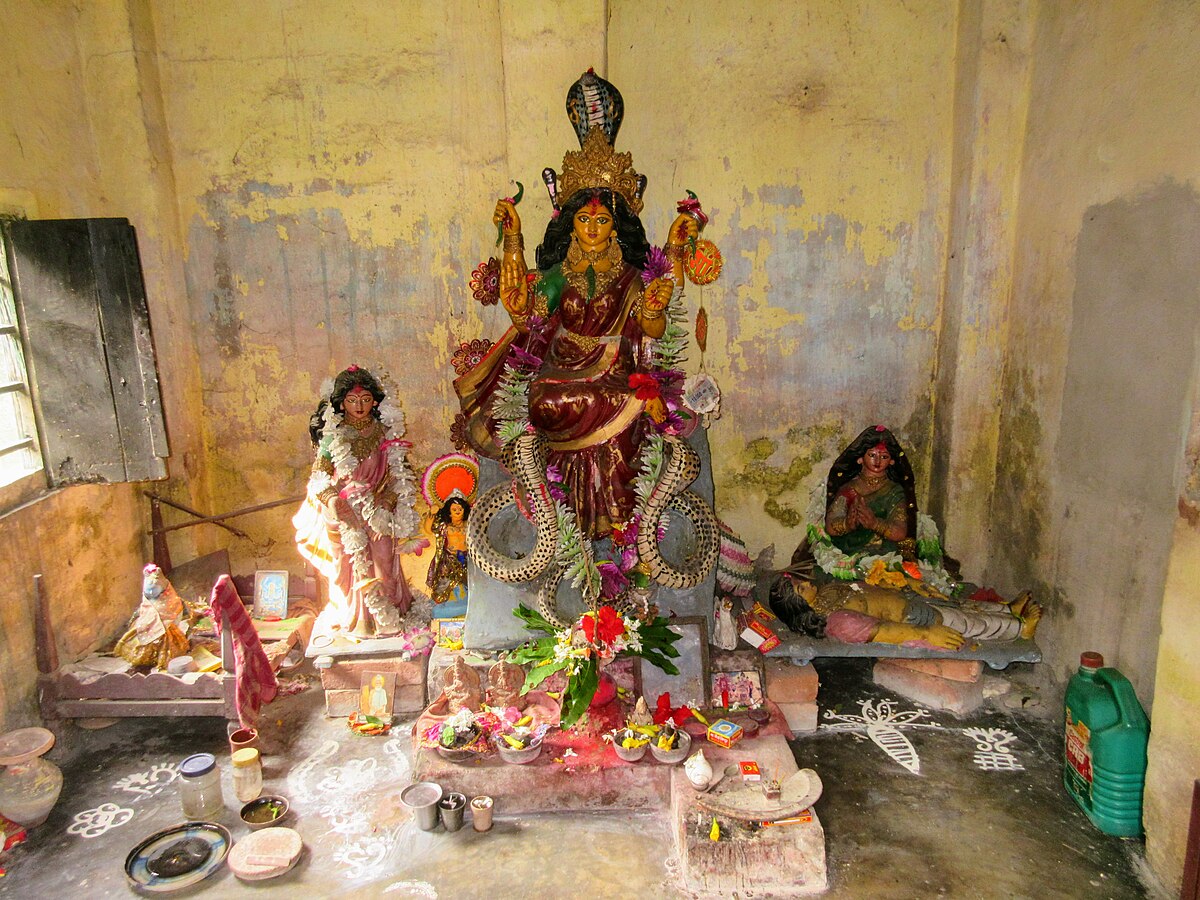
Goddess Manasā (মনসা, मनसा), also known as Viṣaharī (“Destroyer of Poison”), Jagulikā (“the Snake Charmer”), Padmāvatī (“She of the Lotus”), and Nityā (“the Eternal”), is one of the most distinctive and culturally significant deities in the Hindu pantheon. As the presiding goddess of serpents, she is worshipped primarily across Bengal, Assam, Jharkhand, and Odisha for protection from snakebite, fertility, prosperity, and the general welfare of her devotees. Unlike many deities whose worship descends from Vedic or high-Brahmanical origins, Manasā represents a remarkable case of a folk and tribal goddess who gradually ascended into the Śaiva pantheon through centuries of popular devotion and extraordinary literary tradition.
Etymology and Names
The name Manasā derives from the Sanskrit word manas (मनस्), meaning “mind.” According to the Purāṇas, she was born from the mind (manas) of Sage Kaśyapa, thus earning the name “one born of the mind” (mānasī). The name also carries the meaning of “wish” or “desire,” reflecting her role as a fulfiller of devotees’ prayers.
Manasā is known by a wealth of epithets, each illuminating a different aspect of her nature:
- Viṣaharī (Bishohorī in Bengali) — “Destroyer of Poison,” her most celebrated functional title
- Jagulikā (Jagulī) — “the Snake Charmer,” linking her to the folk tradition of serpent handling
- Padmāvatī — “She of the Lotus,” referring to her iconographic association with the lotus
- Āstīkamātā — “Mother of Āstīka,” honouring her role as the mother who saved the serpent race
- Nityā — “the Eternal One”
- Siddhayoginī — “Accomplished Yoginī”
- Vaishṇavī — reflecting her association with the Vaiṣṇava tradition in certain regional narratives
- Kānī — “One-eyed,” a Bengali epithet referring to the mythology of her blinded eye
- Śaivasundarī — “Beautiful Daughter of Śiva”
Origins and Parentage
The Purāṇic Account: Daughter of Kaśyapa
The earliest textual references to Manasā appear in the Purāṇas, which identify her as the daughter of the great sage Kaśyapa and Kadrū (the mother of all nāgas). According to this tradition, when serpents and poisonous reptiles had created chaos on earth, Brahmā directed Kaśyapa to create a deity who could control them. Kaśyapa generated Manasā from his mind, and Brahmā appointed her as the reigning deity of all snakes and serpents. Through this lineage, she is the sister of Vāsuki, the king of nāgas, and of Śeṣa (Ananta), the cosmic serpent upon whom Viṣṇu reclines.
The Bengali Tradition: Daughter of Śiva
In the later Maṅgal Kāvya literature of Bengal (14th-17th centuries), Manasā’s parentage is reimagined. Here she is described as the daughter of Lord Śiva, born from his seed that fell upon a lotus in the cosmic waters. However, she is rejected by her stepmother Caṇḍī (Pārvatī), who is jealous of her existence. According to one widespread version, Caṇḍī was so enraged upon discovering Manasā that she damaged one of the goddess’s eyes — hence the epithet Kānī (“one-eyed”). This rejection by the Brahmanical divine family became the narrative engine of the Maṅgal Kāvya: Manasā’s fierce determination to win worship on earth stems directly from her exclusion from divine legitimacy in heaven.
Marriage to Jaratkāru and the Birth of Āstīka
The Mahābhārata (Ādi Parva, Āstīka Parva section) provides Manasā’s most significant narrative outside Bengali literature. She was married to the ascetic sage Jaratkāru (whose name, intriguingly, she also shares in some traditions). Their union produced a son, Āstīka, who would play a critical role in saving the serpent race. When King Janamejaya performed the great Sarpa Satra (Snake Sacrifice) to avenge his father Parīkṣit’s death from the bite of Takṣaka, it was the young Āstīka who intervened and persuaded the king to halt the yajña, thereby preserving the nāgas from total destruction (Mahābhārata, Ādi Parva, chapters 13-58).
The Manasa Maṅgal Kāvya
Literary Significance
The Manasamaṅgal Kāvya holds the distinction of being the oldest genre of Maṅgal Kāvya — the narrative devotional poems that are among the most important literary achievements of medieval Bengal. These poems narrate the struggles of a deity to establish worship among reluctant humans, blending mythology, social commentary, and dramatic storytelling. The Manasamaṅgal is not merely a religious text but a monumental work of Bengali literature that has shaped the cultural imagination of eastern India for over five centuries.
Principal Authors
The tradition has produced numerous poetic versions, among which the most celebrated are:
- Kānā Haridatta (c. 13th century) — credited with the earliest known version
- Bipradās Pipilāī — author of Manasābijay (1495-96), notable for its literary elegance
- Bijay Gupta — author of Padmāpurāṇa (1484-85), perhaps the most popular and widely recited version
- Ketakādās Kṣemānanda (c. 17th-18th century) — author of Manasār Bhāsān, known for its narrative richness
- Nārāyaṇa Deva (c. 15th century) — another major contributor to the tradition
The Epic Narrative: Cāṅd Sadāgar and the Goddess
The central narrative of the Manasamaṅgal revolves around the fierce conflict between the goddess Manasā and Cāṅd Sadāgar (Chand Saudagar), a wealthy and powerful merchant of Campakanagarī who is a devout worshipper of Lord Śiva. Manasā desires that Cāṅd should establish her worship on earth, for only through the devotion of this influential merchant can she gain universal acceptance. However, Cāṅd contemptuously refuses — not only does he deny her divine status, but he actively insults her, regarding her as an inferior folk deity unworthy of a Śaiva devotee’s attention.
Enraged by his defiance, Manasā unleashes a series of devastating calamities upon Cāṅd. She destroys his merchant fleet, sinking his ships laden with goods in the ocean. One by one, she sends serpents to kill his six sons. Yet Cāṅd remains unbroken in his defiance, sustained by his pride and devotion to Śiva. The conflict between Manasā and Cāṅd has been interpreted by scholars as reflecting the historical tension between established Brahmanical Śaivism and the rising folk-tribal worship traditions of Bengal.
The Behulā-Lakṣīndar Story
The emotional and narrative climax of the Manasamaṅgal is the story of Behulā and Lakṣīndar (also spelled Lakhindar), which ranks among the most celebrated love stories in South Asian literature.
Lakṣīndar, Cāṅd’s youngest and sole surviving son, is prophesied to die of snakebite on his wedding night. Despite this terrible fate, Cāṅd arranges his marriage to Behulā, the virtuous and courageous daughter of a neighbouring merchant. To protect his son, Cāṅd commissions the divine architect Viśvakarmā to construct an iron bridal chamber (bāshor ghar) — a room entirely sealed with iron, without a single gap through which a serpent might enter. However, Manasā’s power proves greater: she compels the architect to leave a tiny hole, and through this opening, the serpent Kālanāgīnī enters and delivers the fatal bite on the wedding night.
Behulā refuses to accept her husband’s death. Against the wishes of her family and all social convention, she places Lakṣīndar’s corpse on a raft made of banana stalks and sets off down the river, accompanying his decomposing body for six months through countless villages and towns. Villagers call her mad; the body decays in the monsoon heat; dangers assail her at every turn. Yet Behulā’s devotion never wavers. She sings prayers to Manasā, dances for the gods, and endures every hardship with unwavering resolve.
Eventually, the raft reaches Netā (also called Netā Dhopānī), Manasā’s elder companion, who is so moved by Behulā’s devotion that she carries the young bride to the court of the gods. There, Behulā’s divine dance so enchants the deities that they agree to restore Lakṣīndar to life — on the condition that Cāṅd finally offers worship to Manasā. The proud merchant, broken at last by the loss of all his sons and the extraordinary courage of his daughter-in-law, relents. He offers flowers to Manasā with his left hand — a gesture of reluctant, grudging acceptance that nonetheless satisfies the goddess. Manasā resurrects all seven sons and restores Cāṅd’s sunken merchant fleet.
Iconography
Manasā’s iconography reflects her dual identity as both a folk deity and a goddess assimilated into the Brahmanical pantheon.
Classical Depictions
In formal artistic representations, Manasā is portrayed as a graceful woman adorned with serpent ornaments, seated in lalitāsana (royal ease posture) upon a lotus that rests above a jar filled with serpents. She wears red garments and possesses a golden complexion. A seven-headed cobra canopy (saptanāga-chattra) rises behind her, signifying her supreme authority over all serpent kind. In her four arms, she typically holds a serpent and a pot of nectar (amṛta), while the other two hands may display abhaya mudrā (fearlessness) and varada mudrā (boon-granting). She is sometimes depicted holding her infant son Āstīka.
The One-Eyed Goddess
A distinctive feature of Manasā iconography, especially in Bengali folk art, is her depiction as one-eyed (eka-netrā). This traces to the myth that her stepmother Caṇḍī blinded one eye in a fit of jealous rage. The epithet Kānī (one-eyed) is widely used in Bengali folk tradition, and the damaged eye becomes a poignant symbol of the goddess’s suffering and her struggle for acceptance.
Folk Worship Objects
In village worship across Bengal, Manasā is frequently venerated without a formal image. Instead, devotees worship:
- A branch of the Euphorbia neriifolia plant (known as Manasā-sij in Bengali), planted in an open courtyard called a Manasā-talā (abode of Manasā)
- Painted earthen pitchers (ghāṭ) decorated with representations of hooded serpents
- Earthen snake images placed in simple shrines called Manasā-bāṛī — mud-walled structures thatched with straw
These aniconic and semi-iconic forms of worship reflect Manasā’s deep roots in pre-Brahmanical folk tradition.
Worship Traditions
Seasonal Context
Manasā Pūjā is observed primarily during the monsoon months of Āṣāḍha and Śrāvaṇa (June-August), the season when rising floodwaters drive snakes from their burrows into human settlements. During this dangerous period, the worship of the serpent goddess becomes an urgent matter of practical protection as much as spiritual devotion. Agricultural communities are especially dependent on her favour, as the monsoon is simultaneously the season of planting and the season of maximum snake encounter.
Ritual Practices
The worship of Manasā combines elements from both Brahmanical and folk traditions:
- Home worship: An earthen snake image or Manasā-sij branch is worshipped with red and yellow flowers, milk, sweets, and incense
- Mantra recitation: The primary mantra is Oṃ Hrīṃ Śrīṃ Klīṃ Aiṃ Mānasā Devyai Svāhā, chanted 108 times, ideally during sunrise or sunset on Pañcamī tithi (the fifth day of the lunar fortnight)
- Fasting: Women devotees observe strict fasts on designated worship days
- Milk offerings: Bowls of milk are offered to live snakes at their burrows, a practice reflecting the deep integration of serpent reverence into village life
- Storytelling and performance: The narrative of the Manasamaṅgal is recited, sung, and performed through Paṭacitra scroll paintings, Jātrā theatre, and Manasā Gān (devotional songs)
The Jhāpan Festival
One of the most remarkable observances connected to Manasā worship is the Jhāpan Melā (Snake Festival), held primarily in the Bankura and Bishnupur districts of West Bengal during Śrāvaṇa. This festival is a vivid expression of the goddess’s folk and tribal roots.
During the Jhāpan, local snake charmers known as Jhāmpāniās gather venomous snakes — cobras, vipers, and pythons — from the surrounding countryside. Members of the Bede (Bedia) tribal community, traditional snake catchers, arrive with their bamboo baskets of serpents. The participants coax live snakes to coil around their bodies, demonstrating that Manasā’s grace protects the faithful from venom. The fact that they remain unharmed is interpreted as proof of the goddess’s pleasure and her protective blessing upon the community. Fishermen carry snakes in procession to the river for a ritual bath, accompanied by images of Manasā, while chanting mantras and singing sacred songs.
Nāga Pañcamī Connection
Manasā worship is closely linked to Nāga Pañcamī, the pan-Indian festival of serpent veneration observed on the fifth day of the bright fortnight of Śrāvaṇa. In Bengal and eastern India, Nāga Pañcamī is essentially a Manasā Pūjā, with offerings of milk, flowers, and rice placed before serpent images or Manasā shrines. The convergence of Manasā worship with the broader nāga-worship tradition illustrates how a regional folk deity became integrated into the wider Hindu festival calendar.
Folk vs. Brahmanical Traditions
The history of Manasā worship illuminates one of the most fascinating dynamics in Hinduism: the tension and eventual synthesis between folk/tribal religion and Brahmanical orthodoxy.
Tribal and Folk Roots
Scholars including Dineshchandra Sen and Asutosh Bhattacharyya have argued that Manasā was originally an Ādivāsī (tribal) deity, worshipped by non-Aryan communities of Bengal long before her incorporation into the Hindu fold. Evidence for her pre-Brahmanical origins includes:
- Her aniconic worship through plants and earthen pots rather than sculpted images
- Her association with snake-handling tribal communities (Bede, Rajbongshi)
- The narrative of the Maṅgal Kāvya itself, which explicitly dramatises her struggle for acceptance against a Śaiva Brahmanical devotee (Cāṅd Sadāgar)
- The absence of Vedic references to Manasā
Gradual Assimilation
By the 14th century, Manasā had been firmly integrated into the Śaiva pantheon as a daughter of Śiva, and her worship was accepted by upper-caste Hindu households. The Manasamaṅgal Kāvya itself served as the literary vehicle for this assimilation — by narrating her triumph over the proud Śaiva merchant, the poets legitimised the worship of a folk goddess within the Brahmanical framework. The story of Cāṅd’s eventual surrender to Manasā symbolises the victory of indigenous religious traditions over orthodox resistance, even as the form of that victory — integration into the Śaiva family — ensures that the folk goddess gains legitimacy only by accepting a subordinate position within the established divine hierarchy.
Temples and Sacred Sites
Tribeni Manasā Temple (West Bengal)
The Maa Manashā and Behulā Lakhindar Temple at Tribeni Ghāṭ in Hooghly district, West Bengal, is one of the most significant Manasā shrines. Located at the sacred confluence of the Gaṅgā, Sarasvatī, and Yamunā, this temple houses an idol of Manasā alongside representations of Behulā and Lakṣīndar, connecting the living worship tradition directly to the literary narrative.
Village Shrines Across Bengal
Throughout rural Bengal, Manasā is worshipped as a household deity (gṛhadevatā). Virtually every village has a Manasā-talā — an open-air shrine beneath a sacred tree or Euphorbia plant where annual worship is performed. These humble shrines, often consisting of nothing more than a painted pot beneath a tree, are testament to the goddess’s deep rootedness in everyday Bengali life.
Temples in Assam and Northeast India
Among the Rājbongshī communities of North Bengal and Assam, Manasā occupies a position of particular honour. She is worshipped at the Kāmākhyā temple complex and at numerous smaller shrines throughout the Brahmaputra valley. In Assam, Manasā Pūjā is accompanied by elaborate folk performances, devotional storytelling, and offerings of milk, flowers, and rice.
Mansa Devi Temples (North India)
Outside Bengal, Manasā is worshipped as Mansā Devī at major temples in Panchkula (Haryana) and Haridwar (Uttarakhand). The Haridwar temple sits atop a hill and attracts pilgrims who tie threads to fulfil wishes. While these North Indian manifestations may represent a partial convergence with other goddess traditions, they indicate the geographical reach of serpent-goddess worship across the subcontinent.
Cultural Legacy
Paṭacitra and Visual Arts
The Manasamaṅgal narrative has been one of the most popular subjects in Bengal Paṭacitra (scroll painting) tradition. Itinerant scroll painters (Paṭuā) travel from village to village, unrolling painted scrolls depicting scenes from the Behulā-Lakṣīndar story while singing the narrative. This living art form preserves the Manasamaṅgal in visual and oral tradition alongside the written literary texts.
The goddess is also a frequent subject in Kalighat painting (the 19th-century school of popular art from Kolkata), terracotta temple panels, and modern Bengali folk art.
Theatre and Performance
The Behulā-Lakṣīndar story has been adapted into numerous Jātrā (Bengali folk theatre) productions, dance dramas, and modern films and television serials. The character of Behulā — the devoted wife who defies death itself — has become an archetype of feminine courage and loyalty in Bengali culture, comparable to Sāvitrī in pan-Indian tradition.
Literary Influence
The Manasamaṅgal Kāvya established the narrative conventions that later Maṅgal Kāvya genres would follow, including the Caṇḍīmaṅgal (for Goddess Caṇḍī) and Dharmamaṅgal (for Dharma Ṭhākur). The genre’s influence on the development of Bengali narrative literature — from medieval verse to modern novel — is difficult to overstate.
Theological Significance
Manasā embodies several important theological themes within Hinduism:
The democratisation of the divine: Her journey from rejected folk goddess to accepted member of the Śaiva family mirrors the process by which Hinduism has continuously absorbed and elevated local and tribal traditions, expanding its theological boundaries while maintaining its core framework.
Śakti in nature: As a serpent goddess, Manasā represents the raw power (śakti) inherent in the natural world. The serpent in Hindu thought is associated with kuṇḍalinī energy, the primordial creative force that lies coiled at the base of the spine. Manasā’s worship thus connects to the broader Śākta understanding of the feminine divine as the animating energy of the cosmos.
Duality of destruction and renewal: Like the serpent that sheds its skin to be reborn, Manasā embodies the cycle of destruction and regeneration. She can both inflict and cure poison — death and healing rest equally in her hands. This duality makes her worship an acknowledgment of nature’s power and an appeal for harmony between human beings and the forces that sustain and threaten their lives.
For the millions of devotees across eastern India who invoke her name during the monsoon rains, Manasā is neither a minor folk deity nor a mere appendage to the Śaiva pantheon. She is the living protector of home, field, and family — the ancient serpent mother whose grace stands between her children and the terrors of the dark, rain-soaked nights.