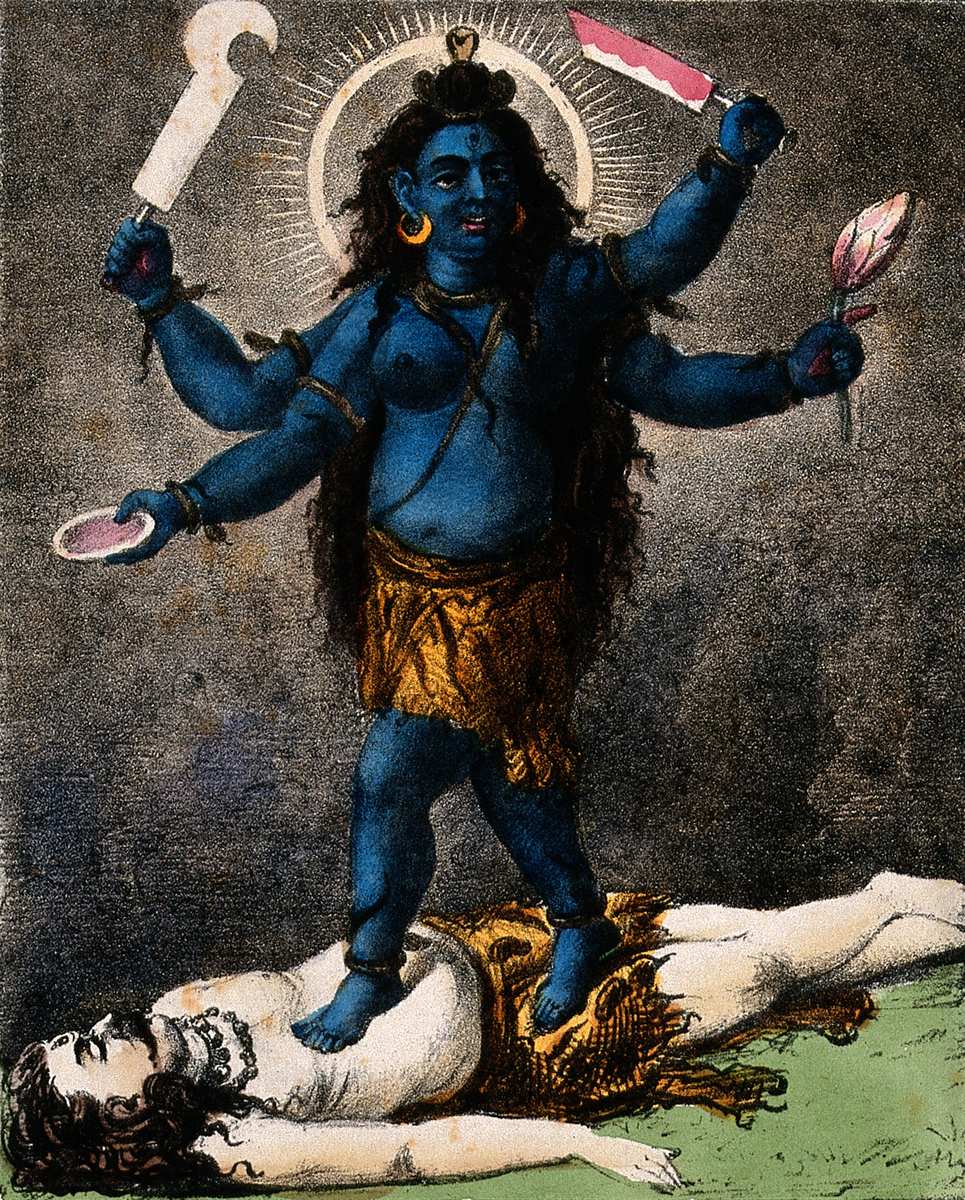
Goddess Tara (तारा), the second of the Dasha Mahavidyas (Ten Great Wisdom Goddesses), is one of the most powerful and enigmatic deities in the Hindu Tantric pantheon. Her name derives from the Sanskrit root tṛ (तृ), meaning “to cross over” or “to save,” establishing her as the one who carries across — the divine force that ferries her devotees safely through the ocean of worldly existence (bhava-sāgara). She is simultaneously tārā (तारा, “star”), the celestial light that guides seekers through the darkness of ignorance toward the radiance of liberation.
In the hierarchy of the Mahavidyas, Tara occupies the position immediately after Kali, and the two goddesses share such profound theological and iconographic kinship that the great 18th-century Bengali poet-saint Ramprasad Sen used their names interchangeably in his devotional songs. Yet Tara possesses her own distinctive identity, tantric literature, and worship tradition — one that bridges Hindu and Buddhist worlds and finds its most intense expression in the cremation grounds of Tarapith in Bengal.
Etymology and Significance of the Name
The name Tārā carries a remarkable richness of meaning in Sanskrit. The Śabdakalpadruma, a comprehensive Sanskrit dictionary, traces the name to the root tṛ (to cross, to save, to deliver), yielding the primary meaning of “she who saves” or “she who enables one to cross over.” The verbal root also gives us the word tāraṇa (तारण, “deliverance”), directly linking the goddess to the act of spiritual rescue.
A second, equally important meaning is “star” (tārā). Just as a star provides orientation to travellers and sailors lost in darkness, Goddess Tara provides navigational guidance to souls lost in the darkness of avidyā (spiritual ignorance). The Tārā Tantra describes her as the star that “shines in the firmament of consciousness, illuminating the path from bondage to liberation.”
A third layer of meaning connects tārā to tāra (तार), meaning “the pupil of the eye.” This links Tara to the faculty of perception itself — she is the light within the eye that enables all seeing, the consciousness within awareness that makes knowledge possible.
The Nīlasarasvatī Tantra encapsulates all three meanings: “Tārā tārayate yasmāt samsārārṇava-duḥkhataḥ / tārakā sā samākhyātā tāriṇī ca prakīrtitā” — “Because she delivers from the suffering of the ocean of saṃsāra, she is called Tārā [star], and she is celebrated as Tāriṇī [the deliverer].”
Mythological Origins
The Samudra Manthana Narrative
One of the most widely narrated origin stories of Goddess Tara connects her to the Samudra Manthana (Churning of the Ocean of Milk). When the Devas and Asuras churned the cosmic ocean to obtain amṛta (the nectar of immortality), the deadly poison Hālāhala emerged, threatening to annihilate all creation. Lord Shiva, moved by compassion, swallowed the poison to save the universe. As the venom’s unbearable heat spread through his body, turning his throat blue and rendering him unconscious, it was Goddess Tara who appeared in her maternal form.
According to the Śākta Mahābhāgavata, Tara took the form of a divine mother and placed the stricken Shiva at her breast, nursing him as a mother nurses her infant. Her celestial milk counteracted the poison’s effect and gradually restored Shiva to consciousness. This act of cosmic nursing — the supreme goddess saving the supreme god through maternal compassion — establishes Tara’s essential nature as the Saviour and Nurturer, the power that sustains even the gods themselves.
The Mahavidya Manifestation
The Bṛhaddharma Purāṇa (13th century CE) narrates how the ten Mahavidyas came into being when Satī, enraged by her father Daksha’s refusal to invite Shiva to his great sacrifice (yajña), resolved to attend despite Shiva’s objections. When Shiva attempted to prevent her departure, Satī, overcome with fury, assumed a terrifying cosmic form. To prevent Shiva from escaping in any direction, she multiplied herself into ten fearsome goddesses who surrounded him from all sides. These are the Dasha Mahavidyas, with Kali appearing first and Tara second.
The Mahābhāgavata Purāṇa provides a variant in which Satī herself transforms into Kali as the primary form, with the remaining nine Mahavidyas — beginning with Tara — emanating as aspects of Kali’s limitless power. In this theological framework, Tara is understood as Kali’s closest manifestation, a near-twin who shares Kali’s transcendent nature while expressing it through the specific power of tāraṇa (deliverance).
Relationship with Kali
The relationship between Tara and Kali is one of the most intimate in Hindu theology. The Todala Tantra states that “Kālī and Tārā are one and the same Devī in two different forms” — Kali represents the supreme reality as the power of Time (kāla), while Tara represents the same reality as the power of Transcendence (tāraṇa). Both are dark-complexioned, both stand upon Shiva, both haunt cremation grounds, and both grant liberation.
Yet distinctions exist. While Kali is described as black (kṛṣṇa varṇā), Tara is described as blue (nīla varṇā). While Kali’s consort is Mahākāla (Great Time), Tara’s consort is Akṣobhya (“the Immovable One”), a form of Shiva who appears as a serpent (nāga) coiled around her matted hair. Where Kali embodies the all-consuming nature of time, Tara embodies the compassionate power that carries beings across time’s destruction.
The 18th-century Bengali mystic-poet Ramprasad Sen beautifully expressed this unity-in-difference: he addressed both goddesses as Ma (Mother) and saw in their apparent ferocity the deepest tenderness. In one of his celebrated songs, Ramprasad declared that whether he called upon Kali or Tara, the same Mother answered — for they are two eyes of the one cosmic face.
Sacred Iconography
The Tārā Tantra and the dhyāna śloka (meditation verse) found in the Tantrasāra of Kṛṣṇānanda Āgamavāgīśa provide the canonical description of Tara’s form:
-
Blue complexion (nīla varṇā): Unlike Kali’s black, Tara’s deep blue skin symbolises the infinite expanse of the sky and the depth of supreme consciousness. Blue also connects her to her Buddhist counterpart, the Blue Tara.
-
Matted hair with a single braid (ekajaṭā): A single topknot of matted hair, around which coils a serpent — her consort Akṣobhya in nāga form. This represents the concentrated power of awakened kuṇḍalinī.
-
Four arms holding: In her upper-right hand, a khaḍga (sword) that severs ignorance; in her lower-right, an indīvara (blue lotus) symbolising purity arising from the mire of worldly existence; in her upper-left, a kartṛ (sacrificial knife or scissors) representing the power to cut through karmic bonds; in her lower-left, a kapāla (skull cup) filled with blood or a begging bowl, symbolising the dissolution of ego.
-
Prominent belly: Often depicted with a protruding belly, signifying her pregnant fullness — the cosmic womb from which all creation emerges.
-
Tiger-skin garment: Where Kali wears a skirt of severed arms, Tara wears a tiger skin around her waist, symbolising the mastery over animal nature and the taming of primal instincts.
-
Garland of severed heads (muṇḍamālā): Like Kali, she wears a garland of fifty skulls representing the fifty letters of the Sanskrit alphabet — she is Śabda Brahman, the embodiment of sacred sound.
-
Lolling tongue: Blood oozes from the corners of her mouth, her tongue protruding — a symbol of her insatiable consumption of worldly illusion.
-
Standing on a corpse: Her left foot rests firmly on the chest of the prostrate Shiva (or a corpse), while she assumes the pratyālīḍha stance (left foot forward). This represents the truth that Shakti (dynamic energy) is supreme, and without her, even Shiva becomes śava (a lifeless corpse).
The Principal Forms of Tara
The Māyā Tantra, as quoted in the Tantrasāra, enumerates eight forms of Tara, each embodying a specific dimension of her power:
Ugra Tārā (The Fierce Tara)
Also known as Mahācīnakrama Tārā (“Tara of the Great Chinese Practice”), Ugra Tara is the most wrathful form. The epithet Mahācīnakrama reflects an ancient tradition that associates her worship with practices transmitted from Mahācīna (Greater China, possibly Tibet). The Rudrayāmala Tantra narrates how the sage Vasiṣṭha, failing in his sādhanā of Tara, was directed by Viṣṇu to travel to Mahācīna to learn the correct method of worship from the Buddha, who was practising Tara’s Tantric ritual. This narrative is significant as it explicitly acknowledges a shared worship tradition between Hindu and Buddhist practitioners.
Ugra Tara’s fierce form is invoked for protection against unforeseen calamities, for victory over enemies, and for the destruction of obstacles on the spiritual path. Her dhyāna śloka describes her laughing terribly while standing on a burning funeral pyre.
Nīla Sarasvatī (Blue Saraswati)
Nīla Sarasvatī (नील सरस्वती, “Blue Saraswati”) is Tara’s most intellectually potent form, associating her with profound knowledge, eloquence, and mastery over speech (vāk). While the orthodox Sarasvatī is white-complexioned and serene, Nīla Sarasvatī is dark blue and fierce — she represents not the gentle flow of learning but the thunderous power of transcendent wisdom that shatters all conceptual limitations.
Worship of Nīla Sarasvatī is prescribed for those seeking mastery in debate, scholarship, poetry, and the sacred arts. The Nīlasarasvatī Tantra contains her specific mantras, yantras, and ritual procedures.
Ekajaṭā (Single-Braided One)
Ekajaṭā (एकजटा) takes her name from the single matted braid of hair (ekajaṭā) that characterises her iconography. She represents the unified, single-pointed force of creation behind its infinite multiplicity of forms. In Buddhist Tantra, Ekajaṭā is one of the most important protector deities, demonstrating the deep cross-pollination between Hindu and Buddhist Tara worship.
The remaining five forms enumerated in the Māyā Tantra are Mahogra Tārā (the Supremely Fierce), Kāmeśvarī Tārā (the Mistress of Desire), Cāmuṇḍā Tārā, Vajra Tārā (the Adamantine Tara), and Bhadrakālī Tārā (the Auspicious Dark One).
The Buddhist Tara Parallel
The figure of Tara occupies a position of extraordinary importance in both Hindu and Buddhist traditions — a rare case of a major deity shared across these two dharmic paths with distinct but related theological understandings.
In Tibetan Buddhism, Tara is among the most beloved and widely worshipped deities, appearing in 21 principal forms (the Twenty-One Taras), with Green Tara (Syāmatārā) and White Tara (Sitatārā) being the most prominent. The Buddhist Tara is gentle, youthful, and compassionate — a bodhisattva who vowed to always appear in female form to liberate beings from suffering.
The Hindu Tara, by contrast, is “almost always fierce, dangerous, and terrible to witness,” as scholar David Kinsley observed. Yet both share the fundamental soteriological function: deliverance. Both Hindu and Buddhist Tara are saviours who rescue their devotees from the perils of worldly existence.
Scholars debate the direction of influence. Some, following the account in the Rudrayāmala Tantra of Vasiṣṭha’s journey to Mahācīna, argue that Tara worship entered Hinduism from Buddhist sources. Others point to the Vedic references to tārā as a star-goddess and Tara as the wife of Bṛhaspati in the Matsya Purāṇa as evidence of independent Hindu origins. The most balanced scholarly view, articulated by N. N. Bhattacharyya in his History of the Tantric Religion, holds that Tara worship developed through centuries of mutual exchange between Hindu and Buddhist tantric practitioners, particularly in Bengal, Assam, Nepal, and Tibet.
Tarapith: The Sacred Seat of Tara
Tārāpīṭh (তারাপীঠ), located in the Birbhum district of West Bengal, is the most important pilgrimage site dedicated to Goddess Tara and one of the foremost centres of Tantric worship in all of India. The temple is recognised as both a Śaktipīṭha (seat of the Goddess) and a Siddhapīṭha (seat of perfected spiritual accomplishment).
The Temple
The present temple houses the iconic image of Mother Tara nursing the infant Shiva — a unique depiction that directly illustrates the Samudra Manthana narrative. The goddess is shown in her maternal aspect, the fierce Mahavidya transformed into a tender mother suckling the blue-throated god. This image, crafted in stone, is the central object of worship and is adorned daily with fresh flowers, vermillion, and offerings.
According to tradition, the temple marks the spot where the third eye (tṛtīya netra) of Satī fell when her body was dismembered by Viṣṇu’s Sudarśana Cakra after Daksha’s sacrifice. This makes Tarapith one of the 51 Shakti Pithas, though the specific body part attributed varies across different traditions.
The Cremation Ground
Adjacent to the temple lies the śmaśāna (cremation ground), which is as sacred and central to Tarapith’s identity as the temple itself. In Tantric tradition, the cremation ground is not a place of horror but a supremely powerful spiritual site — where the ego is burned away, where the distinction between purity and impurity dissolves, and where the practitioner confronts the ultimate reality of death and transcendence. For centuries, Tantric sādhakas have performed their austerities among the funeral pyres of Tarapith, seeking Tara’s grace through the most direct encounter with mortality.
Bamakhepa: The Mad Saint of Tarapith
No account of Goddess Tara would be complete without the extraordinary figure of Bamakhepa (বামাক্ষেপা, 1837-1911), the “mad saint” (kṣepā means “mad” in Bengali) whose life and sādhanā are inseparable from the spiritual identity of Tarapith.
Born Bamacharan Chattopadhyay in the village of Atla, near Tarapith, Bamakhepa showed utter indifference to worldly concerns from early childhood. Drawn irresistibly to the cremation ground, he became a disciple of Kailaspati Baba, a Tantric master who recognised the young man’s extraordinary spiritual potential. Under Kailaspati’s guidance, Bamakhepa began practising intense Tantric sādhanā in the Tarapith śmaśāna, meditating among corpses and funeral pyres.
Bamakhepa’s relationship with Tara was that of a child with his mother — utterly intimate, fearless, and without any trace of formal religiosity. He addressed the goddess as Ma and treated her image in the temple with the casual affection of a son, sometimes scolding her, sometimes weeping before her, sometimes laughing with ecstatic abandon. His erratic, unconventional behaviour earned him the epithet kṣepā (mad), but devotees recognised in his madness the intoxication of divine love.
A pivotal event in Bamakhepa’s life involved the temple’s head priest, who denied him entry to the sanctum. The Rani of Natore, a great patroness of the temple, intervened after receiving a vision of Tara in a dream commanding that Bamakhepa be given unrestricted access. From that point, the saint lived in and around the temple and cremation ground, freely worshipping his Mother.
Bamakhepa fundamentally transformed the public perception of Tara. Through his devotion, he “sweetened” the terrifying goddess — demonstrating that behind Tara’s fierce exterior lies the most tender maternal love. When Bamakhepa left his body in 1911, his mortal remains were interred in a seated position near the cremation ground entrance. His samādhi (burial shrine) now stands there as a place of pilgrimage, receiving daily worship from countless devotees and sādhus.
Tara in Bengali Shakta Tradition
Goddess Tara holds a position of special prominence in Bengali Shakta tradition, where she is venerated alongside Kali as one of the two greatest Mahavidyas. The cultural landscape of Bengal — with its rich Tantric heritage, its tradition of fierce goddess worship, and its embrace of the śmaśāna as a sacred space — provides uniquely fertile ground for Tara’s worship.
In Bengal, Tara is not merely a goddess of the Tantric elite but a living presence in popular devotion. The Tārā Stotra and Nīla Sarasvatī Stotra are recited by householders and monks alike. Village traditions in Birbhum, Bankura, and surrounding districts preserve folk narratives of Tara’s miraculous interventions — saving children from drowning, healing the sick, guiding lost travellers by appearing as a blue light in the darkness.
The Shakta Padāvalī tradition of Bengali devotional poetry includes numerous songs to Tara composed by poet-saints including Ramprasad Sen and Kamalakanta Bhattacharya, who saw in the fierce blue goddess the ultimate expression of maternal love.
Tantric Texts and Worship
The principal tantric scriptures governing Tara worship include:
- Tārā Tantra: The primary text dedicated to Tara’s worship, containing her dhyāna ślokas, mantras, yantra descriptions, and ritual procedures.
- Nīla Tantra / Bṛhannīla Tantra: A major Tantric compendium with extensive sections on Tara and Nīla Sarasvatī.
- Nīlasarasvatī Tantra: Specifically focused on the Nīla Sarasvatī form.
- Brahmayāmala and Rudrayāmala: Early Tantric texts containing important Tara material.
- Tantrasāra of Kṛṣṇānanda Āgamavāgīśa: A comprehensive Bengali Tantric compendium that systematises Tara worship.
- Tārābhaktisudhārṇava of Narasiṃha Ṭhakkura: A devotional text on Tara.
- Tārārahasya of Brahmānanda Giri: An esoteric treatise on Tara’s mysteries.
- Prāṇatoṣiṇī: Another important Tantric compendium with Tara sections.
Sacred Mantras
The principal bīja mantra (seed syllable) of Tara is Strīṃ (स्त्रीं). Her most widely used mantra is:
Oṃ Hrīṃ Strīṃ Hūṃ Phaṭ
The Tārā Gāyatrī is:
Oṃ Tāradevyai ca vidmahe, Ugratāradevyai dhīmahi, tanno Devī pracodayāt
These mantras are chanted for deliverance from suffering, protection from danger, attainment of wisdom, and ultimately, liberation (mokṣa).
Philosophical Significance
At the deepest level, Goddess Tara represents the supreme power of transcendence — not an escape from the world but a crossing through it. The cremation ground where she is worshipped is the perfect metaphor: one must pass through the fire of ego-death, through the dissolution of all that is impermanent, to reach the deathless shore of liberation.
Her ferocity is not cruelty but compassion in its most radical form. Like a surgeon who must cut to heal, Tara wields her sword and scissors to sever the bonds that keep the soul imprisoned in ignorance. Her protruding tongue and blood-stained mouth consume not the devotee but the devotee’s delusions, fears, and false attachments.
As the Star (tārā), she is the fixed point of eternal consciousness around which the entire cosmos revolves. As the Saviour (tāriṇī), she is the boat that carries souls across the terrifying ocean of birth and death. As Nīla Sarasvatī, she is transcendent wisdom itself — not the pale, bookish knowledge of the academy but the thunderous, transformative gnosis that shatters all conceptual prisons and reveals reality as it truly is.
For her devotees in Bengal and beyond, Goddess Tara is ultimately Ma — Mother — whose fierce blue face, when truly seen, reveals nothing but infinite, unshakeable, and unconditional love.