Introduction
King Hariścandra (Sanskrit: हरिश्चन्द्र, IAST: Hariścandra) stands as the most celebrated embodiment of Satya (truth) and Dharma (righteousness) in the entire Hindu tradition. A legendary sovereign of the Ikṣvāku (Solar) dynasty who ruled from Ayodhyā, Hariścandra is remembered not for military conquests or territorial expansion but for something far more extraordinary: his absolute, unshakeable commitment to truth, even when that commitment cost him his throne, his wealth, his family, and his personal freedom (Wikipedia, “Harishchandra”).
The story of Hariścandra is one of the most frequently told narratives in Indian civilization — retold across Vedic literature, the Purāṇas, the Mahābhārata, medieval devotional poetry, modern theatre, and cinema. His name has become a synonym for truthfulness itself: to call someone “Hariścandra” in any Indian language is to declare them incorruptibly honest. The sage Viśvāmitra’s relentless tests of the king’s integrity, Hariścandra’s willingness to sell his own wife and son into slavery rather than break a promise, and his ultimate vindication by the gods constitute one of the most powerful moral narratives ever composed — a story that directly shaped the conscience of Mahātmā Gāndhī and, through him, the course of modern Indian history.
Genealogy: The Solar Dynasty
Hariścandra belongs to the illustrious Sūryavaṃśa (Solar dynasty), one of the two great royal lineages of Hindu tradition (the other being the Candravaṃśa, or Lunar dynasty). His genealogy, as recorded in the Viṣṇu Purāṇa, Matsya Purāṇa, and Vāyu Purāṇa, places him in a direct line of descent from the sun-god Vivasvān (Sūrya) through Vaivasvata Manu, the progenitor of humanity, and Ikṣvāku, the founder of the dynasty (Wikipedia, “Solar dynasty”).
Hariścandra’s father was Triśaṅku (also known as Satyavrata), himself a famous figure in Hindu mythology — the king whom Viśvāmitra attempted to bodily elevate to heaven, resulting in the creation of a parallel celestial realm (“Triśaṅku’s heaven”). Hariścandra thus inherited a complex relationship with the sage Viśvāmitra that would define his own legend.
The Solar dynasty’s lineage would continue through Hariścandra’s descendants to produce some of the most revered figures in Hindu tradition, ultimately culminating in Lord Rāma, the avatāra of Viṣṇu and the hero of the Rāmāyaṇa. Hariścandra is thus recognized as an ancestor of Rāma — and the connection is theologically significant: Rāma, known as Maryādā Puruṣottama (the ideal man of perfect conduct), inherited the same uncompromising commitment to truth and duty that Hariścandra exemplified.
The Aitareya Brāhmaṇa Account: Hariścandra and Śunaḥśepa
The earliest extant textual reference to King Hariścandra appears in the Aitareya Brāhmaṇa (7.13–18), a Vedic prose text attached to the Ṛgveda, dating to approximately 800–600 BCE. This account presents a strikingly different narrative from the later Purāṇic versions and is significant for its archaic Vedic character (Wikipedia, “Aitareya Brahmana”).
The Vow to Varuṇa
In this version, King Hariścandra of the Ikṣvāku dynasty had a hundred wives but no son. On the advice of the sage Nārada, he prayed to the deity Varuṇa for a male heir, promising in exchange that the child would be sacrificed to the god. Varuṇa granted the boon, and a son named Rohita (also called Rohitāśva) was born.
After the birth, Varuṇa appeared to claim the promised sacrifice. Hariścandra, torn between paternal love and his sacred vow, sought delay after delay — arguing that the child should first be named, then that he should be weaned, then that his teeth should come in, then that his teeth should fall out. Each time Varuṇa agreed but warned that the sacrifice must eventually be fulfilled. When Rohita finally reached adulthood and Hariścandra prepared to honor his vow, the young prince fled into the forest, refusing to be sacrificed.
The Suffering of the King
Varuṇa, angered by the endless postponements, afflicted Hariścandra with a terrible stomach ailment (jalodara, dropsy). For six years, as Rohita wandered in the wilderness, the king suffered this divine punishment — a physical manifestation of the spiritual consequences of an unfulfilled vow.
The Story of Śunaḥśepa
In the sixth year, Rohita encountered a destitute Brāhmaṇa named Ajīgarta Sauyavasī, a descendant of the sage Aṅgiras, who had three sons and was starving. Rohita purchased the middle son, named Śunaḥśepa, as a substitute for himself in the sacrifice to Varuṇa. Ajīgarta himself agreed to serve as the executioner for an additional payment (Wikipedia, “Shunahshepa”).
At the sacrificial ritual, as Ajīgarta raised his blade to slay his own son, Śunaḥśepa desperately invoked the Ṛgvedic deities — reciting hymns to Prajāpati, Agni, Savitṛ, Varuṇa, and finally Uṣas (the goddess of dawn). With his final hymn to Uṣas, the bonds that held Śunaḥśepa were miraculously loosened, and King Hariścandra was simultaneously cured of his illness. The sage Viśvāmitra, who was present as one of the ritual priests, was so moved by the boy’s devotion that he adopted Śunaḥśepa as his eldest son, renaming him Devarāta (“given by the gods”).
This Vedic account presents Hariścandra not yet as the supreme exemplar of truth-keeping but rather as a king caught between conflicting obligations — his vow to a god and his love for his son. The moral complexity of the story anticipates, in a more archaic register, the later Purāṇic narratives of Hariścandra’s trials.
The Mārkaṇḍeya Purāṇa: The Full Saga of Sacrifice
The most famous and elaborate version of the Hariścandra legend appears in the Mārkaṇḍeya Purāṇa (chapters 7–8), likely composed between the 3rd and 7th centuries CE. This is the version that has permeated Indian popular consciousness and become the definitive telling of the story (Wikipedia, “Harishchandra”).
The Debate in Heaven
The narrative begins with a debate among the gods about whether any mortal king could be truly, absolutely truthful under all circumstances. The sage Vasiṣṭha, Hariścandra’s family priest (purohita), declared that his patron Hariścandra was such a king — a man who would never utter a falsehood regardless of the consequences. The sage Viśvāmitra, Vasiṣṭha’s great rival, scoffed at this claim and undertook to prove that every man has a breaking point.
Viśvāmitra’s Demand
While King Hariścandra was hunting in the forest, he heard the anguished cries of a woman. Rushing to investigate, he inadvertently disturbed the meditation of Viśvāmitra. The sage’s tapas (accumulated spiritual energy) was disrupted, and he confronted the king in fury. Hariścandra, bound by the dharma of a kṣatriya to atone for any offense, promised to give Viśvāmitra anything he desired as reparation.
Viśvāmitra demanded the entire kingdom — the treasury, the army, the palace, the lands, every last possession of the royal house — as dakṣiṇā (the ritual fee owed to a priest after a sacrifice). Hariścandra, true to his word, surrendered everything without hesitation. But Viśvāmitra was not satisfied. He demanded an additional dakṣiṇā in gold, declaring that the kingdom alone was insufficient.
The Exile to Kāśī
With nothing left to give, Hariścandra asked for a month’s grace to find the additional payment. He departed his kingdom on foot, accompanied only by his faithful wife Tāramatī (also called Śaivyā in some texts) and their young son Rohitāśva. The citizens of Ayodhyā wept and followed them, but Viśvāmitra appeared and forbade it — the people belonged to him now, along with everything else in the kingdom.
The destitute family traveled to Kāśī (Varanasi), the city of Lord Śiva, hoping to find a way to raise the promised gold. As the month drew to its close, Viśvāmitra appeared once more, demanding immediate payment.
The Selling of Wife and Son
In an act of devastating self-sacrifice, Tāramatī herself suggested that Hariścandra sell her into servitude to raise the money. With tears streaming down his face, the king sold his beloved wife and their son Rohitāśva to a Brāhmaṇa household, where Tāramatī was set to work as a domestic servant performing the most menial tasks — sweeping, grinding grain, and fetching water.
Even this was not enough. The amount raised from selling his wife and son fell short of what Viśvāmitra demanded. To pay the remaining debt, Hariścandra sold himself into slavery to a caṇḍāla (an outcaste who managed the cremation grounds). The king of the Solar dynasty — descendant of the sun-god, ancestor of Rāma — was now a keeper of the burning ghāṭ, collecting taxes from the families who brought their dead for cremation.
Servitude at the Cremation Ground
Hariścandra’s duties at the śmaśāna (cremation ground) represent the nadir of his worldly existence. In the hierarchical social framework of ancient India, working at the cremation ground was considered the most polluting and degrading of all occupations. The king who had once performed great Vedic sacrifices now collected fees from grieving families, tended the funeral pyres, and lived among the ashes of the dead.
Yet even in this extremity, Hariścandra’s commitment to truth and duty never wavered. He faithfully performed his master’s work, collected the proper taxes, and never once lamented his fate or cursed the sage who had brought him to this pass. He continued to observe dharma in every detail, treating even the most wretched of his fellow workers with dignity and fulfilling every obligation, however small, with scrupulous honesty.
The Death of Rohitāśva
The cruelest test was yet to come. Young Rohitāśva, while plucking flowers in the garden of his master’s house, was bitten by a venomous serpent and died. Tāramatī, half-mad with grief, carried her dead child through the streets of Kāśī to the cremation ground, only to discover that the attendant who must collect the cremation fee before any body could be burned was her own husband.
The scene that followed is one of the most harrowing in all of Indian literature. Husband and wife, separately enslaved, stood over the body of their dead son. Tāramatī had no money to pay the cremation tax. Hariścandra, though his heart was shattered, could not waive the fee — it was not his to waive; he was a slave, duty-bound to collect his master’s dues. To remit the tax would be a form of theft, a betrayal of his obligation, and therefore a violation of truth.
Tāramatī offered the only thing she possessed: half of her sārī, the single garment that covered her body. “This is all I have,” she said. “Accept half of it as the fee.”
As Tāramatī began to tear her sārī to pay for the cremation of her own child, both husband and wife resolved to end their lives on the funeral pyre alongside Rohitāśva. They had endured every conceivable suffering, and now, with nothing left to live for, they prepared to die together — still truthful, still dutiful, still unbroken.
The Divine Revelation
At that climactic moment, the heavens opened. Lord Viṣṇu appeared, accompanied by Dharma (the personified god of righteousness), Indra, and the assembled host of devas. The caṇḍāla master revealed himself to be Yama, the god of death and cosmic justice, who had been testing Hariścandra in disguise. Viśvāmitra himself appeared, his fury replaced by admiration and reverence.
The gods declared that Hariścandra had passed every test. His truthfulness was not merely verbal honesty but a total alignment of thought, word, and deed with dharma — a state of being in which truth was not a rule to be followed but the very substance of one’s existence. Rohitāśva was restored to life. Hariścandra’s kingdom was returned. Tāramatī was freed from servitude. The entire ordeal had been a divine examination (daivaparīkṣā), and Hariścandra had emerged as the ultimate moral victor.
Indra offered Hariścandra a place in Svarga (heaven) for himself alone, but the king refused — he would not accept any reward that did not include his subjects as well. Moved by this final act of selfless leadership, the gods granted heavenly abode to Hariścandra, his family, and all the citizens of his kingdom.
The Mahābhārata References
The Mahābhārata references Hariścandra in multiple contexts, consistently presenting him as the benchmark of royal virtue. In the Śānti Parva (the “Book of Peace,” which contains extensive discourses on dharma and governance), Hariścandra is cited as the exemplary king whose commitment to truth and sacrifice set the standard against which all rulers should measure themselves.
The Mahābhārata also includes Hariścandra among the kings who attained heaven through their extraordinary dharma, placing him in the company of figures like Nala, Yayāti, and Śibi — all rulers famous for the extremity of their sacrifices and the purity of their conduct.
Philosophical Significance: The Nature of Satya
The Hariścandra legend is not merely a morality tale about the rewards of honest behaviour. It engages with some of the deepest philosophical questions in Hindu thought:
Satya as Ontological Reality
In Hindu philosophy, Satya (truth) is not simply the opposite of lying. It is an ontological category — truth is the fundamental nature of Brahman (the Absolute Reality), as expressed in the Upaniṣadic declaration “Satyam Jñānam Anantam Brahma” (“Truth, Knowledge, Infinity is Brahman,” Taittirīya Upaniṣad 2.1). Hariścandra’s commitment to truth is therefore not merely moral but metaphysical — by aligning himself completely with Satya, he aligns himself with the deepest reality of the universe.
The Conflict of Dharmas
The story also dramatizes the profound problem of dharma-saṅkaṭa — the conflict between competing moral obligations. Hariścandra faces impossible choices: his duty as a husband versus his duty as a truthful man, his love for his son versus his obligation to his master, his right to self-preservation versus his commitment to his word. The narrative insists that Satya — truth-keeping at the level of cosmic principle — must take precedence even over the most compelling personal bonds. This teaching parallels the Bhagavad Gītā’s insistence that one must act according to one’s svadharma regardless of personal attachment (Gītā 2.47, 3.35).
Suffering as Purification
The progressive stripping away of Hariścandra’s possessions — kingdom, wealth, wife, son, freedom, dignity — mirrors the spiritual process described in texts like the Yoga Sūtras and the Upaniṣads, in which the Self (ātman) is progressively freed from its identification with external objects and roles. Hariścandra loses everything that the world considers the markers of identity — his royal status, his family relationships, his caste position — yet his essential nature as a truthful being remains inviolate. The story can be read as an allegory of vairāgya (dispassion) achieved through extreme tapas (austerity).
Influence on Mahātmā Gāndhī
The Hariścandra legend played a decisive role in shaping the moral consciousness of Mohandās Karamcand Gāndhī — the leader who would transform the principle of truth into a political weapon that brought down the British Empire in India. In his autobiography, The Story of My Experiments with Truth (1927), Gāndhī describes seeing a theatrical performance of Satya Hariścandra as a child and being transformed by it (Gandhi, Autobiography, Chapter 2):
“It haunted me and I must have acted Harishchandra to myself times without number.”
The young Gāndhī asked himself: “Why should not all be truthful like Harishchandra?” The idea that truth could be maintained at any cost — that one could endure the loss of everything and still remain committed to Satya — became the foundation of Gāndhī’s philosophy of Satyāgraha (“truth-force” or “insistence on truth”), the principle of nonviolent resistance that would guide India’s independence movement. Gāndhī himself acknowledged that his entire life was an attempt to live out the ideal that Hariścandra represented.
Rājā Hariścandra (1913): The Birth of Indian Cinema
The legend of Hariścandra holds a unique distinction in the history of world cinema: it was the subject of India’s first feature film. In 1913, Dādāsāheb Phālke (Dhundiraj Govind Phalke), widely regarded as the “Father of Indian Cinema,” directed and produced Rājā Hariścandra, a silent film that premiered at the Olympia Theatre in Mumbai on 21 April 1913 and had its theatrical release at the Coronation Cinematograph on 3 May 1913 (Wikipedia, “Raja Harishchandra”).
The fact that Phālke chose the Hariścandra legend for India’s first cinematic narrative is deeply significant. At a time when India was under British colonial rule, the story of a king who endured every suffering rather than compromise his truth carried powerful political and cultural resonance. The film was a commercial success and launched the Indian film industry — an industry that would eventually become the largest in the world by volume of production.
The making of the film was itself a story of remarkable dedication. Phālke, inspired after watching the Life of Christ in a cinema, resolved to create indigenous Indian films based on Indian mythology. He traveled to London to learn filmmaking techniques, purchased equipment, and produced the film with minimal resources. Since women did not act in public at that time, all female roles — including Tāramatī — were played by male actors.
Satya Hariścandra in Theatre and Literature
The Hariścandra legend has been one of the most frequently dramatized stories in Indian theatrical history:
-
Bhāratendu Hariścandra (1850–1885), the father of modern Hindi literature and himself named after the legendary king, wrote Satya Hariścandra (1876), one of the seminal plays of Hindi theatre. This is the play that the young Gāndhī likely saw performed.
-
In Kannada literature, the poet Rāghavāṅka (13th century) composed Hariścandra Kāvya, a celebrated retelling that became a foundational text of Kannada literary tradition.
-
The story has been adapted into every major Indian language and continues to be performed in folk theatre traditions across the subcontinent — in Yakṣagāna (Karnataka), Kathākali (Kerala), Rāmlīlā and Nautaṅkī (North India), and countless regional forms.
Temples, Ghāṭs, and Memorials
Hariścandra Ghāṭ, Vārāṇasī
The most significant site associated with King Hariścandra is the Hariścandra Ghāṭ in Vārāṇasī (Varanasi), one of the two principal cremation ghāṭs on the banks of the Gaṅgā (the other being Maṇikarṇikā Ghāṭ). Hindu tradition holds that this is the very cremation ground where Hariścandra served as a slave, collecting taxes on behalf of the caṇḍāla (Varanasi Guru, “Harishchandra Ghat”).
The ghāṭ contains ancient temples dedicated to Rājā Hariścandra, his wife Tāramatī, and their son Rohitāśva. At the top of the shrine complex are images of Hariścandrēśvara and Rohitēśvara (Śiva liṅgas named after the king and his son). It is believed that cremation at Hariścandra Ghāṭ confers mokṣa (liberation) upon the deceased — a belief that draws thousands of Hindu families to this site for the final rites of their loved ones.
In 1986–87, an electric crematorium was established alongside the traditional wood-pyre cremation facilities, combining ancient ritual practice with modern environmental considerations.
Other Sites
The ruins traditionally identified as the Palace of King Hariścandra can be found in parts of Uttar Pradesh, though their historical authenticity is debated. Various temples across India — particularly in Ayodhyā, the ancestral capital of the Ikṣvāku dynasty — include representations of Hariścandra in their sculptural programmes.
Iconography and Art
Raja Ravi Varma (1848–1906), the great Indian painter who brought Hindu mythological subjects to life in the European academic style, created at least two notable paintings depicting the Hariścandra legend:
-
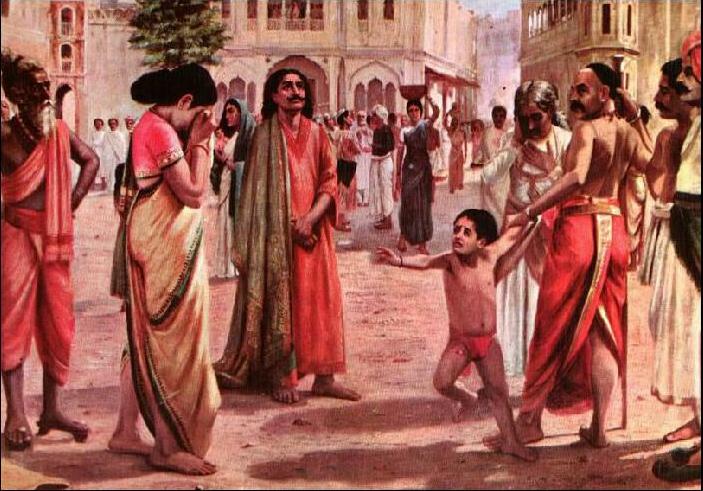
“Hariścandra in Distress” — depicting the anguished king parting with his young son Rohitāśva in an auction, after having already lost his kingdom and all his wealth. The painting captures the moment of supreme sacrifice: Hariścandra, still bearing the dignity of a king despite his reduced circumstances, watches as his son reaches out to him while being led away.
-
“Hariścandra and Tāramatī” — depicting the encounter at the cremation ground, one of the most emotionally charged scenes in Indian mythology.
These paintings, widely reproduced as popular prints by the Ravi Varma Press, brought the Hariścandra legend into millions of Indian homes and helped establish its visual iconography in the modern popular imagination.
Legacy and Continuing Relevance
King Hariścandra’s legacy extends far beyond mythology and into the living fabric of Indian moral culture:
- “Satya Hariścandra” remains a phrase in daily use across Indian languages, denoting anyone who upholds truth at great personal cost.
- The Dadasaheb Phalke Award, India’s highest honour in cinema, is named after the filmmaker whose first work brought Hariścandra to the screen — linking the legend permanently to the history of Indian artistic expression.
- In Indian schools, the Hariścandra story is among the first moral tales taught to children, establishing the primacy of truthfulness as a cultural value from the earliest age.
- The story continues to raise profound ethical questions: Is absolute truthfulness always the right course? What happens when truth conflicts with compassion? Can a commitment to principle justify the suffering of innocents? These questions ensure that the Hariścandra legend remains not a fossilized relic but a living philosophical challenge.
In the broad arc of Hindu ethical thought, Hariścandra represents the ultimate possibility of human moral achievement — the demonstration that a mortal being, through unwavering commitment to Satya, can become worthy of divine honour. As the Mahābhārata declares: “Satyam eva jayate nānṛtam” — “Truth alone triumphs, not falsehood” (Muṇḍaka Upaniṣad 3.1.6). In the figure of Hariścandra, this cosmic principle finds its most complete human embodiment.