Introduction
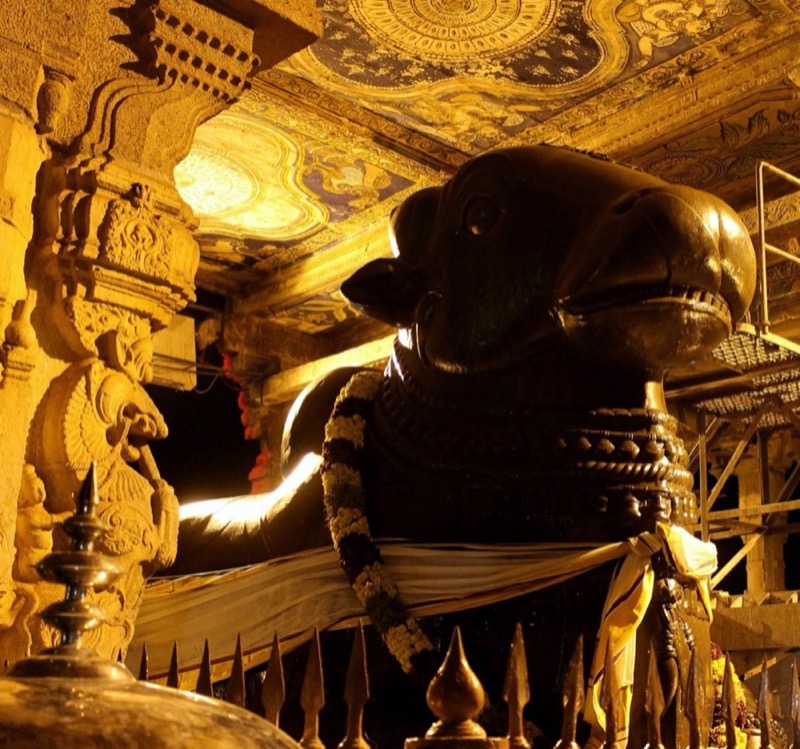
Nandī (IAST: Nandī; Sanskrit: नन्दी, “The Joyful One”), also known as Nandīśvara (“Lord of Joy”) and Nandikēśvara (“Lord Nandī”), is the sacred bull who serves as the divine mount (vāhana) and foremost devotee (gaṇa) of Lord Śiva. In every Śiva temple across the Indian subcontinent, one encounters Nandī’s imposing stone figure — kneeling reverently, facing the Śivaliṅga with ears pricked forward and eyes fixed in eternal adoration. This posture is no mere decorative convention; it embodies the deepest ideal of Hindu devotion: patient, surrendered, unwavering attention to the Divine.
Nandī occupies a singular position in Hindu mythology. He is simultaneously a cosmic figure — the gatekeeper of Kailāsa, Śiva’s celestial abode — and an intimately approachable one, the loyal companion who stands between the devotee and the Lord. His image is among the most ubiquitous in Indian sacred art, found in every Śaiva temple from the Himalayan caves to the coastal shrines of Tamil Nadu. To understand Nandī is to understand the very architecture of Śaiva worship and the Hindu theology of faithful devotion.
Mythological Origins
Son of Kaśyapa and Surabhī
The Purāṇic literature provides several accounts of Nandī’s birth. The most widely cited narrative identifies him as the son of the sage Kaśyapa and Surabhī (also called Kāmadhenu), the divine wish-fulfilling cow. According to the Śiva Purāṇa (Rudra Saṃhitā), Nandī was born with a luminous white body, adorned with divine marks, and possessed of extraordinary spiritual powers from his very birth. Some Purāṇic versions instead name the sage Śilāda as his father — a childless ṛṣi who performed severe austerities to obtain a son directly from Śiva’s grace. In this account, Nandī emerged from the sacrificial fire during Śilāda’s yajña, a divine child destined to serve the Lord.
Regardless of the variant, the theological point is consistent: Nandī is not merely an animal mount but a celestial being of the highest spiritual attainment, born through divine will to serve as Śiva’s eternal companion. The Liṅga Purāṇa (1.20) describes Nandī as one of Śiva’s principal gaṇas (attendants) and the chief among them — hence his title Gaṇādhipa (“Chief of the Gaṇas”), a title he shares with Gaṇeśa in different contexts.
Devotion and Transformation
A moving narrative in the Śiva Purāṇa recounts how Nandī, upon learning from the sage Mārkaṇḍeya that his lifespan would be short, performed intense tapas (austerities) directed toward Lord Śiva. Pleased by his devotion, Śiva appeared before Nandī, blessed him with immortality, and appointed him as the chief of his attendants and the guardian of his abode. Śiva placed his hand upon Nandī’s head and declared that no one could approach Kailāsa without Nandī’s permission. This episode establishes Nandī’s dual role as dvārapāla (gatekeeper) and pradhāna gaṇa (chief attendant) — the first being a devotee must encounter before reaching the Lord.
Gatekeeper of Kailāsa
Nandī’s role as the gatekeeper of Mount Kailāsa, Śiva’s celestial residence, is central to his mythological identity. The Śiva Purāṇa and the Skanda Purāṇa both describe Nandī as stationed perpetually at the entrance to Kailāsa, permitting entry only to those deemed worthy. Several famous mythological episodes turn on this gatekeeping function:
-
Rāvaṇa’s Humiliation: The Rāmāyaṇa tradition (particularly the Uttara Kāṇḍa) narrates how the demon king Rāvaṇa, intoxicated with pride after receiving boons from Brahmā, attempted to uproot Mount Kailāsa. Nandī confronted him at the gate and, when Rāvaṇa mocked his bull-like face, cursed the demon king that monkeys (whose faces Rāvaṇa had ridiculed) would one day destroy his kingdom — a prophecy fulfilled by Hanumān’s burning of Laṅkā (Vālmīki Rāmāyaṇa, Uttara Kāṇḍa 16).
-
The Devotee’s Passage: In temple architecture, the placement of Nandī directly before the sanctum sanctorum (garbhagṛha) containing the Śivaliṅga ritually re-enacts this cosmic gatekeeping. The devotee symbolically seeks Nandī’s permission before approaching the Lord — a practice observed in millions of temples across India to this day.
The Nandīśvara Upaniṣad
The Nandikēśvara Kāśikā (also referred to in some traditions as the Nandī Upaniṣad) is a brief but significant text attributed to Nandīśvara himself. This work, classified among the Śaiva Āgamic literature, contains Nandī’s teachings on the nature of Oṃkāra (the sacred syllable Oṃ), the practice of praṇava upāsanā (meditation on Oṃ), and the path to liberation through devotion to Śiva. The text declares:
“He who meditates upon the Praṇava as identical with Śiva, whose form is consciousness and bliss, crosses over the ocean of saṃsāra.”
The attribution of a philosophical text to Nandī underscores his status in Śaiva theology as not merely an animal companion but a fully realised spiritual master — a guru who transmits the highest knowledge. In some South Indian Śaiva Siddhānta traditions, Nandī is regarded as the ādiguru (primordial teacher) through whom Śiva’s wisdom first entered the world, preceding even the great human preceptors like Tirumūlar and Meykāṇḍar.
Significance in Śaivism
The Ideal Devotee
Nandī’s primary theological significance lies in his embodiment of the ideal bhakta (devotee). His posture in every Śiva temple — kneeling, alert, with gaze fixed unwaveringly upon the Śivaliṅga — represents ekāgratā (one-pointed concentration) and śaraṇāgati (complete surrender). The Śaiva Siddhānta tradition teaches that the devotee should approach Śiva with the same qualities Nandī displays: patience, humility, unwavering focus, and joyful devotion (nandī literally means “joy” or “delight”).
Dharma Personified
In Hindu symbolism, the bull represents dharma (cosmic order, righteousness). This identification draws from the Vedic metaphor in which dharma is described as a bull standing on four legs — satya (truth), dayā (compassion), tapas (austerity), and dāna (charity). The Mahābhārata (Śānti Parva) uses this imagery extensively. Nandī, as the bull of Śiva, is thus dharma itself standing before the Lord — a visual declaration that righteousness is the path to the Divine.
The Intermediary
In Śaiva temple ritual, devotees traditionally whisper their prayers into Nandī’s right ear, believing that he transmits their petitions directly to Lord Śiva. This practice, observed across South India and parts of the Deccan, establishes Nandī as an intermediary — accessible, compassionate, and willing to carry the devotee’s voice to the highest reality. This role parallels the theological function of intercessory figures in other religious traditions, though Nandī’s unique bovine form gives it a distinctly Hindu character.
Nandī in Temple Architecture
The placement of Nandī within the Śaiva temple follows a precise architectural grammar. In most temples, a large stone or bronze Nandī sits in a separate pavilion (nandī-maṇḍapa) directly aligned with the entrance to the garbhagṛha, facing the Śivaliṅga. This axial alignment — Nandī, the entrance, and the liṅga forming a single line of sight — is one of the most consistent features of Indian temple design across all regional styles.
The Lepakshi Nandī (Andhra Pradesh)
The colossal Nandī at Lepakshi (Anantapur district, Andhra Pradesh), dating to the 16th century Vijayanagara period, is carved from a single granite boulder and measures approximately 4.5 metres in height and 8.2 metres in length. It is considered one of the largest monolithic Nandī sculptures in India. The Lepakshi Nandī displays exquisite detailing — ornamental bells, garlands, and a finely carved saddle cloth — reflecting the Vijayanagara empire’s patronage of Śaiva art.
The Mysore (Chamundi Hill) Nandī
Atop Chamundi Hill near Mysore, Karnataka, stands a magnificent monolithic Nandī carved in 1659 CE under the patronage of Dodda Devarāja Woḍeyar of the Mysore kingdom. At approximately 4.9 metres tall and 7.6 metres long, this black granite bull is adorned with intricate carvings of bells, chains, and ornamental cloth. It is one of the most visited sacred sites in Karnataka.
The Thanjavur (Bṛhadīśvara Temple) Nandī
The great Nandī at the Bṛhadīśvara Temple in Thanjavur, Tamil Nadu — a UNESCO World Heritage Site built by Rājarāja Chōḷa I (c. 1010 CE) — is carved from a single stone and measures approximately 3.7 metres in height. This Nandī sits in a dedicated pavilion (nandī-maṇḍapa) aligned with the massive Śivaliṅga inside the temple’s towering vimāna. The Chōḷa-era craftsmanship displays a naturalistic yet idealised rendering that has influenced South Indian temple sculpture for a millennium.
Other Notable Nandī Sculptures
- Bull Temple (Dodda Basavana Gudi), Bangalore: A 4.6-metre monolithic Nandī built under the Kempe Gowda dynasty (16th century), one of the largest in the world.
- Hoysaleśvara Temple, Halebidu: Finely detailed Nandī sculptures in the distinctive Hoysala style (12th century).
- Ellora Caves (Cave 15, Dashavatara): A beautiful Nandī sculpted in the Rāṣṭrakūṭa period (8th century).
Nandī in Festivals and Worship
Nandī Jayantī
Nandī Jayantī is observed on the aṣṭamī (eighth day) of the bright half (śukla pakṣa) of the month of Bhādrapada (August–September) in some regional traditions. Devotees offer special prayers to Nandī, anoint his image with sandalwood paste, turmeric, and flowers, and seek his blessings for health and prosperity.
Monday and Pradoṣa Worship
Since Mondays (Somavāra) are sacred to Śiva, Nandī receives special veneration on these days. During Pradoṣa Vrata (observed on the thirteenth day of each lunar fortnight), the worship of Nandī is considered integral to the ritual. Devotees believe that worshipping Śiva through Nandī during the Pradoṣa period brings the removal of sins and the fulfilment of desires.
Temple Rituals
In daily temple worship (nityapūjā), the priest performs abhiṣeka (ritual bathing) and alaṅkāra (decoration) of the Nandī image alongside the Śivaliṅga. In many South Indian temples, devotees touch or embrace Nandī’s neck before proceeding to the inner sanctum, a gesture of reverence and petition.
Symbolism and Philosophical Significance
Joy and Bliss
The name “Nandī” derives from the Sanskrit root nand (“to rejoice, to delight”). His very name proclaims that the essence of devotion is not grim austerity but joy — the ānanda (bliss) that arises from communion with the Divine. This aligns with the Upaniṣadic declaration: Ānando brahmeti vyajānāt — “He knew Bliss as Brahman” (Taittirīya Upaniṣad 3.6).
The Controlled Senses
The bull in Indian symbolism also represents the untamed power of the senses and desires. A bull under control — harnessed, kneeling, serene — symbolises the disciplined mind and senses that are prerequisites for spiritual progress. Nandī kneeling before Śiva thus represents the ideal state of the yogī: powerful but surrendered, vital but still.
Fertility and Abundance
As a bull, Nandī also carries associations with agricultural fertility, abundance, and prosperity. In rural India, the worship of Nandī is closely linked to the worship of cattle and the prayer for good harvests. The Atharva Veda (4.21) praises the bull as a source of strength and nourishment, and this ancient association persists in the Nandī cult.
Nandī Beyond India
Nandī’s image accompanied the spread of Hinduism across Southeast Asia. Magnificent Nandī sculptures have been found at:
- Prambanan (Java, Indonesia): The great 9th-century Śaiva temple complex includes a dedicated Nandī shrine facing the main Śiva temple.
- My Son (Vietnam): The Champa kingdom’s Śaiva temples (4th–13th centuries) feature Nandī sculptures in the characteristic Cham artistic style.
- Angkor (Cambodia): Several Angkorian temples include Nandī images as part of their Śaiva iconographic programmes.
These Southeast Asian Nandī figures demonstrate the universality of the bull-devotee symbolism across the Hindu world.
Conclusion
From the Purāṇic narratives of his celestial birth to the silent granite monoliths that guard a million Śaiva sanctuaries, Nandī embodies the very heart of Hindu devotion. He is joy (nanda), dharma, the controlled mind, and the faithful companion who stands at the threshold between the human and the Divine. His eternal posture — kneeling, alert, gazing at the Lord — is the posture every devotee aspires to: not merely visiting the temple but dwelling there in spirit, not merely hearing the name of Śiva but being wholly absorbed in it. In the words of the Tamil Śaiva saint Māṇikkavācakar: “Even Nandī, the chief of Śiva’s hosts, attained his glory through love alone” (Tiruvācakam). To worship Nandī is to worship the very possibility of perfect devotion — and to pray that one day, one’s own heart might become as steadfast as the sacred bull who has kept his vigil since the beginning of time.