Introduction
Bharata (IAST: Bharata; Sanskrit: भरत, “the cherished one”) is among the most foundational figures in Hindu civilisation — a legendary Chakravartī emperor whose dominion was so vast and his rule so righteous that the entire Indian subcontinent came to bear his name: Bhāratavarṣa, “the land of Bharata.” This is no mere honorific of antiquity. When the framers of the Indian Constitution chose a name for the newly independent republic in 1950, Article 1 declared: “India, that is Bhārat, shall be a Union of States” — directly invoking the memory of this ancient sovereign (Constitution of India, Article 1).
Two distinct figures named Bharata appear in Hindu scripture, and conflation between them is common. The first and more widely celebrated is Emperor Bharata, son of King Duṣyanta (Dushyanta) and the sage-maiden Śakuntalā, whose story forms one of the most beloved narratives of the Ādi Parva of the Mahābhārata and was immortalised in Kālidāsa’s classic play Abhijñānaśākuntalam. The second is Jaḍa Bharata (“Bharata the Inert”), a king of a later age whose spiritual tale occupies Canto 5 of the Bhāgavata Purāṇa and serves as a profound parable about attachment and liberation. This article treats both figures, with primary focus on the first.
The Story of Śakuntalā and Duṣyanta
Śakuntalā in the Hermitage
The story of Bharata’s parents is one of the most celebrated love stories in world literature. According to the Mahābhārata (Ādi Parva, chapters 62–69), Śakuntalā was the daughter of the sage Viśvāmitra and the celestial apsarā Menakā. Abandoned at birth in a forest, she was found and raised by the ṛṣi Kaṇva in his peaceful āśrama, where birds (śakunta) sheltered and nurtured the infant — hence her name, “she who is protected by the birds” (Mahābhārata, Ādi Parva 62.14–18).
King Duṣyanta of the Puru dynasty, while on a hunting expedition in the forest, chanced upon Kaṇva’s hermitage and was struck by the beauty and poise of the young Śakuntalā. In the absence of her foster-father, the two exchanged vows and were married according to the Gāndharva rite — a union consecrated by mutual consent, recognised as valid in the dharmaśāstra tradition (Mahābhārata, Ādi Parva 67.8–12).
The Birth of Sarvadamana
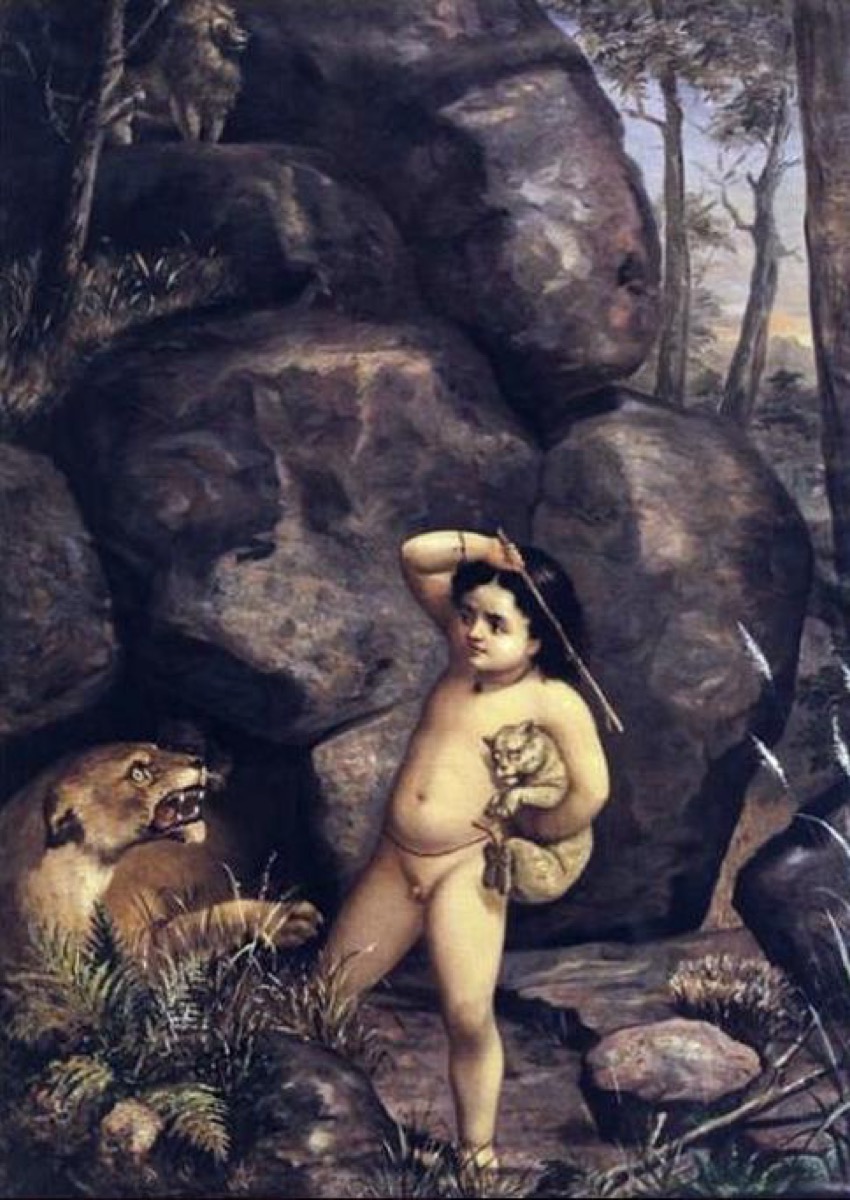
Before departing for his capital Hastināpura, Duṣyanta gave Śakuntalā a royal signet ring as a token of their union. In time, Śakuntalā gave birth to a son of extraordinary vitality. The child was named Sarvadamana — literally “he who subdues all” — for even as a toddler he would fearlessly wrestle with lion cubs, pry open the jaws of tigers, and count their teeth. The Mahābhārata describes how the boy would tie wild animals to trees in the āśrama and ride upon them, displaying a superhuman strength that foretold his destiny as a world-conqueror (Ādi Parva 69.1–12).
This scene of the child Bharata playing with lion cubs became one of the most iconic images in Indian art, immortalised by Raja Ravi Varma’s celebrated painting and in countless miniature and folk-art traditions across the subcontinent.
Duṣyanta’s Recognition
When Śakuntalā brought her son to the royal court to seek acknowledgement from Duṣyanta, the king — in the Mahābhārata’s telling — initially denied her, claiming not to recognise her. A celestial voice (antarikṣavāṇī) then intervened, confirming Śakuntalā’s truthfulness and commanding the king to accept his son. The divine pronouncement declared: “The mother is but the sheath; the father is the true progenitor. Cherish your son, O Duṣyanta, and do not dishonour Śakuntalā” (Ādi Parva 69.20–26). It was this celestial command to “cherish” (bharasva) the child that gave him the name Bharata — “the cherished one.”
Kālidāsa’s later dramatic retelling in the Abhijñānaśākuntalam (c. 4th–5th century CE) adds the famous motif of a lost ring and a sage’s curse of forgetfulness — dramatic embellishments absent in the original epic text but which made the story one of the most performed plays in Sanskrit literary history (Wikipedia, “Abhijñānaśākuntalam”).
Bharata the Chakravartī Emperor
The Conquest of Bhāratavarṣa
Upon receiving the throne from his father, Bharata embarked on a programme of world-conquest (digvijaya) that established him as a Chakravartī Samrāṭ — an emperor whose chariot wheel (cakra) rolls unimpeded across the earth. The Mahābhārata states that Bharata performed many great sacrificial rites and conquered all the kings of the earth through both valour and righteousness (Ādi Parva 69.27–40).
The Viṣṇu Purāṇa (2.1.28–32) provides the most explicit connection between Bharata and the naming of the subcontinent:
“Uttaraṃ yat samudrasya himādreścaiva dakṣiṇam / varṣaṃ tad bhārataṃ nāma bhāratī yatra santatiḥ” (“The land that lies north of the ocean and south of the snowy mountains is called Bhārata; there dwell the descendants of Bharata.”)
This verse has served for over a millennium as the scriptural warrant for calling the Indian subcontinent Bhāratavarṣa. The Matsya Purāṇa and Agni Purāṇa contain similar verses, confirming that the name was well established across the Purāṇic tradition.
The Great Sacrifices
Bharata’s reign was marked by magnificent Vedic sacrifices that demonstrated both his power and his piety. The Mahābhārata records that he performed seventy-eight Aśvamedha yajñas (horse sacrifices) along the banks of the Yamunā and fifty-five along the banks of the Gaṅgā. He also performed the Rājasūya sacrifice, establishing his sovereignty over all other kings, and is said to have distributed vast quantities of gold and cattle as dakṣiṇā (ritual gifts) to the Brahmins who officiated (Ādi Parva 69.28–35).
These sacrificial numbers — clearly hyperbolic in their intent — convey the epic’s estimation of Bharata as the ideal monarch: one who combined martial conquest with religious devotion, generosity, and adherence to Vedic dharma.
Just Rule and Dharma
Bharata is remembered not merely as a conqueror but as a dharmarāja — a righteous king. His administration embodied the concept of rājadharma (royal duty) as articulated in the later dhārmaśāstra literature: protection of the people, maintenance of the varṇāśrama social order, patronage of learning and sacrifice, and the pursuit of justice. The Mahābhārata describes his kingdom as one where the people were prosperous, virtuous, and free from fear — the hallmarks of a sattvic (righteous) reign.
The Bharata Dynasty and the Kuru Lineage
From Bharata to the Kauravas and Pāṇḍavas
Bharata’s significance extends beyond his own reign into the vast genealogical architecture of the Mahābhārata. The dynasty he founded — the Bhārata vaṃśa — branched and flourished over many generations. According to the epic’s genealogy (Ādi Parva, chapters 89–95), his descendants include:
- Hasti — who founded the city of Hastināpura, the capital of the Kuru kingdom
- Kuru — the ancestor who gave his name to the Kuru dynasty and the sacred field of Kurukṣetra
- Śāntanu — the king whose marriages to the river-goddess Gaṅgā and the fisherwoman Satyavatī produced the lineages that culminated in the Pāṇḍavas and Kauravas
- Bhīṣma, Dhṛtarāṣṭra, Pāṇḍu, and eventually the five Pāṇḍava brothers and their hundred Kaurava cousins
The entire Mahābhārata is subtitled “The History of the Bhārata Dynasty” — hence its own name, Mahā-Bhārata, “the Great [Tale] of the Bhāratas.” The word Bhārata in this context functions simultaneously as a dynastic name, a geographical term, and a civilisational identity.
The Question of Succession
A remarkable detail in the Mahābhārata is that Bharata, despite having nine sons by three wives, found none of them worthy of kingship. He therefore performed a great sacrifice to the Marut gods, who granted him an adopted son named Bhumanyu through a sacred rite. In some recensions, the sage Bharadvāja’s son Vitatha is identified as the adopted heir. This willingness to bypass biological heirs in favour of merit became a model for the Hindu ideal that dharmic fitness, not mere birth, should determine succession (Ādi Parva 69.42–49).
Jaḍa Bharata: The King Who Became Attached to a Deer
A Second Bharata in the Bhāgavata Purāṇa
The Bhāgavata Purāṇa (Canto 5, chapters 7–14) narrates the story of a different Bharata — sometimes called Jaḍa Bharata — who was a descendant of Ṛṣabhadeva, the first Tīrthaṅkara in Jain tradition (also recognised in certain Hindu Purāṇic lineages as a divine incarnation). This Bharata ruled wisely but renounced his kingdom in middle age to pursue spiritual liberation through meditation in the forest.
Attachment to a Fawn
While performing austerities by a river, Bharata witnessed a pregnant doe leap in fright at the roar of a lion. She fell into the river, gave birth, and died. Moved by compassion, the ascetic rescued the newborn fawn and began to nurture it. Gradually, his attachment to the deer grew so consuming that it displaced his meditation entirely. He would think of the fawn while chanting mantras, worry about it while performing austerities, and rush to find it if it wandered.
The Bhāgavata Purāṇa states: “He who had renounced a kingdom, wives, and sons could not renounce his attachment to a deer” (Bhāgavata Purāṇa 5.8.26). When Bharata died, his final thought was of the fawn — and consequently, by the law of karma, he was reborn as a deer (5.8.29).
The Life of Jaḍa Bharata
Remarkably, even in his deer body, Bharata retained memory of his previous life and understood the cause of his fall. He spent that life in quiet penance near the hermitage of sages. In his subsequent human rebirth, he was born into a Brahmin family but deliberately behaved as though dull-witted and mute — hence the name Jaḍa (“inert” or “dull”). He did this to avoid any worldly entanglement that might once again derail his spiritual progress.
The climax of Jaḍa Bharata’s story comes when King Rahūgaṇa of Sindhu commandeers him as a palanquin bearer. When the king abuses him for walking too slowly and unevenly (Jaḍa Bharata was carefully stepping over ants to avoid killing them), the sage breaks his silence and delivers a stunning discourse on the nature of the ātman, the illusion of bodily identification, and the futility of worldly power. King Rahūgaṇa, humbled and transformed, falls at his feet and becomes his disciple (Bhāgavata Purāṇa 5.10–13).
The Teaching of Jaḍa Bharata
Jaḍa Bharata’s discourse to Rahūgaṇa is one of the most profound passages in the Bhāgavata Purāṇa. He explains that the self (ātman) is distinct from the body, that the mind’s attachment to objects of the senses is the root cause of bondage, and that even the noblest attachment — compassion for a helpless creature — can become a chain if it displaces devotion to the Supreme. The parable became a standard teaching text in Vedāntic traditions for illustrating the subtlety of māyā (illusion).
Comparing the Two Bharatas
The two Bharatas of Hindu scripture represent complementary ideals. Emperor Bharata embodies the pinnacle of worldly dharma — righteous kingship, martial valour, Vedic sacrifice, and the creation of a just social order. He is the pravṛtti (engaged action) ideal carried to perfection. Jaḍa Bharata, by contrast, embodies the nivṛtti (renunciation) path — but his story serves as a cautionary tale that even renunciation can fail if the mind is not truly disciplined. Together, the two Bharatas illustrate the Hindu understanding that both engagement and renunciation require unwavering focus on the ultimate reality.
Some scholars have noted that the Bhāgavata Purāṇa’s Bharata may be a theological reimagining of the Mahābhārata figure, transposed into a Vaiṣṇava devotional framework. Whether or not they share a historical kernel, the two narratives have functioned independently in Hindu thought for centuries.
Artistic and Cultural Depictions
In Classical Art
The image of the child Bharata (Sarvadamana) fearlessly playing with lion cubs is one of the most recognisable motifs in Indian art. Raja Ravi Varma (1848–1906) painted the subject multiple times, depicting a robust, fearless child grasping a lion cub while the mother lioness snarls nearby — an image that captures both innocence and preternatural strength. This scene also appears in Pahari miniature paintings, Tanjore art, and modern calendar art traditions.
The story of Śakuntalā and Duṣyanta, with the child Bharata as its culmination, has been depicted in sculpture at Khajurāho, in Mughal miniature paintings commissioned by Akbar, and in European Orientalist art following Sir William Jones’s 1789 English translation of Kālidāsa’s Abhijñānaśākuntalam — a translation that profoundly influenced Goethe, Herder, and the German Romantic movement.
Bharata and Indian National Identity
The name Bhārat has served as a cultural and political rallying point throughout Indian history. During the independence movement, leaders invoked the idea of Bhāratavarṣa as a civilisational unity that predated colonial boundaries. Bankim Chandra Chattopadhyay’s Vande Mātaram hymn personifies the motherland as Bhāratamātā (Mother India). The founding of the Republic of India as “Bhārat” in 1950 was a conscious act of linking the modern nation-state to the ancient mythological sovereign.
In September 2023, the Government of India sent official G20 dinner invitations under the name “President of Bharat,” reigniting public discussion about the country’s dual nomenclature and the historical figure behind the Sanskrit name.
Significance in Hindu Thought
Bharata’s legacy operates on multiple levels within Hindu tradition:
-
Genealogical foundation: He is the ancestor from whom the entire Mahābhārata epic and the Kuru lineage descend — making him the progenitor of the Pāṇḍavas, Kauravas, and the narrative universe of the great epic.
-
Geographical identity: The name Bhāratavarṣa, attested in the Viṣṇu Purāṇa, Matsya Purāṇa, and other texts, defines the sacred geography of the Indian subcontinent — bounded by the Himālayas to the north and the ocean to the south.
-
Political ideal: As a Chakravartī, Bharata represents the Hindu ideal of universal sovereignty exercised through dharma rather than mere force — a model invoked by historical kings from the Mauryas to the Guptas and Cholas.
-
Spiritual parable: Through Jaḍa Bharata, the name also carries a warning about the subtlety of attachment and the supreme importance of maintaining spiritual focus through all circumstances.
Conclusion
The name Bharata echoes across millennia — from the forest hermitage where a fearless child subdued lions, through the sacrificial fires of a Chakravartī emperor, to the constitutional text of the world’s most populous democracy. In Hindu tradition, Bharata is simultaneously a historical ancestor, a geographical marker, a political ideal, and — in the person of Jaḍa Bharata — a profound spiritual teacher. When over a billion people today call their nation Bhārat, they invoke not merely a name but an entire civilisational memory: of righteous sovereignty, of sacred geography stretching from the Himālayas to the sea, and of the ancient conviction that a land is defined not by its boundaries but by the dharma of its people.