Introduction
Lord Kṛṣṇa (IAST: Kṛṣṇa; Sanskrit: कृष्ण), the eighth avatar of Lord Viṣṇu, is one of the most beloved, widely worshipped, and theologically significant deities in Hinduism. Revered as the Svayaṁ Bhagavān — the Supreme Personality of Godhead — by many Vaiṣṇava traditions, Kṛṣṇa occupies a unique position in Hindu thought: he is at once the cosmic sovereign who reveals the Viśvarūpa (universal form) on the battlefield of Kurukṣetra, the mischievous child who steals butter in Gokula, the enchanting flute-player of Vṛndāvan, the divine lover of Rādhā, and the supreme teacher whose discourse in the Bhagavad Gītā has shaped Indian philosophy for over two millennia.
The primary scriptural source for Kṛṣṇa’s life is the Bhāgavata Purāṇa (also known as the Śrīmad Bhāgavatam), particularly its Tenth Book (Daśama Skandha), which recounts his birth, childhood, youth, and divine exploits in extraordinary detail (Britannica, “Bhagavata Purana”). The Mahābhārata, of which the Bhagavad Gītā forms chapters 25–42 of the Bhīṣma Parva, presents Kṛṣṇa as the charioteer, counsellor, and friend of the Pāṇḍava prince Arjuna. Additional references appear in the Harivaṁśa (an appendix to the Mahābhārata), the Viṣṇu Purāṇa, and the Brahmavaivarta Purāṇa.
Birth and Divine Mission
Kṛṣṇa was born in the city of Mathurā to Devakī and Vasudeva of the Yādava clan. His birth occurred in a prison cell, where his maternal uncle Kaṁsa — the tyrannical king of Mathurā — had imprisoned his parents after receiving a divine prophecy that Devakī’s eighth child would be his destroyer (Bhāgavata Purāṇa 10.1–3).
On the night of Kṛṣṇa’s birth, the eighth day (Aṣṭamī) of the dark fortnight of the month of Bhādrapada, miraculous events unfolded. The prison guards fell asleep, the chains binding Vasudeva broke open, and the doors of the cell unlocked by themselves. Vasudeva carried the newborn across the flooding Yamunā river — whose waters parted to allow passage — to the village of Gokula, where he exchanged the child with a baby girl born to Nanda and Yaśodā. When Kaṁsa attempted to kill this infant, she rose into the sky and revealed herself as the goddess Yogamāyā, warning him that his destroyer had already escaped (Bhāgavata Purāṇa 10.3–4).
This narrative establishes Kṛṣṇa’s dual nature from the very moment of his birth: he is simultaneously the supreme divine being whose birth defies natural law, and a human infant placed in the care of humble cowherds.
Childhood Pastimes (Bāla Līlā)
The childhood exploits of Kṛṣṇa in Gokula and Vṛndāvan form some of the most cherished narratives in Hindu literature and art. The Bhāgavata Purāṇa’s Tenth Book devotes extensive chapters to these pastimes, which serve both as delightful stories and as profound theological allegories.
The Butter Thief (Navanīta Cora)
One of Kṛṣṇa’s most endearing childhood traits is his love for butter (navanīta or makhan). Despite Yaśodā’s attempts to hide it, young Kṛṣṇa would steal butter from the houses of the gopīs (cowherd women), earning him the epithet Makhan Chor (Butter Thief). When Yaśodā tried to tie him to a grinding mortar as punishment, she found that every rope was always two inches too short — until Kṛṣṇa, moved by her devotion, allowed himself to be bound. This episode, known as Dāmodara Līlā (Bhāgavata Purāṇa 10.9), reveals that the infinite Lord can be bound only by the rope of pure love.
Subduing Demons
Even as a child, Kṛṣṇa destroyed numerous demons sent by Kaṁsa to kill him. He subdued the serpent-demoness Pūtanā, who attempted to poison him with her breast milk (Bhāgavata Purāṇa 10.6). He crushed the cart-demon Śakaṭāsura with a kick, uprooted the twin Arjuna trees to liberate the gandharvas Nalakūvara and Maṇigrīva trapped within them, and danced upon the hoods of the great serpent Kālīya in the Yamunā river, compelling him to leave Vṛndāvan (Bhāgavata Purāṇa 10.16). Each of these episodes illustrates the divine child’s effortless mastery over cosmic forces while maintaining the appearance of innocent play.
Lifting Govardhana Hill
When the young Kṛṣṇa persuaded the residents of Vraja to worship Govardhana Hill instead of Indra, the king of the gods, Indra responded with a devastating rainstorm. Kṛṣṇa lifted the entire Govardhana Hill on the little finger of his left hand and held it aloft for seven days, sheltering the villagers and their cattle beneath it (Bhāgavata Purāṇa 10.25). This episode earns him the beloved name Giridhārī (He who lifted the mountain) and represents the triumph of devotion and divine protection over institutional ritualism.
The Flute and the Rāsa Līlā
Kṛṣṇa’s flute (veṇu or bāṁsurī) is one of his most iconic attributes. When he plays his flute in the moonlit groves of Vṛndāvan, the gopīs forget all worldly duties and are irresistibly drawn to him. The Bhāgavata Purāṇa describes how even the rivers stop flowing, the trees shed tears of joy, and the deer stand motionless at the sound of his music (Bhāgavata Purāṇa 10.21). The flute symbolises the divine call that draws all souls back to their source in God — the soul must become hollow like the flute to receive the divine breath.
The Rāsa Līlā (Bhāgavata Purāṇa 10.29–33) is the culminating episode of Kṛṣṇa’s Vṛndāvan pastimes. On a full-moon autumn night, Kṛṣṇa multiplied himself so that each gopī believed she danced with him alone. This cosmic dance represents the highest form of spiritual love (madhurya bhāva) — the ecstatic, selfless union of the individual soul (jīvātman) with the divine (paramātman). The Rāsa Līlā is not mere romantic allegory; it is understood in Vaiṣṇava theology as the supreme revelation of God’s intimate, personal relationship with each devotee.
Kṛṣṇa and Rādhā
Rādhā (Rādhikā) occupies a central position in Kṛṣṇa devotion, particularly within the Gauḍīya Vaiṣṇava tradition founded by Śrī Caitanya Mahāprabhu (1486–1534). Though Rādhā does not appear by name in the Bhāgavata Purāṇa, she is referenced obliquely and is celebrated extensively in the Gīta Govinda of Jayadeva (12th century), the Brahmavaivarta Purāṇa, and the theological writings of the Six Gosvāmīs of Vṛndāvan.
In Gauḍīya theology, Rādhā is not merely a devotee of Kṛṣṇa — she is his hlādinī śakti, his intrinsic pleasure potency. Together, Rādhā and Kṛṣṇa represent the complete Absolute Truth: Kṛṣṇa is the supreme energetic source, and Rādhā is the supreme energy. They are non-different, like musk and its fragrance, like fire and its heat (Wikipedia, “Radha Krishna”). Caitanya Mahāprabhu himself is understood by Gauḍīya Vaiṣṇavas as Kṛṣṇa incarnating with the devotional mood (bhāva) and complexion of Rādhā, in order to experience the depth of her selfless love from within.
The Bhagavad Gītā
Kṛṣṇa’s most celebrated contribution to world philosophy is the Bhagavad Gītā (“Song of God”), a 700-verse dialogue spoken on the battlefield of Kurukṣetra just before the commencement of the great Mahābhārata war. When the warrior prince Arjuna is paralysed by moral despair at the prospect of fighting his own kinsmen, Kṛṣṇa — serving as his charioteer — delivers a comprehensive discourse on duty, action, knowledge, and devotion.
Core Teachings
The Gītā synthesises multiple strands of Indian philosophical thought into a coherent framework:
-
Karma Yoga (the path of selfless action): “You have a right to perform your prescribed duties, but you are not entitled to the fruits of your actions” (karmaṇy evādhikāras te mā phaleṣu kadācana — Gītā 2.47). This teaching of niṣkāma karma (desireless action) is among the most influential ethical principles in Indian thought.
-
Jñāna Yoga (the path of knowledge): Kṛṣṇa teaches Arjuna about the eternal, indestructible nature of the ātman (soul): “The soul is never born, nor does it ever die… It is unborn, eternal, ever-existing, and primeval” (Gītā 2.20).
-
Bhakti Yoga (the path of devotion): “Abandon all varieties of dharma and simply surrender unto Me. I shall deliver you from all sinful reactions; do not fear” (sarva-dharmān parityajya mām ekaṁ śaraṇaṁ vraja — Gītā 18.66). This verse, considered the essence of the Gītā, establishes devotion as the supreme path.
The Vision of the Universal Form
In Chapter 11, Kṛṣṇa reveals his Viśvarūpa — the cosmic universal form — to Arjuna. Arjuna sees the entire universe, all beings, all worlds, all time contained within Kṛṣṇa’s infinite body. This terrifying and awe-inspiring vision demonstrates that the gentle charioteer beside him is in truth the Lord of all creation (Gītā 11.9–13).
Philosophical Synthesis
The Gītā uniquely synthesises elements of Sāṅkhya philosophy, Vedānta, Yoga, and theistic devotion. While the Upaniṣads focus primarily on knowledge and the identity of the self with Brahman, the Gītā shifts emphasis towards the worship of a personal deity. This synthesis has made the Gītā perhaps the most pan-Hindu scripture, revered across Vaiṣṇava, Śaiva, Smārta, and Advaita traditions alike (Wikipedia, “Bhagavad Gita”).
Iconography
Kṛṣṇa’s iconography is among the richest and most varied in Hinduism, reflecting the multiple dimensions of his divine personality:
-
Bāla Kṛṣṇa (child Kṛṣṇa): Depicted as a crawling infant or toddler, often with a ball of butter in hand, representing divine playfulness and the accessibility of God.
-
Veṇugopāla (the flute-playing cowherd): Standing in the graceful tribhaṅga (triple-bend) posture, playing the flute, usually with cows and gopīs nearby. This is the most iconic and widely recognised form.
-
Rādhā-Kṛṣṇa: Kṛṣṇa standing or seated with Rādhā, representing the divine couple and the union of the soul with God.
-
Pārthasārathi (charioteer of Arjuna): Seated on Arjuna’s chariot on the Kurukṣetra battlefield, delivering the Gītā.
-
Viṣṇu-Kṛṣṇa: In his four-armed (caturbhuja) form, holding the śaṅkha (conch, symbolising the primordial sound of creation), sudarśana cakra (discus, representing the cycle of time and divine justice), gadā (mace, symbolising intellect and the power of knowledge), and padma (lotus, signifying purity and spiritual liberation) (HD Asian Art, “Vishnu’s Divine Attributes”).
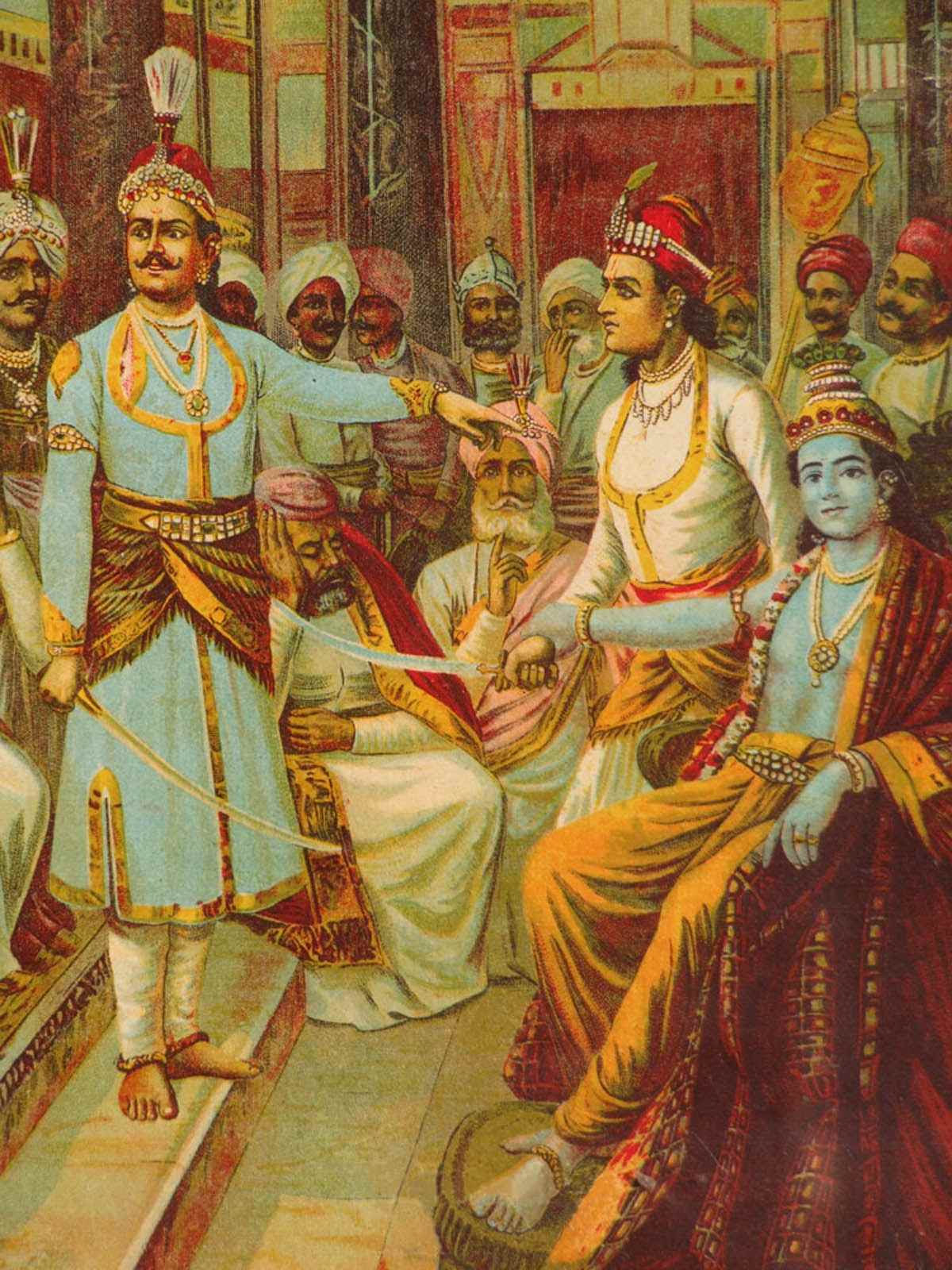
Kṛṣṇa is typically depicted with dark blue or black skin — the name “Kṛṣṇa” itself means “dark” or “all-attractive” — symbolising the infinite, boundless nature of the divine, like the night sky or the deep ocean. He wears a crown of peacock feathers, yellow silk garments (pītāmbara), and the Kaustubha gem on his chest.
Major Temples and Sacred Sites
Kṛṣṇa worship centres on several sacred sites across India:
-
Śrī Kṛṣṇa Janmabhūmi, Mathurā (Uttar Pradesh): The believed birthplace of Kṛṣṇa, one of the holiest sites in Hinduism.
-
Bāṅke Bihārī Temple, Vṛndāvan (Uttar Pradesh): One of the most visited temples in the Braj region, renowned for the distinctive curtain (jhāṅkī) darśan of the deity.
-
Dvārakādhīśa Temple, Dvārkā (Gujarat): Located in the ancient city of Dvārakā on the Gujarat coast, where Kṛṣṇa established his kingdom. Part of the Cār Dhām pilgrimage.
-
Jagannātha Temple, Purī (Odisha): Dedicated to Lord Jagannātha (a form of Kṛṣṇa), famous for the annual Ratha Yātrā (chariot festival), one of the largest religious processions in the world.
-
Guruvāyūr Temple (Kerala): Known as the “Dvārakā of the South,” housing the Guruvāyūrappan form of Kṛṣṇa as a four-armed child.
-
ISKCON Temples worldwide: The International Society for Krishna Consciousness, founded by A. C. Bhaktivedānta Svāmī Prabhupāda in 1966, has established hundreds of Kṛṣṇa temples across the globe, making Kṛṣṇa bhakti one of the most internationally visible Hindu traditions.
Festivals
Janmāṣṭamī
Janmāṣṭamī celebrates Kṛṣṇa’s birth on the eighth day (Aṣṭamī) of the dark fortnight in the month of Bhādrapada (August–September). Devotees fast throughout the day, sing devotional songs, enact scenes from Kṛṣṇa’s childhood, and celebrate at midnight — the believed hour of his birth — with elaborate abhiṣeka (ritual bathing) of the deity and the rocking of a decorated cradle. In Maharashtra, the festival includes the popular Dahi Handi tradition, where teams of young men form human pyramids to break a pot of curd suspended high above the ground, re-enacting Kṛṣṇa’s butter-stealing exploits.
Holi
The festival of Holī is deeply connected to Kṛṣṇa. In Vṛndāvan, Mathurā, and the Braj region, Holī celebrations last for over a week and recreate the playful colour-throwing between Kṛṣṇa and the gopīs. The Lāṭhmār Holī of Barsānā and Nandgāon is particularly famous.
Ratha Yātrā
The annual Ratha Yātrā in Purī, Odisha, draws millions of devotees who pull the enormous chariots of Lord Jagannātha, Baladeva, and Subhadrā through the streets — a tradition dating back over a thousand years.
Sacred Names and Epithets
Kṛṣṇa is known by innumerable names, each illuminating a facet of his divine nature. The Viṣṇu Sahasranāma (Thousand Names of Viṣṇu) includes many that specifically apply to Kṛṣṇa. Among the most commonly invoked:
- Govinda — Protector of cows; giver of joy to the senses
- Gopāla — Cowherd; protector of cows
- Giridhārī — He who lifted Govardhana Hill
- Murārī — Destroyer of the demon Mura
- Mādhava — Husband of the goddess of prosperity; descendant of Madhu
- Dāmodara — He who was bound around the waist by Yaśodā’s rope
- Kanhaiyā / Kānhā — Affectionate names for the child Kṛṣṇa
- Keśava — He with beautiful hair; slayer of the demon Keśī
- Jagannātha — Lord of the universe
- Vāsudeva — Son of Vasudeva; He who dwells in all beings
Philosophical Significance Across Traditions
Kṛṣṇa’s theological significance varies across the major schools of Hindu philosophy, yet his centrality is undisputed:
-
Gauḍīya Vaiṣṇavism (Caitanya Mahāprabhu): Kṛṣṇa is the Svayaṁ Bhagavān, the original Supreme Person, from whom all other forms of God — including Viṣṇu — emanate. The highest practice is prema-bhakti (ecstatic loving devotion), cultivated through the congregational chanting of the Hare Kṛṣṇa Mahāmantra: Hare Kṛṣṇa Hare Kṛṣṇa, Kṛṣṇa Kṛṣṇa Hare Hare / Hare Rāma Hare Rāma, Rāma Rāma Hare Hare (Wikipedia, “Gaudiya Vaishnavism”).
-
Śrī Vaiṣṇavism (Rāmānujācārya): Kṛṣṇa is a supreme manifestation of Viṣṇu-Nārāyaṇa. Devotion (prapatti, surrender) to the Lord is the means to liberation.
-
Dvaita Vedānta (Madhvācārya): Kṛṣṇa is identical with Viṣṇu, the independent supreme reality eternally distinct from the individual soul.
-
Advaita Vedānta (Śaṅkarācārya): Kṛṣṇa is a manifestation of nirguṇa Brahman who assumes form (saguṇa) to guide aspirants towards the realisation of non-dual truth.
-
Puṣṭi Mārga (Vallabhācārya): Kṛṣṇa is worshipped as Śrīnāthji, and devotion takes the form of sevā (loving service), particularly to the child form of Kṛṣṇa.
Kṛṣṇa in Literature, Music, and Art
Kṛṣṇa has inspired an unparalleled wealth of literary, musical, and artistic creation across India and the world:
- Jayadeva’s Gīta Govinda (12th century): A lyrical masterpiece celebrating the love of Rādhā and Kṛṣṇa, foundational to Odissi dance and Indian classical music.
- Sūrdās’ Sūrsāgar (16th century): Thousands of poems in Braj Bhāṣā depicting Kṛṣṇa’s childhood and the gopīs’ devotion.
- Mīrābāī’s Bhajans (16th century): Passionate Rajasthani and Braj devotional songs addressed to Kṛṣṇa as her divine husband.
- Miniature painting traditions: The Rājasthānī, Pahāṛī (Kangra, Basohli), and Mughal schools produced thousands of exquisite paintings depicting Kṛṣṇa’s līlā.
- Classical dance: Bharatanāṭyam, Odissi, Kathak, Kūchipuḍi, and Maṇipuri traditions all draw extensively on Kṛṣṇa narratives for their repertoire.
Contemporary Relevance
Kṛṣṇa’s teachings and personality continue to resonate deeply in the modern world. The Bhagavad Gītā is studied in universities worldwide as a masterpiece of philosophical literature. ISKCON has brought Kṛṣṇa consciousness to every continent, with temples in over 100 countries. The annual Janmāṣṭamī and Ratha Yātrā celebrations draw millions globally. In India, Kṛṣṇa’s image pervades daily life — from temple worship and home shrines to music, cinema, theatre, and popular culture.
Conclusion
Kṛṣṇa’s life, as narrated across the vast corpus of Hindu scripture and tradition, teaches that God is not remote or abstract but intimately present in creation — stealing butter in a cowherd’s kitchen, playing the flute in a moonlit forest, driving a chariot on a battlefield, and dwelling in the heart of every being. His message in the Gītā — that the purpose of life is to know, love, and serve the divine through selfless action, wisdom, and devotion — remains the living heart of Hindu spirituality. As Kṛṣṇa himself declares: ye yathā māṁ prapadyante tāṁs tathaiva bhajāmy aham — “As they surrender unto Me, I reward them accordingly” (Gītā 4.11).