Introduction
Lord Rāma (IAST: Rāma; Sanskrit: राम), also known as Rāmacandra, is one of the most revered deities in Hinduism and the seventh avatar of Lord Viṣṇu. Celebrated as Maryādā Puruṣottama — the perfect man who upholds the highest boundaries of dharma — Rāma embodies righteousness, filial devotion, marital fidelity, compassionate kingship, and unwavering moral courage. He is the central figure of the Rāmāyaṇa, the ancient Sanskrit epic composed by the sage Vālmīki, which has inspired hundreds of millions of people across South Asia and Southeast Asia for over two and a half millennia.
The Rāmāyaṇa is not merely a narrative of heroic adventure. As Vālmīki himself declares, it is an ādi-kāvya — the first poem — that explores the fundamental question of what it means to live a righteous life in an imperfect world. Rāma’s journey through exile, separation, war, and return serves as an extended meditation on the nature of dharma, the cost of virtue, and the possibility of an ideal society (Britannica, “Ramayana”).
The epic’s influence has been immense. In addition to Vālmīki’s original Sanskrit text of approximately 24,000 verses (śloka), the story has been retold in virtually every Indian language — most notably in Tulsīdās’ Rāmcaritmānas (16th century, Avadhī), Kambaṉ’s Rāmāvatāram (12th century, Tamil), and Kṛttivāsa’s Rāmāyaṇa (15th century, Bengali). Beyond India, the Rāmāyaṇa has given rise to the Thai Ramakien, the Cambodian Reamker, the Javanese Rāmāyaṇa Kakawin, the Lao Phra Lak Phra Ram, and numerous other Southeast Asian traditions (University of Washington, “Ramayanas of Southeast Asia”).
Birth and Family
According to the Bāla Kāṇḍa (Book of Youth) of the Vālmīki Rāmāyaṇa, Rāma was born to King Daśaratha and Queen Kauśalyā in Ayodhyā, the capital of the Kingdom of Kosala. Daśaratha, though a mighty and righteous king, was childless for many years. On the advice of his priest Vasiṣṭha, he performed the Putreṣṭi Yajña (sacrifice for the boon of sons). From the sacred fire emerged a divine being bearing a golden vessel of pāyasa (consecrated food), which was distributed among Daśaratha’s three queens (Vālmīki Rāmāyaṇa, Bāla Kāṇḍa 15–16).
From this divine offering, four sons were born, each carrying a portion of Lord Viṣṇu’s essence:
- Rāma (born to Kauśalyā) — bearing the greatest portion of Viṣṇu’s divinity
- Bharata (born to Kaikeyī)
- Lakṣmaṇa and Śatrughna (born to Sumitrā)
Rāma’s birth occurred on the ninth day (Navamī) of the bright half of the month of Caitra, which is celebrated annually as Rāma Navamī. The young prince grew up displaying extraordinary martial prowess, deep learning, and a gentle, compassionate temperament that endeared him to all of Ayodhyā.
Education and the Breaking of Śiva’s Bow
Under the tutelage of the sage Viśvāmitra, Rāma and Lakṣmaṇa ventured into the forest to protect the sages’ sacrificial rites from the depredations of the rākṣasas (demons) Tāṭakā, Mārīca, and Subāhu. This period of training with Viśvāmitra was formative: Rāma received divine weapons (divyāstra), learned the arts of war and statecraft, and demonstrated the humility and obedience to his guru that would characterise his entire life (Vālmīki Rāmāyaṇa, Bāla Kāṇḍa 26–30).
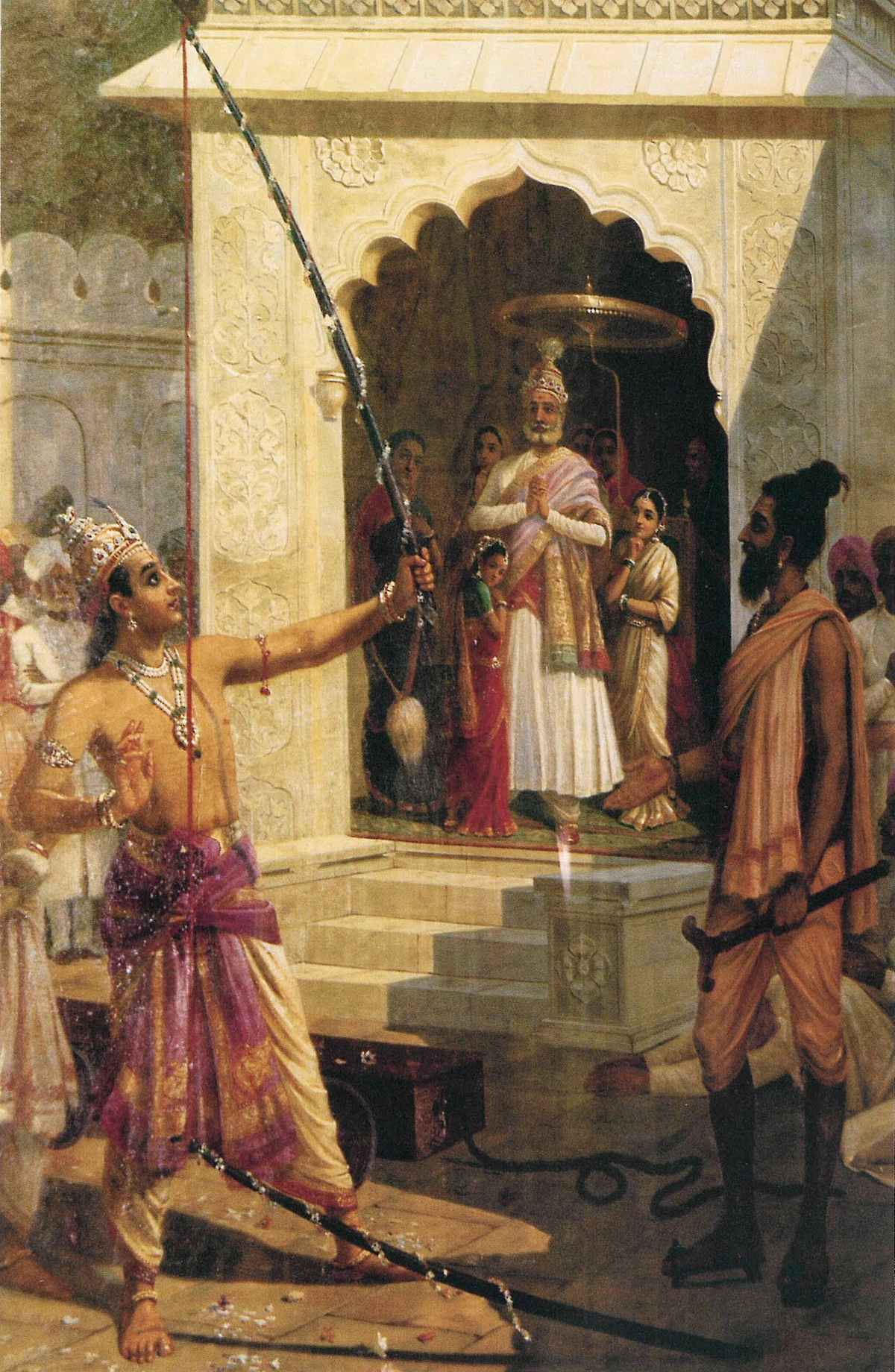
The culminating event of the Bāla Kāṇḍa is Rāma’s attendance at the svayaṁvara (self-choice ceremony) of Princess Sītā in the court of King Janaka of Mithilā. The challenge was to string the great bow of Lord Śiva, which no king or warrior had been able to even lift. Rāma not only lifted the immense bow but broke it in two by the sheer force of drawing its string (Vālmīki Rāmāyaṇa, Bāla Kāṇḍa 67). This feat won him the hand of Sītā, the daughter of the Earth, whose union with Rāma would become the paradigm of ideal marriage in Hindu tradition.
The Exile (Araṇya Kāṇḍa)
Rāma’s life took a dramatic turn when his father Daśaratha, bound by a promise made years earlier to his second queen Kaikeyī, was compelled to grant her two boons: that her son Bharata would be crowned king and that Rāma would be exiled to the forest for fourteen years. Kaikeyī had been manipulated by her maidservant Mantharā, who poisoned her mind with suspicion and ambition (Vālmīki Rāmāyaṇa, Ayodhyā Kāṇḍa 9–12).
Rāma’s response to this devastating decree reveals the essence of his character. Without a word of protest or bitterness, he accepted exile, prioritising his father’s honour and the sanctity of a royal promise over his own claim to the throne. His devoted wife Sītā and loyal brother Lakṣmaṇa insisted on accompanying him into the wilderness. King Daśaratha, heartbroken by the separation, died shortly after Rāma’s departure — an event that underscores the profound cost of dharma (Vālmīki Rāmāyaṇa, Ayodhyā Kāṇḍa 58).
During their stay in the forest, Rāma, Sītā, and Lakṣmaṇa received the blessings and guidance of sages such as Bharadvāja, Atri, and Agastya. They immersed themselves in spiritual practice, philosophical discussion, and the defence of forest hermitages from rākṣasa depredation. The exile period, far from being merely a punishment, became a crucible that tested and refined Rāma’s dharmic qualities.
The Abduction of Sītā and the Alliance with the Vānaras
The most dramatic chapter of the Rāmāyaṇa begins with the abduction of Sītā by Rāvaṇa, the ten-headed rākṣasa king of Laṅkā. Rāvaṇa employed a ruse involving the golden deer Mārīca to lure Rāma and Lakṣmaṇa away from their hermitage, then seized Sītā and carried her across the sea to Laṅkā (Vālmīki Rāmāyaṇa, Araṇya Kāṇḍa 49–56). The vulture king Jaṭāyu attempted to rescue her but was mortally wounded by Rāvaṇa; Rāma later performed his funeral rites with the reverence due to a father.
In their search for Sītā, Rāma and Lakṣmaṇa allied with the vānara (forest-dweller) kingdom of Kiṣkindhā. Rāma aided Sugrīva in defeating his brother Vālī and reclaiming his throne, and in return Sugrīva pledged his entire army to the search. It was Hanumān, the son of Vāyu and the greatest of all devotees, who leapt across the ocean to Laṅkā, discovered Sītā in the Aśoka grove, and returned bearing Rāma’s signet ring as proof (Vālmīki Rāmāyaṇa, Sundarā Kāṇḍa).
The War and Triumph of Dharma
The Yuddha Kāṇḍa (Book of War) recounts the monumental battle between Rāma’s vānara army and Rāvaṇa’s rākṣasa forces. The vānara army, led by Hanumān, Sugrīva, Aṅgada, Nīla, and Jāmbavān, constructed the legendary Rāma Setu (bridge) across the ocean to Laṅkā — a feat attributed to the architect Nala.
The war lasted many days and involved titanic combats between the greatest warriors of both sides. Lakṣmaṇa was struck down by Rāvaṇa’s son Indrajit’s śakti weapon and was revived only when Hanumān flew to the Himalayas and brought back the entire Droṇagiri mountain bearing the life-giving Sañjīvanī herb (Vālmīki Rāmāyaṇa, Yuddha Kāṇḍa 101).
The climactic battle between Rāma and Rāvaṇa is one of the greatest passages in world literature. Rāvaṇa, despite his immense power and knowledge, ultimately fell to the divine arrow consecrated by the sage Agastya — the Brahmāstra. Rāma’s victory over Rāvaṇa represents the eternal triumph of dharma over adharma, of righteousness over tyranny (Vālmīki Rāmāyaṇa, Yuddha Kāṇḍa 108–111).
Rāma Rājya: The Ideal Kingdom
After Rāma’s triumphant return to Ayodhyā — celebrated ever since as the festival of Dīpāvalī (the festival of lights) — he was crowned king and established Rāma Rājya, the ideal kingdom. The Uttara Kāṇḍa describes this reign as a golden age:
- There was no disease, no famine, no crime
- Rivers flowed on time, rains came as needed
- All citizens were truthful and virtuous
- No parent outlived a child; no widow mourned
- All four varṇas lived in harmony, each fulfilling their svadharma
Rāma Rājya has become a powerful ideal in Indian political and moral thought, invoked by figures as diverse as Mahātmā Gandhi and contemporary politicians as the standard of just governance.
Maryādā Puruṣottama: The Perfect Man
Rāma’s supreme epithet is Maryādā Puruṣottama — the perfect man who honours all boundaries of dharma. Unlike Kṛṣṇa, who often transcends or subverts conventional rules through divine play, Rāma operates entirely within human moral boundaries. This is precisely what makes his example so powerful and demanding:
- As a son: He accepted exile without question to honour his father’s word, even though the command was manifestly unjust
- As a husband: His devotion to Sītā and his grief at her abduction reveal the depth of his love, while his painful decisions regarding her reflect the agonising conflicts that dharma can impose
- As a brother: His bond with Lakṣmaṇa is one of literature’s most profound portrayals of fraternal loyalty
- As a king: He placed the welfare of his subjects above his own happiness, embodying the principle that a ruler is the servant of his people
- As a warrior: He fought with honour, offered Rāvaṇa multiple chances to return Sītā and avoid war, and performed proper funeral rites for his fallen enemy
Iconography
Rāma’s visual representation follows established conventions in Hindu art and temple architecture:
- Skin colour: Rāma is depicted with blue or dark skin, like Viṣṇu, symbolising the infinite, boundless nature of the divine — the colour of the sky and the deep ocean
- The bow (Kodaṇḍa): Rāma’s primary attribute, symbolising his martial prowess, his commitment to righteousness, and his readiness to defend dharma. The arrow represents precision, focus, and determination
- Royal attire: He wears princely garments and a tall conical crown (kirīṭa-mukuṭa), indicating his royal status
- Companions: Rāma is most commonly depicted with Sītā at his side, Lakṣmaṇa standing guard, and Hanumān kneeling in devoted service — the iconic Rāma Pañcāyatana (five-fold image)
The tilaka on Rāma’s forehead, often in the shape of his bow, marks his devotees across India and is worn particularly by followers of the Rāmānandī Sampradāya.
Major Temples and Sacred Sites
- Rāma Mandir, Ayodhyā (Uttar Pradesh): The grand temple at Rāma’s believed birthplace, consecrated in January 2024, housing the central mūrti of Rāma Lallā (child Rāma). The first Rāma Navamī after consecration witnessed the Sūrya Tilak — a ray of sunlight anointing the deity’s forehead at noon through a specially designed optical arrangement (Wikipedia, “Ram Mandir”).
- Rāmeśvaram (Tamil Nadu): Where Rāma is believed to have worshipped Lord Śiva before crossing to Laṅkā; one of the Cār Dhām pilgrimage sites.
- Bhadracalam (Telangana): A major centre of Rāma worship in South India, famous for its Rāma Navamī celebrations attended by hundreds of thousands.
- Sītāmarhi (Bihar): Believed to be Sītā’s birthplace and an important pilgrimage destination.
- Rāma temples across Southeast Asia: Including the ancient Khmer temples of Angkor Wat, the Thai Ramakien murals at the Grand Palace in Bangkok, and the Prambanan temples in Java, Indonesia.
Festivals and Worship Traditions
Rāma Navamī
Rāma Navamī celebrates Rāma’s birth on the ninth day of the bright half of Caitra (March–April). Devotees fast, recite the Rāmāyaṇa, perform pūjā with specially prepared offerings, and join processions featuring decorated chariots bearing images of Rāma, Sītā, Lakṣmaṇa, and Hanumān. Major celebrations take place in Ayodhyā, where the grand Śobhā Yātrā and Sarayū river āratī draw vast crowds (Wikipedia, “Rama Navami”).
Dīpāvalī (Diwali)
The festival of lights celebrates Rāma’s return to Ayodhyā after fourteen years of exile and his victory over Rāvaṇa. The lighting of dīpa (oil lamps) symbolises the triumph of light over darkness, knowledge over ignorance, and dharma over adharma.
Vijayadaśamī (Dussehra)
Dussehra marks Rāma’s victory over Rāvaṇa. Across North India, enormous effigies of Rāvaṇa, Meghanāda, and Kumbhakarṇa are burned in public celebrations. The nine nights preceding Dussehra feature Rāmlīlā performances — dramatic enactments of the Rāmāyaṇa — a tradition believed to have been initiated by Tulsīdās himself. The Rāmlīlā of Vārāṇasī and Rāmnagar are recognised by UNESCO as an Intangible Cultural Heritage of Humanity.
Mānasa Pāṭha
Across North and Central India, millions of households maintain the practice of daily recitation of Tulsīdās’ Rāmcaritmānas, known as Mānasa Pāṭha. Complete recitations are organised during auspicious occasions, and the text is considered “the living sum of Indian culture” and “the greatest book of all devotional literature” (Wikipedia, “Ramcharitmanas”).
The Rāmāyaṇa Tradition Beyond India
The Rāmāyaṇa’s cultural influence extends far beyond the Indian subcontinent, representing one of the most remarkable instances of cultural transmission in human history:
- Thailand: The Ramakien is the Thai national epic, deeply localised with Thai motifs and settings. Before Bangkok, the capital of Siam was called Ayutthaya — a direct tribute to Rāma’s Ayodhyā. The Ramakien is the basis of all khon (masked dance) and nang (shadow puppet) dramas in Thailand (Wikipedia, “Ramakien”).
- Cambodia: The Reamker adapts the story with Buddhist influences, featuring unique episodes such as Hanumān’s encounter with the mermaid Sovann Macchā.
- Indonesia: Despite being the world’s largest Muslim-majority nation, Indonesia preserves the Rāmāyaṇa through wayang kulit (shadow puppet theatre) and the spectacular Sendratari Ramayana ballet at Prambanan, Java.
- Laos, Myanmar, and the Philippines: Each maintains its own Rāmāyaṇa tradition, testifying to the epic’s universal appeal.
Philosophical Significance
Rāma’s theological importance extends across the major schools of Hindu thought:
- Rāmānandī Sampradāya: The largest Vaiṣṇava monastic order in India, founded by Svāmī Rāmānanda (14th century), centres its devotion on Rāma and Sītā. Its influence pervades North Indian religious life.
- Viśiṣṭādvaita (Rāmānujācārya): Rāma is a supreme manifestation of Nārāyaṇa; the devotee surrenders (prapatti) to him for liberation.
- Advaita Vedānta (Śaṅkarācārya): Rāma is saguṇa Brahman — Brahman with form — whose story guides aspirants towards the realisation of non-dual truth. Śaṅkara himself composed the Rāma Bhujañga Prayāta Stotram.
- Tulsīdās’ theology: The Rāmcaritmānas presents a henotheistic vision that reconciles Vaiṣṇavism and Śaivism. In Tulsīdās’ telling, Śiva himself is the archetypal devotee of Rāma, narrating the story to Pārvatī (Wikipedia, “Ramcharitmanas”).
Sacred Names and Epithets
Rāma is known by many sacred names, each reflecting a dimension of his divine nature:
- Rāmacandra — The moon-like Rāma; he whose face is as pleasing as the moon
- Maryādā Puruṣottama — The perfect man who honours all boundaries of dharma
- Rāghava — Descendant of Raghu, the illustrious ancestor of the solar dynasty
- Dāśarathi — Son of Daśaratha
- Sītāpati — Husband and lord of Sītā
- Kodaṇḍapāṇi — He who holds the bow Kodaṇḍa
- Paṭṭābhirāma — Rāma enthroned; the coronated king
- Karuṇānidhi — Ocean of compassion
Conclusion
Rāma’s story teaches that true strength lies not in the exercise of power but in the unwavering adherence to dharma, even when it demands the greatest personal sacrifice. He accepted exile to honour his father’s word, searched the earth to rescue his beloved, waged war only as a last resort, and governed with such justice that his kingdom became the eternal standard of righteous rule. As Tulsīdās wrote: rāma nāma mani dīpa dharu, jīha dehārī dvāra — “Place the jewel-lamp of Rāma’s name on the threshold of your tongue.”
Rāma remains, across centuries and civilisations, the supreme exemplar of a life lived in service to truth, duty, and love — Maryādā Puruṣottama, the ideal for all humanity.