Introduction
Lord Viṣṇu (IAST: Viṣṇu; Sanskrit: विष्णु, “The All-Pervading One”), also revered as Nārāyaṇa (“The Ultimate Refuge”), Hari (“The Remover of Sins”), and Bhagavān (“The Blessed Lord”), is one of the principal deities of Hinduism and the Supreme Being within Vaiṣṇavism — the largest denomination of the Hindu tradition, encompassing approximately two-thirds of all Hindus worldwide (Britannica, “Vaishnavism”). Within the Trimūrti framework, Viṣṇu is the preserver and protector of the universe, sustaining the cosmic order (ṛta) alongside Brahmā (the creator) and Śiva (the destroyer). Yet for Vaiṣṇavas, he is not merely one god among three but the Supreme Godhead from whom all existence proceeds and into whom it ultimately returns.
Viṣṇu’s theological character is defined by compassionate intervention. Whereas Brahmā creates and Śiva dissolves, Viṣṇu descends into the world whenever dharma is threatened, taking embodied form — an avatāra — to restore righteousness and protect the faithful. This doctrine of divine descent, articulated most famously by Kṛṣṇa in the Bhagavad Gītā (4.7–8), is the theological heart of Vaiṣṇavism:
Yadā yadā hi dharmasya glānir bhavati bhārata / abhyutthānam adharmasya tadātmānaṃ sṛjāmy aham — “Whenever there is a decline of dharma and a rise of adharma, O Bhārata, I manifest myself.” (Bhagavad Gītā 4.7)
Vedic Origins: The Three Strides of Viṣṇu
Viṣṇu appears in the Ṛg Veda, the oldest of the Vedas (c. 1500–1200 BCE), though he is not yet the supreme deity of later tradition. Five hymns of the Ṛg Veda are dedicated to Viṣṇu, the most significant being Ṛg Veda 1.154, which celebrates his celebrated three strides (trivikrama):
Trīṇi padā vi cakrame Viṣṇur gopā adābhyaḥ — “Viṣṇu, the undeceivable protector, strode across [the universe] in three steps.” (Ṛg Veda 1.154.1)
These three strides — traversing earth, atmosphere, and the highest heaven — establish Viṣṇu as a cosmic deity whose reach encompasses all realms. The Ṛg Veda further describes his “highest step” (paramaṃ padam) as the abode where “departed selves (ātman) reside” (Ṛg Veda 1.154.5), already hinting at the later Vaiṣṇava concept of Vaikuṇṭha, the eternal realm of liberation. Viṣṇu is also closely associated with the sun in these early hymns, functioning as a solar deity of beneficent energy whose strides bring light and life to all beings (Wikipedia, “Vishnu”; Sacred Texts, “Rig Veda 1.154”).
In the later Vedic period, Viṣṇu’s stature grows dramatically. The Śatapatha Brāhmaṇa identifies him with the sacrifice (yajña) itself, and the Taittirīya Āraṇyaka contains the Nārāyaṇa Sūkta, a hymn that elevates Nārāyaṇa-Viṣṇu to the status of the Supreme Being — the inner self of all creatures and the lord of the universe.
Iconography and Symbolism
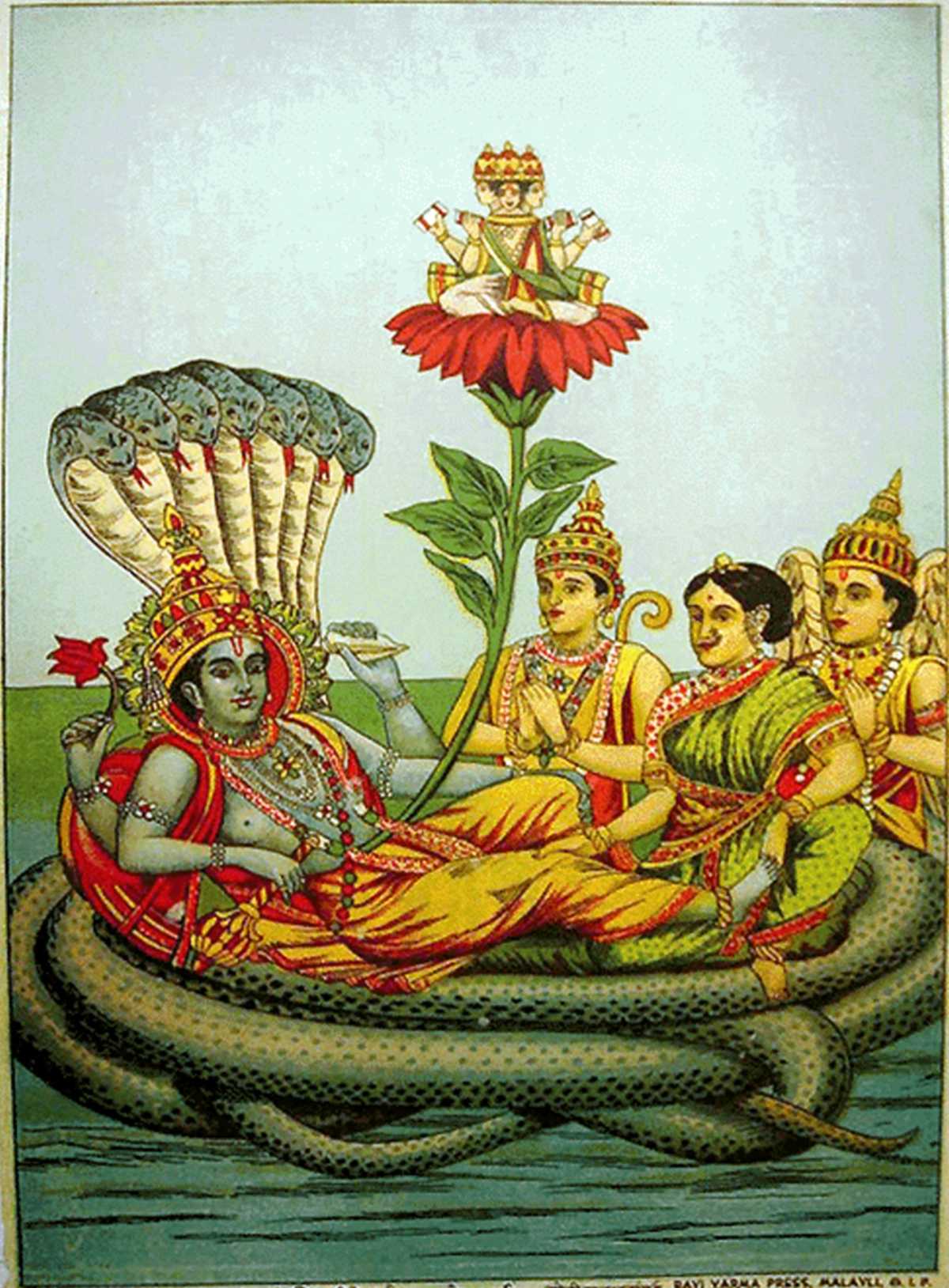
Viṣṇu’s visual depictions are rich with philosophical symbolism. He is typically portrayed with a serene expression, a dark blue-black complexion (śyāma), and four arms, reclining on the cosmic serpent Śeṣa or standing in a majestic posture.
The Blue Complexion (Śyāma)
Viṣṇu’s deep blue skin — sometimes described as the colour of rain-bearing clouds — symbolises the infinite, all-pervading nature of consciousness, like the boundless sky. It evokes vastness, depth, and the mystery of the formless Absolute made visible.
The Four Sacred Attributes (Āyudhas)
Each of Viṣṇu’s four hands holds an object of deep symbolic significance:
-
Pāñcajanya (Conch Shell): Named after the demon Pañcajana whom Viṣṇu defeated, the conch emits the primordial sound Oṃ when blown and represents the five elements (pañca-bhūta). Its sound is the call to dharma, the awakening of beings from the sleep of ignorance. Indian mysticism links the conch to the sacred sound Oṃ, said to be the very breath of Viṣṇu pervading all space.
-
Sudarśana Chakra (Discus): The spinning disc of divine will, representing the wheel of time (kāla-cakra) and cosmic order. The Viṣṇu Purāṇa identifies the cakra with the human mind, “whose thoughts flow faster than even the mightiest wind.” As a weapon, the Sudarśana destroys evil and adharma, and uniquely returns to the hand of its wielder — symbolising the self-correcting nature of cosmic justice.
-
Kaumodakī (Mace): Symbolises sovereign authority (aiśvarya), the power to enforce moral law, and the primal force from which all physical and mental strength derives.
-
Padma (Lotus): The lotus blooming from muddy waters is an ancient Indian symbol of purity, spiritual awakening, and the unfolding of consciousness. In Viṣṇu’s hand, it represents the universe emerging from the formless Absolute — beauty arising from the primordial waters.
The Kaustubha Gem and Śrīvatsa Mark
The radiant Kaustubha gem on Viṣṇu’s chest represents pure consciousness (cit), while the Śrīvatsa mark signifies the presence of Lakṣmī — his consort and the embodiment of divine grace — eternally upon his heart.
Garuḍa: The Divine Mount
Viṣṇu’s vāhana (mount) is Garuḍa, the king of birds — a mighty eagle-like being who represents the Vedas themselves. The name Garuḍa is etymologically linked to “wings of speech,” and he is said to carry the Lord of Sacrifice (Yajña) through the cosmos. Garuḍa embodies speed, devotion, and the power of sacred knowledge to uplift the soul.
Anantaśayana: The Cosmic Vision
One of the most iconic images of Viṣṇu is Anantaśayana — the Lord reclining on the coils of the thousand-headed serpent Śeṣa (also called Ananta, “the Endless”) upon the primordial ocean of milk (Kṣīra Sāgara). Goddess Lakṣmī sits at his feet, gently pressing them, while from Viṣṇu’s navel rises a lotus upon which Brahmā sits, ready to begin the work of creation.
This image is a cosmogonic vision of extraordinary power. Śeṣa, whose name means “Remainder,” represents that which endures when all else is dissolved — the substratum of infinite time and consciousness. The milk ocean symbolises the pure, undifferentiated ground of being. Viṣṇu’s sleep (yoga-nidrā) is not unconsciousness but the state of supreme awareness from which the entire universe dreams itself into existence. The lotus emerging from his navel conveys that creation is not a mechanical act but an organic unfolding from the divine body itself (Wikipedia, “Shesha”; Śrī Vaiṣṇavism, “Consorts and Attendants of Vishnu”).
The Daśāvatāra: Ten Descents of the Divine
The doctrine of the Daśāvatāra — ten principal incarnations of Viṣṇu — is one of the most distinctive and beloved teachings of Hinduism. Described most fully in the Bhāgavata Purāṇa (Canto 1, Chapter 3) and the Viṣṇu Purāṇa, these incarnations follow a theological logic: whenever cosmic order is disrupted, Viṣṇu takes the form most suited to restore it.
-
Matsya (Fish): Saved the Vedas and the sage Manu from the cosmic deluge, preserving the seeds of dharma for the next creation cycle (Bhāgavata Purāṇa 8.24).
-
Kūrma (Tortoise): During the samudra manthana (churning of the ocean of milk), Kūrma supported Mount Mandara on his back as the churning rod, enabling devas and asuras to extract the nectar of immortality (amṛta) and other divine treasures (Bhāgavata Purāṇa 8.7).
-
Varāha (Boar): Dived into the cosmic waters to rescue the Earth goddess Bhūdevī, who had been dragged to the ocean floor by the demon Hiraṇyākṣa. The image of Varāha lifting the Earth on his tusks is one of the most powerful in Hindu iconography (Viṣṇu Purāṇa 1.4).
-
Narasiṃha (Half-Man, Half-Lion): Emerged from a pillar to destroy the demon Hiraṇyakaśipu — who had received a boon making him nearly invincible — in order to protect his devotee Prahlāda. This avatāra demonstrates that the Lord will transcend even the laws of nature to protect those who take refuge in him (Bhāgavata Purāṇa 7.8).
-
Vāmana (Dwarf): Appeared as a small Brahmin boy to reclaim the three worlds from the benevolent but dangerously powerful demon king Bali. In three cosmic strides — echoing the Ṛg Vedic trivikrama — Vāmana measured out earth, sky, and heaven (Bhāgavata Purāṇa 8.18–21).
-
Paraśurāma (Warrior Sage): Born to the sage Jamadagni, he wielded an axe (paraśu) received from Śiva and cleansed the earth of corrupt kṣatriya rulers who had abandoned dharma (Mahābhārata, Anuśāsana Parva).
-
Rāma: The crown prince of Ayodhyā, hero of the Rāmāyaṇa, and the embodiment of maryādā (righteous conduct). Rāma’s life — his exile, the abduction and rescue of Sītā, and his just reign — provides the ideal model of dharmic kingship.
-
Kṛṣṇa: The divine cowherd of Vṛndāvana, the charioteer of Arjuna, and the speaker of the Bhagavad Gītā. In many Vaiṣṇava traditions — particularly the Gauḍīya school — Kṛṣṇa is not merely an avatāra but the source of all avatāras, svayam bhagavān (the original Supreme Person).
-
Buddha: The enlightened sage who taught compassion and non-violence. The inclusion of the Buddha among Viṣṇu’s avatāras reflects Hinduism’s capacity for synthesis and its recognition of the Buddha’s moral authority, though the theological interpretation varies across traditions.
-
Kalki: The future avatāra, prophesied to appear at the end of the Kali Yuga riding a white horse, wielding a blazing sword, to destroy the forces of darkness and inaugurate a new Satya Yuga (Viṣṇu Purāṇa 4.24; Bhāgavata Purāṇa 12.2).
Modern commentators have noted that the sequence from aquatic creature (Matsya) to fully human forms appears to parallel biological evolution — an observation first made by the theosophist Helena Blavatsky and later echoed by many Indian writers, though this was not the original theological intent.
Vaiṣṇava Philosophy: Schools of Devotion
Vaiṣṇavism has produced some of the most sophisticated and influential philosophical systems in Indian thought:
Viśiṣṭādvaita (Qualified Non-Dualism) — Rāmānuja
Rāmānuja (1017–1137 CE), the greatest philosopher of Śrī Vaiṣṇavism, taught that Brahman is not the featureless Absolute of Advaita Vedānta but a personal God — Viṣṇu-Nārāyaṇa — who possesses infinite auspicious qualities. Individual souls (jīvas) and the material world (prakṛti) are real, not illusory, and constitute the “body” of God. Liberation (mokṣa) is achieved through bhakti (devotion) and prapatti (complete surrender), and consists not in the dissolution of the self but in the soul’s eternal, loving communion with God in Vaikuṇṭha (Wikipedia, “Sri Vaishnavism”).
Dvaita (Dualism) — Madhvācārya
Madhvācārya (1238–1317 CE) established the Dvaita school, teaching that God (Viṣṇu), individual souls, and matter are eternally distinct realities. Viṣṇu alone is independent (svatantra); all else depends upon him. Devotion to Viṣṇu — expressed through study of scripture, ethical conduct, and loving service — is the sole means of liberation.
Gauḍīya Vaiṣṇavism — Caitanya Mahāprabhu
Caitanya (1486–1534 CE), the Bengali mystic and reformer, taught acintya-bhedābheda — the “inconceivable simultaneous oneness and difference” of God and the soul. He emphasised the ecstatic chanting of the divine names (saṅkīrtana), especially the Hare Kṛṣṇa mahāmantra, as the supreme spiritual practice for the Kali Yuga. His movement, carried forward by the six Gosvāmīs of Vṛndāvana and in the modern era by the International Society for Krishna Consciousness (ISKCON), has made Vaiṣṇava devotion a global phenomenon.
The Āḻvārs: Tamil Poet-Saints
The twelve Āḻvārs (“those immersed in God”) were Tamil poet-saints of South India (6th–9th centuries CE) who composed the Nālāyira Divya Prabandham — “Four Thousand Divine Verses” — in Tamil, celebrating Viṣṇu with passionate bhakti. Śrī Vaiṣṇava theologians regard the Āḻvārs’ Tamil hymns as equal in authority to the Sanskrit Vedas — a radical theological move that democratised access to divine truth. The temples visited and celebrated by the Āḻvārs are known as the 108 Divya Desams — the most sacred Vaiṣṇava pilgrimage sites, distributed across Tamil Nadu (84), Kerala (11), Andhra Pradesh (2), Uttar Pradesh (4), Uttarakhand (3), Gujarat (1), and Nepal (1), with two conceived as transcendent realms (Tiruppārkkaḍal and Vaikuṇṭham) (Wikipedia, “Sri Vaishnavism”).
Major Temples and Pilgrimage
Vaiṣṇava temple architecture and worship represent one of the richest traditions in world religion:
-
Śrī Raṅganāthasvāmī Temple, Śrīraṅgam (Tamil Nadu): The largest functioning Hindu temple in the world, dedicated to Viṣṇu as Raṅganātha (reclining on Śeṣa). It is the foremost of the 108 Divya Desams.
-
Tirumala Veṅkaṭeśvara Temple (Andhra Pradesh): Dedicated to Lord Veṅkaṭeśvara (a form of Viṣṇu), it is the most visited and wealthiest religious site on earth, drawing tens of millions of pilgrims annually.
-
Jagannātha Temple, Purī (Odisha): Home to the famous Ratha Yātrā (chariot festival) and the worship of Jagannātha — “Lord of the Universe” — a distinctive form of Viṣṇu-Kṛṣṇa.
-
Badrīnāth Temple (Uttarakhand): One of the four Char Dhām pilgrimage sites, situated in the Himalayas at an altitude of over 3,100 metres, sacred to Viṣṇu as Badrī Nārāyaṇa.
-
Padmanābhasvāmī Temple, Thiruvananthapuram (Kerala): Dedicated to Viṣṇu in the Anantaśayana posture, and one of the 108 Divya Desams.
Divine Family and Consorts
Lakṣmī (Śrī)
Viṣṇu’s eternal consort is Lakṣmī (also known as Śrī), the goddess of wealth, fortune, prosperity, and grace. In Śrī Vaiṣṇava theology, Lakṣmī is not merely a consort but a co-equal divine principle — the mediating grace (puruṣakāra) through whom devotees approach the Lord. Whenever Viṣṇu incarnates, Lakṣmī accompanies him: as Sītā with Rāma, as Rukmiṇī and Rādhā with Kṛṣṇa. The very name “Śrī Vaiṣṇavism” places the goddess first, reflecting her theological centrality.
Bhūdevī and Nīlā
In South Indian Vaiṣṇava tradition, Viṣṇu is also accompanied by Bhūdevī (Earth goddess) and Nīlā Devī, forming a triad of divine consorts — each representing a different aspect of the Lord’s creative and sustaining power.
Names and Epithets
Viṣṇu is celebrated through a thousand sacred names in the Viṣṇu Sahasranāma (Mahābhārata, Anuśāsana Parva), chanted daily by millions of devotees. Among the most significant:
- Nārāyaṇa — “The ultimate refuge”; “one whose abode is the primordial waters”
- Hari — “The remover of sins and sorrows”
- Padmanābha — “The lotus-navelled one,” from whose navel creation springs
- Vāsudeva — “The all-pervading Lord”; also the patronymic of Kṛṣṇa
- Acyuta — “The infallible, imperishable one”
- Keśava — “The one with beautiful hair”; also “the slayer of the demon Keśī”
- Mādhava — “The consort of Mā (Lakṣmī)”; “the sweet one”
- Govinda — “The protector of cows”; “the one who is known through the Vedas”
Festivals and Worship Practices
Vaikuṇṭha Ekādaśī
The most sacred Vaiṣṇava festival, observed on the eleventh day of the bright half of the month of Mārgaśīrṣa (December–January). Devotees fast, maintain vigil, and worship Viṣṇu throughout the night. At the Śrīraṅgam temple, the “Vaikuṇṭha Dvāram” (Gate of Heaven) is opened only on this day.
Rāma Navamī and Janmāṣṭamī
The birthdays of Viṣṇu’s two most beloved avatāras — Rāma (in Caitra) and Kṛṣṇa (in Bhādrapada) — are celebrated with fasting, devotional singing, dramatic enactments of divine līlā, and temple worship across India.
Daily Worship
Vaiṣṇava daily worship (nitya-pūjā) includes the application of the ūrdhva-puṇḍra (vertical tilak markings), recitation of the Viṣṇu Sahasranāma and the Puruṣa Sūkta, offerings of tulasī (holy basil) leaves, and the chanting of sacred mantras — foremost among them Oṃ Namo Nārāyaṇāya (the Aṣṭākṣarī, or eight-syllable mantra) and Oṃ Namo Bhagavate Vāsudevāya (the Dvādaśākṣarī, or twelve-syllable mantra).
Philosophical Significance
Viṣṇu embodies several of the most profound themes in Hindu theology:
-
Divine Accessibility: Unlike deities who remain remote, Viṣṇu enters the world — as fish, tortoise, boar, man-lion, dwarf, warrior, prince, cowherd — demonstrating that no form is too humble for the divine. This doctrine of saulabhya (easy accessibility) is central to Vaiṣṇava theology.
-
Dharma as Cosmic Law: Viṣṇu’s interventions are always in service of dharma — the moral and natural order that sustains the universe. His avatāras teach that dharma is not a static code but a living principle that must be actively defended and renewed in every age.
-
Grace and Surrender: The concept of prapatti (total surrender) — that the Lord saves those who take refuge in him with absolute trust — is the crowning insight of Vaiṣṇava soteriology. Rāmānuja’s teaching that even a single act of genuine surrender suffices for liberation has made Vaiṣṇavism profoundly accessible and hopeful.
-
Love as the Highest Path: From the Āḻvārs’ ecstatic poetry to Caitanya’s streets-of-Navadvīpa kīrtana, Vaiṣṇavism declares that the deepest relationship between the soul and God is not one of fear or philosophical detachment but of love — a love that longs, weeps, dances, and ultimately finds its home in the eternal embrace of the Lord.
Conclusion
From the cosmic strider of the Ṛg Veda to the reclining Lord of the milk-ocean, from the playful child Kṛṣṇa of Vṛndāvana to the just king Rāma of Ayodhyā, Viṣṇu is the deity who comes to meet humanity where it is. His promise — repeated across ages, scriptures, and languages — is simple and unwavering: Whenever dharma declines, I will come. For the countless devotees who chant Oṃ Namo Nārāyaṇāya, this promise is not a distant theological abstraction but a lived experience of divine presence, protection, and love — the all-pervading one who sustains the world and the heart alike.