Introduction
Matsya (Sanskrit: मत्स्य, IAST: Matsya, “fish”) is the first of the ten principal avatāras (daśāvatāra) of Lord Viṣṇu and one of the most ancient and universally resonant incarnation narratives in the Hindu tradition. In this avatāra, the Supreme Lord assumed the form of a colossal divine fish to rescue Manu (the progenitor of humanity), the Saptaṛṣis (seven great sages), the seeds of all living beings, and — in later Purāṇic elaborations — the sacred Vedas themselves from the catastrophic pralaya (cosmic deluge) that periodically dissolves the manifest universe (Wikipedia, “Matsya”; Vedabase, Bhāgavata Purāṇa 8.24).
The Matsya narrative occupies a singular position in Hindu mythology: it is simultaneously the oldest avatāra myth (with roots in the Vedic Brāhmaṇa literature of c. 800–600 BCE), a profound cosmological statement about the cyclical nature of creation and dissolution, and a story of extraordinary tenderness — a tiny fish, rescued by the kindness of a pious king, grows to cosmic proportions and repays that kindness by saving all of existence. The tale belongs to the universal family of flood myths found across civilizations from ancient Sumer to the Hebrew Bible, yet its distinctive theological content — the preservation of sacred knowledge (veda) and righteous order (dharma) through the waters of annihilation — gives it a uniquely Hindu philosophical depth.
The Earliest Account: Śatapatha Brāhmaṇa (1.8.1)
The oldest extant textual account of the Matsya-flood narrative appears in the Śatapatha Brāhmaṇa (1.8.1), a Vedic prose commentary on the Yajurveda, composed approximately between 800 and 600 BCE. This makes the Hindu flood narrative one of the most ancient surviving flood accounts in world literature (Sacred Texts, Śatapatha Brāhmaṇa).
In this earliest version, the story is told with austere Vedic simplicity. One morning, as Manu (here identified simply as the primordial man, without the later royal titles) was washing his hands, a small fish (śapharī) came into his hands along with the water. The tiny fish spoke to Manu: “Rear me, and I shall save you.” When Manu asked from what danger it would save him, the fish replied: “A flood will carry away all these creatures; from that I will save you.”
Manu, moved by compassion, placed the fish in a jar. As the fish grew, he transferred it to a pit, and when it outgrew the pit, he carried it to the sea. By this time, the fish had grown to enormous proportions — a jhasha, a great fish of the deep ocean. Before departing into the sea, the fish instructed Manu: “In such and such a year the flood will come. You shall then attend to my advice and prepare a ship; and when the flood has risen, you shall enter the ship, and I will save you from it.”
When the predicted year arrived, Manu built a ship as instructed. The flood waters rose, and Manu embarked upon his vessel. The great fish swam up to him, and Manu fastened the ship’s rope to the horn (śṛṅga) on the fish’s head. The fish towed the ship northward to the northern mountain (later traditions identify this with the Himālayas). As the waters receded, Manu descended the mountain slope gradually, and for this reason the slope of the northern mountain is called Manoravataraṇa — “Manu’s descent.”
Notably, in this earliest version, the fish is not yet identified as Viṣṇu. The Śatapatha Brāhmaṇa presents it as a mysterious divine being, associated by some scholars with Prajāpati (the creator deity) or Brahmā. The identification of the fish-saviour with Viṣṇu belongs to the later Purāṇic tradition, reflecting the process by which Viṣṇu gradually absorbed the roles and narratives of earlier Vedic deities.
The Bhāgavata Purāṇa Account (Canto 8, Chapter 24)
The most theologically developed and devotionally beloved account of the Matsya avatāra appears in the Śrīmad Bhāgavata Purāṇa, Canto 8, Chapter 24. Here, the narrative is set within the grand cosmic framework of the manvantara (the reign of a Manu) and explicitly identifies the fish as an avatāra of Lord Viṣṇu (Vedabase, Bhāgavata Purāṇa 8.24).
King Satyavrata and the Little Fish
In the land of Drāviḍa (South India), there lived a righteous king named Satyavrata, who was destined to become Vaivasvata Manu — the progenitor and lawgiver of the current cosmic age. One day, while performing water-libation (tarpaṇa) in the Kṛtamālā River, Satyavrata cupped water in his palms and discovered a tiny fish (śapharī) within. The little creature pleaded with him: “O great king, I am a small helpless fish, afraid of the large aquatic creatures. Please protect me.”
Filled with compassion, the king placed the fish in his water-pot (kamaṇḍalu). But by the next day, the fish had grown too large for the pot. He transferred it to a well, then to a pond, then to a lake, and finally to the ocean — and at each stage, the fish outgrew its container with astonishing speed. Recognizing that no ordinary creature could exhibit such supernatural growth, Satyavrata addressed the fish with folded hands: “You are no mere fish. You must be the Supreme Lord Nārāyaṇa Himself. I bow to You, O Lord of the universe — please reveal to me the purpose of this form.”
The Divine Command
Pleased by Satyavrata’s discernment, Lord Viṣṇu in His Matsya form revealed His purpose. He foretold that within seven days, the three worlds would be submerged by the ocean of dissolution (pralaya). He commanded Satyavrata to gather the Saptaṛṣis (the seven great sages — Marīci, Atri, Aṅgiras, Pulastya, Pulaha, Kratu, and Vasiṣṭha), along with the seeds of all living beings, medicinal herbs, and the various categories of grain, and to board a great boat that would be sent by the gods.
The Lord further instructed: “When the boat is tossed about by the tempestuous winds of dissolution, fasten it to My horn with the great serpent Vāsuki as your rope. I shall tow you through the waters of annihilation until the night of Brahmā ends and a new creation begins.”
The Cosmic Voyage
When the pralaya arrived, the ocean surged forth in mighty waves, inundating the three worlds. Satyavrata, the sages, and the seeds of all creation boarded the divine vessel. As promised, the colossal Matsya appeared — a golden fish of incomprehensible magnitude, blazing like a second sun upon the dark waters of dissolution. A single great horn rose from His head. Satyavrata bound the ship to this horn using the serpent Vāsuki as a cable, and the Matsya towed them through the roaring cosmic ocean.
During this voyage across the waters of annihilation — which lasted the entire night of Brahmā (a period of 4.32 billion years in Hindu cosmology) — the Lord Matsya imparted to Satyavrata the deepest spiritual wisdom: the knowledge of the Ātman (Self), the nature of Brahman (the Absolute), and the principles of dharma by which the coming age should be governed. This teaching is sometimes identified with the Matsya Purāṇa itself, which is framed as a discourse of Lord Viṣṇu in His fish form.
The Matsya Purāṇa: Rescue of the Vedas from the Demon Hayagrīva
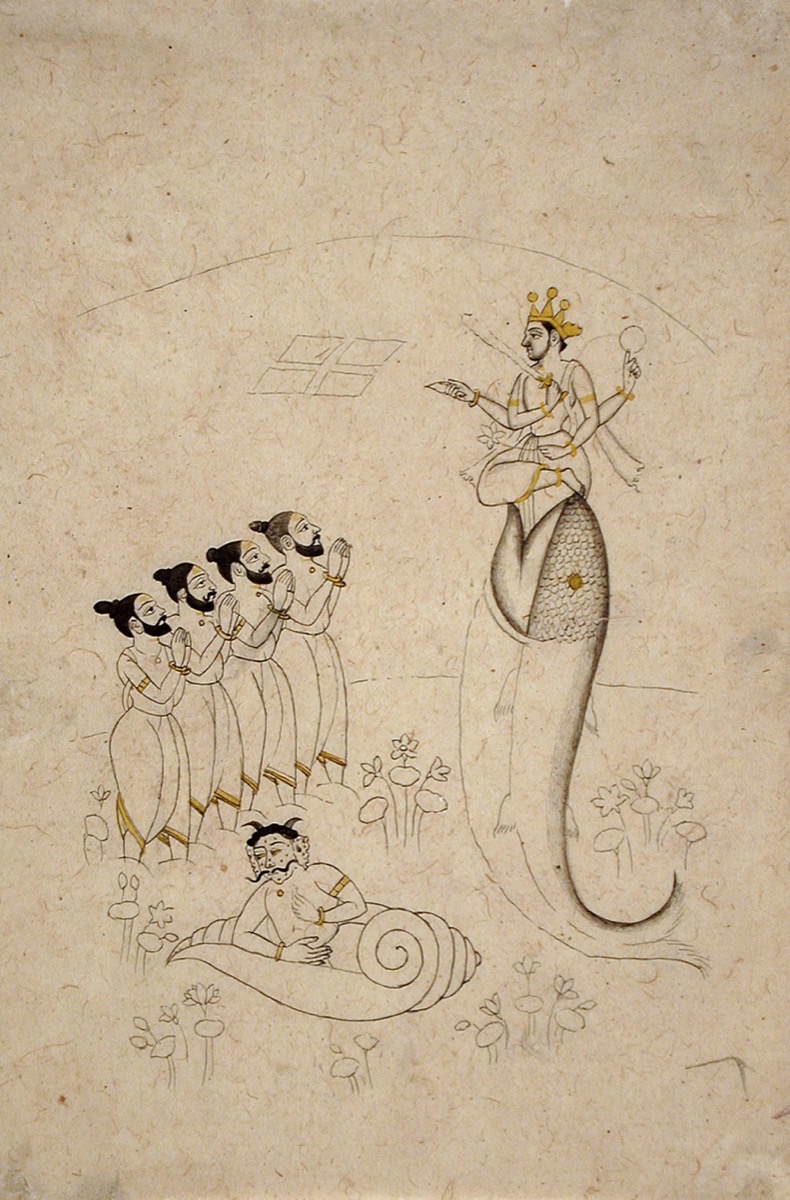
The Matsya Purāṇa — one of the eighteen major Mahāpurāṇas, containing approximately 14,000 verses across 291 chapters — introduces a dramatic additional element to the Matsya narrative: the rescue of the stolen Vedas from the demon Hayagrīva (WisdomLib, Matsya Purāṇa).
According to this account, at the end of the previous cosmic cycle, as Lord Brahmā grew drowsy at the close of his day, the sacred Vedas — the repositories of all divine knowledge — slipped from his mouth as he yawned. A powerful demon named Hayagrīva (“horse-necked”) seized the Vedas and plunged with them into the cosmic ocean, hiding in its depths. Without the Vedas, creation could not be renewed, for the Vedas contain the śabda-brahman — the sonic blueprint of the universe, the primordial vibrations from which all existence manifests.
It is important to distinguish this demon Hayagrīva from the deity Hayagrīva, who is a benevolent horse-headed avatāra of Viṣṇu himself, worshipped as a god of wisdom and learning. The demonic Hayagrīva of the Matsya Purāṇa is a daitya (a descendant of the primordial demon Diti) who stole sacred knowledge, whereas the divine Hayagrīva is an embodiment of Viṣṇu who restores it. Some scholars suggest that these two Hayagrīvas represent opposite sides of the same mythic archetype — knowledge stolen and knowledge restored.
Lord Viṣṇu incarnated as Matsya not only to save Manu and the sages but also to slay the demon Hayagrīva and recover the Vedas. After guiding Manu’s boat safely through the deluge, the divine fish dove into the cosmic deep, confronted the demon, slew him in battle, and retrieved the Vedas. He then restored the sacred texts to the awakening Brahmā, who could now recommence the work of creation with the full divine blueprint intact.
This narrative layer adds a profound theological dimension: the Matsya avatāra preserves not merely biological life but knowledge itself — the eternal wisdom without which existence is meaningless. Viṣṇu’s mission is not simply to save bodies but to save dharma, jñāna, and the cosmic order.
The Saptaṛṣis and the Seeds of All Life
A key element of the Matsya narrative, present in virtually all versions, is the preservation of the Saptaṛṣis — the seven primordial sages who serve as the conduits of Vedic wisdom across cosmic cycles. These sages — traditionally enumerated as Marīci, Atri, Aṅgiras, Pulastya, Pulaha, Kratu, and Vasiṣṭha — represent the living bearers of spiritual knowledge. By saving them alongside the Vedas, Viṣṇu ensures that sacred knowledge is preserved not merely as text but as a living tradition transmitted from teacher to student.
Equally significant is the command to preserve the seeds of all living beings (sarvauṣadhī-bīja) — grains, herbs, medicinal plants, and the genetic essence of all creatures. This element transforms the flood narrative from a story of individual salvation into a tale of cosmic conservation: the divine fish is the preserver of the entire biological heritage of creation. The boat of Manu becomes a floating ark of biodiversity, carrying the potential for all future life through the waters of annihilation.
Comparative Mythology: Flood Narratives Across Civilizations
The Matsya-Manu flood narrative belongs to a global family of flood myths that has fascinated scholars of comparative mythology since the nineteenth century. The most prominent parallels include (Wikipedia, “Flood myth”):
-
Sumerian tradition (c. 2600 BCE): The myth of Ziusudra, the pious king of Shuruppak, who is warned by the god Enki of an impending flood decreed by the divine assembly. Ziusudra builds a great boat and survives the seven-day deluge, after which he offers sacrifice and is granted immortality.
-
Babylonian/Akkadian tradition (c. 1800–1200 BCE): The Atrahasis epic and the flood episode in the Epic of Gilgamesh (Tablet XI), in which Utnapishtim is warned by the god Ea, builds an ark, and survives the flood sent by the god Enlil. After the waters recede, Utnapishtim offers sacrifice on a mountaintop.
-
Hebrew tradition: The narrative of Noah in the Book of Genesis (chapters 6–9), warning from God, construction of the ark, the preservation of animal pairs, the mountaintop landing on Ararat, and the post-flood covenant.
The striking structural parallels — divine warning to a righteous individual, construction of a vessel, preservation of life through a catastrophic flood, landing on a mountain, and post-flood renewal — have led scholars to propose various theories of relationship: common cultural ancestry, diffusion from a single source narrative, or independent responses to shared experiences of catastrophic flooding in river civilizations.
The Hindu Matsya narrative, however, possesses distinctive features that set it apart from its Near Eastern counterparts: the growth motif (the fish growing from palm-sized to cosmic proportions, symbolizing the expansion of divine grace), the cyclical cosmology (the flood is not a unique divine punishment but a recurring cosmic dissolution inherent in the structure of time), and the preservation of sacred knowledge (the Vedas, not merely biological life, are the primary objects of rescue). These elements ground the Matsya narrative firmly within Hindu philosophical frameworks of saṃsāra (cyclical existence), dharma (cosmic order), and avatāra (divine descent for the restoration of righteousness).
Iconography and Visual Tradition
The Classical Iconographic Forms
Matsya is depicted in Indian art in two principal forms (MAP Academy, “Matsya”):
-
Fully zoomorphic (complete fish form): A colossal golden fish, sometimes with a single prominent horn (śṛṅga) or tusk on its head — the horn to which Manu fastened his boat-rope. The fish is often shown with the boat roped to its horn, the sages seated within, and the cosmic waters swirling around. This form is favoured in earlier depictions and in miniature paintings.
-
Therianthropomorphic (half-fish, half-human form): The upper body of Viṣṇu — with four arms carrying His characteristic attributes (the cakra/discus, śaṅkha/conch, gadā/mace, and padma/lotus) and wearing a tall kirīṭa-mukuṭa (conical crown) and royal ornaments — mounted upon the lower body of a massive fish. This hybrid form emphasizes the divine identity within the animal form and became the standard iconographic type from the medieval period onward.
In both forms, Matsya is typically depicted as golden (suvarṇa), referencing the Bhāgavata Purāṇa’s description of the divine fish blazing with a golden radiance upon the dark waters of dissolution. The horn is a consistent feature, serving both as the practical anchor-point for Manu’s rope and as a symbolic crown — the mark of divine sovereignty even in an animal form.
Temple Art: Deogarh and Badami
The Dashavatara Temple at Deogarh (early 6th century CE, Gupta period), Lalitpur district, Uttar Pradesh, is one of the earliest surviving Hindu stone temples and contains sculptural panels depicting the complete daśāvatāra sequence along its friezes and plinth mouldings. The Matsya panel, though weathered, represents one of the oldest monumental depictions of the fish avatāra in Indian temple art (Wikipedia, “Dashavatara Temple, Deogarh”).
The Badami Cave Temples (6th century CE, early Chalukya dynasty) in Karnataka contain magnificent Vaiṣṇava sculptural panels. Cave 3, dedicated to Viṣṇu, includes representations of various avatāras. The Chalukya sculptors of Badami developed a powerful visual vocabulary for depicting Viṣṇu’s incarnations that influenced Deccan temple art for centuries.
Miniature Painting Traditions
The Matsya avatāra became a favourite subject of the Pahari (hill) miniature painting schools — particularly the Chamba, Basohli, and Kangra ateliers of Himachal Pradesh (17th–19th centuries). In these paintings, Matsya is typically shown in the hybrid half-human, half-fish form, set against vivid backgrounds of swirling cosmic waters, with the boat of Manu and the sages riding the storm above. The LACMA collection preserves a notable Chamba-style Matsya painting (c. 1700–1725) exemplifying this tradition.
Rajput and Mughal miniatures also frequently depict the complete daśāvatāra sequence, with Matsya occupying the first panel — a golden fish or fish-human hybrid, often accompanied by an inscription identifying the avatāra.
Theological Significance
Preservation Through Dissolution
The central theological message of the Matsya avatāra is that Viṣṇu preserves dharma and sacred knowledge even through the most catastrophic cosmic dissolution. The pralaya destroys the physical universe — the mountains, rivers, continents, and the structures of civilization are all swallowed by the cosmic waters. Yet through the agency of Matsya, the essential continuity of existence is maintained: the Vedas (eternal knowledge), the Saptaṛṣis (the living wisdom tradition), and the seeds of all life are carried safely through the darkness to emerge in the new creation.
This teaching addresses one of the deepest anxieties of human existence — the fear that knowledge, culture, and meaning can be permanently lost. The Matsya avatāra affirms that the Supreme Being is the ultimate guardian of dharma and jñāna, ensuring their survival across all cycles of time.
The Daśāvatāra Sequence and Evolutionary Symbolism
Matsya’s position as the first avatāra in the daśāvatāra sequence — followed by Kūrma (tortoise), Varāha (boar), Narasiṃha (man-lion), and Vāmana (dwarf) — has been noted by modern commentators as an extraordinary parallel to biological evolution: the progression from aquatic life (fish) to amphibian (tortoise) to terrestrial mammal (boar) to transitional form (man-lion) to fully human form (dwarf brāhmaṇa). While Hindu tradition understands this sequence theologically rather than biologically — as a progressive revelation of divine purpose — the parallel remains striking and has been discussed by scholars from the nineteenth century onward.
Compassion as the Foundation of the Cosmos
A subtle but profound element of the narrative is the role of compassion (karuṇā). In every version of the story, the future Manu first shows kindness to a small, helpless fish — rescuing it from predators, nurturing it as it grows. This act of selfless compassion is the foundation upon which the salvation of the entire cosmos rests. The theological implication is clear: dharma begins with compassion toward the vulnerable, and it is this compassion that invokes divine grace. The god saves humanity because a human first saved a fish.
Worship and Living Tradition
While standalone Matsya temples are relatively rare compared to temples dedicated to other avatāras, Matsya is invariably represented in Dashavatara panels found in Vaiṣṇava temples throughout India. The fish avatāra appears in the sculptural programmes of major temple complexes at Tirupati, Srirangam, Belur, Halebidu, and countless other sites.
Matsya Dvādaśī — the twelfth day (dvādaśī) of the bright fortnight of the month of Caitra (March–April) — is observed in some Vaiṣṇava traditions as the day commemorating the Matsya avatāra. On this day, devotees observe fasts, worship Viṣṇu in His fish form, and recite the Matsya narratives from the Purāṇas.
The Matsya Purāṇa itself, as a Mahāpurāṇa, remains an important text in Hindu religious life, consulted for its prescriptions on dharma, vrata (religious observances), dāna (charitable giving), temple construction, and sacred geography.
In the broad sweep of Hindu theology, Matsya stands as the inaugural statement of Viṣṇu’s perpetual promise: that whenever dharma is threatened — whether by cosmic dissolution, demonic aggression, or the entropy of time — the Lord will descend in whatever form is needed to preserve the righteous, protect the innocent, and ensure that the light of sacred knowledge is never extinguished. As the Bhāgavata Purāṇa (1.3.15) declares: “In the period of the first Manu, the Lord accepted the form of a fish and protected the earth, Vaivasvata Manu, from the great deluge.”