Introduction
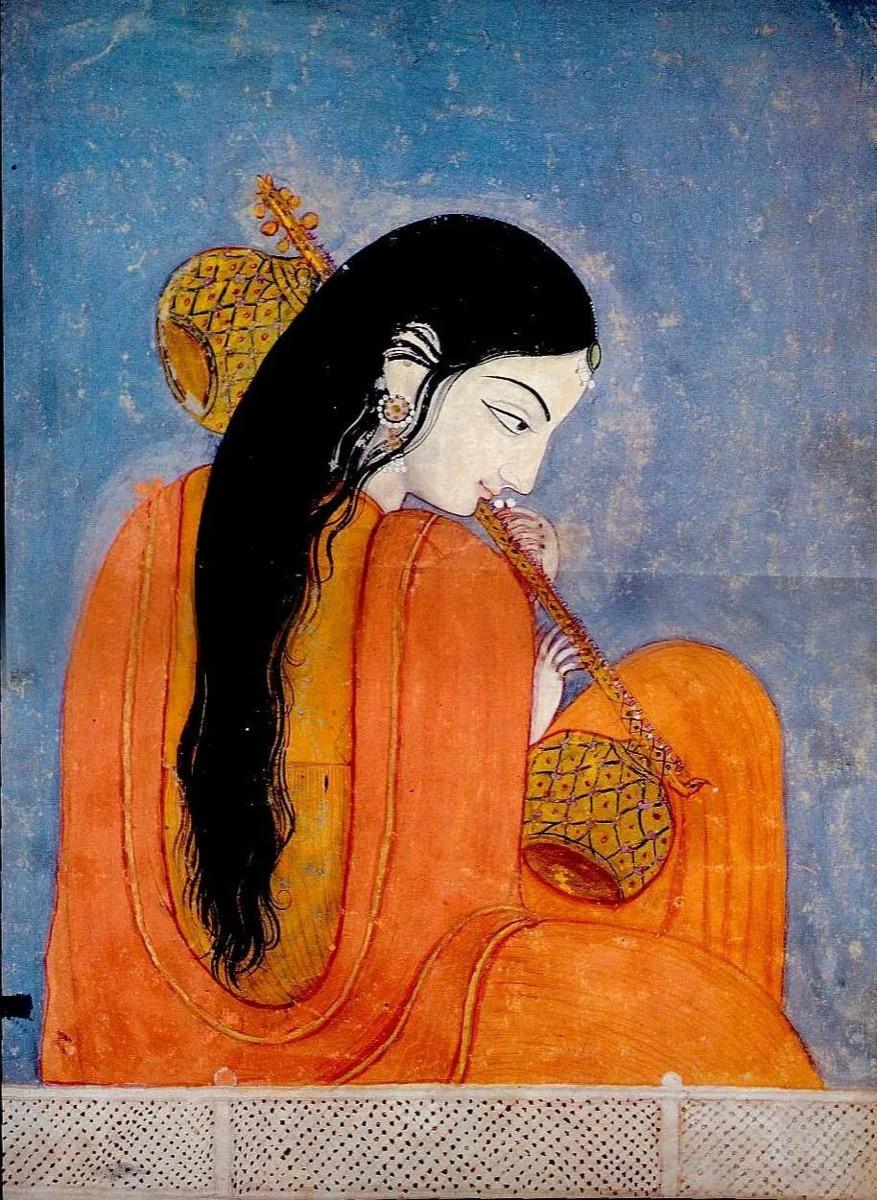
Mīrābāī (IAST: Mīrābāī; c. 1498–1547 CE), also spelt Meera Bai or Mira Bai, is among the most beloved and widely celebrated poet-saints in Indian history. A Rajput princess by birth, she renounced the comforts and obligations of royal life to pursue an all-consuming devotion (bhakti) to Lord Kṛṣṇa, whom she regarded as her true husband, her eternal beloved, and the sole refuge of her soul. Her passionate bhajans (devotional songs) — composed in Rajasthani and Braj Bhāṣā — have been sung across the Indian subcontinent for nearly five centuries, transcending barriers of language, caste, region, and sect.
The Poetry Foundation describes her as “the most famous of the women bhakta poets of north India,” and her compositions continue to occupy a central place in Hindu devotional music, Hindustani classical traditions, and the living memory of popular Hinduism (Poetry Foundation, “Mirabai”). More than 1,300 padas (lyric verses) are attributed to her, although scholars estimate that a smaller core of a few hundred can be traced with reasonable confidence to Mīrā herself (Britannica, “Mira Bai”). Regardless of exact attribution, the figure of Mīrā — the defiant princess singing ecstatically of divine love — has become an archetype of unconditional devotion in the Indian spiritual imagination.
Early Life and Family
Mīrābāī was born around 1498 CE in the Rāṭhore Rajput stronghold of Mertā (or the nearby village of Kuḍkī) in the Mārwār region of Rajasthan. She was the daughter of Ratan Singh Rāṭhore and the granddaughter of Rāo Dūdājī, the founder and ruler of Mertā. Her family belonged to the distinguished Rāṭhore clan, one of the most prominent Rajput lineages of medieval Rajasthan (Encyclopedia.com, “Mira Bai 1498–1547”).
Mīrā’s mother died when she was young, and she was raised largely by her grandfather Dūdājī, a devout Vaiṣṇava. Traditional hagiographies recount that even as a small child, Mīrā displayed an intense attachment to Kṛṣṇa. A well-known legend describes the young Mīrā watching a wedding procession pass by and asking her mother who her bridegroom would be; her mother, in a playful moment, pointed to an image of Lord Kṛṣṇa and said, “This is your bridegroom.” Mīrā took these words literally and, from that day forward, considered Kṛṣṇa her divine husband — a conviction she carried throughout her life (Wikipedia, “Mirabai”).
Growing up in the cultured atmosphere of the Mertā court, Mīrā received an education that included music, religion, and the devotional literature of the Vaiṣṇava tradition. This early exposure to both spiritual learning and the arts laid the foundation for her later career as one of India’s supreme lyric poets.
Marriage and the Court of Mewār
In 1516, Mīrā was married in a political alliance to Bhoj Rāj, the crown prince of Mewār and eldest son of the legendary Rāṇā Saṅgā (Rāṇā Sāṅgā) of Chittorgarh. The Mewār dynasty was among the most powerful Rajput kingdoms, and the marriage was intended to cement ties between the Rāṭhore and Sisodiyā clans.
Bhoj Rāj was wounded in the ongoing wars between the Rajput confederacy and the Delhi Sultanate — likely during the campaigns against Ibrāhīm Lodī — and died of his injuries in 1521, leaving Mīrā a widow at approximately twenty-three years of age (Britannica, “Mira Bai”). In the rigid patriarchal world of Rajput nobility, a young widow was expected to observe strict seclusion, practice austerities, and ultimately submit to the authority of her husband’s family. Mīrā, however, chose a radically different path.
Defiance of Social Conventions
Following her husband’s death, Mīrā refused to perform satī (self-immolation on the husband’s funeral pyre), declined to observe the severe restrictions expected of a Rajput widow, and instead devoted herself entirely to the worship of Kṛṣṇa. She spent her days in her private temple, singing bhajans, receiving sādhus (holy men) and pilgrims — including people of lower castes — and dancing in ecstatic devotion. This behaviour scandalised the Mewār court.
Her defiance was not merely personal but profoundly political and social. By refusing to accept the authority of her in-laws, by mixing freely with saints of all castes, and by publicly declaring Kṛṣṇa — rather than any earthly lord — as her true master, Mīrā challenged the foundational structures of Rajput patriarchy, caste hierarchy, and royal honour (kula-maryādā).
Traditional narratives describe multiple attempts by her in-laws to silence or kill her. The most famous legends recount that Rāṇā Vikram Singh (who succeeded Rāṇā Sāṅgā) sent her a cup of poison, declaring it sacred nectar (caraṇāmṛta); Mīrā drank it while chanting Kṛṣṇa’s name and was unharmed. In another episode, a basket containing a venomous snake was sent to her, but when she opened it, she found a śālagrāma (sacred stone of Viṣṇu) inside. While modern historians note that the earliest surviving sources about Mīrā (dating to the 17th century) do not confirm these specific episodes, the legends powerfully illustrate the tradition’s understanding of her as a saint whose devotion rendered worldly threats impotent (Wikipedia, “Mirabai”; Encyclopedia.com).
Guru and Spiritual Lineage
Mīrā is traditionally regarded as a disciple of Sant Raidās (Ravidās), the great leather-worker saint of Varanasi who was himself a disciple of Svāmī Rāmānanda. If this connection is historical — and several textual traditions affirm it — it is profoundly significant: a Rajput princess accepting a low-caste cobbler-saint as her spiritual preceptor was an act of radical social transgression that embodied the Bhakti movement’s egalitarian ideals.
In her own verses, Mīrā repeatedly invokes Raidās as her guru:
Guru miliyā Raidāsa jī, dīnhī gyān kī gutakī — “I met my Guru Raidāsa, who gave me the treasure of knowledge.”
A later tradition also connects Mīrā with Tulsīdās, the author of the Rāmacaritamānasa. According to this account, when Mīrā wrote to Tulsīdās seeking counsel about her family’s opposition, the poet-saint replied advising her to abandon those who cannot understand devotion to God and to seek the company of saints. While the historical veracity of this correspondence is debated, it reflects how later tradition wove Mīrā into the broader network of Bhakti saints (ETV Bharat, “Guru Ravidas Jayanti”).
Devotional Poetry: Themes and Style
Mīrā’s poems are composed primarily in Rajasthani and Braj Bhāṣā, the literary lingua franca of North Indian devotional poetry. They are lyric padas set to specific rāgas (melodic modes), designed to be sung rather than merely read. This musical quality is intrinsic to their power — Mīrā’s verses have been carried through the centuries not on the page but on the voice.
The Divine Beloved
The central motif of Mīrā’s poetry is madhura bhakti — the sweetness of a lover’s devotion to the beloved. Kṛṣṇa appears in her verses under many names: Giridhara Gopāla (the cowherd who lifted the mountain), Giridhara Nāgara (the clever mountain-holder), Hari, Govinda, Mādhava. Mīrā addresses him as her husband, her lord, and her very life-breath:
Mere to Giridhar Gopāl, dūsarā na koī — “Mine is Giridhar Gopal, there is no other.”
This famous opening line of perhaps her best-known bhajan is a declaration of absolute, exclusive devotion. The divine marriage (divya vivāha) with Kṛṣṇa is not metaphor for Mīrā — it is her lived reality, more real than any earthly bond.
Separation and Longing
Equally powerful is Mīrā’s expression of viraha — the agony of separation from the beloved. Drawing on the conventions of Rajasthani love poetry and the viraha-pada tradition, she gives voice to a longing so intense that it becomes a form of spiritual practice:
Mero dard na jāṇe koī — “No one knows my pain.”
Her viraha poems describe sleepless nights, tear-soaked pillows, the body wasting with longing, the mockery of the world — and through it all, an unshakeable certainty that the beloved will come.
Renunciation and Fearlessness
A third major strand is Mīrā’s fearless rejection of worldly ties and social expectations. She sings of having drunk the cup of divine love and caring nothing for the consequences:
Rāṇā jī, mhāro rāṁ ratan dhan pāyo — “O Rana, I have found the treasure of Ram’s name.”
In the celebrated bhajan “Pag Ghuṅghrū Bāndh Mīrā Nācī Re” (“Mīrā danced with bells on her feet”), she proclaims her ecstatic dancing in the public square, heedless of censure. These poems are acts of social defiance set to music.
Key Compositions
Among the bhajans most widely attributed to Mīrā and still sung across India are:
- “Mere to Giridhar Gopāl” — The quintessential declaration of devotion to Kṛṣṇa as divine husband
- “Pāyojī Maine Rām Ratan Dhan Pāyo” — A joyful celebration of having received the wealth of God’s name
- “Pag Ghuṅghrū Bāndh Mīrā Nācī Re” — The ecstatic dance of the devotee, defying social shame
- “Hari Tum Haro Jan Kī Pīr” — A plea to Kṛṣṇa to remove the suffering of his devotees
- “Mero Dard Na Jāṇe Koī” — The anguished cry of separation from the divine beloved
- “Bāī Rī, Main Govind Liyā Mol” — “O sister, I have purchased Govinda” — devotion as the ultimate transaction
Later Life: Vrindāvan and Dvārakā
Unable or unwilling to remain in the hostile atmosphere of the Mewār court, Mīrā eventually left Chittorgarh and embarked on a life of pilgrimage. Tradition places her in two of the most sacred sites associated with Kṛṣṇa: Vṛndāvan, the forest of Kṛṣṇa’s youthful līlā (divine play) in the Braj region of Uttar Pradesh; and Dvārakā, the legendary kingdom of Kṛṣṇa on the coast of Gujarat.
In Vṛndāvan, Mīrā is said to have sought the company of the great Vaiṣṇava teacher Jīva Gosvāmī (or, in some accounts, Rūpa Gosvāmī). A famous story recounts that Jīva initially refused to meet her because she was a woman and he had taken a vow not to see women; Mīrā replied that in Vṛndāvan, Kṛṣṇa alone is male and all souls are female (gopīs), humbling the scholar (Encyclopedia.com).
Mīrā’s final years are traditionally placed at Dvārakā, the seat of Kṛṣṇa’s Ranchoḍjī temple on the Saurashtra coast. Here, the most celebrated legend of her death unfolds: while singing before the image of Kṛṣṇa in the Raṇachoḍ temple, Mīrā merged bodily into the idol, disappearing from the physical world. This account, usually dated to approximately 1547 CE, mirrors the Indian hagiographic motif of the saint’s final union with the divine — the ultimate fulfilment of the longing that animated her entire life (Britannica; Wikipedia).
Mīrā and the Bhakti Movement
Mīrābāī lived during the high tide of the North Indian Bhakti movement, a vast, multi-lingual spiritual upheaval that swept across the subcontinent from roughly the 12th to the 17th centuries. The movement emphasised personal, emotional devotion to God over ritualism, priestly mediation, caste hierarchy, and scholastic learning. Its saints — Kabīr, Tulsīdās, Sūrdās, Raidās, Nāmdev, and many others — composed in vernacular languages and addressed their poetry to all people regardless of social station.
Within this constellation, Mīrā occupies a unique position. She is the most prominent female voice of the North Indian Bhakti tradition, and her poetry is distinguished by its intensely personal, autobiographical quality. Where other Bhakti saints often speak in universal or philosophical terms, Mīrā narrates her own story — her marriage to Kṛṣṇa, her conflict with her in-laws, her wandering, her longing. This fusion of the personal and the devotional gives her verses an immediacy and emotional power that have made them accessible across centuries and cultures (ResearchGate, “On the Poetry of Mirabai”).
Mīrā also embodies the Bhakti movement’s challenge to social hierarchy. As a high-born Rajput woman who accepted a low-caste guru, sang and danced in public, consorted with wandering saints, and refused the authority of kings, she enacted in her own life the egalitarian principles that the movement preached. Her example has been invoked by reformers, feminists, and social activists in every subsequent generation.
Literary and Musical Legacy
Mīrā’s bhajans form a living tradition. They are sung today in temples, homes, concerts, and films across India. Major Hindustani classical vocalists — including M. S. Subbulakshmi, Kishori Amonkar, and Pandit Jasraj — have performed her compositions, while Bollywood has returned to her songs repeatedly. The 1979 film Meera (starring Hema Malini) and numerous television serials have brought her story to mass audiences.
In the literary sphere, Mīrā’s verses have been translated into English by distinguished poets and scholars, including Robert Bly and Jane Hirshfield (Mirabai: Ecstatic Poems, 2004), Andrew Schelling (For Love of the Dark One, 1993), and A. J. Alston (The Devotional Poems of Mirabai, 1980). These translations have introduced Mīrā to global audiences and placed her in the company of other great mystical poets such as Rūmī, Ḥāfiẓ, and John of the Cross.
Scholarly interest in Mīrā has grown significantly since the late 20th century. Nancy M. Martin, John Stratton Hawley, and Parita Mukta have produced major studies situating Mīrā’s poetry in its historical, social, and literary contexts. The Chapman University monograph Rajasthan: Mirabai and her Poetry offers a sustained literary and theological analysis of her work (Chapman Digital Commons).
Mīrā in Indian Cultural Memory
Beyond literature and music, Mīrābāī has become a symbol in Indian cultural consciousness. She is invoked as an exemplar of women’s courage and spiritual independence, a proto-feminist who refused to accept the confinement imposed on her by patriarchal structures. Mahātmā Gandhi admired her deeply and cited her as a model of non-violent resistance through devotion. The Indian government has honoured her with postage stamps, and institutions across Rajasthan bear her name.
For the Rajasthani people, Mīrā is a source of immense cultural pride — the princess who chose God over crown, who sang when the world demanded silence, and whose voice has outlasted every kingdom that tried to suppress it.
Conclusion
Mīrābāī’s life and poetry represent one of the most powerful expressions of bhakti in the entire Hindu tradition. In a society that demanded obedience, she offered only love — love for Giridhara Gopāla, so total and so fearless that it shattered the conventions of caste, gender, and royal authority. Her bhajans, sung in the lyric beauty of Rajasthani and Braj Bhāṣā, have carried that love across five centuries, from the courts of Mewār to concert halls in New York, from village temples to the digital streams of the modern world.
As she herself sang: Mere to Giridhar Gopāl, dūsarā na koī — “Mine is Giridhar Gopal, there is no other.” In those words lives the essence of Mīrā: a soul that found its home in the divine and never looked back.