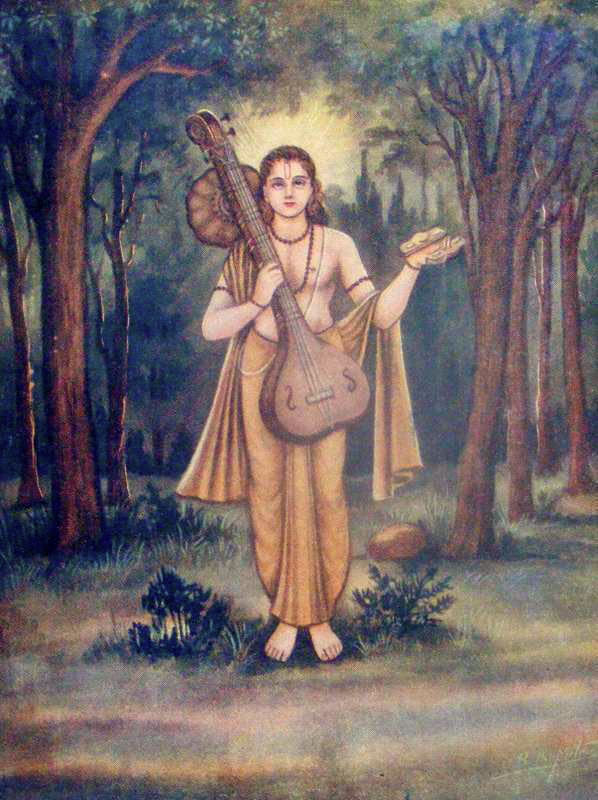
Devarṣi Nārada (नारद, “Giver of Wisdom”), also known as Nārada Muni, is one of the most beloved and ubiquitous figures in Hindu scripture. He is the cosmic wanderer who traverses the three worlds — heaven, earth, and the netherworld — with his vīṇā (stringed instrument) in hand, ceaselessly chanting “Nārāyaṇa, Nārāyaṇa.” Part sage, part musician, part storyteller, and part divine provocateur, Nārada serves as the essential link between gods and humans, catalyst of countless Purāṇic narratives, and the supreme exemplar of bhakti (devotion) to Lord Viṣṇu.
Birth and Origin
The accounts of Nārada’s birth vary across different scriptures, reflecting the multiple dimensions of his divine personality.
The Bhāgavata Account
According to the Bhāgavata Purāṇa (1.5-6), in a previous birth, Nārada was the son of a maidservant who served wandering sages during the Cāturmāsya (four-month rainy retreat). The young boy attended to the sages with devotion, ate their leftover food, and listened intently to their discourses on the glories of Lord Viṣṇu. When the sages departed, they blessed him with spiritual knowledge.
After his mother died from a snakebite, the boy wandered alone into the forest. Meditating on the form of the Lord he had heard described, he had a momentary vision of Viṣṇu within his heart — a vision so overwhelming and blissful that when it vanished, he was left in a state of intense longing. A divine voice then told him (Bhāgavata Purāṇa 1.6.22-23):
“You have been granted this brief vision so that your desire to see Me will grow ever stronger. This longing will purify you of all material attachment, and at the end of this life, you will attain My eternal abode.”
At death, the boy was reborn as Nārada, a mind-born son (mānasa-putra) of Lord Brahmā, with full divine consciousness and eternal freedom to roam all worlds.
The Brahmā Connection
In another tradition, Nārada is simply listed as one of the Prajāpatis — the mind-born sons of Brahmā created at the dawn of the universe. The Viṣṇu Purāṇa (1.7) and the Mahābhārata both acknowledge him as a Brahmā-putra (son of Brahmā), placing him among the foremost of the divine sages alongside Sanaka, Sanandana, Sanātana, and Sanat-kumāra.
The Inventor of the Vīṇā and Celestial Music
Nārada holds the honored title of being the inventor of the vīṇā — the ancient stringed instrument that is foundational to Indian classical music. His instrument is specifically called the mahati vīṇā or sometimes the Nārada vīṇā.
In Hindu tradition, music is not mere entertainment but a spiritual discipline — a form of nāda-yoga (the yoga of sacred sound). Nārada is considered the first musician, and through his constant singing of the Lord’s glories, he demonstrates that music is the highest form of worship. The Nārada Śikṣā, a text on Vedic phonetics attributed to him, discusses the sacred dimensions of sound.
The Saṅgīta Makarandha, an important medieval text on Indian music theory, credits Nārada as the originator of the musical system. He is the patron deity of musicians and is invoked at the beginning of musical performances in many traditions.
His constant companions are his vīṇā and his karatāla (small hand cymbals), with which he accompanies his devotional singing as he wanders through the cosmos.
The Nārada Bhakti Sūtras
Among Nārada’s greatest contributions to Hindu philosophical literature are the Nārada Bhakti Sūtras — eighty-four aphorisms that constitute one of the most important texts on devotional love in the entire Hindu canon.
The text defines bhakti in its opening sūtra (1.2): “Sā tvasmin paramapremārūpā” — “That (bhakti) is of the nature of supreme love for Him (God).” Nārada proceeds to describe:
- The Nature of Bhakti: Supreme love that is self-sufficient and needs no external validation (Sūtra 5: “Having obtained which, a person desires nothing else, grieves for nothing, hates nothing, delights not in anything mundane, and makes no effort for selfish ends”)
- The Path of Devotion: Surrender of all actions to God, and extreme anguish when one forgets the Divine (Sūtra 19)
- Forms of Love: Nārada describes eleven forms of bhakti (Sūtras 82), including love of the Lord’s qualities (guṇa-māhātmya), love of His form (rūpa), love of His worship (pūjā), love of constant remembrance (smaraṇa), love of servitude (dāsya), love as friendship (sakhya), love as a parent (vātsalya), love as a beloved (kānta), love of complete self-surrender (ātma-nivedana), love of being absorbed in Him (tanmaya), and love of the pain of separation (parama-virahā)
- Superiority of Bhakti: Nārada declares bhakti superior to both karma (action) and jñāna (knowledge) as a means of liberation
The Nārada Bhakti Sūtras profoundly influenced later Vaiṣṇava movements, including the Gauḍīya Vaiṣṇava tradition of Caitanya Mahāprabhu and the Puṣṭimārga of Vallabhācārya.
The Nārada Purāṇa
The Nārada Purāṇa (also called the Nāradīya Purāṇa) is one of the eighteen Mahāpurāṇas, attributed to Nārada’s discourses. It is unique among the Purāṇas for its encyclopedic character — it not only narrates mythology but also provides summaries of the other seventeen Purāṇas, making it a meta-text of the entire Purāṇic tradition.
The text is divided into two parts: the Pūrva-bhāga (first part) of 125 chapters and the Uttara-bhāga (latter part) of 82 chapters. It covers a vast range of topics including cosmology, grammar, dharma, astrology, pilgrimage sites, and the supreme importance of devotion to Viṣṇu.
Nārada’s Role in Purāṇic Narratives
No sage appears in as many stories across as many texts as Nārada. His interventions serve as the catalytic sparks that ignite some of the most important events in Hindu mythology.
The Curse of Dakṣa
In the Bhāgavata Purāṇa (6.5), the Prajāpati Dakṣa asked his ten thousand sons (the Haryaśvas) to populate the universe. Nārada appeared before them and through philosophical discourse convinced them that they should first understand the nature of the universe before creating progeny. They departed on a quest for spiritual truth and never returned. When Dakṣa produced another thousand sons (the Śabalāśvas), Nārada repeated his intervention. Furious, Dakṣa cursed Nārada: “You shall never stay in one place!” — which, ironically, became Nārada’s greatest blessing, allowing him to wander freely through all worlds as the eternal cosmic messenger.
Prahlāda’s Devotion
One of Nārada’s most significant interventions was teaching devotion to the unborn Prahlāda while the child was still in his mother Kayādhū’s womb (Bhāgavata Purāṇa 7.7.1-15). This instruction planted the seed of unwavering Viṣṇu-bhakti that led to the dramatic appearance of the Narasiṃha avatāra.
The Story of Dhruva
Young Dhruva, rejected by his father King Uttānapāda, set out to find God. It was Nārada who intercepted the boy, tested his resolve, and upon finding it unshakeable, taught him the meditation on the mantra “Om Namo Bhagavate Vāsudevāya” that led Dhruva to direct communion with Viṣṇu and his elevation to the Pole Star (Bhāgavata Purāṇa 4.8-9).
The Salvation of the Hunter (Mṛgāri)
The Padma Purāṇa narrates how Nārada encountered a hunter named Mṛgāri who was torturing animals by half-killing them. Through compassionate persuasion, Nārada converted the cruel hunter into a devotee of Viṣṇu, demonstrating that bhakti is available to all regardless of occupation or past sins.
The Divine Trickster
Nārada is not merely a solemn preacher — he is famously known as the kalaha-priya (“lover of disputes”). His apparent mischief-making always serves a higher purpose, setting in motion events necessary for the unfolding of divine plans.
He would carry news from one deity to another, often embellishing details in ways that provoked reactions — but invariably, these provocations led to righteous outcomes. For instance, in the Bhāgavata Purāṇa, it is often Nārada who informs the gods of impending dangers, who alerts sages to the activities of demons, and who creates the conditions for divine intervention.
The Skanda Purāṇa contains stories where Nārada’s apparent gossip leads to marriages, conflicts, and resolutions that fulfill cosmic destiny. His trickster nature is never malicious but always pedagogical — he uses drama and provocation as teaching tools.
Nārada in the Mahābhārata
In the Mahābhārata, Nārada appears as a respected counselor at the court of the Pāṇḍavas. His most important intervention occurs in the Sabhā Parva (Chapters 5-12), where he visits Yudhiṣṭhira’s newly established court and narrates the story of the Rājasūya sacrifice, warning Yudhiṣṭhira of the dangers of royal ambition.
He also tells the cautionary tale of Sage Aṣṭāvakra and describes the glories of the celestial courts to the assembled kings. Throughout the epic, Nārada functions as the voice of wisdom, offering perspective from one who has witnessed countless cosmic cycles.
Nārada’s Universal Compassion
What distinguishes Nārada from other celestial sages is his universal accessibility. He does not discriminate between high and low, divine and demonic, learned and ignorant. He teaches the Bhāgavata to Vyāsa, but he also converts a common hunter. He advises kings, but he also comforts abandoned children.
The Bhāgavata Purāṇa (1.5.23-24) records his teaching to Vyāsa:
“The Supreme Lord’s glories are the remedy for all the world’s suffering. O sage, you have described dharma, artha, kāma, and mokṣa, but you have not sufficiently glorified the Supreme Personality of Godhead. This is why your heart is not satisfied.”
This instruction prompted Vyāsa to compose the Bhāgavata Purāṇa itself, making Nārada the indirect author of one of Hinduism’s most beloved scriptures.
Iconography and Worship
Nārada is typically depicted as a slim, ascetic figure with a topknot, carrying his vīṇā in one hand and karatāla or japamālā (prayer beads) in the other. He is usually shown standing or walking, reflecting his nature as an eternal wanderer. His expression is often one of serene joy — the face of one perpetually immersed in divine love.
While there are no major temples dedicated exclusively to Nārada, he is worshipped as part of Vaiṣṇava traditions, especially during Nārada Jayantī, celebrated on the first day (Pratipada) of the bright half of the month of Vaiśākha. He is invoked by musicians before performances, by devotees seeking spiritual guidance, and by those who wish for the obstacles in their lives to lead to higher outcomes.
Philosophical Significance
Nārada embodies several key principles of Hindu thought:
Bhakti as the Highest Path: Through his Bhakti Sūtras and his lived example, Nārada teaches that pure devotional love surpasses all other spiritual attainments.
The Power of Saṅga (Association): His own spiritual awakening came through associating with sages as a child. He in turn transforms everyone he encounters — demonstrating that spiritual progress happens through connection with the divine and with divine beings.
Joyful Renunciation: Unlike austere ascetics, Nārada’s renunciation is joyful. He has given up everything worldly but is not grim or severe — he sings, dances, plays music, and radiates happiness. He models spirituality as celebration, not deprivation.
Communication as Sacred Service: As the cosmic messenger, Nārada shows that carrying wisdom from one being to another — connecting people with truth — is itself a sacred act. In an age of information, his example reminds us that what we communicate matters profoundly.
For devotees across all Hindu traditions, the cry of “Nārāyaṇa, Nārāyaṇa!” evokes the joyful figure of Nārada — the eternal wanderer whose vīṇā sings of nothing but the glory of the Divine, whose apparent mischief is always in service of cosmic truth, and whose example teaches that the highest wisdom is inseparable from the deepest love.