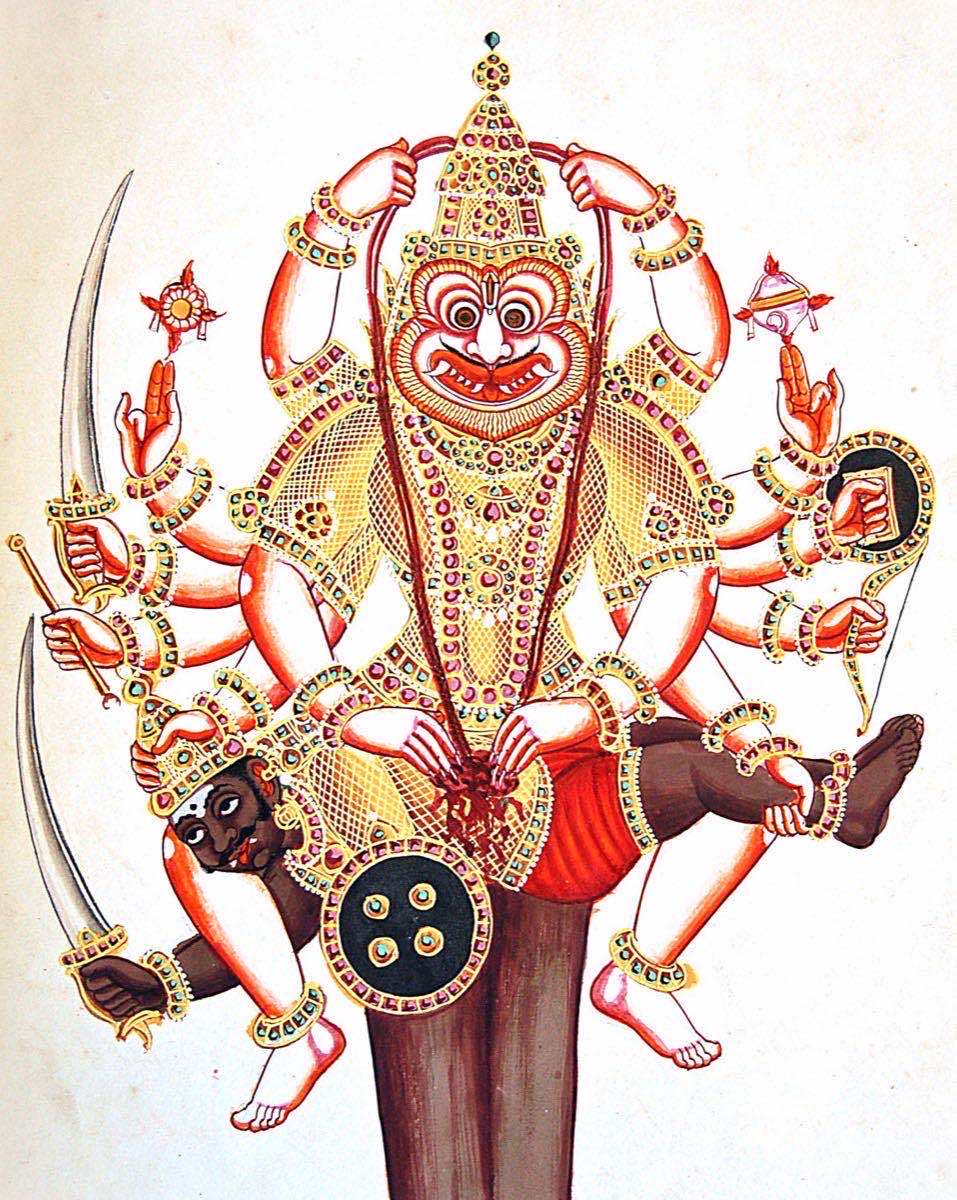
Lord Narasiṃha (नरसिंह, “Man-Lion”), also known as Nṛsiṃha, is the fourth of the Daśāvatāra — the ten principal incarnations of Lord Viṣṇu. In this extraordinary form, the Supreme Lord manifested as half-man (nara) and half-lion (siṃha) to vanquish the tyrannical demon king Hiraṇyakaśipu and rescue his devoted son Prahlāda. Narasiṃha is celebrated across Hindu traditions as the fierce protector of the faithful, the destroyer of arrogance, and the embodiment of divine justice that transcends all worldly limitations.
The Origin: Hiraṇyakaśipu’s Boon
The story of Narasiṃha is inseparable from the tale of Hiraṇyakaśipu, a powerful asura (demon) king. Hiraṇyakaśipu was the elder brother of Hiraṇyākṣa, who had been slain by Lord Viṣṇu in the Varāha (Boar) avatar. Consumed by grief and burning with rage against Viṣṇu, Hiraṇyakaśipu undertook severe penances on Mount Mandara to propitiate Lord Brahmā.
His tapas (austerity) was so intense that it shook the three worlds. Pleased by this extraordinary penance, Brahmā appeared before him. Hiraṇyakaśipu, cunning and ambitious, requested a boon of invincibility. Though Brahmā could not grant absolute immortality, Hiraṇyakaśipu crafted a boon of extraordinary conditions:
- He could not be killed by any human, deva, or animal
- He could not be killed indoors or outdoors
- He could not be killed during the day or at night
- He could not be killed on earth or in the sky
- He could not be killed by any weapon, whether astra (projectile) or śastra (handheld)
Armed with what he believed to be impenetrable protection, Hiraṇyakaśipu conquered the three worlds, expelled the devas from Svarga (heaven), and declared himself the Supreme Lord, demanding that all beings worship him alone.
Prahlāda: The Unshakeable Devotee
In a profound twist of divine irony, Hiraṇyakaśipu’s own son, Prahlāda, became the most ardent devotee of Lord Viṣṇu. Even while still in his mother Kayādhū’s womb, Prahlāda had received spiritual instruction from the sage Nārada, who taught him about the supremacy of Viṣṇu and the path of bhakti (devotion).
As described in the Bhāgavata Purāṇa (Canto 7, Chapters 4-9), Prahlāda’s devotion was absolute and unwavering. Despite being raised in an asura household, the child spoke constantly of Viṣṇu’s glory. He taught his fellow students the nine forms of bhakti:
- Śravaṇam — hearing about the Lord
- Kīrtanam — chanting the Lord’s names and glories
- Smaraṇam — remembering the Lord
- Pāda-sevanam — serving the Lord’s feet
- Arcanam — worshipping the Lord
- Vandanam — offering prayers
- Dāsyam — serving as the Lord’s servant
- Sakhyam — cultivating friendship with the Lord
- Ātma-nivedanam — complete self-surrender
Hiraṇyakaśipu was enraged by his son’s devotion. He ordered his teachers, Ṣaṇḍa and Amarka, to correct the boy, but Prahlāda’s faith could not be shaken. The demon king then subjected his son to a series of terrifying punishments: he had Prahlāda thrown from a cliff, trampled by elephants, cast into a pit of venomous serpents, poisoned, submerged in the ocean, and placed in a blazing fire by his aunt Holikā. Yet through each trial, Prahlāda emerged unharmed, his devotion to Viṣṇu only growing stronger.
The Manifestation of Narasiṃha
The climactic confrontation, narrated in Bhāgavata Purāṇa 7.8, is one of the most dramatic episodes in all of Hindu scripture. In a final confrontation, Hiraṇyakaśipu challenged Prahlāda: “Where is this Viṣṇu of yours? Is he in this pillar?”
Prahlāda replied with serene confidence: “He is in the pillar, and He is outside the pillar. He is everywhere.”
In a fury, Hiraṇyakaśipu struck the pillar with his mace. With a terrifying roar that shook the cosmos, Lord Narasiṃha burst forth from within the pillar — neither fully man nor fully beast, but a magnificent, awe-inspiring form with the torso and lower body of a man and the face and claws of a lion.
The Lord systematically fulfilled every condition of Brahmā’s boon:
- Neither man nor animal: He appeared as half-man, half-lion
- Neither indoors nor outdoors: He dragged Hiraṇyakaśipu to the threshold of the palace doorway
- Neither day nor night: The event occurred at twilight (sandhyā-kāla)
- Neither on earth nor in the sky: He placed Hiraṇyakaśipu across his lap
- Not by any weapon: He tore the demon apart with his bare claws
With Hiraṇyakaśipu thus slain, the heavens resounded with celebration. Yet Narasiṃha’s fury did not immediately subside. None among the devas — not Brahmā, not Śiva, not even Lakṣmī — could approach the blazing form. It was young Prahlāda who stepped forward and offered prayers of devotion (the Prahlāda Stuti), whereupon the Lord’s wrath was pacified. Narasiṃha placed Prahlāda upon his lap and blessed him.
Symbolism and Philosophical Significance
The Narasiṃha avatāra carries profound layers of meaning that Hindu philosophers and devotees have contemplated for millennia.
The Omnipresence of the Divine
When Prahlāda declares that Viṣṇu is present even within a pillar, and the Lord then emerges from that very pillar, it powerfully demonstrates the Vedāntic teaching that Brahman (the Absolute) pervades all of existence. As the Īśāvāsya Upaniṣad (1.1) declares: “Whatever exists in this universe is enveloped by the Lord.”
The Destruction of Ego
Hiraṇyakaśipu represents ahaṃkāra (ego) at its most extreme. His boon made him believe he had conquered even death itself. Narasiṃha’s appearance teaches that no matter how cleverly one constructs defenses for the ego, divine truth will find a way through. The demon’s elaborate conditions were not circumvented but transcended — the Lord found a form that existed in the spaces between all of Hiraṇyakaśipu’s categories.
The Power of Devotion
Prahlāda’s story illustrates that sincere bhakti can withstand any trial. A child, powerless by worldly standards, proved stronger than the mightiest asura because his strength came not from physical might but from unwavering faith. The Bhāgavata Purāṇa (7.9.19) records Prahlāda’s words: “My dear Lord, I am not afraid of the fearful Lord Narasiṃha; I am afraid of the cycle of birth and death.”
Balance of Ferocity and Compassion
Narasiṃha embodies the principle that divine love is not merely gentle — it can manifest as fierce, protective wrath when devotees are threatened. The same Lord who terrified the entire cosmic assembly was instantly pacified by the touch and prayers of a child devotee. This paradox — supreme ferocity and supreme tenderness in one being — is a hallmark of the Narasiṃha theology.
Scriptural Sources
The Narasiṃha narrative appears across multiple Hindu scriptures:
- Bhāgavata Purāṇa (Canto 7, Chapters 1-10): The most detailed and beloved account, including Prahlāda’s philosophical teachings and the dramatic emergence from the pillar
- Viṣṇu Purāṇa (Book 1, Chapters 17-20): An earlier account focusing on the narrative arc
- Narasiṃha Purāṇa: A dedicated Upa-Purāṇa (minor Purāṇa) of 68 chapters devoted entirely to this avatāra
- Agni Purāṇa and Padma Purāṇa: Contain supplementary accounts
- Ahirbudhnya Saṃhitā and other Pāñcarātra texts: Describe various forms and worship procedures
Sacred Forms of Narasiṃha
Hindu iconography recognizes numerous forms of Narasiṃha, each representing a different aspect of the divine:
- Ugra Narasiṃha: The fierce form in the act of slaying Hiraṇyakaśipu
- Yoga Narasiṃha: The meditative form, seated in yogic posture
- Lakṣmī Narasiṃha: The gentle form, seated with Goddess Lakṣmī on his lap
- Stambha Narasiṃha: Emerging from the pillar
- Sudarśana Narasiṃha: Holding the Sudarśana Cakra prominently
- Prahlāda Varada Narasiṃha: Blessing Prahlāda after the battle
Temples and Worship
Narasiṃha worship is widespread across India, with particularly strong traditions in Andhra Pradesh, Telangana, and Karnataka.
Ahobilam (Andhra Pradesh)
The most important Narasiṃha pilgrimage centre is Ahobilam in Nandyal district, Andhra Pradesh. This sacred complex houses the Nava Narasiṃha — nine temples dedicated to nine different forms of Narasiṃha, spread between Upper Ahobilam (in a steep gorge) and Lower Ahobilam. It is one of the 108 Divya Desams, canonized by the 9th-century Tamil saint Thirumangai Āḻvār in the Periyatirumoḻi. The Ahobila Maṭha, a prominent Śrī Vaiṣṇava institution, was established here.
Simhachalam (Andhra Pradesh)
The Simhachalam temple near Viśākhāpaṭnam enshrines Varāha Lakṣmī Narasiṃha. The deity is uniquely covered in sandalwood paste (candana) throughout the year, with the true form revealed only once annually during the Candana Yātrā festival in Akṣaya Tṛtīyā.
Other Notable Temples
- Yādagiri Gutta (Telangana): Famous for the Pancha Narasiṃha shrines
- Narasiṃha Jharnī (Bidar, Karnataka): Temple near a waterfall
- Mangalagiri (Andhra Pradesh): Where the deity is worshipped with jaggery water
- Melkote (Karnataka): Houses the Yoga Narasiṃha form
Narasiṃha Jayantī
The appearance of Narasiṃha is celebrated on the fourteenth day (Caturdaśī) of the bright half (Śukla Pakṣa) of the month of Vaiśākha (April-May). Devotees observe fasting, perform special abhiṣeka (ritual bathing) of the deity, chant the Narasiṃha Kavaca (a protective prayer), and recite the Prahlāda Stuti through the night.
Narasiṃha in Devotional Literature
The Narasiṃha Kavacam from the Trailokyamaṅgala Stotram is one of the most widely chanted protective hymns in Vaiṣṇava tradition. Devotees recite it for protection from fear, danger, and negative influences. The Narasiṃha Mantra — “Om Ugram Vīram Mahāviṣṇum Jvalantam Sarvatomukham / Nṛsiṃham Bhīṣaṇam Bhadram Mṛtyormṛtyum Namāmyaham” — invokes the Lord as the death of death itself.
The Āḻvār poets of the Śrī Vaiṣṇava tradition composed many hymns praising Narasiṃha, and the deity occupies a central place in South Indian Vaiṣṇava devotional practice. Madhvācārya, the founder of Dvaita Vedānta, was a particularly devoted worshipper of Narasiṃha, and his followers continue to hold this form of Viṣṇu in special reverence.
For devotees, Lord Narasiṃha stands as the eternal assurance that no force of evil, however cleverly protected, can withstand the power of divine righteousness — and that the Lord will go to any length, even shattering the very laws of nature, to protect those who surrender to Him with sincere devotion.