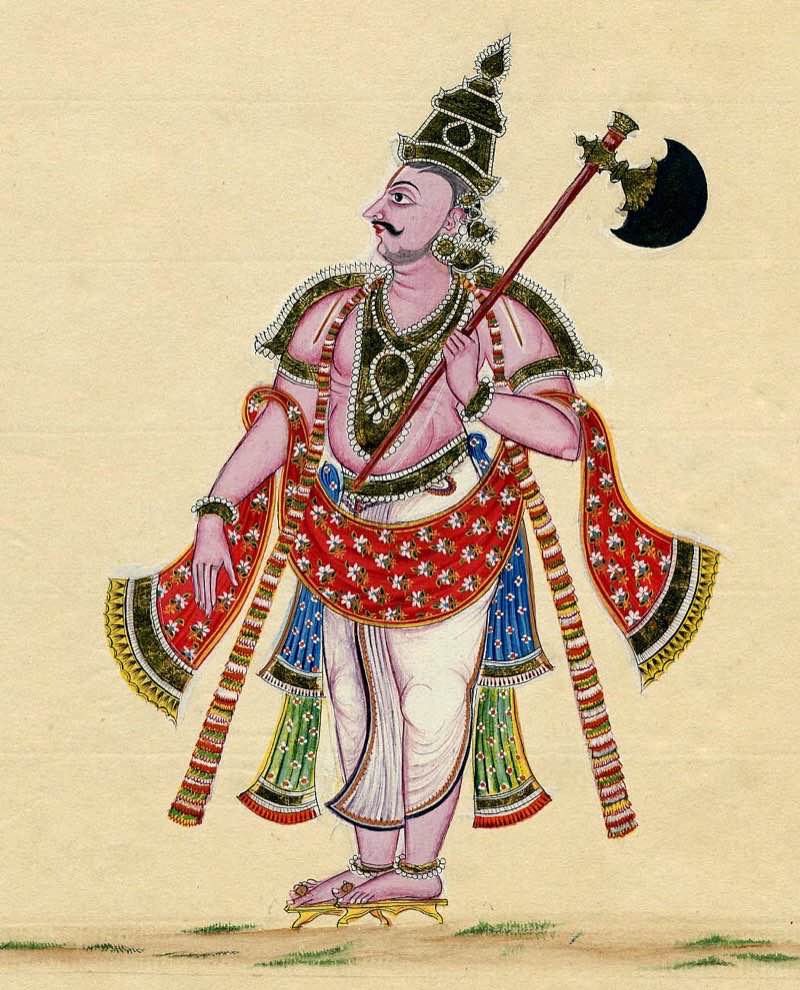
Lord Paraśurāma (परशुराम, “Rāma with the Axe”), also known as Bhārgava Rāma and Jāmadagnya, is the sixth of the Daśāvatāra — the ten principal incarnations of Lord Viṣṇu. Unlike other avatāras who appear and depart, Paraśurāma is one of the seven Chirajīvīs (immortals) believed to be alive even today, awaiting his role in the future age. He embodies the rare fusion of Brahminical learning and Kṣatriya martial prowess, representing the principle that dharma must be defended with both wisdom and strength when tyranny threatens the cosmic order.
Birth and Lineage
Paraśurāma was born as the fifth son of the great sage Jamadagni and his wife Reṇukā, in the lineage of Bhṛgu (hence the patronymic Bhārgava). The Bhārgava clan was among the most illustrious of Brahmin families, and Jamadagni himself was a powerful ṛṣi who possessed the divine cow Kāmadhenu (also called Suśīlā in some texts), granted to him by the celestial cow Nandinī.
According to the Bhāgavata Purāṇa (9.15-16), Paraśurāma’s birth was no ordinary event. His grandfather was the sage Ṛcīka, who had married Satyavatī, daughter of King Gādhi. The family’s spiritual power was immense — Jamadagni was considered one of the Saptaṛṣis (seven great sages) in certain reckonings.
The boy was initially named Rāma, but he earned the prefix “Paraśu” (axe) after receiving the divine weapon from Lord Śiva. From childhood, he displayed extraordinary qualities: fierce devotion to his parents, mastery of the Vedas, and a warrior’s temperament that set him apart from typical Brahmin ascetics.
The Divine Axe from Śiva
The most defining moment in Paraśurāma’s early life was his pilgrimage to Mount Kailāsa to propitiate Lord Śiva through intense tapas (austerity). Pleased by the young Brahmin’s devotion and ascetic power, Mahādeva bestowed upon him the Paraśu — a divine battleaxe of celestial origin.
The Śiva Purāṇa describes how Śiva not only granted the axe but also trained Paraśurāma in martial arts, making him the supreme warrior of his age. Some traditions state that Paraśurāma learned the art of warfare directly from Śiva himself, mastering every weapon and military strategy. The Paraśu was no ordinary weapon — it was indestructible, always returned to its wielder, and could cleave mountains and annihilate armies.
Additionally, Paraśurāma is said to have received the Vijaya bow from Śiva — the same celestial bow that would later play a crucial role in the Mahābhārata when it was passed to Karṇa.
The Slaying of Kārtavīrya Arjuna
The pivotal event that transformed Paraśurāma from a sage’s son into a warrior of cosmic vengeance was the murder of his father Jamadagni.
King Kārtavīrya Arjuna (also called Sahasrārjuna, “the thousand-armed”) was the powerful Haihaya king of Māhiṣmatī. As narrated in the Mahābhārata (Vana Parva, Chapters 115-117) and the Bhāgavata Purāṇa (9.15.17-26), Kārtavīrya visited Jamadagni’s hermitage and was sumptuously fed by the sage through the power of Kāmadhenu. Covetous of the divine cow, Kārtavīrya forcibly seized her and devastated the āśrama.
When Paraśurāma returned and learned of the outrage, he single-handedly pursued Kārtavīrya. Despite the king’s legendary thousand arms and his boon of invincibility from Lord Dattātreya, Paraśurāma engaged him in ferocious combat and severed his thousand arms one by one before slaying him with the divine axe.
But the tragedy did not end there. In retaliation, the sons of Kārtavīrya attacked Jamadagni’s hermitage and murdered the sage while Paraśurāma was away. They beheaded Jamadagni, and Reṇukā struck her chest twenty-one times in grief, crying out for her son.
Twenty-One Campaigns Against the Kṣatriyas
Consumed by righteous fury at his father’s murder, Paraśurāma made a terrible vow: he would purge the earth of the Kṣatriya class — not once, but twenty-one times — corresponding to the twenty-one times his mother had beaten her chest in grief.
The Mahābhārata (Śānti Parva 49) and the Bhāgavata Purāṇa (9.16.18-19) describe how Paraśurāma traversed the entire earth, engaging Kṣatriya armies in battle after battle. He filled the five lakes of Samantapañcaka (identified with Kurukṣetra) with the blood of fallen warriors. The Bhāgavata Purāṇa (9.16.18) records:
“Lord Paraśurāma, taking up his axe, went to Māhiṣmatī and killed Kārtavīrya’s sons. Thereafter, he circumambulated the earth twenty-one times, annihilating the warrior class each time.”
This cosmic act of retribution was not mere vengeance but a restoration of dharmic order. The Kṣatriya class had become tyrannical, abusing their power over Brahmins and the common people. Paraśurāma’s campaigns represent the principle that when any varṇa (social class) transgresses its dharmic boundaries and oppresses others, the divine will intervene to restore balance.
After completing his twenty-one campaigns, Paraśurāma performed the Aśvamedha yajña (horse sacrifice) and donated the entire conquered earth to the sage Kaśyapa as dakṣiṇā (ritual offering), retiring from warfare to resume his life as an ascetic on Mahendra Parvata (Mahendra Mountain).
Role in the Mahābhārata
Far from disappearing after his campaigns, Paraśurāma plays several crucial roles in the Mahābhārata, appearing as a teacher, mentor, and formidable presence.
Guru to Bhīṣma, Droṇa, and Karṇa
Paraśurāma is one of the greatest gurus in epic tradition. Three of the Mahābhārata’s most important warriors received their martial education from him:
Bhīṣma (Devavrata): The grandsire of the Kuru dynasty studied under Paraśurāma and mastered the science of weapons. Their relationship was tested when Paraśurāma challenged Bhīṣma in combat to compel him to marry Ambā. The two fought for twenty-three days in one of the most extraordinary duels in epic literature, ending in a stalemate — the only opponent who ever matched Paraśurāma in single combat (Mahābhārata, Udyoga Parva 178-185).
Droṇācārya: The preceptor of both the Pāṇḍavas and Kauravas received his entire martial education from Paraśurāma, including the knowledge of the devastating Brahmāstra.
Karṇa: Perhaps the most tragic connection. Karṇa approached Paraśurāma disguised as a Brahmin to learn the supreme weapons. When Paraśurāma discovered the deception (by how Karṇa endured pain from an insect bite without flinching — a Kṣatriya trait), he cursed Karṇa that he would forget the invocation of the Brahmāstra at the moment he needed it most (Mahābhārata, Śānti Parva 3). This curse proved pivotal in Karṇa’s eventual defeat at the hands of Arjuna.
Confrontation with Rāma
In the Rāmāyaṇa (Bāla Kāṇḍa 74-76), after Lord Rāma (the seventh avatāra) broke Śiva’s bow at Sītā’s svayaṃvara, Paraśurāma confronted him, furious at the destruction of the bow. He challenged Rāma to string the Vaiṣṇava bow. When Rāma not only strung it but also aimed it at Paraśurāma’s accumulated spiritual merit, the elder Rāma recognized the younger as the Supreme Lord Himself and withdrew, his martial purpose fulfilled.
This episode symbolically represents the transition from one avatāra to the next — the warrior sage yielding to the righteous king.
Connection to Kerala and the Konkan Coast
One of Paraśurāma’s most enduring legacies is the creation of the Kerala coast and the Konkan region. According to the Kerala Māhātmya and local traditions preserved in the Keralolpatti, after donating the earth to Kaśyapa, Paraśurāma had no land of his own. He stood at Gokarṇa (in present-day Karnataka) and hurled his axe into the ocean. The sea receded as far as the axe fell, creating the western coastal strip from Gokarṇa to Kanyākumārī.
This newly reclaimed land — Paraśurāma Kṣetra (Paraśurāma’s territory) — became Kerala. He is said to have established 108 sacred groves (kāvu) and 108 temples across the land, installed Brahmin families (the 64 grāmams), and organized the social structure of the region. The tradition of Kerala’s unique Brahmin communities (Namboothiri Brahmins) traces their origins to Paraśurāma’s settlement.
The Konkan coast of Maharashtra and Goa similarly reveres Paraśurāma as its creator. Temples dedicated to him are found throughout the western coast, including the famous Paraśurāma Temple in Chiplun, Maharashtra.
Chirajīvī: The Immortal Sage
Paraśurāma holds the unique distinction of being a Chirajīvī — one of the seven immortals of Hindu tradition who are believed to exist through all four Yugas. The traditional verse enumerating the Chirajīvīs begins:
Aśvatthāmā Balirvyāso Hanumāṃśca Vibhīṣaṇaḥ | Kṛpaḥ Paraśurāmaśca Saptaite Cirajīvinaḥ ||
According to the Kalki Purāṇa, Paraśurāma will return at the end of Kali Yuga to serve as the martial guru of Kalki — the final avatar of Viṣṇu — training him in the art of warfare and bestowing upon him divine weapons for the destruction of evil and the restoration of Satya Yuga.
Temples and Worship
Paraśurāma is worshipped across India, with particular devotion along the western coast:
- Paraśurāma Temple, Chiplun (Maharashtra): One of the most important temples dedicated exclusively to Paraśurāma
- Paraśurāma Temple, Thiruvallam (Kerala): An ancient temple near Thiruvananthapuram
- Lothal and sites across Gujarat where Paraśurāma is venerated in connection with coastal creation myths
- Pajaka Kṣetra (Karnataka): The birthplace of Madhvācārya, associated with Paraśurāma traditions
The annual festival of Paraśurāma Jayantī is celebrated on the third day (Tṛtīyā) of the bright half of Vaiśākha month (April-May), observed with special pūjās, recitation of the Paraśurāma narrative, and fasting.
Symbolism and Philosophical Significance
Paraśurāma represents several profound principles in Hindu thought:
The Unity of Knowledge and Action: As a Brahmin who mastered warfare, he embodies the Gītā’s teaching that all varṇas must act to defend dharma. His axe symbolizes the cutting away of adharma.
Righteous Anger: Unlike blind rage, Paraśurāma’s fury was directed at systemic injustice. His campaigns were not personal vengeance but cosmic correction — restoring the balance when power became tyrannical.
Renunciation After Action: After his twenty-one campaigns, Paraśurāma gave away everything he had conquered. This act of total renunciation mirrors the Gītā’s ideal of niṣkāma karma — action without attachment to results.
Continuity and Eternity: As a Chirajīvī, Paraśurāma bridges all the ages of Hindu cosmology. He is the thread connecting the ancient sages to the future Kalki avatāra, embodying the eternal nature of dharma itself.
For devotees, Paraśurāma stands as the reminder that spirituality does not require passivity in the face of injustice. The divine axe, received through devotion to Śiva and wielded in service to dharma, represents the courage to act decisively when the moral order is under threat — and the wisdom to renounce all fruits of action once duty is fulfilled.