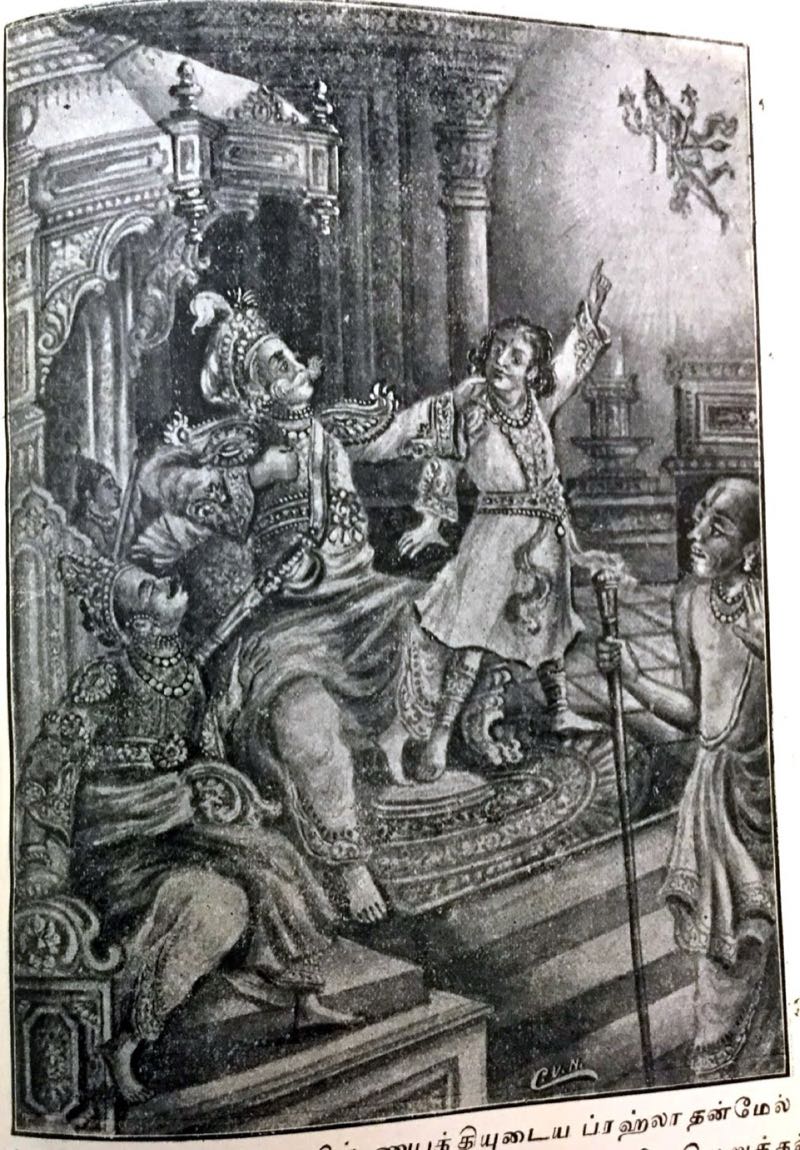
Prahlāda (प्रह्लाद, “Overflowing Joy”) is one of the most beloved and venerated figures in Hindu tradition — a child whose unwavering devotion to Lord Viṣṇu withstood the most terrifying ordeals that demonic power could devise. The son of the fearsome asura king Hiraṇyakaśipu, Prahlāda chose faith over fear, love over lineage, and divine truth over worldly authority. His story, narrated most fully in the seventh canto of the Bhāgavata Purāṇa, stands as the supreme illustration of the power of bhakti (devotion) and the certainty that the Lord will protect those who surrender to Him completely.
Lineage and Birth
Prahlāda was born into the most powerful asura dynasty. His father, Hiraṇyakaśipu (“Golden Garment”), was the elder brother of Hiraṇyākṣa, who had been slain by Lord Viṣṇu in the Varāha (Boar) avatāra. Consumed by grief and vengeance against Viṣṇu, Hiraṇyakaśipu performed extraordinary tapas (austerities) on Mount Mandara, eventually receiving from Brahmā a boon that made him virtually invincible — he could not be killed by man or animal, indoors or outdoors, by day or by night, on earth or in the sky, by any weapon.
Armed with this near-immortality, Hiraṇyakaśipu conquered the three worlds, expelled the devas from Svarga (heaven), and demanded that all beings worship him as the Supreme Lord. Into this household of ego, tyranny, and hatred for the divine was born a soul of pure devotion.
Instruction by Sage Nārada
The origin of Prahlāda’s devotion is traced to a profound event that occurred before his birth. The Bhāgavata Purāṇa (7.7) narrates that while Hiraṇyakaśipu was away performing tapas, the devas attacked his kingdom. During the chaos, Indra captured Prahlāda’s mother, Kayādhū (also called Līlāvatī), intending to destroy the unborn child of the enemy.
The great sage Nārada Muni intervened, assuring Indra that the child in the womb was a mahā-bhāgavata — a supreme devotee of the Lord — and must not be harmed. Nārada took Kayādhū to his hermitage and, during the months of her stay, imparted profound spiritual wisdom. While Kayādhū herself fell asleep during these teachings, the unborn Prahlāda absorbed every word. As Prahlāda later recalled:
“While I was still in my mother’s womb, the great sage Nārada instructed me in the science of devotion to the Supreme Lord. Although my mother forgot these teachings after my birth, I, by the grace of the sage, did not forget.” (Bhāgavata Purāṇa 7.7.30-31)
This prenatal initiation established Prahlāda as a devotee of Viṣṇu from his very first breath, making his bhakti innate rather than acquired — a crucial theological point in Vaiṣṇava philosophy.
Conflict with Hiraṇyakaśipu
When Hiraṇyakaśipu returned victorious and assumed lordship over the three worlds, he enrolled young Prahlāda in the school of Ṣaṇḍa and Amarka, two asura teachers tasked with educating the prince in the arts of politics, warfare, and power. But Prahlāda, whenever given the opportunity, taught his fellow students about devotion to Viṣṇu instead.
The Bhāgavata Purāṇa (7.6) records Prahlāda’s remarkable classroom teachings, in which the young boy instructed his asura classmates on the nine forms of bhakti:
- Śravaṇam — hearing about the Lord’s glories
- Kīrtanam — chanting and singing the Lord’s names
- Smaraṇam — constantly remembering the Lord
- Pāda-sevanam — serving the Lord’s lotus feet
- Arcanam — offering worship to the deity
- Vandanam — offering prayers and prostrations
- Dāsyam — serving the Lord as a humble servant
- Sakhyam — cultivating friendship with the Lord
- Ātma-nivedanam — complete self-surrender
He urged them: “One who is sufficiently intelligent should use the human form of body from the very beginning of life to practice devotion. The human body, although temporary, is meant for achieving the highest perfection.” (Bhāgavata Purāṇa 7.6.1)
When Hiraṇyakaśipu learned that his own son was praising Viṣṇu — his mortal enemy — he was consumed by fury. He demanded that the teachers correct the boy, but Prahlāda’s devotion could not be altered by any instruction.
The Five Great Trials
Enraged beyond measure, Hiraṇyakaśipu subjected Prahlāda to a series of increasingly terrible punishments, each designed to break his spirit or end his life. The Bhāgavata Purāṇa (7.5) and the Viṣṇu Purāṇa describe these harrowing ordeals:
1. Poison
Hiraṇyakaśipu ordered that Prahlāda be given deadly poison to consume. The child drank it while chanting the name of Viṣṇu, and the poison had no effect whatsoever — it became as harmless as nectar through the Lord’s grace.
2. Trampled by Elephants
The demon king commanded his war elephants to charge at the boy and crush him. The massive beasts rushed toward Prahlāda, but upon reaching him, they became gentle and refused to harm the child devotee. Some accounts describe the elephants’ tusks breaking upon Prahlāda’s body.
3. Serpents
Venomous serpents were released upon Prahlāda. The snakes, despite their deadly nature, could not bite or harm the child. They slithered around him harmlessly, their fangs unable to penetrate his body, which was protected by the constant remembrance of Viṣṇu.
4. Cast into Fire
Prahlāda was thrown into a blazing fire. The flames, which should have consumed him instantly, instead surrounded him like a cool breeze. The Bhāgavata Purāṇa describes the boy sitting peacefully in the midst of the inferno, untouched, his mind absorbed in meditation on Viṣṇu.
5. Thrown from a Cliff
Hiraṇyakaśipu had Prahlāda cast from the summit of a mountain. The child fell, chanting the Lord’s name, and was caught by the earth itself — landing without a single injury.
Other accounts add further trials: being submerged in the ocean, being subjected to black magic by asura sorcerers, being starved, and being thrown into a pit of venomous creatures. Through each ordeal, Prahlāda’s faith never wavered, and the Lord’s protection never failed.
The Holikā Episode
One of the most famous episodes in Prahlāda’s narrative is the story of Holikā, Hiraṇyakaśipu’s sister. This story, narrated in the Padma Purāṇa and various regional traditions, is the origin of the festival of Holī.
Holikā possessed a divine boon — a special garment (or, in some versions, a natural immunity) that rendered her impervious to fire. Hiraṇyakaśipu devised a plan: Holikā would sit in a blazing pyre holding Prahlāda on her lap, thereby burning the boy while she herself remained unharmed.
The fire was lit, and Holikā took her seat with the child. But divine justice intervened. The protective garment flew from Holikā and covered Prahlāda instead. Holikā was consumed by the flames she had intended for her nephew, while Prahlāda emerged unscathed, chanting the name of Viṣṇu.
This episode is celebrated each year during Holī, when bonfires (Holikā Dahan) are lit on the eve of the festival to commemorate the triumph of devotion over demonic power, and good over evil.
The Manifestation of Narasiṃha
The climactic confrontation between father and son is narrated in Bhāgavata Purāṇa 7.8, one of the most dramatic episodes in all of Hindu scripture.
In a final challenge, Hiraṇyakaśipu asked his son mockingly: “Is your Viṣṇu present in this pillar?”
Prahlāda replied with serene conviction: “He is in the pillar, and He is outside the pillar. He is everywhere.”
Hiraṇyakaśipu struck the pillar with his mace. With a thunderous roar that shattered the cosmic order, Lord Narasiṃha — the Man-Lion avatāra of Viṣṇu — burst forth from within the pillar. In a form that was neither fully man nor fully beast, the Lord placed Hiraṇyakaśipu on his lap at the threshold of the palace doorway, at the hour of twilight, and tore the demon apart with his claws — thereby fulfilling every condition of Brahmā’s boon while shattering its protection entirely.
Prahlāda’s Prayer (Bhāgavata Purāṇa 7.9)
After the destruction of Hiraṇyakaśipu, the Narasiṃha form blazed with such fury that none in the universe — not Brahmā, not Śiva, not even Lakṣmī — dared approach. It was young Prahlāda who stepped forward without fear and offered one of the most profound prayers in all of Hindu devotional literature.
The Prahlāda Stuti (Bhāgavata Purāṇa 7.9.8-50) contains several landmark verses:
“My dear Lord, I am not afraid of the fearful form of Narasiṃha, for I was never afraid of the terror of the cycle of birth and death. I am afraid only of the cycle of birth and death itself.” (7.9.19)
“O best of the great personalities, I am not at all afraid of material existence, for wherever I stay I am fully absorbed in thought of Your glories and activities.” (7.9.43)
Prahlāda prayed not for wealth, power, or even liberation for himself, but for the welfare of all beings. He asked the Lord to show mercy to his father and to all creatures trapped in the illusion of material existence. This selfless prayer is considered the highest expression of bhakti in Vaiṣṇava theology.
Pleased beyond measure, Narasiṃha placed Prahlāda upon his lap, blessed him, and pacified his own divine fury. The Lord crowned Prahlāda as the righteous king of the asuras and instructed him to rule with dharma, setting the model of a devotee-king.
Prahlāda as King of the Asuras
After the death of Hiraṇyakaśipu, Prahlāda ascended to the throne of the asura kingdom. Unlike his father, he ruled with justice, compassion, and devotion. The Bhāgavata Purāṇa describes his reign as an era of peace when even the asuras lived in harmony with the cosmic order.
Prahlāda is also identified in Hindu genealogy as the grandfather of Mahābali (Bali), the generous asura king who was later subdued by the Vāmana (Dwarf) avatāra of Viṣṇu. This lineage — from the devotee Prahlāda to the magnanimous Bali — is one of the most remarkable in Hindu mythology, showing that devotion can transform an entire dynasty.
Symbolism and Theological Significance
The Power of Bhakti
Prahlāda’s story is the quintessential demonstration that devotion transcends all worldly power. A powerless child overcame the mightiest demon in the universe, not through strength or cunning, but through pure surrender to the divine. This is the central message of the Bhakti traditions across Vaiṣṇavism, Śaivism, and Śāktism.
The Omnipresence of God
Prahlāda’s declaration that Viṣṇu is present “in the pillar and outside the pillar” affirms the Vedāntic principle of divine omnipresence. The Lord is not confined to temples, images, or sacred spaces — He pervades every atom of creation. The fact that Narasiṃha emerged from a stone pillar powerfully demonstrates this truth.
Fearlessness Through Faith
Prahlāda faced poison, serpents, elephants, fire, and mountain cliffs without flinching. His story teaches that true courage is not the absence of danger but the presence of faith. The devotee who is anchored in the divine has nothing to fear from any force in creation.
The Ideal Bhakta
In Vaiṣṇava tradition, Prahlāda is counted among the twelve Mahājanas — the great authorities on dharma and devotion. He is the exemplar of bhakti in its purest form: selfless, fearless, constant, and compassionate. His name is synonymous with the ideal devotee, and his story is told to children across India as the first and finest lesson in faith.
For devotees across all Hindu traditions, Prahlāda stands as the eternal reminder that no power in the universe can overcome the protection that the Lord extends to those who surrender with a pure heart — and that the Lord Himself will take whatever form is necessary to keep His promise to His devotees.