Introduction
Rāmānujācārya (IAST: Rāmānuja; c. 1017-1137 CE by traditional dating, though some modern scholars prefer c. 1077-1157 CE) stands as one of the most consequential philosopher-theologians in the history of Indian thought. As the chief architect of the Viśiṣṭādvaita (“qualified non-dualism”) school of Vedānta, he mounted a systematic and formidable challenge to the Advaita (non-dual) interpretation of Śaṅkarācārya, arguing that ultimate reality is not an undifferentiated, attributeless Brahman but a supremely personal God endowed with infinite auspicious qualities, who stands in an organic relationship with individual souls and the material world. The Internet Encyclopedia of Philosophy describes him as “one of the Indian philosophical tradition’s most important and influential figures,” noting that he pioneered “the first systematic theistic interpretation” of Vedic philosophy (IEP, “Rāmānuja”).
His magnum opus, the Śrī Bhāṣya — a monumental commentary on Bādarāyaṇa’s Brahma Sūtras — remains a masterpiece of Indian scholastic philosophy. Together with the Vedārthasaṅgraha and the Bhagavadgītā Bhāṣya, it laid the intellectual foundation for Śrī Vaiṣṇavism, a devotional tradition centred on the worship of Viṣṇu (Nārāyaṇa) and his consort Śrī (Lakṣmī) that continues to shape the religious lives of millions across South and Southeast Asia.
Early Life and Education
According to the traditional hagiographies known as the Guruparamparāprabhāvam and other Śrī Vaiṣṇava biographical literature, Rāmānuja was born in Śrīperumbūdūr, a town near modern Chennai in Tamil Nadu, into a Brahmin family (Britannica, “Ramanuja”). His mother was Kānthimatī and his father Āsuri Keśava Somayājī, a learned Vedic ritualist.
Rāmānuja displayed extraordinary intellectual ability from his youth. He was sent to study under Yādavaprakāśa in Kāñcīpuram, a scholar who followed a monistic interpretation of the Upaniṣads akin to Śaṅkara’s Advaita. From the very beginning, student and teacher clashed over hermeneutical matters. Where Yādavaprakāśa read the Upaniṣadic texts as pointing to an impersonal, attributeless Absolute, the young Rāmānuja insisted on a theistic reading that affirmed the reality of the personal God, individual souls, and the material world. The disagreements became so intense that, according to traditional accounts, Yādavaprakāśa plotted to have Rāmānuja killed during a pilgrimage — a plan that was foiled when Rāmānuja’s cousin warned him and he escaped (IEP, “Rāmānuja”).
A pivotal moment came when the ageing Yāmunācārya (Āḷavandār), the spiritual leader of the nascent Śrī Vaiṣṇava community centred at the Śrī Raṅganātha temple in Śrīraṅgam, recognized Rāmānuja’s exceptional potential. Yāmuna wished to appoint Rāmānuja as his successor but died before the two could meet. Tradition recounts that when Rāmānuja arrived at the funeral, he noticed three of Yāmuna’s fingers were curled. He made three solemn vows — to write a Vedāntic commentary on the Brahma Sūtras that would honour the theistic tradition, to systematize the teachings of the Āḻvār saint-poets, and to commemorate the great sages Parāśara and Vyāsa — at which point the fingers relaxed one by one (Heart of Hinduism, “Life of Ramanuja”).
Renunciation and Leadership at Śrīraṅgam
After separating from his wife — whose caste-conscious behaviour had become an obstacle to his spiritual mission — Rāmānuja took formal saṁnyāsa (renunciation) and assumed the leadership of the Śrī Vaiṣṇava community at Śrīraṅgam. He earned the title yatirāja (“king of ascetics”) and devoted himself to a programme of philosophical writing, temple reform, and institutional organization (Britannica, “Ramanuja”).
At Śrīraṅgam, Rāmānuja reorganized the worship practices of the Śrī Raṅganātha temple and established protocols for daily liturgy, festival observances, and community governance that remain normative in Śrī Vaiṣṇava temples to this day. He also undertook extensive pilgrimages across India — from Rāmeśvaram in the south to Badrīnāth and the Gaṅgā in the north — engaging rival philosophers and attracting disciples.
Exile in Karnataka and the Melkote Years
When the Cōḻa king, a staunch Śaiva, began persecuting Vaiṣṇavas, Rāmānuja was forced to flee Śrīraṅgam. He found refuge in the Hoysaḷa kingdom of Karnataka, where he spent approximately twelve years in the area around Melkote (Tirunārāyaṇapuram). During this period, he is credited with converting the Jain king Biṭṭidēva (who took the Vaiṣṇava name Viṣṇuvardhana), reconsecrating the Cheluvanarayana Swamy temple at Melkote, and establishing new centres of Śrī Vaiṣṇava worship (New World Encyclopedia, “Ramanuja”). After the Cōḻa persecution abated, Rāmānuja returned to Śrīraṅgam, where he continued to teach and administer the community until his death at an extraordinarily advanced age.
Philosophy: Viśiṣṭādvaita Vedānta
Rāmānuja’s philosophical system, known as Viśiṣṭādvaita (“non-duality of the qualified whole”), represents a distinctive middle path within the Vedāntic tradition. The term can be parsed as viśiṣṭa (“qualified” or “distinguished”) + advaita (“non-duality”), signifying that Brahman is one, but is internally differentiated by real qualities, real individual souls (cit), and real matter (acit). Against Śaṅkara’s Advaita, which held the phenomenal world to be mithyā (mere appearance) and Brahman to be nirguṇa (without attributes), Rāmānuja insisted that plurality, individuality, and moral values are genuinely real features of the ultimate reality (IEP, “Rāmānuja”).
The Body-Soul Analogy (Śarīra-Śarīrī Bhāva)
The central metaphor of Rāmānuja’s metaphysics is the body-soul relationship. Just as the individual soul (jīva) animates, controls, and sustains the body while remaining distinct from it, so Brahman — identified with Viṣṇu-Nārāyaṇa — functions as the inner Self (antaryāmin) of the entire cosmos. Individual souls and matter constitute the “body” of Brahman; Brahman is their “soul.” This organic model preserves both genuine unity (there is ultimately one reality) and genuine plurality (souls and matter are distinct from one another and from Brahman’s essence). It allows Rāmānuja to interpret the great Upaniṣadic mahāvākyas such as tat tvam asi (“that thou art,” Chāndogya Upaniṣad 6.8.7) as affirming that all selves subsist in Brahman, without collapsing the distinction between the finite self and the infinite Lord (IEP, “Rāmānuja”).
Critique of Advaita
Rāmānuja’s Śrī Bhāṣya contains one of the most sustained and penetrating critiques of Advaita Vedānta in Indian philosophical literature. He attacked the Advaita concept of avidyā (ignorance) on multiple fronts. If Brahman alone is real and ignorance is what conceals Brahman’s true nature, then who is the locus of this ignorance? It cannot be the individual self, for the individual self is supposed to be a product of ignorance. It cannot be Brahman, for Brahman is by definition pure knowledge. The concept, Rāmānuja argued, is self-undermining. He famously compared the Advaita position to “claiming that his own mother never had any children” (IEP, “Rāmānuja”).
He also attacked the Advaita epistemology: if all cognition is ultimately erroneous (since the perceived world is mithyā), then the very cognition that reveals Brahman’s nature must also be erroneous — a performative contradiction. Rāmānuja insisted that consciousness is always intentional — always of something. There is no such thing as pure, contentless awareness. If consciousness necessarily involves objects, then difference and plurality must be real.
Three Realities: God, Souls, and Matter
Rāmānuja’s ontology recognizes three eternal categories: Īśvara (God, i.e. Viṣṇu-Nārāyaṇa), cit (conscious individual souls), and acit (unconscious matter or prakṛti). Souls and matter are real, eternal, and dependent on God. They are distinct from God but inseparable from him — just as attributes are distinct from a substance yet cannot exist without it. God is the inner controller and support of all; souls and matter form his body. This triad is sometimes called the tattva-traya (“three realities”) (Britannica, “Vishishtadvaita”).
Major Works
Rāmānuja authored nine Sanskrit works, of which the three major commentaries are universally accepted as authentic (IEP, “Rāmānuja”; Britannica):
Major Commentaries:
- Śrī Bhāṣya (“The Beautiful Commentary”) — His magnum opus: a comprehensive commentary on the Brahma Sūtras that systematically establishes the Viśiṣṭādvaita interpretation against Advaita and other rival schools. It is celebrated for its rigorous scholastic argumentation and philosophical depth.
- Vedārthasaṅgraha (“Summary of the Meaning of the Vedas”) — His first major independent work, presenting a systematic exposition of his theistic, realist philosophy and hermeneutical method for interpreting the Upaniṣads.
- Bhagavadgītā Bhāṣya — A commentary on the Gītā emphasizing bhakti (devotion), karma (action), and prapatti (surrender) as paths to liberation, with God’s grace as the decisive factor.
Shorter Works:
- Vedāntadīpa and Vedāntasāra — Shorter commentaries on the Brahma Sūtras.
- Gadya Traya (“Three Prose Hymns”) — Śaraṇāgati Gadya, Śrīraṅga Gadya, and Vaikuṇṭha Gadya — devotional prose compositions expressing complete surrender (prapatti) to the Lord, though their attribution is debated by some scholars.
- Nityagrantha — A manual of daily worship and ritual observance.
Soteriology: Liberation Through Devotion
For Rāmānuja, the highest goal of human life is mokṣa — liberation from the cycle of birth and death. Unlike Advaita, which defines liberation as the realization that the individual self is Brahman (and that individuality was illusory all along), Rāmānuja understands liberation as the soul’s eternal, blissful awareness of its true nature as a mode of Brahman, and of Brahman’s own infinite, auspicious nature. The liberated soul does not merge into an undifferentiated Absolute; it enjoys an eternal, loving relationship with the personal God (IEP, “Rāmānuja”).
The path to liberation centres on bhakti yoga — the discipline of unwavering devotion. This involves two intertwined elements: karma yoga (the performance of prescribed duties without attachment to results, offered to God) and constant, loving meditation on God’s nature and excellences. Rāmānuja taught that bhakti is not merely an emotion but an epistemic state — a form of direct knowledge. When devotion matures into parabhakti (supreme devotion), it becomes a direct, perceptual awareness of Brahman’s nature, having “the character of direct perception” (IEP, “Rāmānuja”).
Crucially, Rāmānuja emphasized that God’s grace (prasāda) is indispensable. Individual effort alone cannot achieve liberation; it is God who, moved by the devotee’s love and surrender, removes the obstacles of karma and grants the final vision. This emphasis on divine grace would later become the source of a major sectarian division within Śrī Vaiṣṇavism.
The Āḻvārs and the Dual Vedānta
Although Rāmānuja wrote exclusively in Sanskrit for the pan-Indian scholarly community, the Śrī Vaiṣṇava tradition he codified is inseparable from the devotional legacy of the twelve Āḻvār saint-poets, whose four thousand Tamil hymns (the Nālāyira Divya Prabandham) are venerated as the “Tamil Veda.” Poets like Nammāḻvār, Āṇṭāḷ, and Tiruppāṇāḻvār expressed an intense, emotional love for Viṣṇu that became the devotional heart of the tradition. Rāmānuja’s philosophical systematization provided the Sanskrit intellectual framework that legitimized this vernacular devotional movement within orthodox Brahmanical Hinduism, creating what the tradition calls ubhaya vedānta — a “dual Vedānta” grounded in both the Sanskrit Upaniṣads and the Tamil Prabandham (IEP, “Rāmānuja”).
Legacy and Influence
Rāmānuja’s impact on Indian religious and intellectual history has been profound and enduring:
- Philosophical: He established Viśiṣṭādvaita as one of the three most influential schools of Vedānta, alongside Śaṅkara’s Advaita and Madhva’s Dvaita. His uncompromising defence of theism, moral realism, and the reality of individual souls provided a powerful alternative to monistic interpretations. Karl Potter has observed that “Rāmānuja’s tradition can be said to represent one of the main arteries through which philosophy reached down to the masses” (IEP, “Rāmānuja”).
- Institutional: He is credited with founding seventy-four siṁhāsanādhipatis (administrative centres) to govern the Śrī Vaiṣṇava community, a network that endures in modified form to this day. Major Vaiṣṇava temples — including the Śrī Raṅganātha temple at Śrīraṅgam and the Vēṅkaṭēśvara temple at Tirupati — continue to follow the worship protocols he established.
- Social: Rāmānuja is celebrated for his inclusive vision. Tradition recounts his befriending of Kāñcīpūrṇa, a devotee of low caste, and his insistence that devotion to God transcends social barriers — a stance that earned him the epithet “the one who made Viṣṇu accessible to all.”
- Sectarian Development: Within two centuries of his death, the Śrī Vaiṣṇava community divided into the Vaḍagalai (Northern) school, founded by Vēdānta Dēśika, which emphasizes Vedic observance and the cooperative role of human effort and divine grace, and the Teṅgalai (Southern) school, founded by Maṇavāḷamāmuṉi, which stresses the Āḻvār heritage and holds that grace is freely and unconditionally dispensed by God (IEP, “Rāmānuja”).
The Statue of Equality
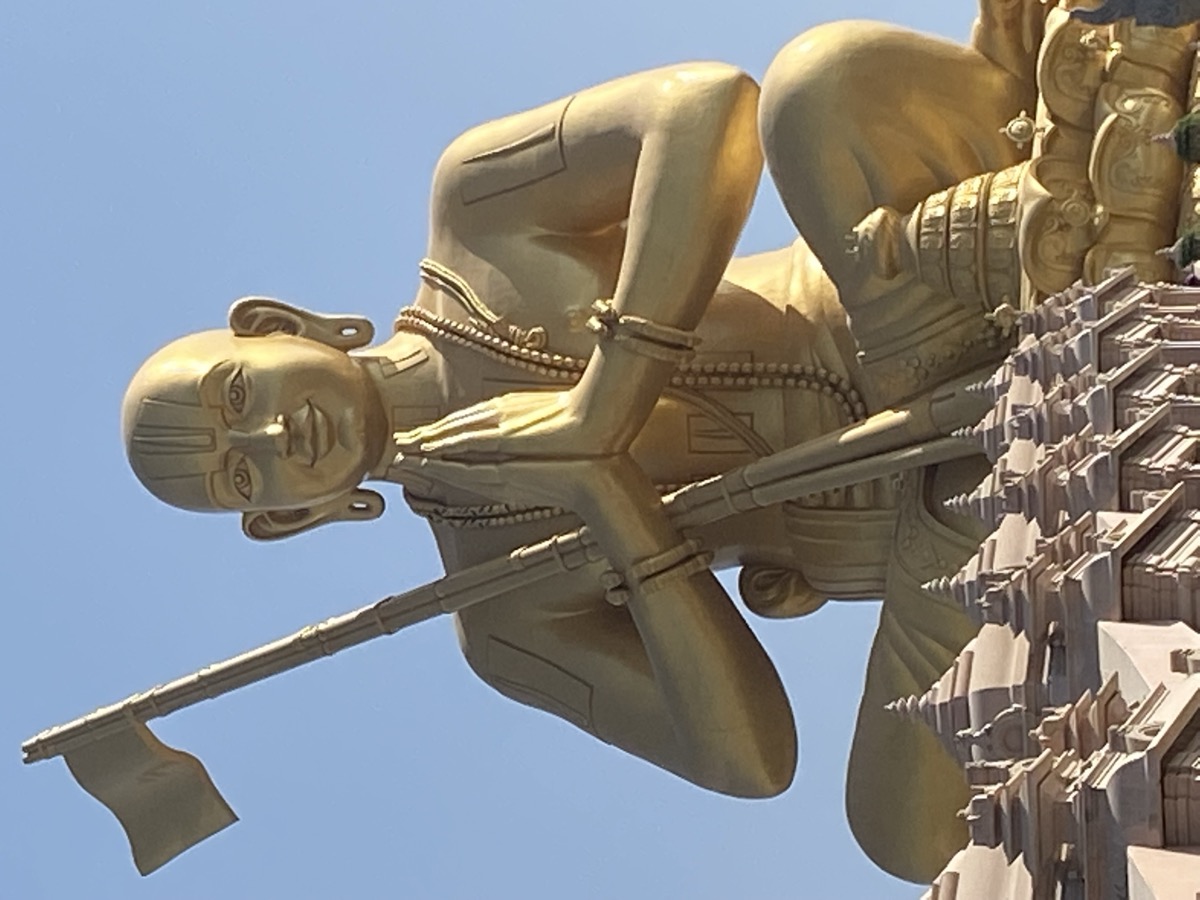
In February 2022, the Statue of Equality — a 216-foot (66-metre) seated figure of Rāmānuja, the second tallest sitting statue in the world — was inaugurated at Muchintal, near Hyderabad, Telangana, under the auspices of the Chinna Jeeyar Trust. Constructed from 700 tonnes of pañcaloha (a five-metal alloy of gold, silver, copper, brass, and zinc), the monument was fabricated in China, shipped in 1,600 individual pieces, and assembled on site over fifteen months. The 54-foot base building, known as the Bhadravēdī, houses a 120-kilogram gold statue of Rāmānuja and recreations of the 108 Divya Dēśams (sacred Vaiṣṇava shrines). The statue’s name, “Equality,” honours Rāmānuja’s legacy of social inclusiveness and his teaching that all souls — regardless of birth — are equally dear to God (Wikipedia, “Statue of Equality”).
Conclusion
Rāmānuja’s life and thought constitute a watershed in the history of Hindu philosophy and devotion. By demonstrating that rigorous philosophical reasoning and heartfelt bhakti are not merely compatible but mutually reinforcing, he bequeathed to posterity a vision of the divine that is at once intellectually demanding and spiritually nurturing. His insistence on the reality of persons, the goodness of the world, and the supremacy of a loving God has resonated across ten centuries and continues to inspire philosophical inquiry, temple worship, and devotional life in the Śrī Vaiṣṇava community and far beyond.