Introduction
Rāvaṇa (IAST: Rāvaṇa; Sanskrit: रावण, “He Who Makes the Universe Scream”), also known as Daśānana (“Ten-Faced”), Daśagrīva (“Ten-Necked”), and Laṅkeśvara (“Lord of Laṅkā”), is one of the most compelling and complex figures in Hindu mythology. As the primary antagonist of the Rāmāyaṇa, he is the mighty demon king whose abduction of Sītā sets in motion the epic’s central conflict and war. Yet to reduce Rāvaṇa to a simple villain is to miss the profound moral and theological complexity that the Hindu tradition invests in his character.
Rāvaṇa is a Brahmin by birth — the grandson of the creator-sage Pulastya and a formidable scholar of the four Vedas and the six Vedāṅgas. He is a supreme devotee of Lord Śiva, to whom tradition attributes the magnificent Śiva Tāṇḍava Stotram. He is a master of the vīṇā, a conqueror of the three worlds, and a king whose golden city of Laṅkā was the marvel of the age. His downfall — caused not by lack of knowledge or power but by kāma (desire) and ahaṅkāra (ego) — serves as one of Hinduism’s most powerful moral parables: that even the greatest learning and devotion cannot save a soul consumed by arrogance and lust.
Lineage and Birth
The Brahmin Heritage
Rāvaṇa’s genealogy, detailed in the Uttara Kāṇḍa of the Vālmīki Rāmāyaṇa (Chapters 1-12), places him in an exalted Brahminical line. His grandfather was Pulastya, one of the ten Prajāpatis (mind-born sons of Brahmā) and one of the Saptarṣi (seven great sages) in the first Manvantara. Pulastya’s son was Viśravas (also called Vaiśravaṇa), a great sage learned in the Vedas and tapas. Viśravas married Kaikasī (also called Nikashā), a rākṣasī woman of noble lineage — daughter of the daitya king Sumālī and his wife Ketumatī — and their union produced four children: Rāvaṇa, Kumbhakarṇa, Vibhīṣaṇa, and Śūrpaṇakhā.
It is crucial to note that Rāvaṇa’s half-brother through Viśravas’s first wife (Iḍaviḍā or Devavarṇinī) was Kubera, the god of wealth and the original lord of Laṅkā. Rāvaṇa would later seize both Laṅkā and Kubera’s celestial vehicle, the Puṣpaka Vimāna, establishing the sibling rivalry that underscores the epic’s themes of legitimate versus illegitimate sovereignty.
The Meaning of “Rāvaṇa”
The name “Rāvaṇa” is traditionally derived from the Sanskrit root ru (“to scream, to roar”). According to the Uttara Kāṇḍa (7.16), the name was bestowed by Brahmā himself after Rāvaṇa’s terrifying austerities shook the three worlds: “Because you have made all the worlds cry out (rāvayasi), you shall henceforth be known as Rāvaṇa.”
The Great Tapas and Boons from Brahmā
Austerities at Gokarna
The Uttara Kāṇḍa (7.9-7.13) describes Rāvaṇa’s extraordinary tapas in vivid detail. Determined to become invincible, Rāvaṇa performed austerities for ten thousand years at the sacred site of Gokarna. At the end of each thousand years, he offered one of his ten heads into a sacrificial fire. When he was about to sever the tenth and final head, Brahmā appeared before him, impressed by the severity of his penance.
Brahmā restored all ten heads and offered Rāvaṇa a boon. Rāvaṇa asked for invulnerability to devas, dānavas, gandharvas, yakṣas, nāgas, and rākṣasas — every category of celestial and supernatural being. In his arrogance, however, he did not ask for protection from humans and animals, whom he considered beneath his concern. This fatal oversight — born of ahaṅkāra (ego) — became the very door through which his destruction would enter, for it was as a human (mānuṣa) that Viṣṇu incarnated as Rāma to slay him (Vālmīki Rāmāyaṇa, Uttara Kāṇḍa 7.10).
Conquest of the Three Worlds
Armed with Brahmā’s boons, Rāvaṇa embarked on a campaign of conquest that brought the three worlds — heaven (svarga), earth (bhūloka), and the netherworld (pātāla) — under his dominion. He defeated Kubera and seized Laṅkā along with the Puṣpaka Vimāna. He subjugated Indra and the devas, humbled the Nāga king Vāsuki, and even challenged Yama, the god of death. The Uttara Kāṇḍa describes how Rāvaṇa’s armies swept across the cosmos, establishing him as the undisputed sovereign of all realms — a power that no being in creation could check, save for the one category he had so contemptuously dismissed: humanity.
Kumbhakarṇa’s Curse
During the same audience with Brahmā, Rāvaṇa’s brother Kumbhakarṇa intended to request sovereignty over Indra’s throne. But Goddess Sarasvatī, at the behest of the devas, twisted his tongue so that he instead asked for nidrāsana (“a seat of sleep”) rather than Indrāsana (“Indra’s seat”). Brahmā granted this boon, condemning Kumbhakarṇa to sleep for six months at a stretch — a narrative device that explains his absence during much of the Rāmāyaṇa war until his dramatic awakening and death (Vālmīki Rāmāyaṇa, Yuddhakāṇḍa 60-67).
Scholar of the Vedas and Master of Arts
Vedic Learning
Despite his rākṣasa nature, Rāvaṇa is consistently portrayed in the Hindu tradition as a Brahmin of extraordinary erudition. The Rāmāyaṇa describes him as a master of the four Vedas (Ṛg, Yajus, Sāma, Atharva) and the six Vedāṅgas (Śikṣā, Chandas, Vyākaraṇa, Nirukta, Jyotiṣa, Kalpa). His ten heads are traditionally interpreted as symbolising his mastery of these ten branches of sacred knowledge: the four Vedas and the six Vedāṅgas (Hindu American Foundation, “The Symbolism of Ravana’s 10 Heads”).
Even Rāma himself, at the moment of Rāvaṇa’s death, acknowledges his enemy’s learning. In one of the most remarkable passages of the epic, Rāma instructs Lakṣmaṇa to approach the dying Rāvaṇa and receive from him whatever wisdom he may impart — a gesture of extraordinary magnanimity that underscores the Hindu tradition’s refusal to reduce Rāvaṇa to a one-dimensional villain (Vālmīki Rāmāyaṇa, Yuddhakāṇḍa 111, commentarial tradition).
Musical Genius and the Rāvaṇahathā
Rāvaṇa is credited with the invention or mastery of the Rāvaṇahathā (also Rāvaṇāstrōn), an ancient bowed string instrument considered by some scholars to be a precursor of the modern violin family. According to one account preserved in oral tradition, Rāvaṇa fashioned the instrument from one of his own severed heads, using his tendons as strings — a dramatic origin story that reflects both his self-sacrificing devotion and his musical genius. Some traditions also attribute to him mastery of the Rudra Vīṇā, an instrument whose name honours Śiva (Rudra) and whose deep, meditative tones are associated with the dhrupad tradition of Hindustani classical music (MAP Academy, “Of Shiva or Ravana?: The Origins of Rudra Veena”).
His expertise in saṅgīta (music) was so legendary that some traditions describe his ten heads as representing the ten svaras (musical notes) of the complete octave. The image of Rāvaṇa playing the vīṇā appears in temple sculpture and manuscript painting across India and Southeast Asia.
Mastery of Jyotiṣa and Āyurveda
Beyond the Vedas and music, Rāvaṇa is credited in various traditions with expertise in Jyotiṣa (Hindu astrology) and Āyurveda (the science of life and medicine). The Rāvaṇa Saṃhitā, a text on astrology attributed to him, testifies to his reputation as a master of celestial sciences. In Sri Lankan tradition, Rāvaṇa is particularly remembered as an accomplished Āyurvedic physician who advanced the healing arts in his kingdom.
The Golden City of Laṅkā
Laṅkā was no ordinary capital. According to Hindu tradition, the city was originally built by Viśvakarman, the celestial architect, for Lord Śiva himself. After Śiva gifted it to Kubera, Laṅkā flourished as a city of fabulous wealth. When Rāvaṇa seized it from his half-brother, he transformed it into a metropolis of unimaginable splendour. The Sundara Kāṇḍa of the Vālmīki Rāmāyaṇa, narrated through the eyes of Hanumān, describes Laṅkā as a city with golden ramparts, crystal palaces, and streets paved with precious gems. It is said that even the poorest household in Laṅkā ate from vessels of gold, and that hunger was unknown in the kingdom. This depiction of Laṅkā as a utopian city underscores the tragedy of Rāvaṇa’s character: he possessed everything that the world could offer, yet his unchecked desire for what belonged to another ultimately brought it all to ruin.
Devotion to Śiva
The Śiva Tāṇḍava Stotram
One of the most celebrated hymns in Sanskrit devotional literature — the Śiva Tāṇḍava Stotram — is attributed to Rāvaṇa. According to the tradition narrated in the Śiva Purāṇa, Rāvaṇa once attempted to uproot Mount Kailāsa to carry it to Laṅkā, so great was his desire to have Śiva’s abode near him. Śiva pressed the mountain down with his toe, trapping Rāvaṇa beneath it. In agony and devotion, Rāvaṇa composed the Śiva Tāṇḍava Stotram, a thundering hymn of sixteen verses praising Śiva’s cosmic dance:
Jaṭāṭavīgalajjalapravāhapāvitasthale Galēvalambyalambataṃ bhujangaṭuṅgamālikām…
“From the dense forest of his matted locks, a cascade of holy water purifies the earth; around his neck hangs a garland of great serpents…”
Pleased by this extraordinary hymn, Śiva released Rāvaṇa and gifted him the divine sword Chandrahāsa. This episode reveals the Hindu tradition’s nuanced understanding of Rāvaṇa: he is not merely a demon but a devotee capable of producing literature of the highest spiritual order.
The Ātmaliṅga Episode
Another important Śaiva narrative concerns Rāvaṇa’s quest for the Ātmaliṅga — Śiva’s personal liṅga of supreme power. According to the tradition preserved at the Gokarna Mahābalēśvara Temple (Karnataka), Śiva granted the Ātmaliṅga to Rāvaṇa on the condition that he not set it down before reaching Laṅkā. The devas, alarmed at the prospect of such power in Rāvaṇa’s hands, conspired with Gaṇeśa to trick Rāvaṇa into placing it on the ground at Gokarna, where it became permanently installed. Rāvaṇa’s fury at this deception — he attempted to uproot the liṅga, scattering fragments across five sites in coastal Karnataka (the Pañca Kṣetras) — reveals both his passionate devotion and his consuming desire for power.
The Abduction of Sītā and the War
The Central Crime
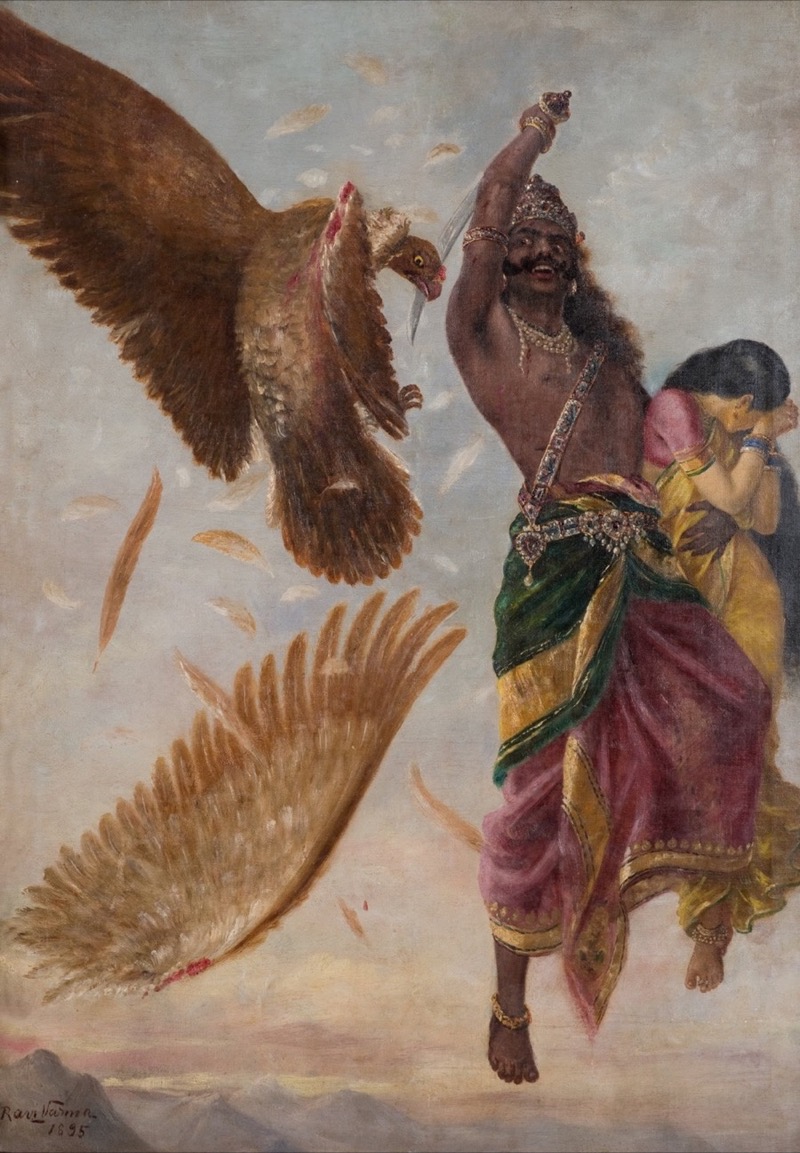
The narrative pivot of the Rāmāyaṇa is Rāvaṇa’s abduction of Sītā, the wife of Rāma. The Araṇyakāṇḍa (Book 3) describes how Rāvaṇa, inflamed by his sister Śūrpaṇakhā’s description of Sītā’s beauty, devised a plan to kidnap her. He sent the rākṣasa Mārīca in the form of a golden deer to lure Rāma and Lakṣmaṇa away from their hermitage, then appeared before Sītā disguised as a Brahmin mendicant. When Sītā crossed the protective boundary drawn by Lakṣmaṇa, Rāvaṇa revealed his true form, seized her, and carried her away in his Puṣpaka Vimāna to Laṅkā (Vālmīki Rāmāyaṇa, Araṇyakāṇḍa 46-56).
The noble vulture Jaṭāyu, a friend of Rāma’s father Daśaratha, attempted to rescue Sītā but was mortally wounded by Rāvaṇa — an act of violence against an aged, dharmic creature that further deepens his moral culpability.
The Aśoka Vāṭikā
In Laṅkā, Rāvaṇa confined Sītā to the Aśoka Vāṭikā (Aśoka grove) and attempted to persuade her to become his queen. Significantly, despite his overwhelming power, Rāvaṇa did not force himself upon Sītā — a restraint that some commentators attribute to a curse (the sage Nalakūbara’s curse that Rāvaṇa would die if he violated an unwilling woman) and others to a residual sense of dharmic propriety. Sītā’s steadfast refusal and Rāvaṇa’s inability to overcome it through persuasion form one of the most psychologically rich dynamics in the epic.
The Great War and Death
The Yuddhakāṇḍa (Book 6) narrates the climactic war between Rāma’s army of vānaras (monkeys) and Rāvaṇa’s rākṣasa forces. The war features extraordinary combats, divine weapons (astras), and the sequential deaths of Rāvaṇa’s greatest warriors: Kumbhakarṇa, Indrajit (Meghanāda, Rāvaṇa’s son and perhaps the most formidable warrior of the epic), and finally Rāvaṇa himself.
Rāma slays Rāvaṇa with the Brahmāstra (in some versions, the weapon given to him by the sage Agastya), piercing his navel — the only point where the amṛta (nectar of immortality) sustained his life. As Rāvaṇa falls, the devas rain flowers from heaven.
Death and Liberation
The moment of Rāvaṇa’s death carries profound theological significance. In the Vaiṣṇava interpretive tradition, Rāvaṇa’s slaying by Rāma — an avatāra of Viṣṇu — is understood not merely as punishment but as liberation (mokṣa). To die at the hands of the Supreme Being, even as an adversary, is to be granted the ultimate spiritual release. Some commentators hold that Rāvaṇa attained sāyujya mukti (union with the divine) through death at Rāma’s hands. This interpretation is reinforced by the Jain tradition, which holds that Rāvaṇa will be reborn as a future Tīrthaṅkara — an omniscient teacher who leads souls to liberation. Even Rāma honours his fallen foe, declaring: “He was a mighty warrior, a great scholar, and a lord of rākṣasas. His death diminishes the world” (Yuddhakāṇḍa 111, commentarial tradition).
Vibhīṣaṇa’s Counsel and the Moral Drama
The moral drama is sharpened by the figure of Vibhīṣaṇa, Rāvaṇa’s youngest brother, who repeatedly counsels him to return Sītā and make peace with Rāma. Vibhīṣaṇa’s appeals to dharma — and Rāvaṇa’s proud refusal — constitute some of the finest passages of moral debate in Sanskrit literature (Yuddhakāṇḍa 9-17). When Vibhīṣaṇa finally defects to Rāma’s camp, the break symbolises the irreducible choice every soul faces between dharma and adharma.
Ten Heads: Symbolic Interpretations
Rāvaṇa’s ten heads (daśa-mukha) have been interpreted in multiple ways across Hindu commentarial traditions:
- Ten branches of learning: The four Vedas and six Vedāṅgas, representing his encyclopaedic knowledge.
- Ten directions: Symbolising his sovereignty over the entire spatial universe.
- Ten senses: The five jñānendriyas (sense organs) and five karmendriyas (action organs), representing the complete mastery — and ultimate enslavement — of the sensory world.
- Ten negative qualities: Some commentators associate each head with a vice: kāma (lust), krodha (anger), moha (delusion), lobha (greed), mada (pride), mātsarya (envy), manas (mind), buddhi (intellect), citta (consciousness), and ahaṅkāra (ego) — all of which must be “severed” for liberation.
The burning of ten-headed Rāvaṇa effigies during Dussehra carries this layered symbolism: each head destroyed represents the conquest of one internal demon.
Rāvaṇa Worship and Regional Traditions
While most of India burns Rāvaṇa’s effigy on Dussehra, several communities honour him as a deity, a great ancestor, or a symbol of Brahmin learning.
Bisrakh, Uttar Pradesh
The village of Bisrakh in Greater Noida (Uttar Pradesh) claims to be the birthplace of Rāvaṇa, deriving its name from “Viśravas” (Rāvaṇa’s father). A temple here is dedicated to Rāvaṇa, and the village notably does not celebrate Dussehra with the traditional burning of Rāvaṇa’s effigy, instead observing a period of mourning. During Navaratri, villagers perform yajñas and peace prayers for Rāvaṇa’s departed soul, considering him a mahā-brāhmaṇa (great Brahmin).
Mandsaur, Madhya Pradesh
Mandsaur is believed to be the birthplace of Rāvaṇa’s wife Mandodarī, and the city’s name is traditionally derived from hers. A towering 35-foot statue of Rāvaṇa stands in the Khanpur area, erected in 2005. Rather than burning effigies on Dussehra, the residents of Mandsaur mourn Rāvaṇa’s death. Women observe purdah out of respect for their “son-in-law” (damād), and men make offerings at his statue when their wishes are fulfilled. Rāvaṇa is worshipped here as a symbol of Vedic learning and devotion to Śiva (Daily Pioneer, “In Mandodari’s Mandsaur, Ravan is the Lord”).
Goṇḍ Tribal Traditions
The Goṇḍ (Gondi) people of central India — one of the largest Ādivāsī communities — regard Rāvaṇa as an ancestor-king and spiritual authority. They consider him the tenth dharmaguru of their people and the eighteenth lingo (great divine teacher), carrying forward the legacy of Kūpar Lingo, the supreme ancestor deity of the Goṇḍs. In the village of Paraswāḍī (Gadchiroli district, Maharashtra), the Goṇḍ community observes Dussehra not by burning Rāvaṇa’s effigy but by carrying an image of Rāvaṇa riding an elephant in a ceremonial procession. A bhūmā (Goṇḍ priest) consecrates the idol with rice grains and turmeric, chanting traditional prayers (Adivasi Resurgence, “Celebrating Ravan”). According to the Goṇḍ historical narrative, Rāvaṇa was a Goṇḍ king slain by invaders, and his memory is preserved as that of a just, nature-honouring ruler.
Sri Lanka
In Sri Lanka, Rāvaṇa occupies a more sympathetic position in popular culture. He is sometimes regarded as a great Sinhalese king, an accomplished scholar, and an Āyurvedic physician. Several sites in Sri Lanka — including Sigiriya, the Rāvaṇa Falls, and the Rāvaṇa Cave — are associated with his legend. The Sri Lankan perspective sees Rāvaṇa as a civilisational hero whose kingdom was a centre of advanced learning and medicine.
South India
In parts of Karnataka and Tamil Nadu, certain communities venerate Rāvaṇa as a supreme devotee of Śiva. The Kōlanūpaka Someśvara temple (Telangana) honours Rāvaṇa’s devotion to the Śivaliṅga in its annual festival. At Mandore (near Jodhpur, Rajasthan), a temple maintained by descendants of Mandodarī worships Rāvaṇa as a symbol of Brahmin learning and piety.
The Dussehra Tradition: Burning of the Effigy
Across most of North India, Dussehra (Vijayādaśamī) culminates with the burning of towering effigies of Rāvaṇa, Kumbhakarṇa, and Meghanāda. This spectacle, often preceded by weeks of Rāmlīlā (dramatic enactments of the Rāmāyaṇa), symbolises the triumph of dharma over adharma. The effigies, packed with firecrackers, are set ablaze with flaming arrows fired by an actor playing Rāma, while crowds cheer the victory of good over evil. The largest Rāmlīlā celebrations take place in Delhi, Varanasi, and Lucknow, drawing millions of spectators. UNESCO recognised the Rāmlīlā of Varanasi as an Intangible Cultural Heritage of Humanity.
Rāvaṇa in Southeast Asian Traditions
The Rāmāyaṇa’s spread across Southeast Asia carried Rāvaṇa’s image into diverse cultural contexts:
- In the Thai Ramakien, Rāvaṇa (Thotsakan) is depicted with greater nuance and sometimes sympathetic characterisation.
- In Javanese wayang (shadow puppet) tradition, Rāvaṇa (Rahwana) is a complex anti-hero whose devotion and learning are emphasised.
- In Cambodian tradition, Rāvaṇa appears prominently in the bas-reliefs of Angkor Wat.
Philosophical and Moral Significance
Rāvaṇa’s story encapsulates several of Hinduism’s deepest moral teachings:
- Knowledge without virtue is destructive: Rāvaṇa’s vast learning did not save him because it was not accompanied by moral discipline (śīla) and humility (vinaya).
- Ego is the root of downfall: His refusal to heed counsel, return Sītā, or acknowledge any being as his superior exemplifies ahaṅkāra as the supreme spiritual obstacle.
- Dharma ultimately prevails: Despite Rāvaṇa’s superhuman powers, the cosmic order reasserts itself through Rāma’s victory — affirming the Gītā’s promise: Paritrāṇāya sādhūnāṃ vināśāya ca duṣkṛtām (“For the protection of the good and the destruction of evil-doers”; Bhagavad Gītā 4.8).
- Compassion for the fallen: Rāma’s respect for the dying Rāvaṇa teaches that even enemies deserve honour when they possess genuine qualities, and that the victory of dharma does not require the demonisation of the vanquished.
Conclusion
Rāvaṇa stands as one of the most intellectually rich characters in world literature. He is the grandson of a Prajāpati and a master of sacred learning; a devotee whose hymn to Śiva echoes through the ages; a king whose golden city was the envy of the devas; and yet a man whose single act of adharmic desire — the abduction of another’s wife — brought ruin upon himself, his family, and his kingdom. In the Hindu moral imagination, Rāvaṇa is not merely a demon to be defeated but a mirror to be studied: a warning that the greatest gifts of intellect, power, and devotion are worthless without the foundation of dharma, and that the line between the heroic and the demonic runs not between peoples or races but through every human heart.