Introduction
Few figures in the vast landscape of Hindu thought occupy as singular a position as Sage Kapila (Sanskrit: कपिल). He is simultaneously acknowledged as the founder of one of India’s oldest and most influential philosophical systems — Sāṅkhya — and venerated in Purāṇic literature as a direct incarnation of Lord Viṣṇu who descended to impart the science of ultimate liberation. The name “Kapila” itself, meaning “tawny” or “reddish-brown,” evokes an ascetic of extraordinary radiance, and his legacy stretches across millennia of Indian intellectual and spiritual life.
The Sāṅkhya darśana that Kapila is credited with founding constitutes one of the six orthodox schools (ṣaḍ-darśana) of Hindu philosophy. Its rigorous enumeration of cosmic principles — the famous twenty-five tattvas — provided the metaphysical scaffolding upon which the Yoga school of Patañjali later built its practical system of spiritual discipline. Indeed, it is nearly impossible to study Yoga philosophy without encountering Sāṅkhya categories at every turn. Kapila’s thought thus forms one of the deepest strata of Indian philosophical bedrock.
Historical Context and Scholarly Debate
The historicity of Kapila remains one of the most debated questions in Indological scholarship. Traditional Hindu accounts place him in remote antiquity, sometimes at the very beginning of creation. The Śvetāśvatara Upaniṣad (5.2) contains what many scholars consider the earliest textual reference, describing a “kapila ṛṣi” whom the divine creative power nourishes at the beginning of the cosmos. Some scholars interpret this as a reference to Brahmā (called “Hiraṇyagarbha” — the golden embryo, which can also mean “tawny”), while others see a direct allusion to the philosopher Kapila.
Western Indologists such as Richard Garbe and Hermann Jacobi attempted to date the historical Kapila to approximately the 6th century BCE, making him a near-contemporary of the Buddha and Mahāvīra. This dating rests on the observation that early Buddhist texts appear to engage with proto-Sāṅkhya ideas, suggesting the system was already established by that period. However, the dating remains highly speculative. The Sāṅkhya Sūtras attributed to Kapila in their extant form are widely considered a late compilation (perhaps 14th-15th century CE), though they may preserve much older teachings. The earliest surviving systematic exposition of Sāṅkhya is Īśvarakṛṣṇa’s Sāṅkhyakārikā (c. 3rd-4th century CE), which itself acknowledges Kapila as the primordial teacher of the tradition.
The scholarly consensus holds that there may well have been a historical teacher named Kapila whose philosophical insights were later absorbed into both the systematic Sāṅkhya school and the mythological narratives of the Purāṇas, but separating the historical kernel from its legendary accretions is exceptionally difficult.
Kapila in the Bhāgavata Purāṇa: Viṣṇu’s Incarnation
The most extensive and beloved narrative of Kapila appears in the Third Canto of the Śrīmad Bhāgavata Purāṇa (Chapters 25-33), where he is presented as a direct avatāra of Lord Viṣṇu. According to this account, the great Prajāpati Kardama performed intense austerities on the banks of the river Sarasvatī, seeking a worthy spouse. Pleased by his devotion, Lord Viṣṇu appeared and promised that He Himself would incarnate as Kardama’s son.
Kardama married Devahūti, the daughter of Svāyambhuva Manu. After years of married life and the birth of nine daughters (who became the wives of various sages, including Atri, Bhṛgu, and Vasiṣṭha), Devahūti gave birth to a son of extraordinary luminosity — Kapila. Recognizing that his divine mission was fulfilled, Kardama renounced the world and departed for the forest to pursue liberation through contemplation.
Devahūti, now mature in her spiritual seeking, approached her son with profound humility and requested instruction on the path to mokṣa. The extended dialogue that follows — known as the Kapila-Devahūti Saṃvāda — constitutes one of the Bhāgavata Purāṇa’s most philosophically rich sections and represents a unique instance of a son serving as spiritual preceptor to his own mother.
The Teachings to Devahūti
Kapila’s instructions to Devahūti blend Sāṅkhya metaphysics with fervent devotional theism (bhakti), creating a synthesis that is distinctive to the Bhāgavata tradition. Key themes include:
The Nature of Bondage: Kapila explains that the jīva (individual soul) becomes bound through identification with Prakṛti (material nature) and its three guṇas — sattva (luminosity, goodness), rajas (activity, passion), and tamas (inertia, darkness). This false identification (ahaṅkāra) is the root cause of suffering and transmigration (Bhāgavata Purāṇa 3.26.6-7).
The Path of Devotion: Unlike the classical Sāṅkhya system, which is often characterized as atheistic or non-theistic, the Bhāgavata’s Kapila teaches that supreme liberation comes through unwavering bhakti directed toward the Lord. He describes the characteristics of a true devotee and the transformative power of association with saintly persons (sādhu-saṅga) (Bhāgavata Purāṇa 3.25.20-25).
The Twenty-Five Tattvas: Kapila systematically enumerates the twenty-five principles of reality that constitute the Sāṅkhya framework, from Puruṣa and Prakṛti down through the evolutes of mahat (cosmic intelligence), ahaṅkāra (ego-principle), the five tanmātras (subtle elements), the five mahābhūtas (gross elements), the five jñānendriyas (sense organs), the five karmendriyas (organs of action), and manas (mind) (Bhāgavata Purāṇa 3.26.10-44).
Liberation through Knowledge and Devotion: Kapila teaches that liberation arises when the Puruṣa realizes its absolute distinction from Prakṛti, yet this discrimination is best achieved through loving surrender to the Supreme Person who transcends both (Bhāgavata Purāṇa 3.27.1-30).
Upon receiving these teachings, Devahūti practiced intense meditation and yoga at the confluence of the rivers that became known as Siddhapada, ultimately attaining complete liberation. The site of her practice is traditionally identified with the modern pilgrimage town of Siddhpur in Gujarat.
The Sāṅkhya Philosophical System
The Twenty-Five Tattvas
The philosophical architecture attributed to Kapila is built upon a precise enumeration of twenty-five categories (tattvas) of reality. This system provides a comprehensive map of existence from its most subtle origins to its grossest material expressions:
-
Puruṣa (Consciousness/Spirit) — the eternal, unchanging witness, pure awareness without activity. In classical Sāṅkhya, puruṣas are innumerable and each is individual.
-
Prakṛti (Primordial Nature) — the uncaused cause of all material manifestation, composed of three guṇas in a state of perfect equilibrium. When this equilibrium is disturbed by the proximity of Puruṣa, cosmic evolution begins.
3-25. The Evolutes: From the disturbance of Prakṛti’s equilibrium emerges Mahat (cosmic intelligence or buddhi), from which arises Ahaṅkāra (the ego-principle). Ahaṅkāra, under the influence of the three guṇas, produces the Manas (mind), the five Jñānendriyas (hearing, touch, sight, taste, smell), the five Karmendriyas (speech, grasping, locomotion, excretion, reproduction), the five Tanmātras (subtle elements: sound, texture, form, flavour, odour), and the five Mahābhūtas (gross elements: ether, air, fire, water, earth).
Puruṣa-Prakṛti Dualism
The fundamental insight of Sāṅkhya philosophy is a radical dualism between Puruṣa (consciousness) and Prakṛti (matter). Puruṣa is characterized as eternal, inactive, and the pure subject of experience. Prakṛti is eternal, active, and the source of all objective phenomena. The interplay between these two — sometimes compared to a lame man (Puruṣa, who can see but not move) riding on the shoulders of a blind man (Prakṛti, who can move but not see) — produces the entire manifest universe.
Bondage arises when Puruṣa mistakenly identifies itself with the products of Prakṛti — the body, mind, ego, and senses. Liberation (kaivalya) occurs when Puruṣa recognizes its complete independence from Prakṛti through discriminative knowledge (viveka-jñāna). This state of isolation is not a merger or absorption but rather the pure abiding of consciousness in its own nature.
The Question of Theism
One of the most fascinating tensions in the Kapila tradition is the question of God (Īśvara). Classical Sāṅkhya as presented in the Sāṅkhyakārikā of Īśvarakṛṣṇa is notably non-theistic — it explains cosmic evolution without recourse to a creator deity, relying solely on the interaction of Puruṣa and Prakṛti. This earned it the reputation of being “nirīśvara” (without God).
However, the Bhāgavata Purāṇa’s presentation of Kapila’s Sāṅkhya is emphatically theistic, placing the Supreme Person (Bhagavān) above both Puruṣa and Prakṛti as the ultimate source and controller. Some scholars resolve this tension by positing two Kapilas — an ancient theistic sage and a later atheistic philosopher — while others see the Bhāgavata account as a Vaiṣṇava reinterpretation of the original system. The tradition itself maintains that Kapila originally taught a theistic Sāṅkhya that was later distorted by followers who dropped the devotional element.
Kapila in the Bhagavad Gītā
Lord Kṛṣṇa makes a notable reference to Kapila in the Bhagavad Gītā (10.26), where He declares during the Vibhūti Yoga chapter: “Among perfect beings (siddhas), I am the sage Kapila” (siddhānāṁ kapilo muniḥ). This verse places Kapila in the most exalted company — alongside the Himālayas among mountains, the Ganges among rivers, and Prahlāda among the Daityas — confirming his supreme status among realized sages.
Additionally, the philosophical framework of the Gītā itself draws heavily on Sāṅkhya terminology. Chapter 2, famously titled “Sāṅkhya Yoga,” introduces the immortality of the ātman using language deeply indebted to the Sāṅkhya tradition. The three guṇas, Prakṛti, Puruṣa, and the distinction between kṣetra (field) and kṣetrajña (knower of the field) in Chapter 13 all reflect Sāṅkhya categories, though reinterpreted within a theistic Vedāntic framework.
The Burning of King Sagara’s Sons
A dramatic mythological episode connects Kapila to the legend of the descent of the river Gaṅgā. According to the Rāmāyaṇa (1.38-44), the Viṣṇu Purāṇa, and other texts, King Sagara of the Sūrya dynasty performed an aśvamedha yajña (horse sacrifice). Indra, the king of the devas, stole the sacrificial horse and hid it near the āśrama of Sage Kapila in the netherworld (Pātāla).
Sagara’s sixty thousand sons tracked the horse to Kapila’s hermitage and, mistaking the sage for the thief, attacked him with weapons and insults. Kapila, disturbed from his deep meditation, opened his eyes and reduced all sixty thousand princes to ashes with a single fiery glance. This terrifying display of yogic power underscored the danger of offending a sage of supreme realization.
It was only generations later that Sagara’s descendant Bhagīratha performed extraordinary austerities to bring the heavenly Gaṅgā down to earth to liberate the souls of his ancestors. The place where the Ganges meets the sea — Gaṅgā-Sāgara (Sagar Island) in West Bengal — is named after King Sagara and remains one of India’s most sacred pilgrimage sites, where millions gather during Makara Saṅkrānti.
Kapila and Kapilavastu
An intriguing historical connection links Sage Kapila to Kapilavastu, the city where Siddhārtha Gautama (the Buddha) spent his youth. The name “Kapilavastu” literally means “the abode of Kapila,” and Buddhist tradition itself acknowledges that the city was named after the ancient sage who once had his hermitage there. This linguistic and geographical link has led scholars to explore the relationship between Sāṅkhya philosophy and early Buddhist thought, noting significant parallels in their analysis of suffering, their enumeration of mental and physical phenomena, and their emphasis on experiential knowledge over ritualism.
Influence on Yoga and Later Traditions
Kapila’s Sāṅkhya provided the theoretical foundation upon which Patañjali’s Yoga Sūtras constructed their practical methodology. The Yoga system accepts the Sāṅkhya enumeration of tattvas virtually unchanged and adds Īśvara (the Lord) as a special Puruṣa who was never bound by Prakṛti. The eight limbs of Yoga (aṣṭāṅga yoga) — from yama to samādhi — are essentially the practical means for achieving the discriminative knowledge that Sāṅkhya identifies as the cause of liberation.
Beyond Yoga, Sāṅkhya categories permeate virtually every branch of Hindu thought. Āyurveda (traditional medicine) draws on the theory of the three guṇas and the five mahābhūtas. The Purāṇic cosmology of successive cosmic cycles (sṛṣṭi and pralaya) is framed in Sāṅkhya terms. Even Vedāntic schools that disagreed with Sāṅkhya’s dualism were compelled to engage with its categories — Śaṅkara’s Advaita, Rāmānuja’s Viśiṣṭādvaita, and Madhva’s Dvaita all devote considerable energy to refuting or reinterpreting Sāṅkhya positions, a testament to the system’s enduring philosophical weight.
Iconography and Worship
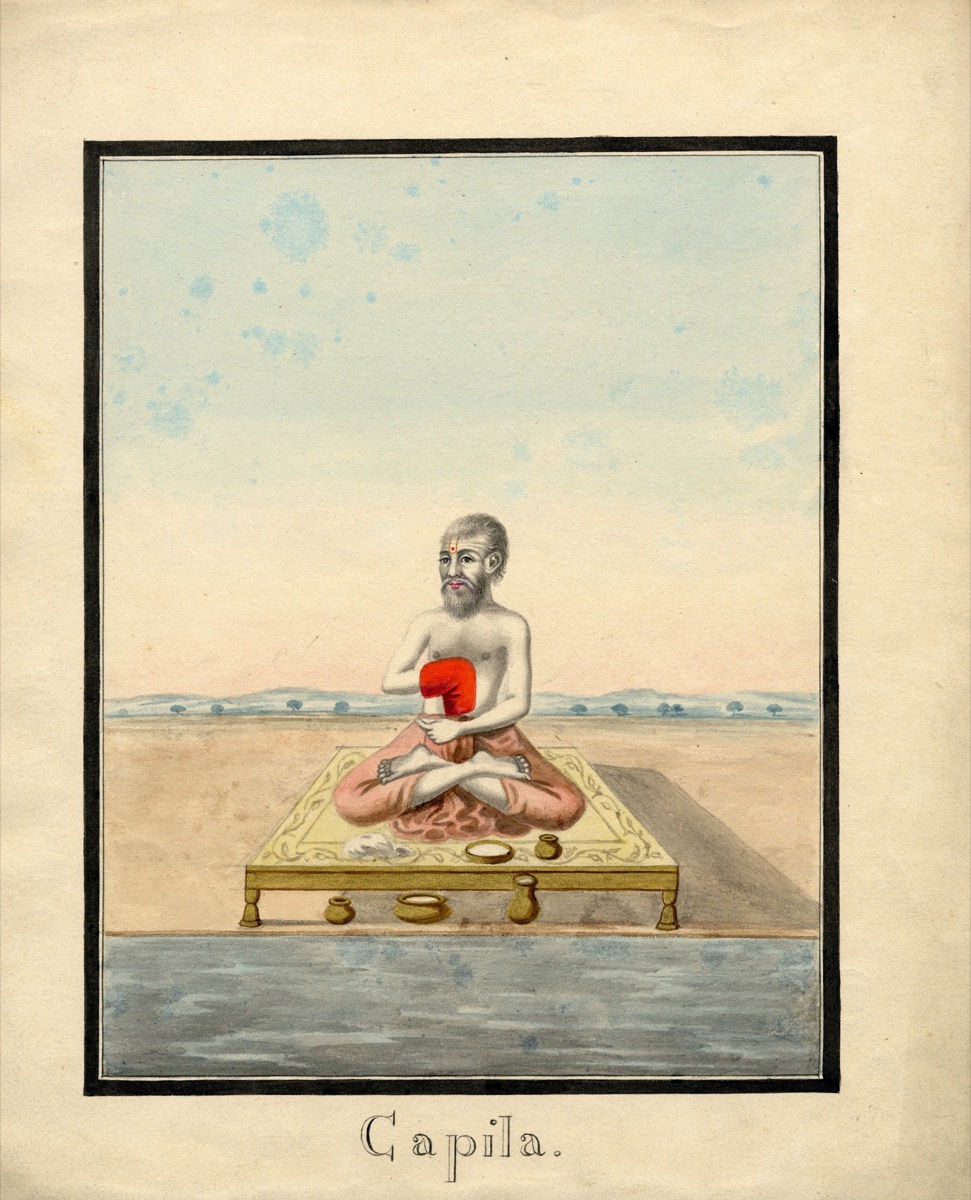
In artistic depictions, Kapila is typically shown as an aged ascetic seated in meditation, often on a raised platform near a body of water — reflecting his traditional association with the confluence of rivers and with the subterranean hermitage where he encountered Sagara’s sons. He bears Vaiṣṇava markings on his forehead (a tilaka or nāman), signifying his identity as an incarnation of Viṣṇu.
While Kapila does not have widespread temple worship comparable to major deities, he is venerated at several sacred sites. The Kapilāśrama at Sagar Island in West Bengal marks the traditional site of his hermitage. Siddhpur in Gujarat, associated with Devahūti’s spiritual practice, is another important pilgrimage destination. The Kapil Muni Temple at Kolkata’s Ganga Sagar is thronged by pilgrims, especially during the annual Ganga Sagar Mela.
Legacy
Sage Kapila’s contribution to Indian civilization is difficult to overstate. As the progenitor of Sāṅkhya, he established one of the earliest systematic attempts in human history to understand the nature of consciousness, matter, and their relationship — a philosophical project that continues to resonate with contemporary discussions in philosophy of mind, cognitive science, and phenomenology. His integration of rigorous analytical thought with spiritual aspiration set a template that would be followed by countless Indian thinkers across millennia.
Whether understood as a historical philosopher of ancient India, a mythological incarnation of the Supreme Being, or both, Kapila remains a towering presence in the Hindu intellectual tradition — the sage whose penetrating vision illuminated the fundamental categories of reality and whose teachings continue to guide seekers on the path to liberation.