Śakuntalā (शकुन्तला, “she who was nurtured by birds”) stands as one of the most beloved and enduring figures in Indian literary and cultural history. Her story — spanning the cosmic drama of celestial interference, the tenderness of forest romance, the agony of unjust separation, and the triumph of recognition and reunion — has been told and retold across more than two thousand years of Indian and world literature. From the narrative corridors of the Mahābhārata to the exquisite Sanskrit verse of Kālidāsa’s Abhijñānaśākuntalam, Śakuntalā embodies the ideals of steadfast love, dignity in adversity, and the quiet power of truth.
She is at once a daughter of heaven and earth — born of the sage Viśvāmitra and the celestial nymph Menakā, raised in the tranquil hermitage of Ṛṣi Kaṇva, and destined to become the wife of King Duṣyanta and the mother of Emperor Bharata, the legendary ruler after whom the Indian subcontinent takes its ancient name, Bhārata-varṣa.
Birth: The Meeting of Heaven and Earth
The story of Śakuntalā’s origin is itself a tale of cosmic proportions. According to the Ādi Parva of the Mahābhārata (Chapters 71–74), the great sage Viśvāmitra (originally a Kṣatriya king who became a Brahmarṣi through millennia of fierce penance) had accumulated such extraordinary ascetic power (tapas) that the gods themselves grew alarmed. Indra, king of the Devas, feared that Viśvāmitra’s austerities might unseat him from his celestial throne. To disrupt the sage’s meditation, Indra dispatched Menakā, the most beautiful of the Apsarās (celestial nymphs), to seduce him.
Menakā descended to earth near Viśvāmitra’s hermitage in the Himālayan foothills. As the wind god Vāyu blew away her garments at a strategic moment, the sage’s concentration was shattered. Overcome by desire, Viśvāmitra spent years in Menakā’s company, and from their union a daughter was born. But the celestial mission was complete — Menakā, bound by her divine duty, abandoned the infant on the banks of the river Mālinī in the Himālayan forests and returned to Indra’s court.
The newborn lay helpless in the wilderness, surrounded by dangers. Yet divine providence intervened: flocks of Śakunta birds (a species often identified with the Indian robin or the śakunī bird) gathered around the infant, sheltering her with their wings, feeding her, and protecting her from predators. When the venerable sage Kaṇva passed through the forest, he discovered the infant encircled by these guardian birds and was filled with compassion. He named her Śakuntalā — “she who was protected by the Śakunta birds” — and took her to his āśrama to raise as his own daughter (Mahābhārata, Ādi Parva 1.74).
Life in Kaṇva’s Hermitage
Śakuntalā grew up in the serene environment of Kaṇva’s forest hermitage (āśrama), a sacred space where sages performed Vedic rituals, students recited scriptures, and wild animals roamed without fear. This idyllic setting — where deer drank alongside ascetics, where sacred fires burned perpetually, and where the rhythms of nature and dharma moved in harmony — became a defining element of Śakuntalā’s character. She was raised not as a princess but as a child of the forest: tending sacred plants, watering young trees, caring for fawns, and learning the ways of natural piety.
Kālidāsa’s Abhijñānaśākuntalam portrays this hermitage life with extraordinary tenderness. Śakuntalā’s bond with nature is so deep that she cannot water the jasmine creeper (navamālikā) without whispering to it as a sister, or leave the hermitage without the deer tugging at the hem of her bark garments, unwilling to let her go (Act IV). This profound harmony between the human and natural worlds is central to Kālidāsa’s artistic vision and to Śakuntalā’s identity as a character who bridges heaven and earth, civilization and wilderness.
The Romance with Duṣyanta
The fateful encounter between Śakuntalā and King Duṣyanta of the Puru dynasty forms the dramatic heart of the story. In both the Mahābhārata and Kālidāsa’s version, the king arrives at Kaṇva’s āśrama while on a hunting expedition, pursuing a deer into the sacred precincts of the hermitage. There he encounters Śakuntalā — in the epic, she is alone in the āśrama while Kaṇva is away; in Kālidāsa’s play, she is tending the garden with her two companions, Anasūyā and Priyamvadā.
The Mahābhārata Version (Ādi Parva, Chapters 71–74)
In the epic account, the encounter is direct and candid. Duṣyanta is immediately captivated by Śakuntalā’s beauty and inquires about her parentage. When she reveals that she is the daughter of Viśvāmitra and Menakā, raised by Kaṇva, the king proposes a Gāndharva vivāha — a marriage by mutual consent, sanctioned by the Dharmaśāstra as one of the eight recognized forms of marriage, particularly appropriate for Kṣatriyas. Śakuntalā agrees, but wisely sets a condition: Duṣyanta must promise that the son born of their union will be his heir and successor. The king consents, and they are united.
Duṣyanta then returns to his capital, Hastināpura, promising to send an escort for Śakuntalā. However, the escort never comes. When Śakuntalā’s son is born — a remarkable child who by the age of six can tame lions and ride elephants — she travels to the royal court with the boy. In the Mahābhārata version, Duṣyanta’s refusal to acknowledge her is portrayed not as the result of a curse but as a deliberate act of political calculation and social propriety. He publicly denies knowing her, calling her a liar before the assembled court. Śakuntalā responds with one of the most powerful speeches in the entire epic, a searing indictment of male dishonesty and a fierce assertion of a woman’s dignity and truth:
“The husband entering his wife makes her body his own, and she brings him forth again from her own body. Therefore, the wife is called jāyā (‘she who gives birth to him again’). The son born of one’s wife is one’s own reflection seen in a mirror.” (Ādi Parva 1.74.40–42)
A celestial voice (divyā vāk) finally intervenes, commanding Duṣyanta to accept Śakuntalā and their son, confirming the boy as his legitimate heir. The child is named Bharata (“the cherished one”), and it is this Bharata who grows up to become the emperor after whom the Indian land is called Bhārata.
Kālidāsa’s Version (Abhijñānaśākuntalam)
Kālidāsa, widely regarded as the greatest poet of classical Sanskrit (c. 4th–5th century CE), transformed this robust epic narrative into an exquisitely crafted seven-act drama that became one of the most celebrated works of world literature. His genius lay in introducing the element of the curse — transforming Duṣyanta from a calculating king into a genuinely forgetful lover, thereby elevating the story from a tale of masculine betrayal into a transcendent meditation on love, memory, and recognition.
In Kālidāsa’s version, the romance unfolds gradually through stolen glances and tender conversations in the forest. The famous scene in Act I, where Śakuntalā pretends to be stung by a bee so that Duṣyanta might reveal himself, exemplifies Kālidāsa’s mastery of śṛṅgāra rasa (the aesthetic sentiment of love). After Duṣyanta departs, Śakuntalā pines for him, lost in lovesick reverie.
Durvāsā’s Curse
The dramatic pivot of Kālidāsa’s play — and the element that gives it its title (Abhijñāna means “recognition” or “token”) — is the curse of the irascible sage Durvāsā. While Śakuntalā sits dreaming of Duṣyanta, the notoriously short-tempered sage arrives at the hermitage seeking hospitality. Lost in thoughts of her beloved, Śakuntalā fails to notice him and neglects the sacred duty of receiving a guest (atithi-dharma). Enraged, Durvāsā pronounces a devastating curse:
“He whom you think of, to the exclusion of all else, shall forget you entirely!” (Act IV)
Śakuntalā’s companion Anasūyā desperately intercedes, and Durvāsā relents partially: the curse shall be lifted when the king sees a token of recognition — the signet ring (abhijñāna) that Duṣyanta had given Śakuntalā as a pledge of their love. But Śakuntalā, unaware of the curse, does not know that the ring is now the only thread connecting her to her husband’s memory.
The Rejection and the Lost Ring
When Śakuntalā, now visibly pregnant, travels to Hastināpura accompanied by Kaṇva’s disciples, she is presented to King Duṣyanta in the royal court. But the curse has taken full effect — the king stares at her blankly, with no flicker of recognition. He denies ever having met her, much less married her. When Śakuntalā reaches for the ring to prove her identity, she discovers to her horror that it has slipped from her finger — lost while bathing in the sacred pool of the river Śacī-tīrtha during the journey.
Publicly humiliated and abandoned, Śakuntalā cries out in anguish. In a moment of divine intervention, her mother Menakā sends a celestial light that carries Śakuntalā away to the hermitage of Ṛṣi Mārīca (Kaśyapa) in the celestial realm, where she gives birth to her son.
Meanwhile, a fisherman discovers the royal signet ring inside the belly of a fish he has caught. When the ring is brought to Duṣyanta, his memories flood back — the forest hermitage, the gentle maiden, the Gāndharva marriage. Consumed by remorse and grief, the king mourns for the wife he has wronged, painting her portrait from memory and gazing at it in anguish (Act VI).
Reunion
The final act of the play brings about the longed-for reunion. Duṣyanta, now aiding Indra in a battle against the demon Kālanemi, travels through the celestial realms and arrives at the hermitage of Ṛṣi Mārīca. There he encounters a fearless young boy playing with a lion cub — his own son Sarvadamana (“tamer of all”), the future Emperor Bharata. Śakuntalā appears, thin and pale from years of ascetic grief, wearing a single braid of mourning. When Duṣyanta sees the ring-mark on her finger and recognizes her, the moment of abhijñāna (recognition) is complete. Mārīca blesses the reunited couple, the curse is fully dissolved, and they return to Hastināpura, where Bharata is declared the rightful heir.
Mother of Bharata: India’s Namesake
The historical and mythological significance of Śakuntalā extends far beyond her personal love story. Her son Bharata (भरत) became one of the most illustrious rulers in Indian legendary history — a cakravartin (universal emperor) whose dominion extended across the entire subcontinent. It is after this Bharata that India takes its constitutional Sanskrit name, Bhārata (भारत), and the great epic itself is called the Mahā-bhārata (“The Great [Story] of the Bharatas”).
The Ādi Parva describes Bharata as a child of supernatural prowess: by the age of six, he could capture and tame wild lions, elephants, and tigers, binding them to trees near the āśrama with his bare hands. As a king, he performed numerous Aśvamedha (horse sacrifice) and Rājasūya yajñas, establishing dharmic rule across the land. The lineage descending from Bharata includes the Kauravas and Pāṇḍavas of the Mahābhārata, making Śakuntalā the ancestral matriarch of the epic’s entire royal dynasty.
Literary Significance: Kālidāsa’s Masterpiece
The Abhijñānaśākuntalam is universally regarded as the crown jewel of Sanskrit drama and one of the finest literary achievements of the ancient world. Kālidāsa’s treatment of Śakuntalā’s story exemplifies his signature qualities: mastery of all nine rasas (aesthetic sentiments), profound sensitivity to nature (prakṛti), psychological depth in characterization, and an ability to weave philosophical themes into seemingly simple narratives.
The play is structured around the concept of viraha (separation) — the exquisite pain of lovers torn apart — which Indian aesthetic theory regards as the highest intensification of śṛṅgāra rasa. The fourth act, in which Śakuntalā departs from the hermitage to join Duṣyanta, is considered by scholars to be one of the most poignant scenes in all of world dramatic literature. The trees shed flowers in farewell, the deer refuse to eat, and old Kaṇva weeps as his foster-daughter leaves — a scene so moving that it has been said to make even stones weep.
The play’s influence on world literature was catalyzed by Sir William Jones’s English translation in 1789 — the first Sanskrit dramatic work translated into a European language. The translation caused a sensation in Romantic-era Europe. The German polymath Johann Wolfgang von Goethe was so profoundly moved that he composed a famous quatrain:
“Willst du die Blüthe des frühen, die Früchte des späteren Jahres, Willst du, was reizt und entzückt, willst du, was sättigt und nährt, Willst du den Himmel, die Erde, mit Einem Namen begreifen, Nenn’ ich, Sakontala, Dich, und so ist Alles gesagt.”
(“If you wish to encompass the blossoms of spring and the fruits of autumn, all that enchants and satisfies, heaven and earth in one name — I name you, Śakuntalā, and all is said.”)
This praise from Goethe brought the play to the attention of the entire European literary establishment, influencing writers from Herder to Schopenhauer and contributing to the birth of Indology as an academic discipline.
Raja Ravi Varma’s Iconic Paintings
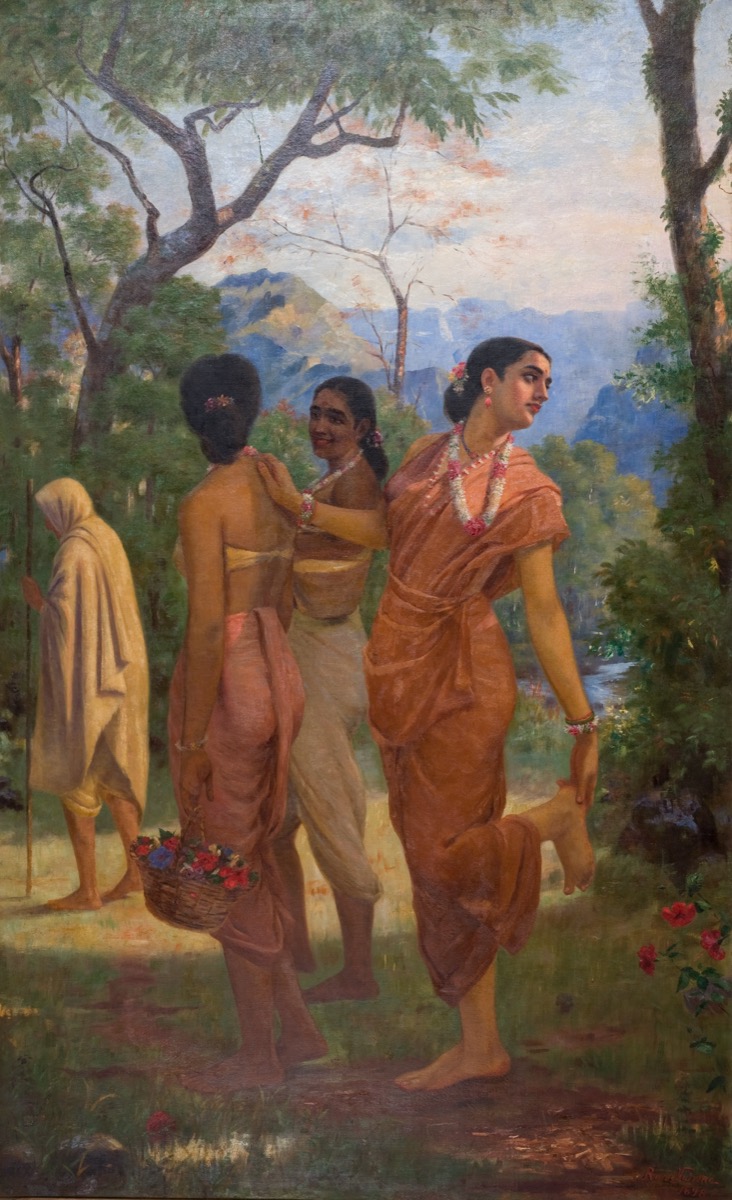
In the visual arts, no depiction of Śakuntalā is more famous than the paintings by Raja Ravi Varma (1848–1906), the pioneering Indian artist who synthesized European academic painting techniques with Indian mythological subjects. His 1898 oil painting Śakuntalā Patralekhanā (“Śakuntalā Writing a Love Letter”) and the celebrated canvas depicting Śakuntalā pretending to remove a thorn from her foot while looking back for a glimpse of Duṣyanta — with her companions Anasūyā and Priyamvadā teasing her — became the defining visual image of the character.
Ravi Varma’s Śakuntalā paintings did more than illustrate a literary text; they created a new visual language for Indian mythological identity, blending the idealized beauty of European Salon painting with the emotional resonance of Sanskrit poetry. His oleograph prints of Śakuntalā circulated across India in the millions, bringing this ancient literary heroine into the homes of ordinary Indians and establishing her as a national cultural icon. The original 1898 painting is housed at the Sree Chitra Art Gallery in Thiruvananthapuram, Kerala.
Feminist Readings and Modern Interpretations
Modern scholarship has increasingly examined Śakuntalā through feminist and postcolonial lenses, yielding rich and sometimes contrasting interpretations.
In the Mahābhārata version, Śakuntalā is a figure of remarkable agency and rhetorical power. When Duṣyanta denies her in the royal court, she does not weep or plead — she delivers a devastating philosophical argument about the nature of marriage, the sanctity of truth, and a woman’s rights, drawing on Vedic authority to shame the king. Scholars such as Irawati Karve (in Yugānta) have read this Śakuntalā as a proto-feminist figure who speaks truth to patriarchal power.
In Kālidāsa’s version, the introduction of the curse shifts moral responsibility away from Duṣyanta, and some feminist critics (notably Romila Thapar in Śakuntalā: Texts, Readings, Histories) have argued that this softening transforms Śakuntalā from an assertive agent into a more passive, suffering heroine — a transformation that reflects changing patriarchal norms between the epic period and the classical Gupta era. However, others counter that even in Kālidāsa’s play, Śakuntalā possesses a quiet dignity and moral authority that transcends victimhood; her suffering ennobles rather than diminishes her, and the play ultimately vindicates her truth.
Contemporary retellings — including Namita Gokhale’s Śakuntalā: The Play of Memory and various theatrical adaptations — continue to explore these tensions, reimagining Śakuntalā for new audiences while honoring the depth of the original narratives.
Śakuntalā in Indian Cultural Memory
Beyond literature and art, Śakuntalā permeates Indian cultural consciousness in numerous forms. She appears in classical dance traditions — Bharatanāṭyam, Kathak, and Odissi regularly feature episodes from the Śakuntalā story. Indian cinema has adapted her tale multiple times, from V. Shantaram’s 1943 Marathi film Shakuntala to numerous Telugu, Tamil, and Hindi versions. The Indian postal service has issued stamps featuring Ravi Varma’s Śakuntalā paintings. The Kalidasa Academy in Ujjain regularly stages the Abhijñānaśākuntalam, and the play remains part of the Sanskrit curriculum across Indian universities.
In temple iconography, Śakuntalā occasionally appears alongside Duṣyanta in sculptural panels depicting scenes from the Mahābhārata — notably at Halebidu and Belur in Karnataka, where Hoysala-era carvings depict the forest romance. Her story is also part of oral traditions across India, told at family gatherings and in folk performances as a timeless parable about the endurance of true love and the ultimate triumph of dharma over injustice.
Legacy
Śakuntalā’s enduring significance lies in the multiple layers of meaning her story carries. She is at once a romantic heroine — the embodiment of tender, faithful love tested by cosmic forces; a cultural ancestor — the mother of the dynasty that gives India its name; a literary icon — the central figure of what many regard as the greatest work of Sanskrit literature; and a philosophical symbol — representing the tension between worldly attachment and spiritual duty, between memory and forgetting, between justice and the arbitrary cruelty of fate.
Two and a half millennia after Vyāsa first told her story in the Mahābhārata, and sixteen centuries after Kālidāsa immortalized her in verse, Śakuntalā continues to speak across time and cultures — a testament to the universality of her story and the inexhaustible depth of the Indian literary imagination.