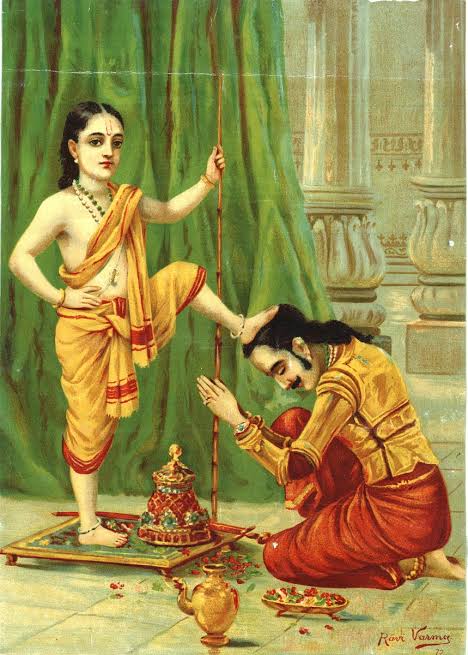
Vāmana (वामन), the fifth avatāra of Lord Viṣṇu, occupies a uniquely paradoxical position among the Daśāvatāras: he is the smallest in form yet the most cosmic in deed. Appearing as a diminutive Brahmin boy before the mighty demon king Bali (Mahābalī), Vāmana asked for a seemingly trivial gift — three paces of land — only to expand into the universe-spanning form of Trivikrama, covering the earth with one stride, the heavens with the second, and demanding the third upon Bali’s own head. This narrative, rich in theological depth, explores themes of divine humility, the limits of material power, the nature of true devotion, and the cosmic order (ṛta) that even the most righteous must honour.
The story of Vāmana is told across multiple sacred texts, including the Ṛg Veda (1.154), the Śatapatha Brāhmaṇa, the Viṣṇu Purāṇa, the Bhāgavata Purāṇa (Canto 8, Chapters 15-23), and the dedicated Vāmana Purāṇa — one of the eighteen Mahāpurāṇas. In each retelling, the essential message remains: divine power transcends physical appearance, and true sovereignty belongs not to those who conquer the world but to those who surrender to the Supreme.
The Context: Bali’s Cosmic Conquest
The story begins with Prahlāda, the great devotee of Viṣṇu whose steadfast faith led to the destruction of his demonic father Hiraṇyakaśipu by the Narasiṁha avatāra. Prahlāda’s grandson was Bali (also called Mahābalī), who inherited his grandfather’s devotion but also the ambition of the Asura dynasty. Under the guidance of his guru Śukrācārya (the preceptor of the Asuras), Bali performed the Viśvajit Yajña — a grand cosmic sacrifice — through which he acquired divine weapons and invincible armour.
Empowered by the fruits of his sacrifice, Bali launched an assault on Svarga (heaven), defeating Indra and the Devas in battle. According to the Bhāgavata Purāṇa (8.15.10-28), the Devas fled in disarray, and Bali established his sovereignty over all three worlds — earth (Bhūrloka), atmosphere (Bhuvarloka), and heaven (Svarloka). Yet unlike typical Asura conquests, Bali’s rule was remarkably just and generous. He performed great yajñas, distributed wealth to Brahmins, and governed with dharma. His generosity became legendary — so vast that it threatened the cosmic order itself.
The Devas, dispossessed and fearful, appealed to Lord Viṣṇu for help. Viṣṇu, however, acknowledged Bali’s virtue. The Bhāgavata Purāṇa (8.15.29) records that Viṣṇu told Indra’s mother Aditi: “Bali is a great devotee and a righteous ruler. I will not destroy him, but I will restore the cosmic order through a different means.” This response reveals a central theological nuance of the Vāmana narrative: the avatāra comes not to punish evil but to rebalance dharma.
The Birth of Vāmana
Aditi, the mother of the Devas, performed the Payovrata — a twelve-day fast and worship of Viṣṇu — seeking divine intervention. Pleased by her devotion, Viṣṇu agreed to incarnate as her son. He was born on the twelfth day of the bright half of Bhādrapada (August-September), a day celebrated as Vāmana Dvādaśī or Vāmana Jayantī.
The Bhāgavata Purāṇa (8.18.1-12) describes the child’s appearance: he was short in stature, with a brilliant complexion like molten gold, wearing the sacred thread (yajñopavīta), carrying a bamboo umbrella (chatrī), a water pot (kamaṇḍalu), and a staff (daṇḍa) — the emblems of a Brahmin student (brahmacārī). Despite his small form, the text says that “the earth trembled at his step, and the directions brightened at his glance.”
Vāmana’s physical smallness is theologically deliberate. The Viṣṇu Purāṇa (Book 5) emphasises that God chooses the humble form to teach that true greatness lies not in outward magnificence but in inner divinity. The dwarf body conceals the infinite — a recurring motif in Vaiṣṇava theology where the Supreme hides within the accessible and approachable.
The Encounter with Bali
Vāmana arrived at the site of Bali’s great Aśvamedha Yajña (horse sacrifice) on the banks of the Narmadā River. The assembled sages, priests, and kings were astonished by the radiance emanating from this tiny Brahmin boy. According to the Bhāgavata Purāṇa (8.18.22-28), even Bali was moved: “Who is this luminous child? His presence seems to fill the entire sacrificial arena.”
Bali, true to his nature as the most generous of donors, welcomed Vāmana with respect, washed his feet, and asked what gift the young Brahmin desired. Vāmana’s request was deceptively modest:
“O great king, I ask only for three paces of land, measured by my own feet. I am a simple Brahmin and have no need for gold, cattle, or kingdoms.”
Bali laughed at the smallness of the request. But his guru Śukrācārya, recognizing the divinity concealed within the dwarf, urgently warned him: “This is no ordinary Brahmin — this is Viṣṇu himself in disguise! Do not grant this boon, or you will lose everything!” (Bhāgavata Purāṇa 8.19.30-35).
Bali’s response to Śukrācārya is one of the most celebrated passages in the Purāṇas. He declared: “If the Lord himself has come to my door as a supplicant, what greater fortune could there be? To refuse a gift to Viṣṇu would be the greatest dishonour. Even if I lose all three worlds, I will not break my word.” This response reveals Bali as not merely generous but profoundly devoted — willing to sacrifice everything for the opportunity to serve God directly.
Bali then solemnized his gift by pouring water from his kamaṇḍalu onto Vāmana’s hands — the ritual of dāna (giving).
The Cosmic Expansion: Trivikrama
The moment the water of gift-giving touched Vāmana’s hands, the transformation began. The Bhāgavata Purāṇa (8.20.16-32) describes the scene in magnificent cosmic imagery:
The tiny Brahmin boy began to grow. His form expanded beyond human proportions, beyond the sacrificial arena, beyond the horizon. His feet sank into the earth and his head pierced the heavens. The sun and moon became his eyes; the wind was his breath; the rivers his veins. He became Trivikrama — the “one of three strides” — a form so vast that it encompassed the entire universe.
With his first stride, Trivikrama covered the entire earth — all of Bhūrloka, from the mountains to the oceans. With his second stride, he covered the heavens — Svarloka and all celestial realms, reaching to the edge of the cosmic egg (Brahmāṇḍa). The Ṛg Veda (1.154.1-3), in one of the oldest references to this myth, praises Viṣṇu’s three strides:
“Of Viṣṇu now I declare the mighty works, who has measured the earthly regions, who propped the heavens above, stepping forth three times, wide-striding.”
Now there was no space left for the third stride. Trivikrama turned to Bali and asked: “Where shall I place my third step? You promised three paces, but the earth and heavens are already mine.”
Bali’s Supreme Surrender
This is the theological climax of the narrative. Bali, stripped of all his kingdoms, all his wealth, all his cosmic sovereignty, stood before the infinite form of God and responded with the highest act of devotion. He bowed his head and said (Bhāgavata Purāṇa 8.22.2):
“O Lord, place your third step upon my head. My head is all that remains to me, and I offer it to you.”
This act of ātma-samarpaṇa (self-surrender) transforms Bali from a defeated king into one of the greatest devotees in Hindu scripture. The Bhāgavata Purāṇa ranks him among the twelve Mahājanas — supreme knowers of dharma. His surrender is not born of defeat but of recognition: recognizing that all sovereignty, all wealth, and all power ultimately belong to the divine, Bali joyfully returns what was never truly his.
Vāmana, moved by Bali’s devotion, did not destroy him. Instead, he granted Bali lordship over Sutala (a region of the nether worlds described as more beautiful than heaven) and promised that Bali would become the Indra of the next cosmic cycle (manvantara). According to the Bhāgavata Purāṇa (8.22.25-35), Viṣṇu himself declared: “I will stand as the doorkeeper of your palace in Sutala, for a devotee of your calibre deserves my personal presence.”
The Onam Festival: Bali’s Annual Return
The Vāmana-Bali narrative has its most vibrant living expression in Kerala, where King Bali — called Mahābalī or Māveli — is venerated as the ideal ruler. Keralites believe that Bali was so beloved by his people that Viṣṇu granted him permission to return to earth once every year to visit his former kingdom.
This annual return is celebrated as Onam (ഓണം), the most important festival of Kerala, falling in the month of Chingam (August-September). During Onam, Keralites:
- Create elaborate floral carpets (pūkkalam) to welcome Māveli
- Prepare the grand feast Onasadya — a traditional meal of up to 26 dishes served on banana leaves
- Perform the Vallamkali (snake boat races) on the backwaters
- Sing Onam songs that recall Māveli’s golden age: “When Māveli ruled the land, all people were equal; there was no falsehood, no deceit, no illness”
The Onam celebration represents a remarkable theological inversion: the “defeated” demon king is honoured above the victorious god. This reflects the deeply nuanced Hindu understanding that Bali’s devotion and righteousness are as worthy of celebration as Viṣṇu’s cosmic power.
The Vāmana Purāṇa
The Vāmana Purāṇa, one of the eighteen major Purāṇas, is specifically dedicated to the Vāmana avatāra. Though it contains the central narrative, it is also a comprehensive encyclopaedia of Hindu cosmology, geography, and ritual. The text describes:
- The sacred geography of Kurukṣetra and the holy rivers
- The mythology of various Śiva temples and tīrthas
- Detailed accounts of cosmic creation and dissolution
- The dharma of gift-giving (dāna-dharma), inspired by Bali’s supreme generosity
The text emphasises that Vāmana’s mission was not merely political (restoring the Devas) but spiritual — demonstrating that even the mightiest material power must bow before the infinite.
Iconography and Temple Worship
Vāmana is typically depicted in two forms:
-
Vāmana (the dwarf): A small Brahmin boy with four arms, holding a parasol, water pot, and staff. His expression is serene, often with a gentle smile that hints at the cosmic power hidden within.
-
Trivikrama (the cosmic strider): A colossal figure with one foot on the earth, one raised to the heavens, and multiple arms radiating in all directions. This form appears widely in South Indian temple sculpture, notably at Mahabalipuram, Badami (Cave 3, 6th century CE), and Srirangam.
Major temples dedicated to Vāmana include:
- Thrikkakara Vamana Murthi Temple, Kochi, Kerala — the primary centre of Onam celebrations
- Vamana Temple, Khajuraho — an 11th-century masterpiece of Pratīhāra architecture
- Trivikrama Perumal Temple, Tirukkoyilur — one of the 108 Divya Desams
Theological Significance
The Vāmana avatāra carries multiple layers of meaning:
- Humility as Divine Strategy: God chooses the smallest form to accomplish the greatest deed, teaching that pride is the obstacle to spiritual realization
- The Limits of Material Power: Bali’s conquest of the three worlds is undone by three steps, demonstrating that material sovereignty is ultimately illusory
- Devotion Transcends Defeat: Bali loses everything materially but gains everything spiritually — the personal presence of God
- Cosmic Order (Ṛta): Even a righteous Asura cannot permanently displace the cosmic hierarchy; dharma requires balance, not domination
- The Grace of Surrender: The highest spiritual act is not accumulation but relinquishment — offering oneself entirely to the divine
The Ṛg Veda (1.154.5) declares of Viṣṇu’s three strides: “In his three wide strides, all living beings dwell.” This ancient verse encapsulates the essence of the Vāmana myth: the divine pervades all realms, and recognizing this pervading presence — as Bali ultimately did — is the path to liberation.
In the grand arc of the Daśāvatāras, Vāmana represents the transition from the early animal and semi-divine incarnations to the fully human forms of Paraśurāma, Rāma, and Kṛṣṇa. He is the first avatāra to appear in fully human guise, marking the point where Viṣṇu’s engagement with the world becomes increasingly personal, intimate, and relational — culminating in the supreme devotional relationships of the later avatāras.