Introduction
Vasiṣṭha (IAST: Vasiṣṭha; Sanskrit: वसिष्ठ, “most excellent”) is one of the most venerated sages in the Hindu tradition and occupies a position of unparalleled authority across Vedic, epic, and Purāṇic literature. He is foremost among the Saptarṣis — the seven primordial sages who preside over the current Manvantara (cosmic epoch) — and is the only sage to hold the exalted title of Brahmarṣi, a seer who has realised Brahman completely. His name itself, derived from the Sanskrit superlative vasiṣṭha (“most wealthy,” “most excellent”), reflects the tradition’s reverence for his spiritual pre-eminence (Wikipedia, “Vasishtha”; VedicFeed, “Saptarishi”).
Vasiṣṭha’s legacy spans every major stratum of Hindu sacred literature. He is credited as the principal seer (draṣṭā) of the entire seventh Maṇḍala of the Ṛg Veda. He is the owner of the legendary wish-fulfilling cow Kāmadhenu (Nandinī/Śabalā). He is the eternal rival — and ultimate reconciler — of King Viśvāmitra. He is the kulapurohita (royal priest) and spiritual preceptor of the Ikṣvāku (Solar) dynasty, including King Daśaratha and Lord Rāma. His wife Arundhatī is the supreme exemplar of marital devotion in Hindu culture. And the monumental philosophical text Yoga Vāsiṣṭha is framed as his discourse to Prince Rāma on the nature of consciousness and liberation.
Birth and Divine Origin
The Purāṇic accounts of Vasiṣṭha’s origin vary, but all affirm his divine provenance. According to the Brahma Purāṇa and the Viṣṇu Purāṇa, Vasiṣṭha was a mānasa-putra (mind-born son) of Lord Brahmā — one of the Prajāpatis created at the very dawn of creation to populate and guide the universe. The Ṛg Veda (7.33.11–13) itself alludes to his miraculous birth, stating that Vasiṣṭha was born from the combined will of the gods Mitra and Varuṇa, placed in a water-jar (kumbha), and that the celestial nymph Urvaśī was involved in his genesis. The Bṛhadāraṇyaka Upaniṣad (2.2.6) lists him among the greatest seers in the spiritual lineage descending from Brahman itself (Wikipedia, “Vasishtha”).
In some Purāṇic recensions, Vasiṣṭha is described as having been born multiple times across different cosmic cycles. In the current Manvantara (the Vaivasvata Manvantara, the seventh), he is one of the seven Saptarṣis alongside Atri, Viśvāmitra, Kaśyapa, Jamadagni, Bharadvāja, and Gotama. This idea of cyclical rebirth underscores the Hindu understanding that Vasiṣṭha is not merely a historical figure but an eternal archetype of wisdom and dharmic authority.
Seer of Ṛg Veda Maṇḍala 7
Vasiṣṭha’s most concrete contribution to the Vedic corpus is his authorship of the seventh Maṇḍala (book) of the Ṛg Veda, which contains 104 hymns (sūktas). According to the Ṛgvedānukramaṇī (the traditional index of the Ṛg Veda), all hymns in this Maṇḍala are attributed to Vasiṣṭha and his descendants, the Vasiṣṭha gotra (Wikipedia, “Mandala 7”).
The seventh Maṇḍala is notable for several reasons:
- Hymns to Agni and Indra: The majority of hymns are addressed to Agni (the sacrificial fire, hymns 1–18) and Indra (the king of gods, hymns 19–36), reflecting Vasiṣṭha’s role as the pre-eminent ritual priest.
- The Battle of the Ten Kings (Dāśarājña): Hymns 7.18, 7.33, and 7.83 recount the pivotal Battle of the Ten Kings, in which the Bharata king Sudās Paijavana, guided by Vasiṣṭha as his chief priest, defeated a coalition of ten tribal kings on the banks of the river Paruṣṇī (modern Ravi). Hymn 7.33 is an especially personal composition, praising Vasiṣṭha himself for invoking the gods’ favour and securing victory. This battle is one of the earliest recorded military engagements in Indo-Aryan history and marks the ascendancy of the Bharata tribe, from which India (Bhārata) derives its name (Wikipedia, “Battle of the Ten Kings”).
- Hymns to Varuṇa: Several hymns (7.86–7.89) are deeply personal appeals to the god Varuṇa, expressing the poet’s anguish at being separated from the divine and seeking forgiveness for transgressions. These are among the most emotionally compelling and philosophically profound passages in the entire Ṛg Veda.
The Vasiṣṭha family hymns established a priestly lineage (gotra) that remains one of the most prominent in Brahmanical tradition to this day. Millions of Hindus trace their ritual identity to the Vasiṣṭha gotra.
Kāmadhenu: The Divine Wish-Fulfilling Cow
One of the most celebrated legends associated with Vasiṣṭha concerns his possession of Kāmadhenu (also known as Nandinī or Śabalā), the divine wish-fulfilling cow. According to the Mahābhārata (Ādi Parva, chapters 174–177) and the Rāmāyaṇa (Bāla Kāṇḍa, chapters 51–56), Kāmadhenu was a celestial bovine capable of granting any desire and producing unlimited food, wealth, and armies.
The story unfolds as follows: King Viśvāmitra (then a Kṣatriya monarch named Kauśika), while travelling with his army, arrived at Vasiṣṭha’s hermitage. The sage invited him to a feast, and through the miraculous power of his cow Śabalā, produced a lavish banquet for the entire army. Astonished by the cow’s powers, Viśvāmitra demanded that Vasiṣṭha surrender the animal, offering thousands of ordinary cows, elephants, horses, and gold in exchange. When the sage refused — explaining that Kāmadhenu was essential for his sacrificial rites and charitable obligations — Viśvāmitra attempted to seize her by force (Wikipedia, “Kamadhenu”).
Śabalā, distressed at being dragged away, appealed to Vasiṣṭha, who told her to act according to her own nature. The divine cow then produced vast armies of fierce warriors — Pahlavas from her tail, Shakas and Yavanas from her udder, Kambojas from her mouth, and other martial tribes from various parts of her body — who destroyed Viśvāmitra’s entire army and killed all his hundred sons. Humiliated and devastated, Viśvāmitra realised that military might (kṣātra-bala) was inferior to spiritual power (brahma-teja). This realisation drove him to renounce his kingdom and undertake centuries of extreme austerities to transform himself from a Kṣatriya king into a Brahmarṣi.
The story carries profound theological import: it demonstrates the supremacy of tapas (spiritual austerity) over material and military power, and it establishes Vasiṣṭha as the embodiment of brahma-teja — the radiance that comes from the realisation of Brahman.
The Rivalry with Viśvāmitra
The conflict over Kāmadhenu was only the beginning of a legendary rivalry that spans numerous episodes across the Mahābhārata, Rāmāyaṇa, and the Purāṇas. After his initial defeat, Viśvāmitra undertook progressively severe penances, gradually ascending through the ranks of sagehood — from Rājarṣi (royal sage) to Ṛṣi to Maharṣi — but the title of Brahmarṣi eluded him, because it could only be conferred by Vasiṣṭha himself.
Several episodes mark this protracted contest:
-
Triśaṅku’s Ascent: When King Triśaṅku of the Ikṣvāku dynasty wished to ascend to heaven in his mortal body and Vasiṣṭha refused to perform the impossible sacrifice, Viśvāmitra undertook the ritual and, through sheer yogic power, began lifting Triśaṅku bodily into the heavens. When the gods cast Triśaṅku back down, Viśvāmitra created an entirely new constellation (Triśaṅku’s heaven) to fulfil his promise — a feat that displayed extraordinary power but also stubborn pride.
-
The Curse of Vasiṣṭha’s Sons: In some Purāṇic accounts, Viśvāmitra’s machinations led to the deaths of Vasiṣṭha’s hundred sons (either through battle during the Kāmadhenu episode or through a separate curse). Grief-stricken, Vasiṣṭha attempted to end his own life by drowning in a river, casting himself from a cliff, and entering fire — but each time, the elements themselves refused to harm the great sage. The river Vipāśā (Beas) is said to have received its name because it “released” (vi-pāśa) Vasiṣṭha from its bonds, refusing to let him drown.
-
Final Reconciliation: After millennia of penance, Viśvāmitra eventually attained the spiritual purity required for the title of Brahmarṣi. In one of the most moving scenes in Hindu literature, Vasiṣṭha himself acknowledged Viśvāmitra’s achievement, addressing him as “Brahmarṣi Viśvāmitra.” The two erstwhile rivals embraced, demonstrating that the path of dharma ultimately leads to reconciliation and mutual respect.
Guru of the Ikṣvāku (Solar) Dynasty
Vasiṣṭha’s most enduring institutional role was as the hereditary kulapurohita (family priest) and spiritual preceptor of the Sūrya Vaṁśa (Solar dynasty), also known as the Ikṣvāku dynasty — the most illustrious royal lineage in Hindu tradition. The Rāmāyaṇa and the Purāṇas record that Vasiṣṭha served as guru to generations of Solar dynasty kings, beginning with Ikṣvāku himself (the son of Vaivasvata Manu) and continuing through Raghu, Aja, Daśaratha, and ultimately Rāma.
In the Rāmāyaṇa of Vālmīki, Vasiṣṭha plays several pivotal roles:
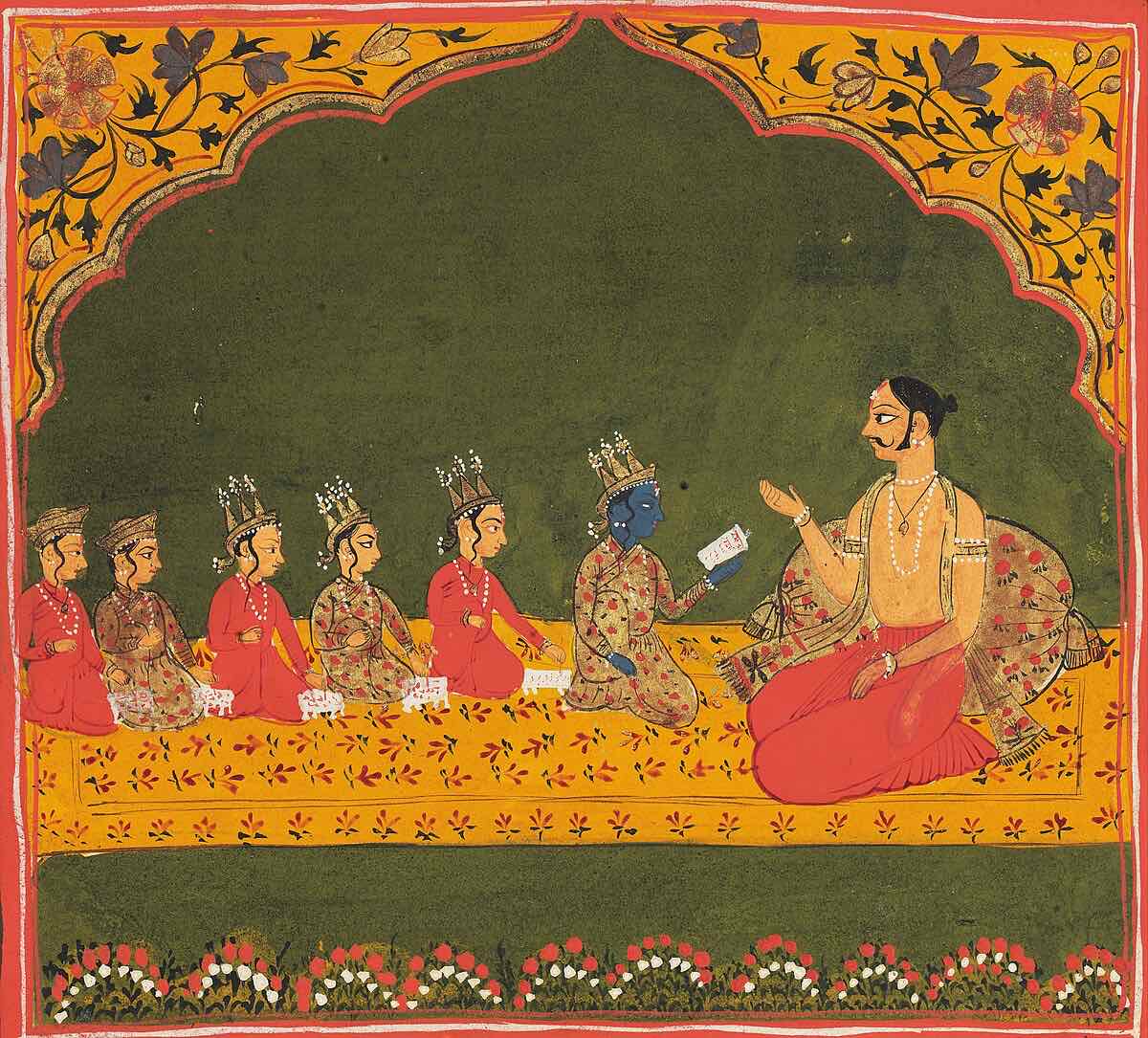
- Guru of the Princes: He served as the principal teacher (ācārya) at the gurukula where Rāma, Lakṣmaṇa, Bharata, and Śatrughna received their education in the Vedas, dharma-śāstra, martial arts, and statecraft.
- Adviser to Daśaratha: Vasiṣṭha counselled King Daśaratha on the Putrakāmeṣṭi yajña (fire sacrifice for obtaining sons), which led to the birth of Rāma and his brothers.
- Coronation Priest: Vasiṣṭha was chosen to preside over Rāma’s coronation ceremony, both the aborted first attempt and the eventual grand coronation after Rāma’s return from exile.
- Moral Authority: Throughout the Rāmāyaṇa, Vasiṣṭha serves as the voice of dharmic propriety, adjudicating disputes and guiding the royal family through crises.
The Mahābhārata (Śānti Parva) additionally records that Vasiṣṭha was the guru of Bhīṣma and taught dharma to numerous other Kṣatriya heroes.
Arundhatī: The Ideal Wife
Vasiṣṭha’s wife Arundhatī (Sanskrit: अरुन्धती) is one of the most revered female figures in Hindu tradition — the supreme embodiment of conjugal devotion (pativratā dharma), fidelity, and feminine spiritual power. The Mahābhārata and the Purāṇas describe her as the daughter of the Prajāpati Kardama (in some accounts, of Nārada or of the sage Medhātithi) and as a woman of extraordinary tapas in her own right (Wikipedia, “Arundhati (Hinduism)”).
Arundhatī’s significance extends beyond mythology into living Hindu ritual practice:
- Wedding Ritual (Arundhatī Darśanam): In traditional Hindu weddings, after the Saptapadī (seven steps), the groom shows the bride the double star of Vasiṣṭha and Arundhatī in the night sky (the stars Mizar and Alcor in Ursa Major). The couple is exhorted to emulate Vasiṣṭha and Arundhatī’s devotion, faithfulness, and mutual respect. This ritual, called Arundhatī Darśanam or Arundhatī Nakṣatram, is one of the most ancient and widespread customs in Hindu marriage ceremonies.
- Symbol of Marital Fidelity: Arundhatī is invoked in Hindu prayers and vows as the gold standard of wifely virtue. The phrase “Arundhatī-vrata” denotes the highest form of marital fidelity.
- Spiritual Authority: Unlike many legendary wives who are defined solely by their husbands, Arundhatī is celebrated in her own right as an accomplished sage, an expert in dharma, and a woman who attained spiritual realisation through her own tapas.
The Yoga Vāsiṣṭha
The Yoga Vāsiṣṭha (also called Mahā-Rāmāyaṇa, Ārṣa Rāmāyaṇa, or Vāsiṣṭha Rāmāyaṇa) is one of the most important philosophical texts in the Hindu tradition, comprising approximately 32,000 verses in six books (prakaraṇas). Dated by modern scholars to the period between the 11th and 14th centuries CE, the text is structured as a dialogue between Sage Vasiṣṭha and the young Prince Rāma, who is experiencing a spiritual crisis — a profound disillusionment with worldly existence — upon returning from a pilgrimage (Wikipedia, “Yoga Vasishtha”; Hindu University of America, “Yogavasistha”).
The six books are:
- Vairāgya Prakaraṇa (Dispassion) — Rāma’s existential despair and questioning
- Mumukṣu Prakaraṇa (Desire for Liberation) — The aspiration for freedom
- Utpatti Prakaraṇa (Creation) — Cosmology and the nature of the universe
- Sthiti Prakaraṇa (Existence) — The sustaining of creation and the nature of consciousness
- Upaśama Prakaraṇa (Dissolution) — Quiescence and the cessation of suffering
- Nirvāṇa Prakaraṇa (Liberation) — The final attainment of mokṣa
The central teaching of the Yoga Vāsiṣṭha is radical non-dualism: nothing exists except absolute consciousness (Brahman), and the perceived world is the imagination (kalpanā) of this universal consciousness. The text is philosophically aligned with Advaita Vedānta but incorporates elements of Yoga, Sāṁkhya, Śaiva Trika, and even Buddhist thought, making it a remarkably syncretic work. It was a major influence on Śrī Ramaṇa Maharṣi, who frequently recommended it and whose practice of ātma-vicāra (self-enquiry) is rooted in its teachings.
The Yoga Vāsiṣṭha presents its philosophy through a rich tapestry of stories within stories — the tales of Queen Līlā, the sage Uddālaka, the crow Bhūśuṇḍa, and many others — each illustrating the illusory nature of the world and the path to self-realisation.
The Star Vasiṣṭha: Mizar in Ursa Major
In Hindu astronomical tradition, the seven stars of the Big Dipper (Ursa Major) are identified with the Saptarṣis. The star Mizar (Zeta Ursae Majoris) is identified as Vasiṣṭha, and its faint optical companion Alcor (80 Ursae Majoris) is identified as Arundhatī. The association of the Saptarṣis with these stars is attested as early as the Ṛg Veda and elaborated in the Śatapatha Brāhmaṇa and the Purāṇas.
The Mizar-Alcor pair is a remarkable astronomical system: Mizar is itself a quadruple star system, and Alcor is a binary, making the pair together a sextuple system. In Hindu tradition, the fact that Alcor (Arundhatī) orbits in close proximity to Mizar (Vasiṣṭha) — neither leading nor following, but moving in synchrony — is interpreted as a symbol of the equal partnership and mutual devotion between husband and wife. The Mahābhārata (Vana Parva) contains an ominous reference: the sage Vyāsa observes that Arundhatī now appears “ahead of” Vasiṣṭha in the sky, an astronomical anomaly that he interprets as a portent of the apocalyptic war to come.
In ancient Indian tradition, the ability to see the faint star Alcor (Arundhatī) next to the bright Mizar (Vasiṣṭha) was used as a test of visual acuity, and the pair was pointed out to newlyweds as a celestial blessing.
Vasiṣṭha’s Cave: The Sacred Guha at Rishikesh
Vasiṣṭha Guhā (Vasishtha Cave) is an ancient cave located approximately 25 kilometres from Rishikesh on the road to Badrinath, on the banks of the Gaṅgā in Uttarakhand. According to tradition, this is the site where Sage Vasiṣṭha performed deep meditation (tapas) after the devastating loss of his hundred sons in the conflict with Viśvāmitra. Having been refused the release of death by the elements themselves — the river would not drown him, the fire would not burn him, the cliff would not break him — Vasiṣṭha found solace in meditation at this cave (eUttaranchal, “Vashistha Cave”).
The cave extends about 20 metres into the hillside and opens into a meditation chamber containing a Śivaliṅga. Nearby is the Arundhatī Guhā, a smaller cave associated with his wife. Since the 1930s, the cave has been maintained by the Swami Purushottamananda Society and continues to be an active site of meditation and spiritual practice. Many seekers, sannyāsins, and yogis from around the world visit the cave to meditate in the atmosphere that tradition holds has been charged with Vasiṣṭha’s millennia of tapas.
Texts Attributed to Vasiṣṭha
Beyond the Ṛg Veda hymns and the Yoga Vāsiṣṭha, several other significant texts bear Vasiṣṭha’s name:
- Vasiṣṭha Dharmasūtra: An ancient legal text (dated approximately 300–100 BCE) containing 1,038 sūtras on dharma, ritual conduct, social duties, and penances. It is one of the earliest surviving Dharmasūtra texts and provides invaluable insights into the legal and ethical framework of ancient Indian society (Wikipedia, “Vasishtha Dharmasutra”).
- Vasiṣṭha Saṁhitā: A medieval-era Yoga text that describes various āsanas, prāṇāyāma practices, and meditation techniques.
- Vasiṣṭha Siddhānta: An astronomical treatise attributed to the sage, dealing with planetary calculations, eclipses, and the calendar.
These diverse attributions reflect the tradition of ascribing foundational texts to the sage as a mark of authority and reverence.
Role in Establishing Dharma
Vasiṣṭha’s significance in Hindu tradition extends far beyond any single story or text. He represents the archetype of the dharma-sthāpaka — the establisher and guardian of cosmic and social order. Several dimensions of his dharmic authority deserve special emphasis:
- Supremacy of Spiritual Power: The Kāmadhenu episode and the rivalry with Viśvāmitra establish the principle that brahma-teja (the radiance of spiritual realisation) surpasses kṣātra-bala (military and political power). This principle undergirds the entire Hindu social philosophy.
- The Guru-Śiṣya Paramparā: As the hereditary guru of the Solar dynasty, Vasiṣṭha embodies the institution of the guru-paramparā (teacher-disciple lineage) — the primary mechanism through which Hindu tradition transmits sacred knowledge across generations.
- Reconciliation and Forgiveness: Despite the devastating personal losses inflicted by Viśvāmitra — the death of his sons, repeated provocations, and attempts at humiliation — Vasiṣṭha ultimately accepted and honoured his rival’s spiritual attainment. This act of magnanimity is presented as the highest expression of dharma.
- Cosmic Custodianship: As a Saptarṣi, Vasiṣṭha is not merely a sage of one era but a cosmic custodian — one of the seven pillars who uphold the dharmic order of the universe across the vast cycles of time.
Legacy and Living Tradition
Vasiṣṭha’s influence pervades Hindu life to this day. The Vasiṣṭha gotra is one of the most common priestly lineages in India, claimed by millions of Brahmins. The Arundhatī Darśanam continues in Hindu wedding ceremonies. The Yoga Vāsiṣṭha remains a cherished text for students of Advaita Vedānta and Yoga. Vasiṣṭha Guhā in Rishikesh draws seekers from across the world. And the stars Mizar and Alcor shine nightly in the northern sky as a celestial reminder of the sage and his devoted wife.
The traditional invocation of the Saptarṣis — “Bhṛgu, Atri, Aṅgiras, Vasiṣṭha, Pulastya, Pulaha, Kratu” — places Vasiṣṭha at the heart of the septad that upholds the cosmos. In his life and legend, Vasiṣṭha embodies the Hindu ideal that the highest power in the universe is not force or wealth, but the radiance of a mind that has realised the ultimate truth — Brahman.