Introduction
Vāyu (Sanskrit: वायु, “wind,” “air,” “breath”) is one of the most ancient and theologically significant deities of the Hindu tradition. In the Ṛgveda — the oldest of the four Vedas, composed between approximately 1700 and 1100 BCE — Vāyu appears as the god of wind, the first deity to receive the soma offering, and the divine force that animates all living creatures. The Ṛgveda opens its praise of Vāyu with the invocation: Vāya, ā yāhi darśateme somā araṁkṛtāḥ — “O Vāyu, come to us, these soma offerings have been prepared for you” (Ṛgveda 1.2.1), placing him immediately after Agni in the sequence of Vedic worship and underscoring his primacy among the atmospheric deities.
Unlike many Vedic gods whose prominence faded in later Hinduism, Vāyu’s significance has only deepened over the millennia. Through the Upaniṣads he became identified with prāṇa — the cosmic breath that sustains all life. Through the epics he became celebrated as the father of two of Hinduism’s greatest heroes: Hanumān and Bhīma. Through the Dvaita Vedānta philosophy of Madhvācārya, he was elevated to the position of Mukhya Prāṇa — the chief intermediary between the supreme God Viṣṇu and the created world. Vāyu is thus not merely a nature deity of ancient hymns but a living theological principle whose relevance spans the full arc of Hindu thought from the Vedic fire altars to modern-day prāṇāyāma practice.
Etymology and Cosmic Identity
The Sanskrit word vāyu derives from the verbal root vā, meaning “to blow” or “to move.” It is cognate with the Greek aēr (“air”) through the Proto-Indo-European root h₂weh₁- (“to blow”). The closely related term vāta (from the same root) appears in the Ṛgveda as a near-synonym, though scholars note a subtle distinction: vāta tends to refer to the physical, meteorological wind, while vāyu carries a more elevated, divine connotation — the cosmic wind, the breath of the universe (Wisdom Library, “God Vayu”).
In Vedic cosmology, Vāyu occupies the intermediate space (antarikṣa) between earth and heaven. He is the lord of the atmosphere, the dynamic force that mediates between the terrestrial fire (Agni) below and the celestial light (Sūrya/Indra) above. This positional theology is not accidental: Vāyu as wind literally connects earth to sky, carrying moisture upward as clouds and returning it as rain, bearing smoke from the sacrificial altar toward the heavens. He is the cosmic intermediary par excellence.
The Śatapatha Brāhmaṇa (1.2.5.5) declares: vāyur vai kṣepiṣṭhā devatā — “Vāyu is truly the swiftest of the gods.” This quality of supreme speed defines Vāyu’s character: he is present everywhere, instantly, without barrier or obstruction. Nothing can contain or obstruct the wind, and this freedom of movement made Vāyu a symbol of omnipresence and liberation.
Vāyu in the Ṛgveda
The Ṛgveda dedicates several hymns to Vāyu, both independently and in conjunction with Indra. In the Vedic sacrificial protocol, Vāyu holds a distinctive honour: he is the first deity to receive the morning soma draught. Ṛgveda 1.2.1–3 addresses Vāyu directly and invites him to partake of the pressed soma before any other god. This liturgical priority reflects the theological understanding that wind/breath is the most immediate and essential of the natural forces — without air, there is no life, no fire, no speech, no sacrifice.
Several Ṛgvedic hymns describe Vāyu’s chariot, drawn by a pair (or sometimes a team of ninety-nine, or even a thousand) of horses. Ṛgveda 1.135 speaks of Vāyu’s niyut steeds — a word that specifically denotes the horses of Vāyu and appears nowhere else in Vedic literature. The chariot’s approach is announced by a great rushing sound, evoking the howl of a storm wind. He shares this chariot with Indra in the paired invocations (Indrāvāyū), where the two gods together represent the complete atmospheric force: Indra as the storm-wielder and Vāyu as the pervading wind (Wikipedia, “Vayu”).
The Ṛgveda also associates Vāyu with the Maruts — the storm gods who serve as Indra’s warrior band. While the Maruts are typically called the sons of Rudra, an alternative tradition assigns their parentage to Vāyu, reflecting the natural association of storm winds with the wind god. Ṛgveda 8.26.21 invokes Vāyu alongside the Maruts, highlighting their functional kinship.
The Forty-Nine Maruts
The Maruts (Sanskrit: मरुत्) are among the most vivid and dramatic figures of Vedic mythology — a band of storm warriors whose numbers are traditionally given as forty-nine (seven groups of seven). They ride golden chariots, wear shining armour, wield lightning spears, and shatter mountains with their battle-cry. The earth trembles at their approach, and forests bow before their passage (Ṛgveda 1.85).
The Vāyu Purāṇa and several other Purāṇic texts describe the Maruts as children born from the womb of Diti, who had sought a son powerful enough to overthrow Indra. Indra, learning of this threat, entered the womb with his vajra and split the embryo into forty-nine pieces. Each piece, instead of perishing, became a Marut — a storm god. In other traditions, the Maruts are explicitly the sons of Vāyu or are identified with the various manifestations of wind (the trade winds, monsoon, gale, breeze, and tempest) (New World Encyclopedia, “Vayu”).
The connection between Vāyu and the Maruts establishes Vāyu not merely as a single deity but as the father or lord of an entire divine host — a force multiplied across the sky, present in every gust and gale, in every monsoon cloud and spring breeze.
Father of Hanumān
The most celebrated of Vāyu’s sons is Hanumān (also written Hanumān or Hanumāna) — the mighty monkey-god whose devotion to Rāma forms the emotional and spiritual heart of the Rāmāyaṇa. According to the tradition preserved in Vālmīki’s Rāmāyaṇa and elaborated in the Purāṇas, Hanumān was born to Añjanā, an apsarā who had been cursed to take the form of a vānara (forest-dweller/monkey). Vāyu, carrying the fragrance of a sacred offering made by King Daśaratha for the birth of heirs, deposited a portion of the divine food (payasam) into Añjanā’s hands. By partaking of this prasāda and through Vāyu’s grace, she conceived and bore Hanumān — Vāyuputra, the “son of the Wind” (Exotic India Art, “Vaayu”).
Hanumān inherits from his father the qualities most associated with Vāyu: extraordinary speed (he leaps across the ocean to Laṅkā), limitless strength (he uproots the Droṇagiri mountain to carry the Sañjīvanī herb), the ability to fly and to change size at will, and a vital, indefatigable energy that never diminishes. The Sundara Kāṇḍa of the Rāmāyaṇa, describing Hanumān’s flight across the sea, is essentially a hymn to the power of Vāyu embodied in his son.
The filial relationship between Vāyu and Hanumān also carries deep theological meaning: Vāyu as prāṇa (life-breath) gives birth to Hanumān as the embodiment of bhakti (devotion) and sevā (selfless service). The implication is that true devotion arises from the vital breath itself — from the deepest animating force of life — and expresses itself as tireless, joyful service to the divine.
Father of Bhīma
Vāyu’s second great son in the Hindu epics is Bhīma (also Bhīmasena) — the second of the five Pāṇḍava brothers and the mightiest warrior of the Mahābhārata. According to the epic’s Ādi Parva (chapters 114–115), Kuntī, the wife of King Pāṇḍu, invoked Vāyu through the divine mantra given to her by the sage Durvāsa. Vāyu appeared before her and blessed her with a son of extraordinary physical power. Bhīma was born with the strength of ten thousand elephants and an appetite to match — qualities directly inherited from the unbounded, all-pervading nature of the wind (World History Encyclopedia, “Vayu”).
Bhīma’s character in the Mahābhārata embodies the elemental qualities of Vāyu: irresistible force, frank directness, boundless energy, and an inability to be contained or constrained. His wielding of the mace (gadā) mirrors the devastating, sweeping power of a hurricane. The Bhāgavata Purāṇa (1.15.16) explicitly acknowledges Bhīma as Vāyusuta (son of Vāyu), linking his martial prowess directly to his divine patrimony.
The pairing of Hanumān and Bhīma as Vāyu’s sons is theologically significant. Hanumān represents Vāyu’s aspect of devoted service and spiritual power; Bhīma represents Vāyu’s aspect of raw, righteous force and protective strength. Together, they demonstrate the full spectrum of what the cosmic wind embodies: gentle, life-sustaining breath and world-shaking storm.
Iconography and Vāhana
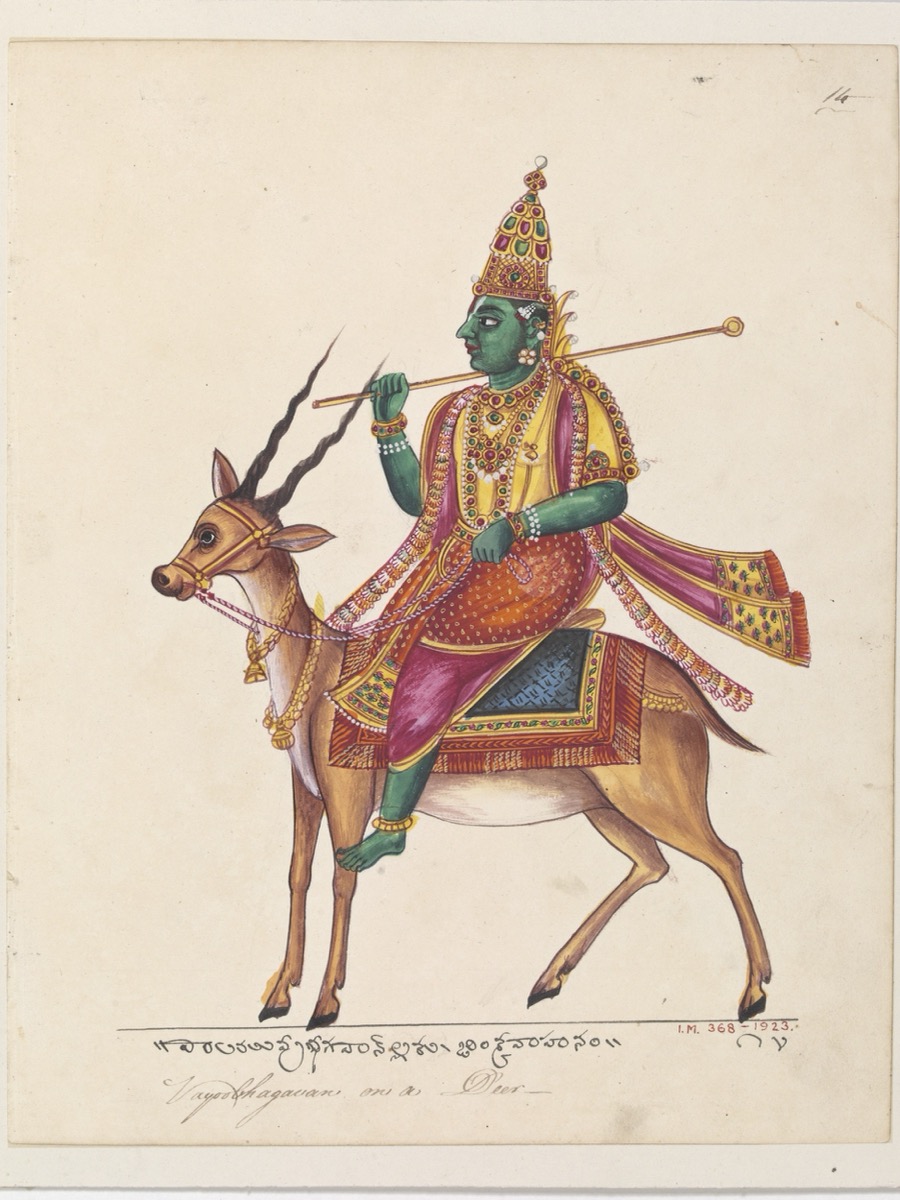
Traditional Hindu iconography depicts Vāyu as a handsome deity of blue or white complexion, dressed in flowing garments that billow as if perpetually caught in a breeze. He is typically shown with two or four arms. In his upper hands he carries a flag or banner (dhvaja) — symbolising the pennant that flutters in the wind — and a staff or goad. His lower hands display the abhaya mudrā (gesture of fearlessness) and the varada mudrā (gesture of boon-giving) (Wisdom Library, “God Vayu”).
Vāyu’s vāhana (divine mount) is the gazelle or antelope (mṛga) — an animal renowned for its swiftness and grace. The choice of a gazelle, rather than a more powerful beast, emphasises Vāyu’s qualities of speed, lightness, and elegance rather than brute force. In some South Indian and Tanjore paintings, Vāyu is depicted riding the antelope at great speed across a sky filled with swirling clouds.
As one of the Aṣṭadikpālas (eight guardians of the directions), Vāyu presides over the northwest (vāyavya). This directional assignment reflects the Indian subcontinent’s meteorological reality: the northwest is the quarter from which the summer monsoon winds approach, bringing life-giving rain after months of drought.
Vāyu in the Upaniṣads: The Doctrine of Prāṇa
The Upaniṣads represent a watershed in the theological understanding of Vāyu. In these philosophical texts, Vāyu transitions from a nature deity to the cosmic principle of prāṇa — the vital breath that sustains all living beings and, at the deepest level, is identical with Brahman itself.
The Bṛhadāraṇyaka Upaniṣad (1.5.21–22) contains one of the most famous passages establishing this identification: when all the sensory faculties (speech, sight, hearing, mind) depart from the body in a contest to determine which is the most essential, the body survives each departure. But when prāṇa (breath/Vāyu) prepares to leave, all the other faculties are immediately drawn out with it, like stakes being pulled from a tent. The conclusion is unequivocal: prāṇa vai śreṣṭham — “prāṇa is indeed the supreme [faculty].” This prāṇa is explicitly identified with Vāyu.
The Chāndogya Upaniṣad (4.3.1–8) recounts the parable of the five prāṇas contesting for supremacy. Each prāṇa — speech, sight, hearing, mind, and breath — leaves the body for a year, and the body continues to function, albeit impaired. But when the breath (mukhya prāṇa) begins to depart, all the other faculties are uprooted. They concede: “You are the greatest among us. Do not depart!”
The Kaṭha Upaniṣad (2.2.2) states: prāṇasya prāṇam — Brahman is “the breath of breath,” suggesting that Vāyu/prāṇa, while supreme among created faculties, is itself animated by the ultimate reality.
The Contest with Ādiśeṣa
A famous mythological episode, recounted in the Vāyu Purāṇa and the Bhāgavata Purāṇa, describes a cosmic contest between Vāyu and Ādiśeṣa (Śeṣanāga), the great serpent on whom Viṣṇu reclines. The devas challenged Vāyu and Ādiśeṣa to a test of strength: Ādiśeṣa would coil himself around Mount Meru, the cosmic mountain at the centre of the universe, and Vāyu would attempt to blow the peak away.
The contest raged for an epoch. Ādiśeṣa held firm while Vāyu unleashed hurricanes of cosmic proportions. The three worlds shook, and the devas trembled. At last, in a moment when Ādiśeṣa briefly loosened one of his coils, Vāyu blew with such force that the summit of Meru was sheared off and hurled into the southern ocean, where it became the island of Laṅkā (Sri Lanka). The sage Nārada intervened to declare the contest a draw, recognising that both Vāyu’s irresistible force and Ādiśeṣa’s immovable steadfastness were equally divine attributes of Viṣṇu’s cosmic order (Hindu Website, “Vayu”).
This story illustrates Vāyu’s cosmic power — a force capable of reshaping the very geography of the world — while also demonstrating that even the mightiest wind cannot overcome the stability of Viṣṇu’s foundation.
Vāyu in Madhva Philosophy: Mukhya Prāṇa
The Dvaita (dualist) Vedānta tradition founded by Madhvācārya (1238–1317 CE) elevates Vāyu to a position of unique theological importance. In Madhva’s cosmology, Vāyu is identified as Mukhya Prāṇa — the “chief vital breath” — and holds the rank of the foremost being in the divine hierarchy, subordinate only to Viṣṇu and Lakṣmī. According to Madhva, Vāyu has incarnated three times for the preservation of dharma: as Hanumān in the Tretā Yuga, as Bhīma in the Dvāpara Yuga, and as Madhvācārya himself in the Kali Yuga (Encyclopaedia Britannica, “Vayu”).
This doctrine of Vāyu Avatāra — the three descents of Vāyu — is central to the Mādhva tradition. It establishes a continual thread of Vāyu’s intervention in human history: first as the perfect devotee (Hanumān), then as the perfect warrior (Bhīma), and finally as the perfect teacher (Madhva). Each incarnation addresses the specific need of its age while demonstrating a different facet of Vāyu’s nature as the cosmic intermediary between God and creation.
Mādhva institutions, particularly the eight maṭhas (monasteries) of Uḍupi in Karnataka, continue to worship Vāyu as Mukhya Prāṇa. The daily liturgy at the Uḍupi Śrī Kṛṣṇa temple includes specific prayers to Vāyu in his threefold incarnation.
The Five Prāṇas and Prāṇāyāma
Hindu philosophy identifies five forms of prāṇa (vital air) that govern different physiological and spiritual functions within the human body:
-
Prāṇa (forward-moving air): Governs inhalation, the heart, and the intake of all sensory experience. Seated in the chest.
-
Apāna (downward-moving air): Governs exhalation, elimination, and the downward flow of energy. Seated in the lower abdomen.
-
Samāna (equalising air): Governs digestion and the assimilation of food and experience. Seated at the navel.
-
Udāna (upward-moving air): Governs speech, growth, and the ascent of consciousness at the time of death. Seated in the throat.
-
Vyāna (pervading air): Governs circulation, the distribution of nutrients, and the coordination of all bodily systems. Pervades the entire body.
These five prāṇas are understood as five functional aspects of Vāyu operating within the microcosm of the human body. The practice of prāṇāyāma — breath control, the fourth limb of Patañjali’s Aṣṭāṅga Yoga (Yoga Sūtras 2.49–53) — is thus not merely a physical exercise but a form of Vāyu worship: the conscious regulation and purification of the divine wind within one’s own body. The Haṭha Yoga Pradīpikā (2.2) states that when the breath is steadied, the mind is steadied — a direct testimony to Vāyu’s governance over consciousness itself.
Temples Dedicated to Vāyu
While Vāyu does not enjoy the proliferation of temples accorded to Viṣṇu or Śiva, several notable shrines honour the wind god:
-
Vāyu Liṅgam, Śrī Kālahastī (Andhra Pradesh): One of the Pañcabhūta Sthala temples, where Śiva is worshipped as the Vāyu Liṅga. The flame in the sanctum is said to flicker perpetually despite no discernible draught — a miracle attributed to Vāyu’s presence.
-
Vāyu Deva Temple, Guwahati (Assam): A rare standalone temple dedicated to Vāyu, located near the Brahmaputra river.
-
Guruvāyūr Temple (Kerala): Though primarily a Kṛṣṇa temple, the name “Guruvāyūr” derives from “Guru” (Bṛhaspati) and “Vāyu” — the tradition holds that Vāyu, along with Guru (Bṛhaspati), installed the idol of Kṛṣṇa here.
-
Uḍupi Śrī Kṛṣṇa Maṭha (Karnataka): The Mādhva monastery where Vāyu is worshipped as Mukhya Prāṇa in his three incarnations.
Conclusion
Vāyu is, in the deepest sense, the breath of the Hindu cosmos — the force that animates every creature, carries every prayer, and connects every realm of existence. He is the unseen presence felt in every inhalation, the invisible power that bends the trees, drives the clouds, and turns the windmill. His sons Hanumān and Bhīma embody his essence in heroic form; his identification with prāṇa in the Upaniṣads reveals his metaphysical depth; his elevation as Mukhya Prāṇa in Dvaita Vedānta gives him a unique theological stature.
As the Bṛhadāraṇyaka Upaniṣad declares: vāyur vai gautama tat sūtram, vāyunā vai gautama sūtreṇāyaṁ ca lokaḥ paraś ca lokaḥ sarvāṇi ca bhūtāni saṁdṛbdhāni bhavanti — “Vāyu, O Gautama, is that thread. By Vāyu as thread, this world and the other world and all beings are strung together” (Bṛhadāraṇyaka Upaniṣad 3.7.2). In those words lies the essential truth of Vāyu: he is the invisible thread upon which all existence is strung, the breath without which there is no life, the wind without which there is no world.