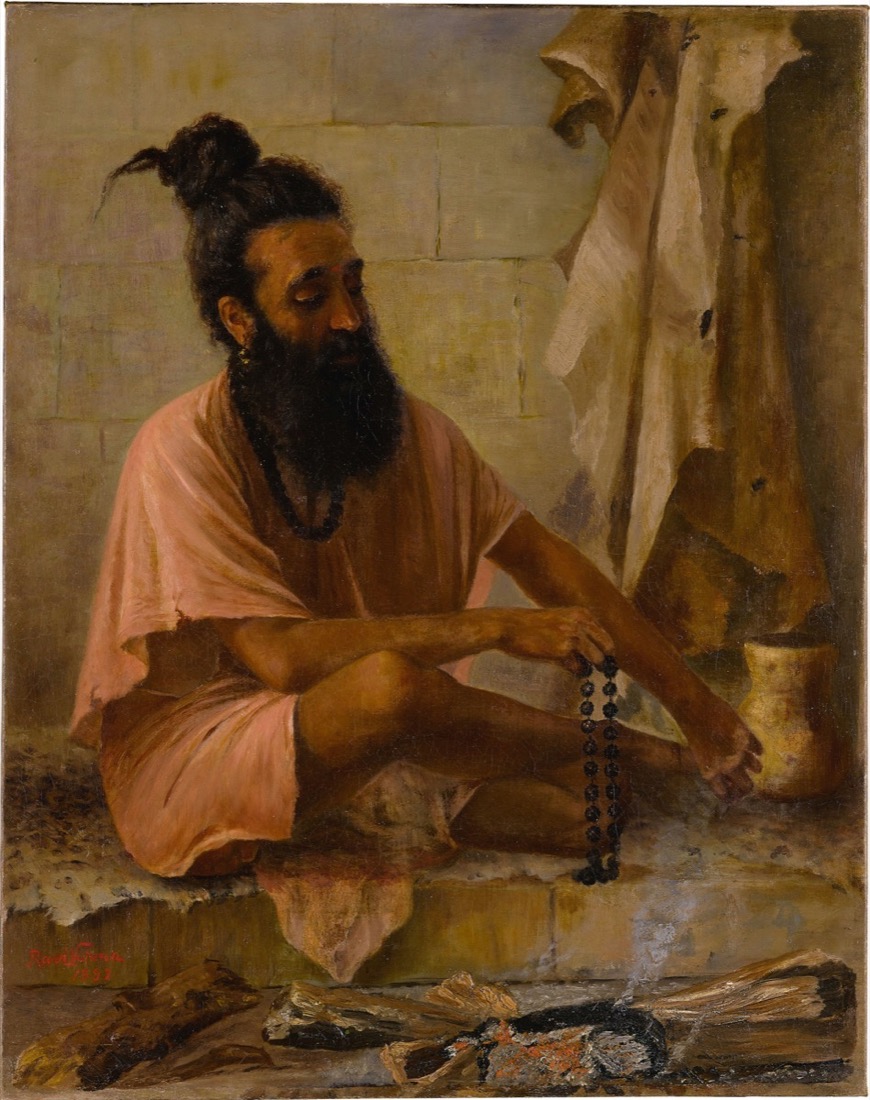
Among the towering figures of Hindu sacred literature, few embody the transformative power of human will as profoundly as Sage Viśvāmitra. Born into royalty as King Kauśika, he relinquished an entire kingdom — not for another throne, but for a spiritual station that even the gods sought to obstruct. His journey from a proud Kṣatriya monarch to a Brahmarṣi (the highest class of sage) is one of the most dramatic narratives in all of Indian scripture, spanning millennia of fierce austerity, devastating setbacks, and ultimate triumph. As the revealer of the Gāyatrī Mantra — arguably the most sacred verse in the Vedas — and as the guru who trained Rāma and Lakṣmaṇa in divine warfare, Viśvāmitra occupies a unique position at the intersection of Vedic wisdom and epic heroism.
Lineage and Royal Origins
Viśvāmitra’s story begins in the royal house of the Chandravanśa (Lunar dynasty). According to the Vālmīki Rāmāyaṇa (Bāla Kāṇḍa, Sarga 51), the lineage traces back to Kuśa, a mind-born son of Brahmā. Kuśa’s son was the mighty Kuśanābha, whose son was Gādhi (also called Gāthin), the king of Kānyakubja (modern Kannauj). Gādhi’s son was Viśvāmitra, originally named Kauśika after his ancestor Kuśa.
As a young king, Kauśika was renowned for his martial prowess, righteous governance, and command over vast armies. The Mahābhārata describes him as a ruler who protected his subjects with the same vigour with which he led his troops in battle. He possessed all the virtues expected of a Kṣatriya sovereign — courage, generosity, and a fierce sense of honour. Nothing in his early life suggested the extraordinary spiritual metamorphosis that lay ahead.
The Encounter with Vasiṣṭha: The Turning Point
The pivotal event that redirected Viśvāmitra’s entire life was his encounter with Sage Vasiṣṭha, the family priest (purohita) of the Ikṣvāku dynasty and one of the original Saptarṣis. As narrated in the Bāla Kāṇḍa (Sargas 52-55) of the Vālmīki Rāmāyaṇa, King Kauśika was returning from a military campaign with his entire army when he stopped at Vasiṣṭha’s āśrama.
Vasiṣṭha, with characteristic hospitality, invited the king and his retinue to dine. Kauśika expected a humble forest meal, but Vasiṣṭha summoned Kāmadhenu (also called Śabalā or Nandinī), his wish-fulfilling divine cow. Through Kāmadhenu’s power, Vasiṣṭha produced a magnificent feast — armies of soldiers, mountains of food, rivers of refreshment — all from the cow’s miraculous ability.
Stunned by this display, Kauśika demanded that Vasiṣṭha surrender Kāmadhenu, arguing that such a treasure belonged rightfully to a king who could use it for the welfare of his kingdom. Vasiṣṭha refused, explaining that Kāmadhenu was essential to his yajñas — the Svāhākāra (offerings to the gods), Havya (food-offerings to deities), and Kavya (ancestral rites).
When diplomacy failed, Kauśika attempted to seize the cow by force. Vasiṣṭha instructed Kāmadhenu to defend herself. From her body emerged thousands of fierce warriors — Pahlavas from her udder, Śakas from her dung, Yavanas from her urine, Śabaras and Kirātas from her pores — who annihilated Kauśika’s vast army. All one hundred of Kauśika’s sons were reduced to ashes by the simple utterance of the sacred syllable Oṃ from Vasiṣṭha’s lips.
This devastating defeat shattered Kauśika’s worldview. He realised that the power of a Brahmarṣi, born of tapas and spiritual knowledge, infinitely surpassed the might of any Kṣatriya’s armies. In that moment of humiliation and revelation, Kauśika renounced his kingdom, his remaining wealth, and his royal identity. He resolved to attain the same — or greater — spiritual power through austerity alone.
The Long Ascent: From Rājarṣi to Brahmarṣi
Viśvāmitra’s path to Brahmarṣi status was neither linear nor easy. Hindu scriptures describe it as a journey spanning thousands of years, punctuated by repeated failures and progressively harder trials. Each setback taught him a lesson essential to his ultimate goal.
The Title of Rājarṣi
After renouncing his kingdom, Kauśika performed intense tapas for many years, propitiating Lord Śiva (according to some accounts) and later Lord Brahmā. Through this, he was first acknowledged as a Rājarṣi — a royal sage, respected but far below the rank of Brahmarṣi. Brahmā granted him knowledge of celestial weapons (divyāstras), and Kauśika, still seething from his defeat, challenged Vasiṣṭha again. But Vasiṣṭha’s Brahmadaṇḍa (the staff of Brahmā) swallowed every divine weapon Kauśika launched, including the fearsome Brahmāstra. Once again humbled, Kauśika realised that spiritual power could not be attained through weapons or combat.
The Title of Maharṣi
Kauśika returned to the forests and performed even more severe austerities. Over centuries of unbroken tapas, the gods grew alarmed at the spiritual energy (tejas) he was accumulating. Indra, king of the devas, feared that Kauśika would amass enough power to overthrow the celestial order.
The Menakā Episode
Indra dispatched Menakā, the most beautiful of the apsarās (celestial nymphs), to disrupt Kauśika’s tapas through seduction. She arrived at his hermitage accompanied by Kāmadeva (the god of love) and Vāyu (the wind god), who conspired to blow away her garments at the precise moment of her approach.
Kauśika, weakened by years of suppressed desire, succumbed. He lived with Menakā for ten years, during which their daughter Śakuntalā was born — the same Śakuntalā who would later become the mother of Emperor Bharata, the progenitor of the Bhārata dynasty after whom India (Bhārata) is named.
When Kauśika finally awoke to the realisation that he had squandered a millennium of tapas, he was filled with anguish but did not curse Menakā, recognising that she had merely been carrying out her duty. He departed alone, resolving to conquer desire once and for all.
The Rambhā Episode and the Curse
Undeterred, Indra sent another apsarā, Rambhā, to tempt the sage. This time, Kauśika recognised the ploy immediately. But instead of maintaining equanimity, he erupted in rage and cursed Rambhā to become a stone for a thousand years. The moment the curse left his lips, he realised his failure: anger was just as destructive a flaw as desire. Centuries of tapas were again depleted in that single moment of wrath.
Devastated by his own weakness, Viśvāmitra retreated to the highest peaks of the Himālayas and undertook the most extreme tapas of his life — ceasing to eat entirely, reducing his breathing to nearly nothing, and remaining motionless for over a thousand years.
The Final Test and Brahmarṣi Status
After these eons of penance, Brahmā appeared before Viśvāmitra with the assembled devas and conferred upon him the title of Maharṣi. But Viśvāmitra desired the supreme recognition: Brahmarṣi, equal to Vasiṣṭha himself. Brahmā told him that he had not yet conquered all his passions.
The final and most significant test came not through temptation but through the very acknowledgement Viśvāmitra had sought for so long. When at last Vasiṣṭha himself addressed him as “Brahmarṣi,” Viśvāmitra’s ego dissolved — the lifelong rival had become his greatest validator. The name “Viśvāmitra” — meaning “friend of the entire universe” (viśva = universe, mitra = friend) — was bestowed upon him, signifying that his compassion now extended to all beings without distinction.
Revealer of the Gāyatrī Mantra
Viśvāmitra’s most enduring contribution to Hindu spiritual life is his revelation of the Gāyatrī Mantra, found at Ṛg Veda 3.62.10:
Oṃ bhūr bhuvaḥ svaḥ Tat savitur vareṇyaṃ Bhargo devasya dhīmahi Dhiyo yo naḥ pracodayāt
(“We meditate upon the glorious splendour of the divine Savitṛ. May he illuminate our intellect.”)
Most of Maṇḍala 3 of the Ṛg Veda is attributed to Viśvāmitra Gāthina (Viśvāmitra, son of Gādhi). This maṇḍala contains 62 hymns addressed primarily to Agni and Indra, with the Gāyatrī Mantra appearing as the culminating verse. According to tradition recorded in the Purāṇas, only 24 ṛṣis across the entire span of cosmic time have fully comprehended the complete power of the Gāyatrī Mantra — Viśvāmitra was the first, and Yājñavalkya was the last.
The Gāyatrī is chanted daily in the Sandhyāvandana (twilight prayers) by millions of Hindus. It is considered the mother of all Vedic metres and the essence of all Vedic wisdom. That this supreme mantra was revealed by a former Kṣatriya — not a born Brāhmaṇa — carries profound philosophical significance: the highest spiritual insight transcends the accident of birth.
Guru of Rāma and Lakṣmaṇa
In the Vālmīki Rāmāyaṇa, Viśvāmitra plays an indispensable role in the Bāla Kāṇḍa. He arrives at the court of King Daśaratha in Ayodhyā and requests the king’s eldest sons — the young princes Rāma and Lakṣmaṇa — to protect his yajña from the rākṣasas Mārīca and Subāhu, who had been polluting sacred rituals with blood and flesh.
Daśaratha, anguished at the thought of sending his beloved sons into danger, reluctantly agrees on Vasiṣṭha’s counsel. During the journey to Viśvāmitra’s hermitage at Siddhāśrama, the sage imparts critical knowledge and divine gifts to the princes:
- Balā and Atibalā Vidyā: Secret knowledge that grants inexhaustible energy, freedom from hunger and thirst, and protection from fatigue — enabling the princes to march tirelessly through dangerous forests.
- Divyāstras: Celestial weapons and the mantras to invoke and recall them, including missiles of Agni, Varuṇa, Indra, and other devas.
- Destruction of Tāṭakā: Viśvāmitra commands Rāma to slay the demoness Tāṭakā, who had been terrorizing the region. When Rāma hesitates to kill a woman, Viśvāmitra teaches him that dharma transcends gender — evil must be confronted regardless of the form it takes.
- Liberation of Ahalyā: While travelling through the forest, Viśvāmitra leads Rāma to the spot where Ahalyā, the wife of Sage Gautama, lay cursed in the form of a stone. At Viśvāmitra’s guidance, Rāma’s footfall liberates her from the curse — an act that prefigures Rāma’s role as the liberator of all beings.
- Sītā Svayaṃvara: Viśvāmitra guides the princes to Mithilā, where Rāma breaks the mighty bow of Śiva (Śiva Dhanuṣ) and wins Sītā’s hand in marriage.
Without Viśvāmitra’s training, Rāma could not have acquired the weapons and wisdom necessary for his later battles against Rāvaṇa. The sage thus serves as the essential catalyst for the entire Rāmāyaṇa narrative.
The Triśaṅku Episode: Creating a Parallel Heaven
One of the most extraordinary demonstrations of Viśvāmitra’s spiritual power is the Triśaṅku Svarga episode, narrated in the Bāla Kāṇḍa (Sargas 57-60).
King Triśaṅku of the Ikṣvāku (Solar) dynasty desired to ascend to Svarga (heaven) in his mortal, physical body — a feat that defied cosmic law. When his guru Vasiṣṭha refused this impossible request, Triśaṅku approached Vasiṣṭha’s sons, who cursed him to become a Cāṇḍāla (outcaste), transforming his appearance.
In this degraded state, Triśaṅku sought Viśvāmitra’s help. The sage, seeing an opportunity to demonstrate his power (and perhaps to challenge Vasiṣṭha’s authority), agreed to perform a great yajña to send Triśaṅku bodily to heaven. Through the accumulated power of his tapas, Viśvāmitra propelled Triśaṅku upward. But when the king reached the gates of Svarga, Indra and the devas rejected him and hurled him back to earth headfirst.
Enraged, Viśvāmitra declared, “Stop!” — halting Triśaṅku mid-fall. Then, in an act of cosmic defiance, the sage began creating an entirely new heaven, complete with its own stars, constellations, and planetary systems. The gods, alarmed that Viśvāmitra might create a new Indra as well, negotiated a compromise: Triśaṅku would remain suspended forever in his own celestial realm between earth and the original heaven, visible as a constellation in the southern sky.
This episode illustrates both the staggering power of concentrated tapas and its limitations — for Triśaṅku’s heaven, while real, remains an imperfect, suspended creation, a reminder that even the mightiest sage cannot fully override cosmic dharma.
Other Notable Episodes
The Śunaḥśepha Episode
In the Aitareya Brāhmaṇa (7.13-18), King Hariścandra, having promised his son Rohita to the god Varuṇa as a sacrificial offering, ultimately substitutes a Brāhmaṇa boy named Śunaḥśepha. Bound to the sacrificial post, Śunaḥśepha prays to various Vedic deities with hymns that would later be incorporated into the Ṛg Veda. The gods free him, and Viśvāmitra adopts Śunaḥśepha as his own son, renaming him Devarāta (“given by the gods”). This episode demonstrates Viśvāmitra’s compassion and his willingness to challenge the rigid boundaries of birth and lineage.
The Test of Hariścandra
In the Mārkaṇḍeya Purāṇa and the Devī Bhāgavata Purāṇa, Viśvāmitra subjects King Hariścandra to a series of devastating tests of truthfulness. When Vasiṣṭha praises Hariścandra as the most truthful king, Viśvāmitra resolves to prove otherwise. He strips Hariścandra of his kingdom, family, and dignity, ultimately forcing the king to work as a keeper of cremation grounds. Through it all, Hariścandra’s truthfulness remains unbroken — and Viśvāmitra, moved beyond measure, restores everything and more. The tale reveals a mature Viśvāmitra who has transcended personal rivalry and instead functions as a divine instrument for testing and validating dharma.
Vedic Hymns and Scriptural Legacy
Viśvāmitra is the attributed seer (draṣṭā) of most hymns in Maṇḍala 3 of the Ṛg Veda, which contains 62 sūktas. Key compositions include:
- Gāyatrī Mantra (3.62.10) — the most universally chanted Vedic mantra
- Hymns to Agni (3.1-3.29) — invocations to the fire god as messenger between humans and devas
- Hymns to Indra (3.30-3.53) — celebrations of the king of the devas, invoking his protection and strength
- Hymns to the Viśvedevas (3.54-3.56) — prayers to all the gods collectively
- Hymns to Savitṛ (3.62) — culminating in the Gāyatrī, addressed to the solar deity who illuminates the intellect
Beyond the Ṛg Veda, Viśvāmitra’s contributions appear in multiple Brāhmaṇa texts, the Rāmāyaṇa, the Mahābhārata, and numerous Purāṇas. The Viśvāmitra Saṃhitā and certain portions of the Viśvāmitra Smṛti are also traditionally attributed to him or his lineage.
Saptarṣi Status
Viśvāmitra holds the distinguished position of being one of the Saptarṣis (Seven Great Sages) of the current Vaivasvata Manvantara — the cosmic age presided over by the current Manu. The traditional list names him alongside Kaśyapa, Atri, Vasiṣṭha, Gautama, Jamadagni, and Bharadvāja. His inclusion among the Saptarṣis is particularly remarkable because he is the only one who was not born a Brāhmaṇa — a testament to the Hindu tradition’s recognition that the highest spiritual attainment can be earned by anyone, regardless of the circumstances of birth.
The Saptarṣis are identified with the seven stars of the constellation Ursa Major (Saptarṣi Maṇḍala). In this celestial mapping, Viśvāmitra is traditionally associated with one of these eternal stars, symbolising his permanent place in the cosmic order.
Philosophical Significance
The story of Viśvāmitra carries several layers of philosophical meaning that remain profoundly relevant:
The supremacy of tapas over birth: In a civilisation that developed the varṇa system, Viśvāmitra’s narrative is a powerful counter-narrative. It demonstrates that spiritual authority (brahmatva) is not an inherited privilege but an earned achievement. A Kṣatriya can become a Brahmarṣi — if he is willing to pay the price in centuries of self-discipline.
The progressive conquest of inner enemies: Viśvāmitra’s repeated failures — succumbing to desire with Menakā, erupting in anger at Rambhā, displaying pride in the Triśaṅku episode — map precisely onto the Hindu understanding of the ṣaḍripu (six inner enemies): kāma (desire), krodha (anger), lobha (greed), moha (delusion), mada (pride), and mātsarya (envy). His story teaches that spiritual progress is not a single breakthrough but a lifelong — indeed, a multi-lifetime — process of confronting and overcoming these adversaries.
Rivalry as spiritual catalyst: The relationship between Viśvāmitra and Vasiṣṭha transcends mere competition. Vasiṣṭha’s very existence — his effortless spiritual power, his calm refusal to be provoked — serves as the irritant that drives Viśvāmitra to the highest attainment. Without the rivalry, there would have been no transformation. Hindu philosophy thus reframes conflict: one’s greatest opponent may be one’s greatest guru.
The name as destiny: The name “Viśvāmitra” — friend of the universe — was not given at birth but earned after the completion of his journey. It signifies the final state of a consciousness that has expanded beyond all narrow identities — king, warrior, rival, ascetic — to embrace universal compassion. In this reading, Viśvāmitra’s entire life was the process of becoming worthy of his own name.
Legacy in Living Tradition
Today, Viśvāmitra’s legacy pervades Hindu life in ways both visible and invisible. Every morning, when millions recite the Gāyatrī Mantra at dawn, they invoke the vision of a former king who renounced everything to sit in meditation until the universe itself yielded its deepest secret. His story is narrated in the Bāla Kāṇḍa as a prelude to the Rāmāyaṇa proper, reminding listeners that even the avatar Rāma needed a human guru — and that this guru was himself a flawed, striving, and ultimately victorious seeker.
The Viśvāmitra Gotra, one of the prominent Brahmanical lineages, traces its descent from the sage, and numerous temples across India honour him — notably at the Viśvāmitra Tapasthali in the Himalayas and at various sacred sites along the Ganges where he is believed to have performed his austerities.
In the end, Viśvāmitra’s story is the Hindu tradition’s most eloquent argument that the highest spiritual attainment is available to all — not as a gift of birth, but as the reward of an indomitable will directed toward the divine.